


The most popular advice about best Christmas cactus fertilizer is also the easiest way to disappoint yourself: buy a high-phosphorus “bloom booster” and pour it on when flower buds appear. I've killed Christmas cacti with that approach. The plant usually doesn't need a miracle formula. It needs diluted fertilizer during active growth, followed by a timely pause before blooming.
University extension guidance supports that simpler method. Clemson recommends monthly feeding from new growth through summer with a half-strength soluble fertilizer, then stopping in late summer for better fall blooming. Another extension schedule recommends a balanced liquid feed, diluted to half strength, plus 1 teaspoon of Epsom salts per gallon of water once a month when magnesium supplementation is needed, with feeding stopped in late summer. (University of Georgia Cooperative Extension guidance)
The best choice depends less on the logo on the bottle and more on whether you can apply it lightly and stop at the right time. Use this guide to choose between liquid concentrate, slow-release pellets, and granular fertilizer without treating a forest cactus like a desert plant.
| Fertilizer choice | Best fit | Main advantage | Main risk |
|---|---|---|---|
| Balanced liquid | Growers who water regularly | Precise dilution control | Overfeeding through frequent applications |
| Slow-release pellets | Forgetful or traveling growers | Low-maintenance nutrient delivery | Difficult to pause before bud formation |
| Balanced granular fertilizer | Casual owners who prefer dry products | Simple, familiar application | Uneven distribution and salt concentration |
| Bloom booster | Usually not my first choice | May appeal during bud season | Can encourage the wrong growth if timing is poor |
Why Christmas Cactus Is Not a Desert Cactus
A Christmas cactus looks like a cactus, but it doesn't live like a barrel cactus. Modern Christmas cactus plants descend from humid forest-dwelling Schlumbergera species and hybrids, not plants adapted to hot, dry desert soil. Britannica notes that most Christmas cacti in cultivation are hybrids of Schlumbergera truncata and Schlumbergera russelliana. (Britannica's Christmas cactus background)
That distinction changes the fertilizer rule. Desert cacti often tolerate lean, sharply draining conditions and long dry intervals. Christmas cactus has flattened segments, a shallow root system, and a preference for an airy container mix that holds some moisture without staying soggy. It expects access to modest nutrients during growth, not a feast followed by mineral buildup.
The forest-cactus feeding pattern
In its native habitat, a forest cactus grows among organic debris and mossy material rather than sitting in deep, mineral-rich ground. Nutrients arrive in small amounts as plant material decomposes and moisture moves through the growing surface. That biology explains why weak, consistent feeding works better than a concentrated dose.
Three practical rules follow:
- Keep nitrogen moderate. Too much nitrogen produces lush segment growth without necessarily improving flowering.
- Avoid salt crust. A visible white residue on the soil or pot rim means soluble material may be accumulating.
- Feed only while the plant is building growth. Once the plant shifts toward bud formation, extra fertilizer can work against the bloom cycle.
Practical rule: Treat Christmas cactus as a lightly fed tropical houseplant, not as a neglected desert succulent.
The plant's cultivated history reinforces this point. It was present in Europe by 1818, a second parent species arrived in 1839, and Schlumbergera x buckleyi was first recorded in 1852 after deliberate crossing in England. (Schlumbergera botanical history) Those hybrids were selected for container performance and flowers, so balanced nutrition and careful timing make more sense than harsh desert-style feeding.
Reading the N-P-K Label the Right Way
The three numbers on a fertilizer label describe the relative amounts of nitrogen, phosphorus, and potassium. They don't tell you how much product your plant needs. A strong formula used at a weak dilution can be safer than a mild formula applied too heavily, which is why the label ratio and application rate must be read together.
What each nutrient does
Nitrogen, the first number, supports green segment growth. A Christmas cactus needs nitrogen to produce healthy new pads and maintain color. Too much can create soft, overly vigorous growth, and it may push the plant toward leaves and segments when you want it preparing for flowers.
Phosphorus, the middle number, supports root activity and reproductive growth. It matters, but a bigger middle number isn't automatically a better bloom solution. UConn guidance says a balanced fertilizer such as 20-20-20 is suitable and notes that the phosphorus number may be the same as or higher than nitrogen for optimum blooms. (University of Connecticut Christmas cactus guidance)
Potassium, the third number, supports overall plant function, stem strength, and stress tolerance. It belongs in a balanced program, but adding extra potassium alone won't rescue a plant with damaged roots, poor light, or a badly timed feeding routine.
Clemson Extension recommends half-strength 20-10-20 or 20-20-20 during active growth. (Clemson Extension holiday cactus guidance) The safe benchmark is therefore a moderate, balanced NPK diluted to reduce salt stress.
How to inspect the label
Look at the guaranteed analysis panel, then answer three questions:
- Is the ratio reasonably balanced? A formula near 1:1:1 is a sound starting point.
- Can you dilute it accurately? Liquid concentrates make this easiest.
- Does the application schedule fit the plant's season? A fertilizer that releases continuously may be inconvenient if you need to stop before buds form.
For a plain-language explanation of the numbers, see this guide to plant fertilizer numbers.
| N-P-K ratio | Best use stage | Effect on Christmas cactus |
|---|---|---|
| 20-20-20 | Active growth | Balanced support for new segments and roots |
| 20-10-20 | Active growth | Balanced feeding with phosphorus present for flowering support |
| 10-10-10 | General maintenance | Moderate, even nutrition when diluted correctly |
| Higher-phosphorus formula | Only when a specific program calls for it | May support reproductive growth, but timing still matters more than the label claim |
The key is dilution. A shallow-rooted Christmas cactus doesn't need fertilizer strength designed to force rapid production. Start at half strength, apply to already-moist soil, and watch the plant rather than escalating because flowers haven't appeared yet.
Liquid vs Pellets vs Slow-Release Compared
Format affects how much control you have. That matters because Christmas cactus has a defined feeding window, and the easiest fertilizer to apply isn't always the easiest one to stop.
Liquid concentrate offers the most control. You mix the product into water, apply it to the root zone, and can switch to plain water as soon as late summer arrives. Products such as Jack's Classic 20-20-20 and Dyna-Gro Foliage Pro illustrate the liquid-concentrate category, but the ratio and dilution instructions matter more than the brand. This format suits growers who already have a regular watering routine.
Slow-release pellets trade precision for convenience. Products such as Osmocote Plus and Schultz Extended Release release nutrients gradually after a top-dress application. That's useful for someone who forgets feedings, but it creates a timing problem. If the product continues releasing nutrients when the cactus is approaching bud formation, you can't instantly remove the fertilizer from the root zone.
Granular products and fertilizer spikes sit between those options. Dry products can work, but uneven placement creates concentrated pockets. Spikes can also place fertilizer too close to stems or roots, especially in a small pot. I'd rather use a measured liquid or a carefully distributed slow-release product than guess at a concentrated dry patch.
Choose the format you can manage
| Format | Application frequency | Dilution control | Burn risk | Best for |
|---|---|---|---|---|
| Liquid concentrate | Applied only during active growth | Excellent | Low when diluted and applied to moist soil | Routine waterers |
| Slow-release pellets | Occasional top-dressing according to label | Limited after application | Moderate if overapplied | Forgetful growers |
| Granular fertilizer | Occasional measured application | Moderate | Moderate to high near stems or roots | Casual owners who prefer dry feed |
| Fertilizer spikes | Infrequent placement | Low | Moderate if placed poorly | Larger containers with careful spacing |
Slow-release fertilizer works by releasing nutrients over time rather than making you mix every feeding. Learn the mechanics in this explanation of what slow-release fertilizer is.
A fertilizer routine you'll follow beats a premium formula you'll apply at the wrong point in the season.
My preference is a balanced liquid for maximum control. I'd choose pellets only when the grower's real problem is forgetting to feed, and I'd skip bloom boosters unless there's a clear, plant-specific reason to use one.
A Seasonal Feeding Calendar That Actually Works
Christmas cactus doesn't need fertilizer all year. The plant should be fed while it's producing new segments, then allowed to transition toward flowering without a late nutrient surge.
The annual rhythm
Late winter, after flowering: Stop feeding and let the plant rest. Don't try to “replace” nutrients immediately after the final flowers fade. The plant benefits from a quiet period before active growth resumes.
Early spring: When new segments begin appearing, resume with a balanced liquid fertilizer at half strength. The University of Georgia schedule recommends active-growth feeding that begins in late winter or early spring, continues monthly through the growing season, and stops in late summer. (University of Georgia feeding schedule)
Spring through summer: Continue a measured balanced feed while the plant is actively growing. Clemson's guidance supports monthly feeding through summer at half strength, rather than heavy applications. (Clemson's holiday cactus care schedule)
Late summer into fall: Stop fertilizer by late summer. This pause gives the plant a cleaner transition into bud formation. Don't start feeding again just because you see tiny buds. The plant is already doing the job you wanted.
Bloom period: Use plain water according to the plant's moisture needs. Fertilizer during flowering is unnecessary and can disturb the transition from bud formation to open blooms.
The exact calendar can shift with indoor light and temperature, but the principle doesn't: feed growth, then stop before the flowering phase. If the plant spends summer outdoors, flush the container with plain water occasionally so accumulated soluble salts can drain away.
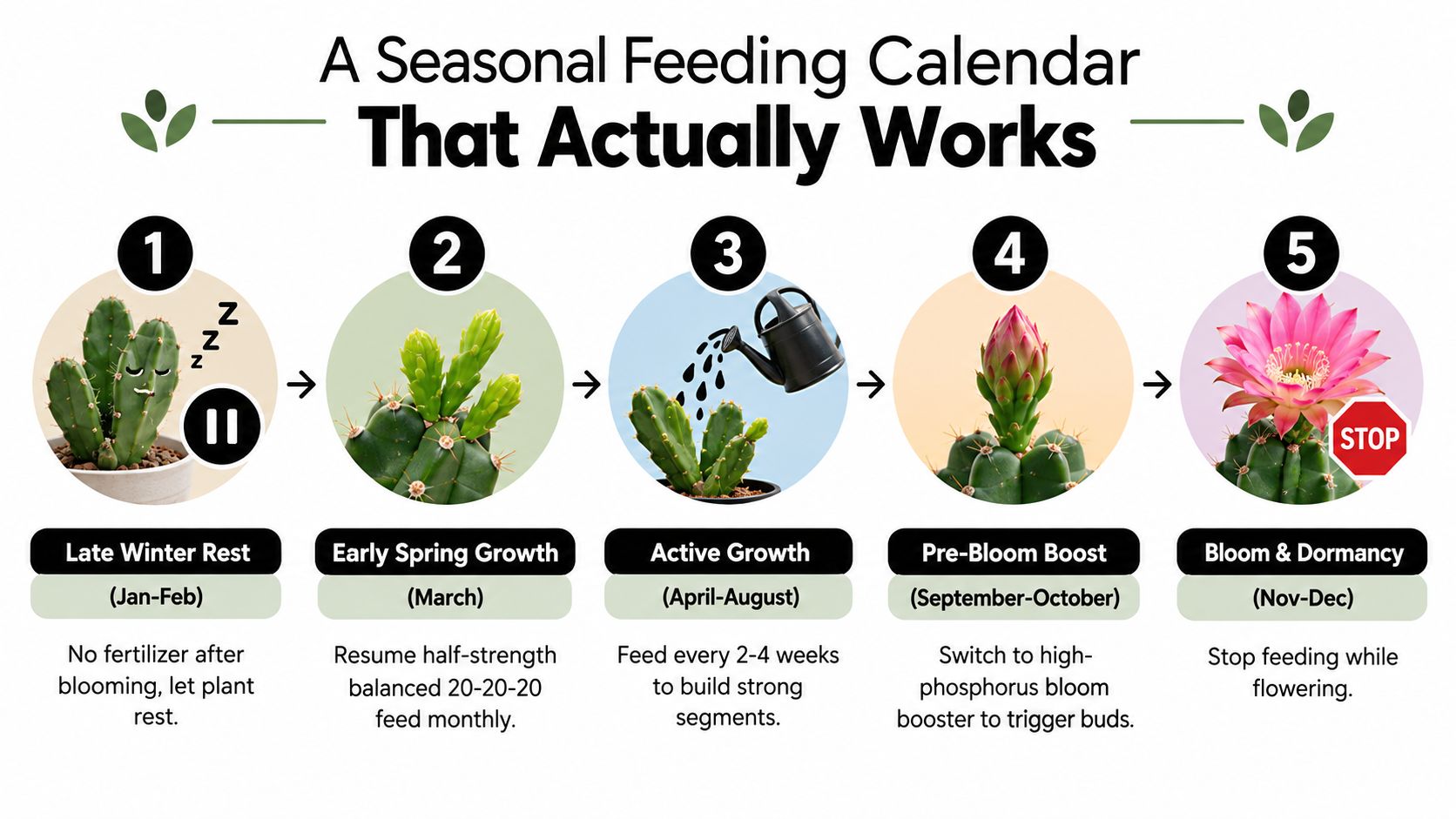
For a broader seasonal framework, use this guide to when to fertilize houseplants.
Here's the correction I'd make to many online calendars: don't automatically switch to a high-phosphorus booster in September. Some advice recommends that approach, but extension guidance consistently emphasizes balanced fertilizer, half-strength application, and stopping in late summer. The pause is more dependable than a last-minute chemical push.
Troubleshooting Common Nutrient Problems
Fertilizer symptoms overlap with light, watering, temperature, and root problems. Don't diagnose from color alone. Check the root zone, recent feeding history, and whether the plant has been exposed to direct sun or sudden drafts.
Red edges and stressed segments
Red or purplish edges can appear when the plant receives too much direct light, experiences temperature stress, or has trouble accessing nutrients because salts have damaged the roots. Phosphorus deficiency is possible, but adding more fertilizer blindly can make a salt problem worse.
Move the plant to bright indirect light and inspect the potting mix. If you see crust, flush the container thoroughly with plain water and allow excess water to drain. Skip the next feeding rather than adding a stronger formula.
Limp segments that stay soft
A limp segment that doesn't recover after appropriate watering points toward root damage, not simple thirst. High fertilizer concentration can injure roots, while wet soil can prevent damaged roots from functioning normally.
Remove the plant from its pot if the stems remain soft. Trim visibly damaged roots, discard exhausted or salty mix, and repot into fresh, airy material. Don't fertilize until the plant produces healthy new growth.
Bud drop after formation
Bud drop usually isn't a fertilizer shortage. A late-season feeding, a sudden temperature change, moving the plant repeatedly, or inconsistent moisture can interrupt the flowering process. Stop fertilizer, keep conditions stable, and avoid turning the pot once buds are established.
Pale new growth without buds
Pale new segments can indicate insufficient nitrogen, poor root function, or a watering issue. If the plant has been receiving no nutrients during active growth and the roots look healthy, resume a balanced fertilizer at half strength. If the mix stays wet or water runs through without wetting the root ball, fix the root and soil problem first.
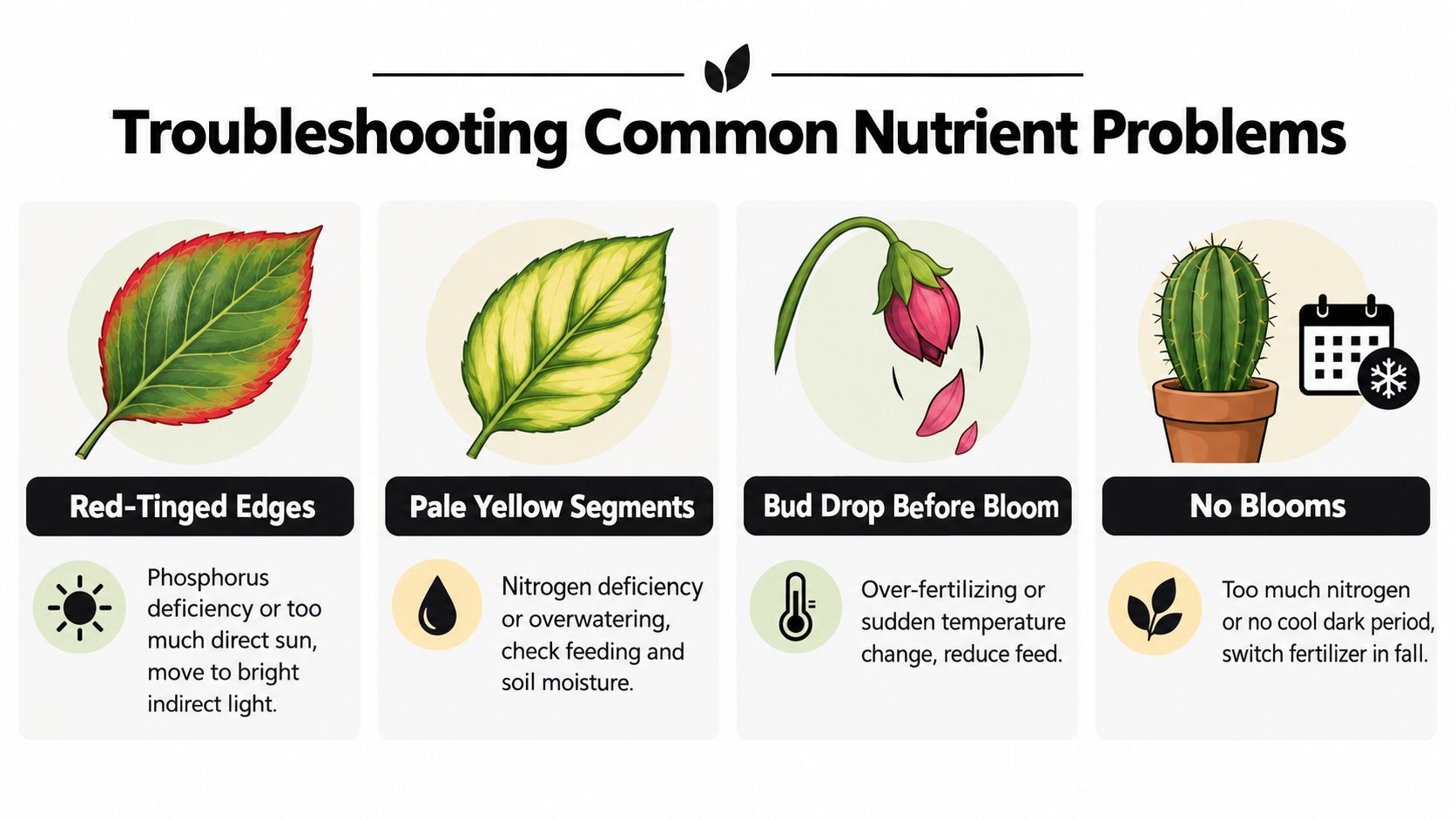
Before feeding again: Check light, roots, moisture, and salt buildup. Fertilizer is not a universal treatment.
Matching Fertilizer Format to Your Routine
The right format is the one that fits the way you care for plants. A product that requires a feeding ritual won't help if you water irregularly, while a slow-release product can become awkward if you need to stop nutrients before buds form.
The forgetful waterer
If you remember your Christmas cactus only when you notice it across the room, choose slow-release pellets. They reduce the number of feeding decisions you need to make and provide a gradual nutrient supply. Follow the label carefully, keep pellets away from the stems, and don't add more just because you missed a watering.
The routine waterer
If you already water several houseplants on a schedule, use a balanced liquid. Apply it at half strength during active growth, then switch to plain water when the feeding season ends. Liquid is the best option for growers who want to respond to the plant instead of committing nutrients months in advance.
The frequent traveler
Travelers need a format that doesn't depend on being home for every feeding. A balanced slow-release product can cover the maintenance problem, but it won't replace sound watering and drainage. If the plant is approaching its flowering period, don't add a fresh dose just before leaving unless the product's release pattern fits the season.
| Grower type | Best format | Feeding frequency | Forgiveness if missed |
|---|---|---|---|
| Forgetful waterer | Slow-release pellets | Occasional application during growth | High for missed feeding, lower for poor timing |
| Routine waterer | Balanced liquid | Regular applications during active growth | Low, but offers excellent control |
| Frequent traveler | Carefully measured slow-release fertilizer | Occasional application during growth | Moderate, provided the dose is conservative |
| Casual dry-fertilizer user | Balanced granular feed | Infrequent application during growth | Moderate, with careful placement required |
Don't choose a format based on the fantasy version of your routine. Choose the one that makes the correct behavior easiest.
Choosing the Best Christmas Cactus Fertilizer
Start with your watering habit, not the fertilizer aisle. Once you know whether you'll mix feed regularly or forget for long stretches, the product decision becomes straightforward.
Best for regular care
Choose a balanced liquid close to a 1:1:1 NPK ratio and dilute it to half strength. A liquid gives you the cleanest stop-start control, which matters because feeding should pause before fall bud formation. Use it only while the plant is actively growing, and apply it to moist soil rather than a dry root ball.
Best for low-maintenance care
Choose a measured slow-release pellet if you regularly miss liquid applications. Leaves & Soul offers slow-release fertilizer pellets as part of its houseplant and garden fertilizer range, making that format an option for growers who prefer gradual feeding over mixing a concentrate. Apply conservatively and account for the product's release period before using it near the end of the growing season.
Best for occasional dry feeding
A balanced granular fertilizer can work for the owner who wants a simple application and can follow directions carefully. Use less than the maximum label rate if the product allows that adjustment, distribute it evenly over the soil surface, and keep it away from stems. Granules aren't my first choice for a small Christmas cactus pot because concentrated pockets are easier to create than with liquid.
The strongest buying criteria are simple:
- Balanced nutrition: Look for a formula near 1:1:1 rather than automatically choosing the highest phosphorus number.
- Routine compatibility: Pick liquid for control, pellets for convenience, and granules only if you can distribute them carefully.
- Seasonal restraint: Stop feeding in late summer and don't restart just because buds appear.
A balanced houseplant fertilizer used at half strength and applied at the right time will usually outperform a specialty bloom booster used heavily or too late. Consistency beats novelty.
Frequent Questions About Feeding Christmas Cactus
Should I use Epsom salts? Only when magnesium deficiency is plausible or confirmed. Interveinal yellowing on older segments can point toward magnesium trouble, but random Epsom salt use adds more soluble material to the container and can worsen salt accumulation. The University of Georgia guidance mentions 1 teaspoon per gallon of water once a month when using Epsom salts as a supplement, not as a mandatory part of every feeding routine. (University of Georgia Epsom salt guidance)
Is foliar feeding better? No. Thick, flattened Schlumbergera segments aren't a reliable substitute for root feeding. Apply fertilizer to the potting mix, where the roots can access it, and avoid spraying flowers or leaving nutrient solution on the foliage.
Should I fertilize when the plant has just finished blooming? Give it a rest first. Resume when active new growth begins, rather than feeding immediately because flowering has ended.
Can coffee grounds replace fertilizer? No. Fresh grounds can alter moisture and texture in a small container, and they don't give you dependable control over the nutrients reaching the roots. Use a measured houseplant fertilizer instead.
What about banana peel water? Skip it. It's an inconsistent nutrient source and can add organic material without solving the plant's actual problem.
When should I repot instead of fertilize? Repot when roots circle tightly, water runs straight through the container, or a crust forms on the soil surface. Fresh, well-draining mix is a better correction than adding more fertilizer to stressed roots. Let the plant recover before restarting a diluted feeding routine.
Leaves & Soul offers balanced liquid fertilizers, slow-release pellets, soils, and targeted amendments for indoor growers who want a more controlled feeding routine. Visit Leaves & Soul to compare formats and choose a fertilizer that matches your Christmas cactus care schedule.