


You've brought home an orchid with glossy leaves, beautiful flowers, and a clear plastic pot. Then you notice the “soil” looks dark and wet, so you water it again. A few weeks later, the leaves begin to yellow, the roots look brown, and the plant seems to be declining even though you've been trying to help.
The problem often isn't your watering technique. It's the growing medium. The best potting soil for orchids usually isn't soil at all, but a structured blend that gives roots access to both moisture and air. The right choice depends on the orchid's genus, the size of the particles, and the conditions in your home.
Why Regular Potting Soil Fails Orchids
A grocery-store Phalaenopsis can look healthy when first planted in ordinary houseplant mix. Weeks later, the leaves may yellow while the roots turn brown and soft. The mix has stayed wet too long, even though the plant may appear properly watered.
Standard houseplant soil is made for plants that grow in the ground. Peat and other fine particles hold moisture and create a firm anchor. Many orchids, however, are epiphytes. They grow attached to trees or other surfaces, where their roots receive water briefly and then dry through exposure to moving air.
A fine mix can settle and compress after repeated watering. The spaces between particles shrink, so the roots lose both drainage and airflow. Like a sponge pressed inside a sealed bag, the medium may contain water but leave little room for fresh air.
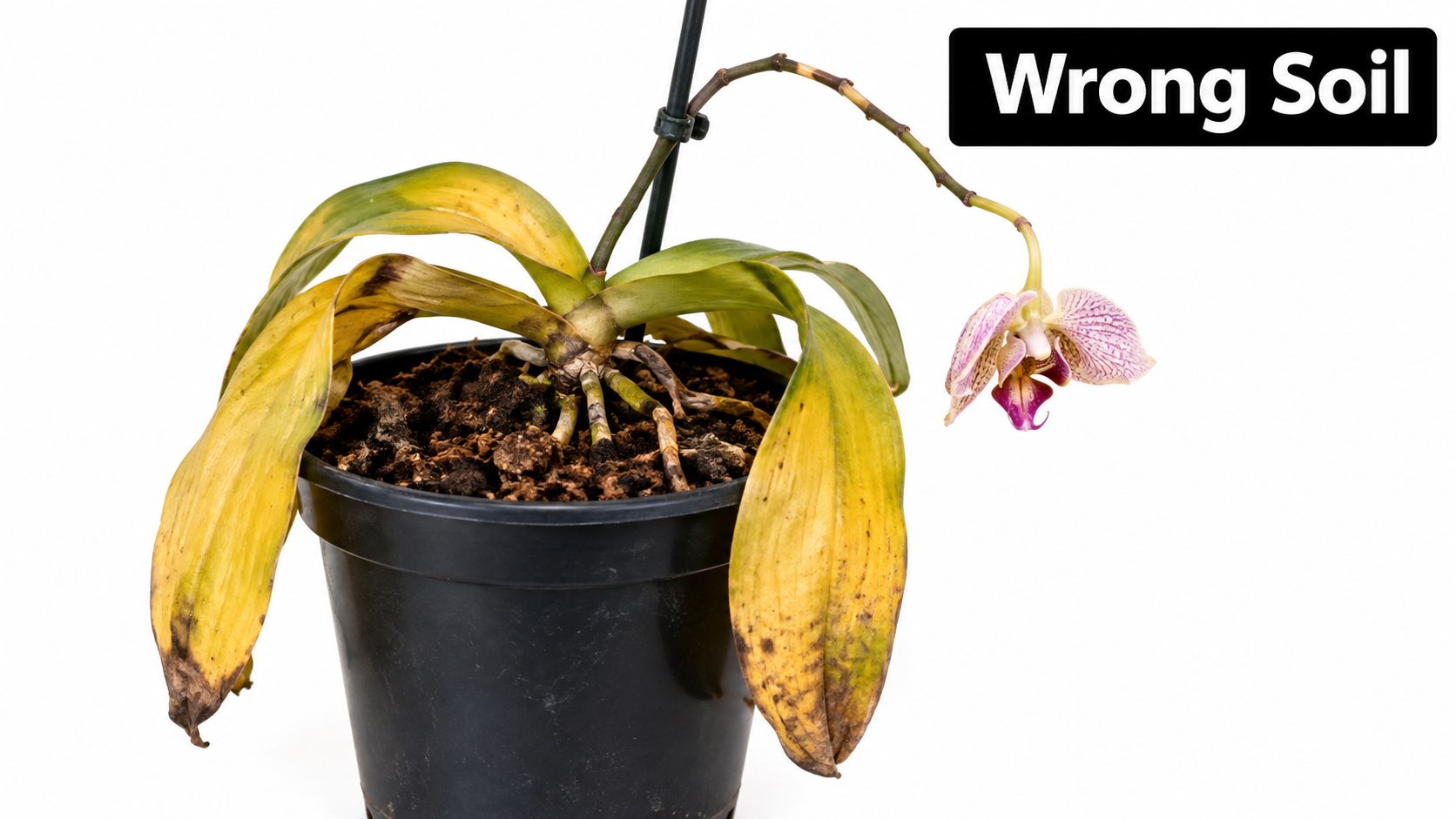
Soil texture matters more than the label
Take a handful of peat-heavy houseplant mix and wet it. Its fine, cohesive texture can form a dense mass around the roots. Take a handful of chunky orchid medium instead. Fir bark, perlite, sphagnum moss, coconut husk chips, or diatomite create irregular spaces where water can pass and air can remain.
The American Orchid Society describes fir bark as a long-standing orchid potting material, after osmunda became scarce and expensive. The point is not to copy one ingredient blindly. Bark, moss, and other components must be combined according to the orchid's roots, pot size, and drying conditions.
Practical rule: If the mix turns to mud when wet, it is too dense for most epiphytic orchids.
The beginner's mental reset
Choose a medium by observing what happens after watering. Does it drain freely while retaining a small amount of moisture? Do open spaces remain around the roots as the mix settles?
That air-and-moisture balance guides the rest of the decision. Start with the orchid's growth habit, then adjust particle size and the bark-versus-moss balance for the room where it grows. A mix that dries quickly may need more moisture-holding material, while a slow-drying room usually calls for coarser, airier particles.
What Orchid Roots Actually Need
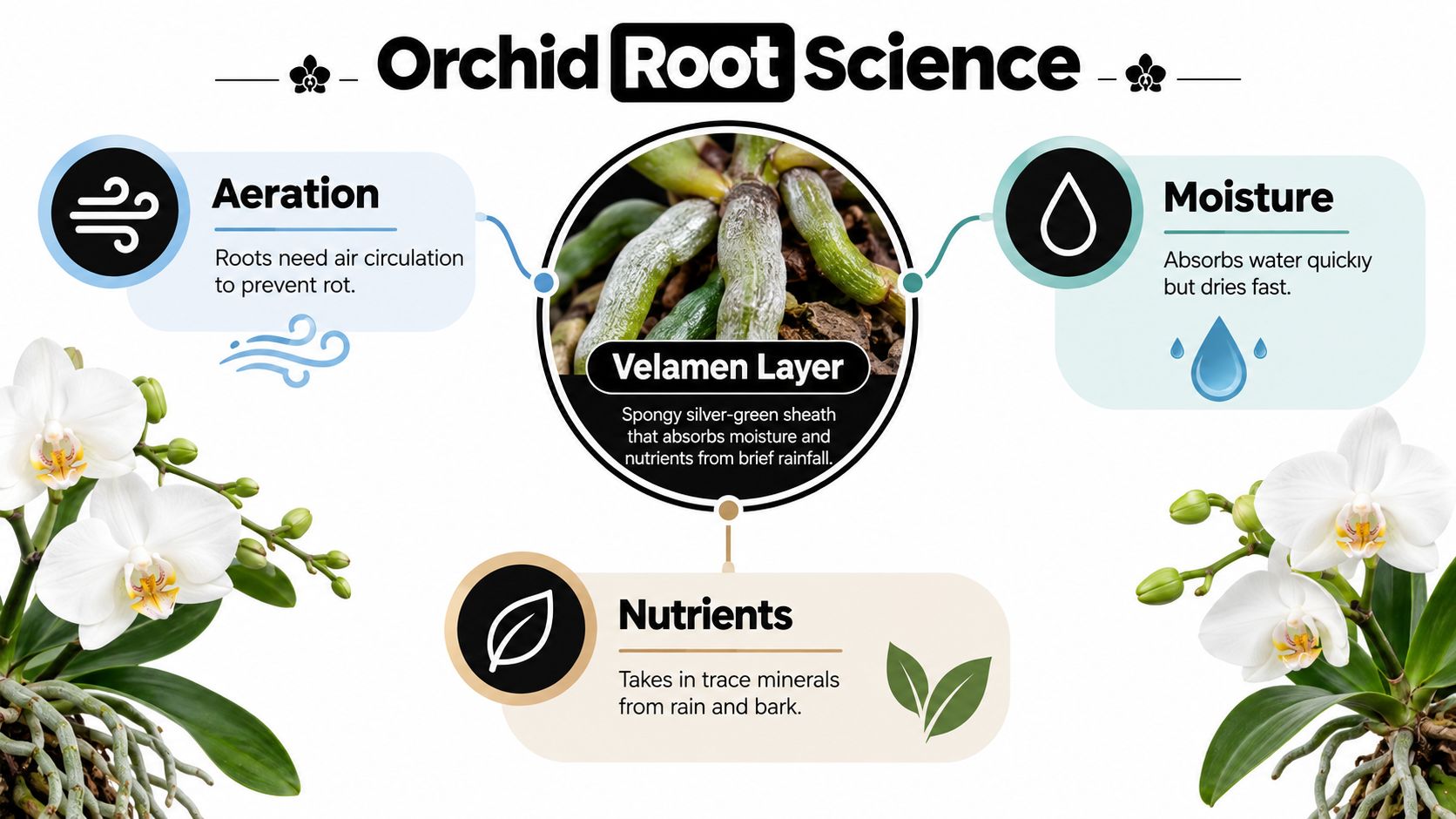
After watering, an orchid's roots should be wet, then have access to air as excess moisture drains away. Many epiphytic orchids have velamen, a spongy outer layer that quickly absorbs water and dissolved nutrients. If that layer stays saturated for too long, the living tissue beneath can deteriorate, weakening water and nutrient uptake.
A helpful comparison is a sponge held inside a wire basket. Water can soak the sponge, while the basket keeps channels open for airflow. Fine, compact soil behaves more like a wet cloth sealed in a plastic bag. It may remain damp, but the roots receive less oxygen.
The American Orchid Society's explanation of orchid media and root aeration connects root health with the way a container and its substrate hold water and air. After irrigation, a useful target is about 25% air, 60% water, and 15% solids. This explains why a coarse orchid medium behaves differently from dense houseplant soil.
Four checks for a suitable medium
Check the mix against four conditions:
- Fast drainage. Water should leave the pot instead of collecting around the roots.
- Open airflow. Particles should preserve air channels after watering.
- Appropriate acidity. Orchid media commonly perform within pH 5.5 to 6.5, according to orchid media research and recommendations.
- Moderate moisture retention. The mix should absorb water readily, then dry gradually without remaining saturated.
The right balance depends on the orchid. Phalaenopsis and Cattleya are commonly grown as epiphytes and often suit an airy bark-based medium. Cymbidium and Paphiopedilum include terrestrial types that can handle finer, more moisture-retentive material. Their roots developed under different conditions, so one recipe cannot suit every genus.
For a practical example, an Oncidium-Miltassa study tested bark and sphagnum at 100:0, 75:25, 50:50, 25:75, and 0:100 by volume. These ratios show how changing the bark-to-moss balance adjusts airflow and moisture, rather than making the choice a simple matter of personal preference (orchid media research and recommendations).
The Core Ingredients in Orchid Mixes
Orchid media work as a team. Bark provides structure, moss buffers moisture, and mineral ingredients protect air space. No ingredient automatically makes a mix suitable. Particle size and the way the components behave after repeated watering matter just as much.
For a broader ingredient overview, see this guide to what goes into orchid potting mix.
Ingredient roles at a glance
| Ingredient | Airflow | Moisture Retention | Decomposition Rate | Best For |
|---|---|---|---|---|
| Fir bark | High, especially in coarse grades | Low to moderate | Gradual breakdown | Most mature epiphytic orchids |
| Sphagnum moss | Moderate, but can decline when compressed | High | Gradual breakdown | Young roots, dry rooms, moisture-loving types |
| Horticultural charcoal | Adds open spaces | Low | Slow and durable | Supporting structure and fresher-feeling mixes |
| LECA clay pebbles | Very high | Low on the surface, with water held in pores | Very slow | Semi-hydroponic or highly aerated setups |
| Tree fern fiber | Good | Moderate | Slow | Long-lasting specialty blends |
| Perlite | High when distributed through the mix | Low | Very slow | Lightweight aeration and drainage |
Fir bark forms the backbone of many orchid blends. Coarse pieces create stable air pockets and offer roots something to grip. Medium bark suits many Phalaenopsis plants, while larger particles better support Cattleyas, Dendrobiums, and orchids grown in bright conditions.
Sphagnum moss holds much more moisture than bark. It can help a small plant or a specimen in dry indoor air, but tightly packed moss may reduce airflow as it settles. Use it as part of a blend unless you're confident you can manage the watering and drying pattern.
Horticultural charcoal is a supporting ingredient, not the main structure. It contributes durable, irregular particles and can help keep the blend from feeling stale. Use horticultural material rather than charcoal treated for grilling or other non-gardening purposes.
LECA is useful when you're deliberately growing in a semi-hydroponic system. It provides a very open structure, but it doesn't behave like bark, so the watering method must change with it.
Tree fern fiber offers a long-lasting, moisture-balanced option for specialty mixes. It can be valuable when you want more structure than moss provides without relying entirely on bark.
Perlite is inexpensive and light. It improves aeration, although it may float upward during watering and become unevenly distributed. Mix it through the container rather than leaving it as a surface layer.
The bark-versus-moss decision is really a choice between faster drying and longer moisture buffering.
Matching the Mix to Your Orchid Type
Start with the label if you have it. The genus gives you a better starting point than the flower color or pot size because it hints at how the plant handles moisture and airflow.
A Phalaenopsis usually suits medium-grade bark with a modest moisture-retentive additive. In a dry room, a small amount of sphagnum can slow drying. A Cattleya, by contrast, generally benefits from a coarser bark structure with perlite, pumice, or charcoal to keep the root zone open.
Dendrobiums often fit the same broad bark-based approach, especially when grown warm and bright. Vanda and other commonly bare-root orchids may perform better in open baskets, mounted arrangements, or containers with very large bark pieces rather than a fine enclosed medium.
Phragmipediums are a different case. They're moisture-loving orchids, so a blend containing sphagnum and perlite can provide a more consistent moisture buffer. Terrestrial orchids such as some Cymbidium and Paphiopedilum types may also need a finer, more moisture-retentive medium than a typical epiphytic bark blend.
Orchid genus to mix match-up
| Orchid Genus | Recommended Mix Base | Texture | Watering Rhythm | Dry Indoor Tip | Humid Room Tip |
|---|---|---|---|---|---|
| Phalaenopsis | Medium bark with a moisture buffer | Medium and open | Water when the mix is approaching dryness | Add a little sphagnum | Use more bark and airflow |
| Cattleya | Coarse bark with perlite or charcoal | Chunky | Allow a clear drying period | Use a modest moisture additive only if needed | Keep the blend very open |
| Dendrobium | Coarse bark with some inorganic material | Chunky and free-draining | Let the mix dry between waterings | Add limited moisture retention | Increase airflow and avoid dense moss |
| Phragmipedium | Sphagnum and perlite blend | Moisture-retentive but loose | Keep it from becoming fully dry | Monitor the center of the pot | Increase drainage if it stays wet |
| Vanda | Open basket or large bark pieces | Very open or mounted | Water according to root exposure | Use frequent checks rather than dense mix | Favor maximum air movement |
Your room matters as much as the plant name. Warm, dry air pulls moisture from bark quickly, while a cool, humid space slows evaporation. Bright light can also increase the plant's demand for water, but it doesn't justify using a compact medium. Adjust particle size and the amount of moss instead of solving every problem by watering more often.
Building a DIY Mix and Choosing a Commercial Blend
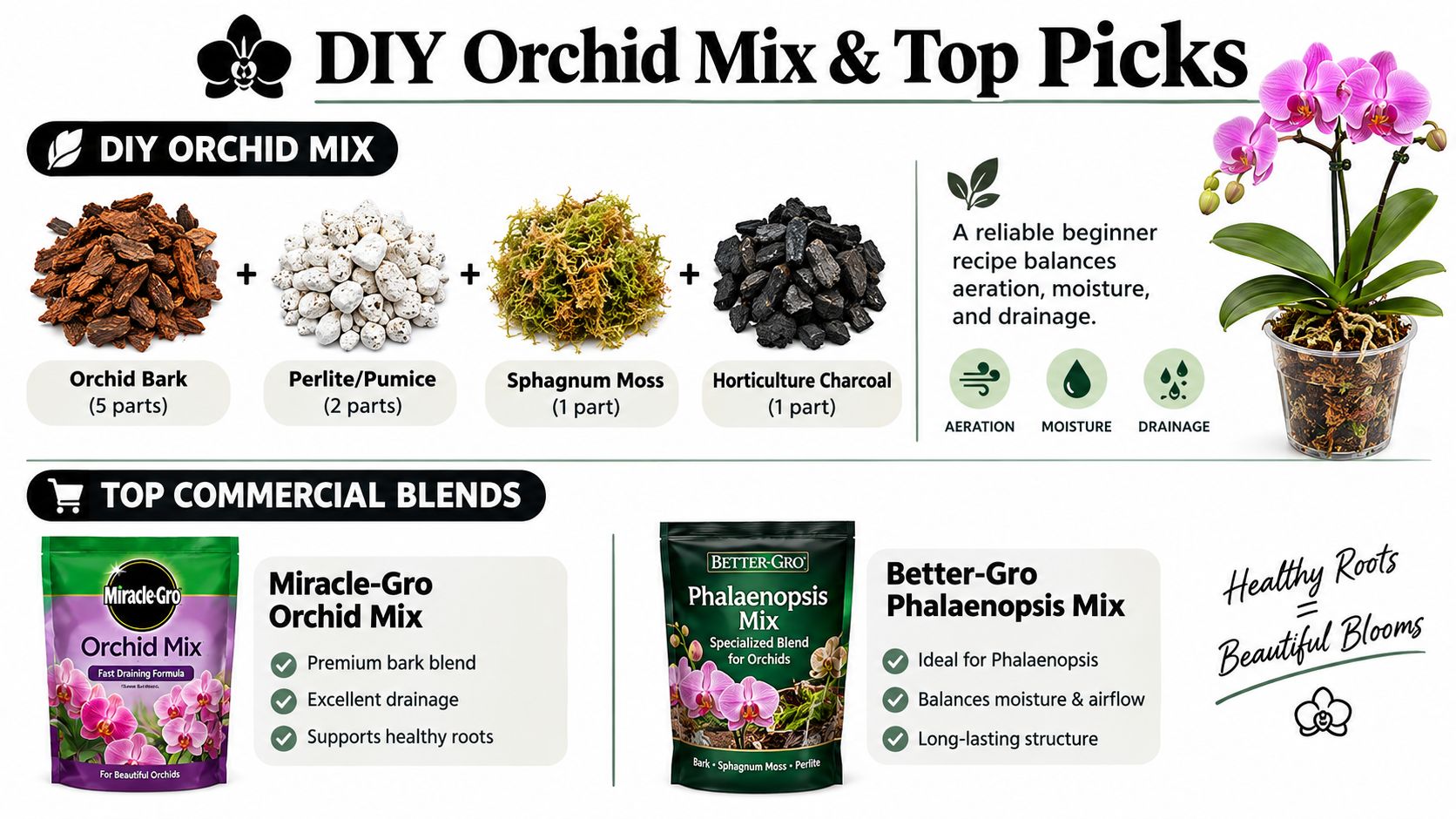
A reliable beginner mix starts with 5 parts medium-grade orchid bark, 2 parts perlite or pumice, 1 part fine sphagnum moss, and 1 part horticultural charcoal. Bark forms the open framework, while the other ingredients adjust air space, drainage, and moisture. The goal is a root zone that holds water briefly without turning into a sealed, soggy pocket.
Prepare the bark first. Soak it overnight, then drain it thoroughly. Dry bark can repel water at first or draw moisture away from the roots. Pre-moistened bark blends more evenly and gives the moss and mineral ingredients a fairer distribution through the pot.
Adjust the recipe by plant and room
Treat the recipe as a starting point. Your orchid's root size, genus, and growing room determine whether the mix should act more like a ventilated basket or a moisture-holding sponge.
- For a dry home: Keep the sphagnum portion and check whether the pot's center dries too quickly.
- For a humid room: Reduce moisture-retentive material and keep the bark structure open.
- For Phragmipediums: Use more sphagnum, while retaining perlite or another aerating component.
- For Cattleyas: Reduce or omit sphagnum if the pot stays wet, and select larger bark pieces.
- For small roots: Choose smaller particles, but leave enough gaps for air to move.
A published orchid potting-media recipe uses 6 parts bark, 1 part coarse perlite, and 1 part chopped sphagnum, equal to 75% bark, 12.5% perlite, and 12.5% sphagnum by volume. Bark-led blends are also commonly recommended with smaller amounts of perlite or pumice, charcoal, and coconut husk or sphagnum. For a measured DIY variation, see this orchid soil mix recipe.
How to judge a commercial bag
Read the ingredients and inspect the texture instead of relying on the word “soil.” A suitable blend feels light and chunky, with bark or coco chips creating the main framework. Perlite, pumice, lava rock, or a similar mineral ingredient adds drainage and air gaps.
Avoid bags dominated by peat, compost, or fine ordinary potting mix. A commercial product saves preparation time and provides a consistent starting texture. Leaves & Soul's Premium Orchid Soil All Purpose Blend is a ready-to-use option described for aeration and drainage around orchid roots. Compare its particle structure with your DIY mixture, then choose the blend that matches how quickly your room dries.
How to Repot an Orchid the Right Way
A repot is a root inspection as much as a container change. Replace the medium when it has broken down, water drains slowly, or flowering has ended and new root growth is beginning. A common refresh interval is 1 to 2 years, following orchid potting-media replacement guidance.
Water the orchid the day before. Hydrated roots bend more easily, so they are less likely to snap as you loosen old bark.
- Prepare the workspace. Set out fresh medium, a clean pot, sterilized scissors, and a wipeable work surface.
- Remove the plant carefully. Ease the root mass out of the container. Pulling on leaves or the flower spike can damage the plant.
- Clear away old media. Shake or rinse off loose bark, then inspect the roots one at a time.
- Trim only damaged roots. Healthy roots feel firm and may look pale green, silver, or white, depending on moisture. Cut away brown, hollow, or mushy roots with sterilized scissors.
- Choose the container. Use a pot only slightly larger than the root mass. Extra space holds unused medium, which can remain wet longer.
- Set the plant at the correct height. Add a shallow base layer, keep the crown level with the rim, and arrange the roots over the medium.
- Settle without compression. Tap the pot gently so bark falls around the roots. Do not press it down. Compacted mix removes the air gaps the roots need.
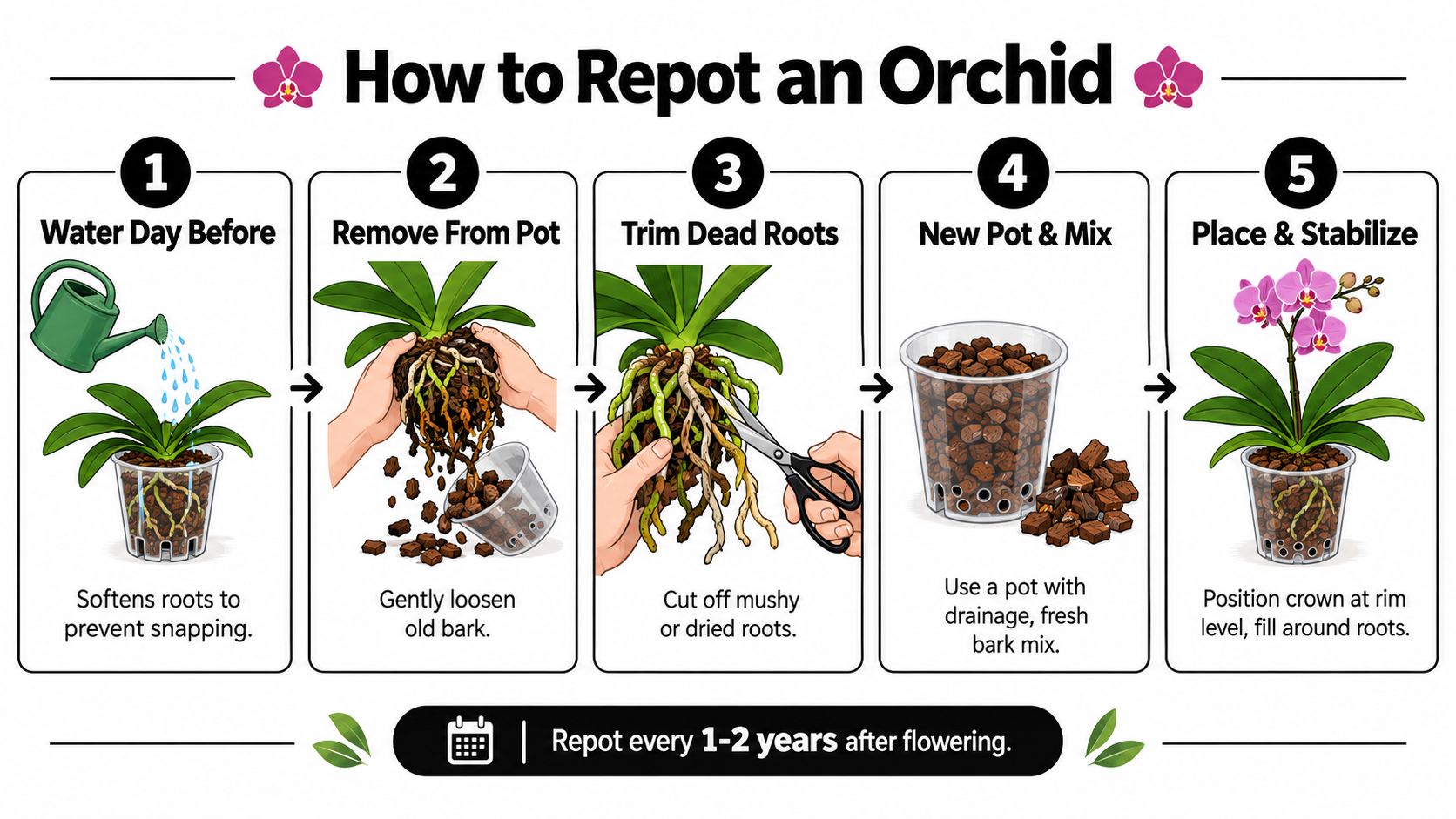
After trimming, wait 3 to 5 days before watering so cut surfaces can callus. Resume careful watering afterward, and avoid fertilizer for the first month while new roots settle into the mix. For a visual demonstration, watch the walkthrough below.
If this is your first repot, use this detailed guide to repotting orchids as you work through each stage.
Troubleshooting Common Orchid Soil Problems
Yellow leaves don't always mean you watered too often. A failing root system can also leave the plant unable to take up water, even when the pot looks damp. Before changing your schedule, examine the medium and the roots.
Old bark often breaks down into fine particles. Those particles fill the spaces that once allowed air to move through the pot, so a plant may decline even if you haven't increased watering. Moss can create a similar problem when it compacts in the center of the root ball.
Diagnose the medium before blaming the routine
Lift the pot and inspect the drainage holes. Does water pass through quickly, or does it sit on top? Does the mix still contain distinct bark pieces, or has it become dark and fine? A sour or stagnant smell also points to poor air exchange and decomposing material.
A white crust on the medium or container can indicate accumulated minerals. Flush the pot periodically with pH-balanced water, allowing plenty of water to pass through and carry residue away. If the container itself has few openings, move the plant into a more breathable orchid pot.
| Symptom | Likely Soil Cause | Recommended Fix |
|---|---|---|
| Yellowing leaves with wet medium | Compacted or waterlogged mix | Repot into a chunkier, airier blend |
| Brown, hollow, or mushy roots | Root decay from prolonged wetness | Remove damaged roots and replace the medium |
| Water remains on the surface | Fine particles or decomposed bark | Refresh the mix and improve drainage |
| White crust on the pot or mix | Mineral accumulation | Flush with pH-balanced water |
| Wrinkled leaves despite damp mix | Roots are damaged and not absorbing well | Inspect roots instead of watering more |
| Mix dries almost immediately | Particles are too coarse for the room | Add a modest moisture-retentive component |
A damp pot doesn't prove that the orchid is hydrated. It may prove that the roots can no longer use the water.
The correction should match the cause. Replace collapsed bark, loosen an overly moss-heavy mix, improve container ventilation, or move the plant to a location where the medium dries at a steadier pace. Don't keep adding water to a plant whose roots are already compromised.
Your Orchid Soil Game Plan
A Phalaenopsis in a dry, bright room may need a different mix from a Paphiopedilum in a cool, humid corner. Make each decision in order.
- Identify the orchid. Phalaenopsis, Cattleya, Dendrobium, Phragmipedium, Vanda, Cymbidium, and Paphiopedilum vary in moisture needs and preferred particle size.
- Read the room. Warm, bright, dry conditions call for more moisture buffering. Cool, humid conditions suit a more open mix that dries faster.
- Choose the mix direction. Build around bark for most established epiphytic orchids. Add moss when roots need a slower moisture release, or combine both when the plant and room fall between those conditions.
- Inspect the pot. Drainage openings and airflow around the roots matter as much as the ingredients. A good mix cannot compensate for a container that traps water.
- Repot based on condition. Refresh the medium every 18 to 24 months, or sooner if bark has broken down, water drains slowly, or roots decay, following this orchid media replacement guidance.
Start with a bark-led blend and watch its drying rhythm at home. If roots stay wet too long, use larger particles or less moss. If the mix dries before the orchid can use it, add a small moisture-retentive component instead of regular soil.
Adjust one variable at a time. Feel the medium, inspect the roots, and record how quickly the pot dries. The target is an airy root zone that wets evenly and dries at a pace the orchid can handle.
Leaves & Soul offers purpose-built growing products, including the Premium Orchid Soil All Purpose Blend, for growers seeking a ready-to-use medium centered on aeration and drainage. Visit Leaves & Soul to explore orchid soil, fertilizers, and other plant-care supplies, then match the blend to your orchid and growing conditions.