


You've fed your fiddle leaf fig, watered it carefully, and still ended up with pale leaves or crispy edges. Or you've tucked pellets into a bonsai pot, only to wonder whether they're feeding the tree gently or creating a concentrated pocket of salts around delicate roots. That frustration usually doesn't come from choosing pellets instead of liquid fertilizer. It comes from choosing a release pattern that doesn't fit the pot, soil, placement, or temperature.
The best slow release fertilizer isn't a universal brand winner. It's the formula that releases nutrients at a useful pace in your particular container. A fast-draining bonsai mix behaves differently from peat-based houseplant soil, and a cool indoor windowsill doesn't activate fertilizer like a warm outdoor bed. This guide focuses on that fit, including N-P-K, coating types, longevity claims, placement, and practical application.
Introduction Why Slow Release Matters for Busy Plant Parents
Liquid fertilizer is useful, but it demands attention. You need to dilute it correctly, apply it when the plant is hydrated, remember the next feeding, and avoid splashing concentrated solution onto foliage or exposed roots. In a small container, one rushed measurement can create a stronger root-zone solution than the plant can safely handle.
Slow-release pellets offer a different rhythm. Instead of making the grower deliver a complete nutrient dose all at once, the pellets act as a stored supply that becomes available gradually. That can make feeding easier for houseplants, bonsai, patio containers, and established garden plants, provided the product's release behavior matches the growing conditions.
A useful primer on the broader category is the Barefoot Organics fertilizer guide, especially if you're comparing granular and liquid options before buying. Still, a product list won't answer the most important question: will those pellets behave properly in your potting mix?
What makes the fit more important than the label
Container growers have less room for error than field growers. A bonsai pot contains a small root zone, a fiddle leaf fig may sit in a moisture-retentive indoor mix, and a succulent container may dry quickly between waterings. The same pellet can release at different speeds in each setting.
Temperature matters too. Research on slow- and controlled-release fertilizers found that nitrogen release changed with both temperature and placement, including whether the product was incorporated into soil or left on the surface in a controlled study. That's why “best” should mean best fit for your plant's environment, not most impressive packaging.
A practical buying framework
Start with four questions:
- What are you feeding? Bonsai, foliage plants, orchids, succulents, vegetables, and outdoor ornamentals don't all need the same nutrient emphasis.
- What does the soil do with water? Fast drainage can shorten contact time, while dense or moisture-retentive mixes can keep pellets active longer.
- Where will the pellets sit? Surface placement and incorporation can produce different release patterns.
- How often do you want to feed? Choose a verified longevity window that suits your routine, then apply conservatively in small containers.
Slow-release pellets shine when you want steady maintenance feeding and fewer interruptions. They fail when you treat the longevity printed on the bag as a guarantee that ignores temperature, moisture, and pot size.
How Slow Release Fertilizers Work
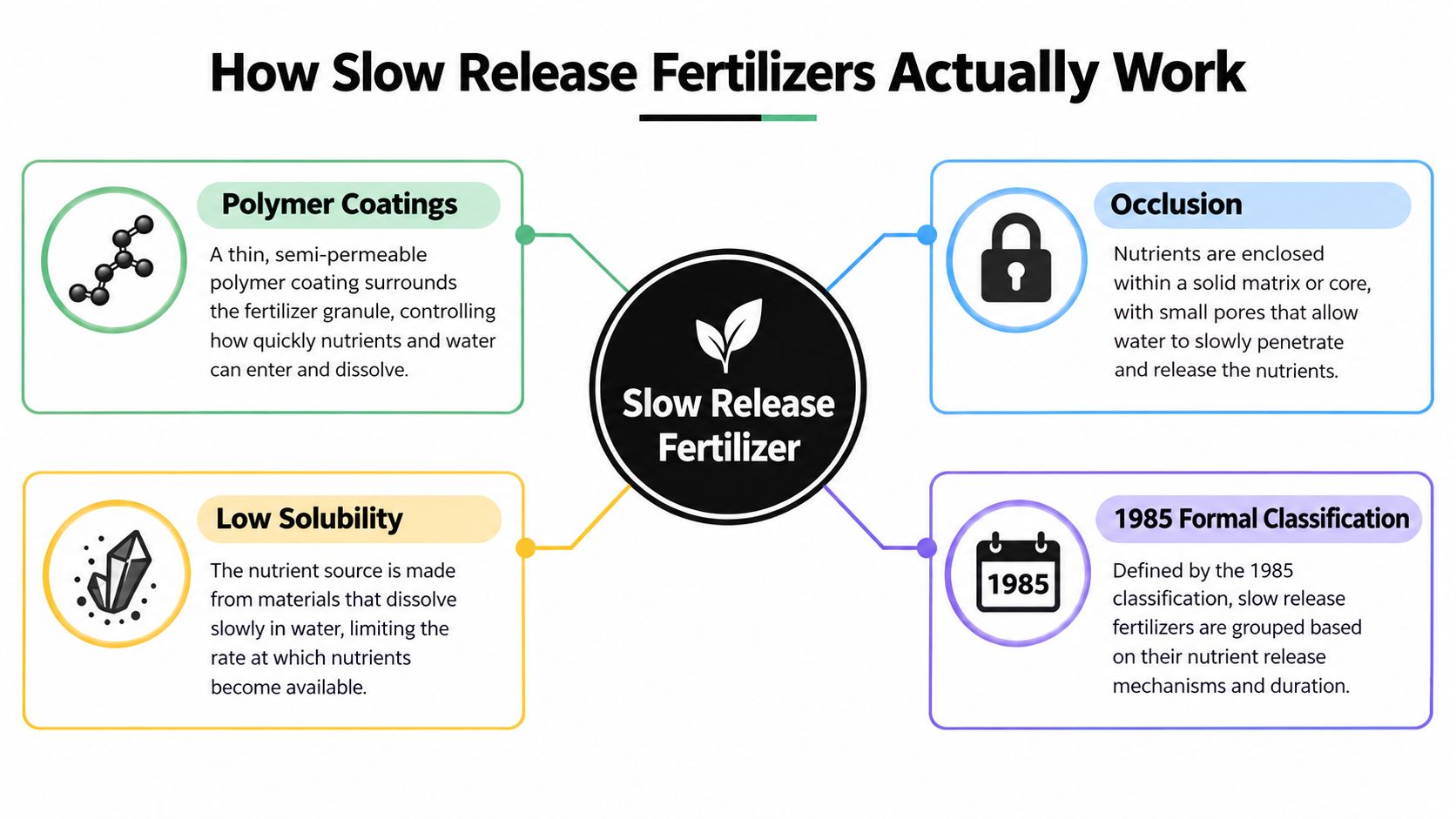
Slow-release fertilizer controls nutrient availability through the fertilizer material or its coating. Some products surround soluble fertilizer with a coating. Others use low-solubility compounds, materials that hold nutrients in place, or chemistry that breaks down gradually through hydrolysis or microbial activity. For a practical overview, see what slow-release fertilizer is and how it works.
The formal classification became clearer in 1985. Slow- and controlled-release fertilizers were defined as materials that delay nutrient availability or extend it well beyond rapidly available fertilizers. The recognized mechanisms are coatings, occlusion, insolubility, and slow hydrolysis, as documented by the International Fertilizer Association.
Slow release versus controlled release
These terms overlap, but the difference helps when choosing pellets. Slow-release fertilizer becomes available gradually because its nutrient source dissolves or decomposes slowly. Controlled-release fertilizer usually follows a more engineered schedule, often using a coating that regulates water entry and nutrient diffusion.
A coated pellet works like a small reservoir. Water enters through the coating, dissolves fertilizer inside, and carries the nutrient solution outward through microscopic pathways. A thicker or less permeable coating slows that exchange. A thinner or more porous coating releases nutrients sooner.
Longevity is a window, not a promise
Industry screening criteria distinguish genuine controlled release from fertilizer that merely dissolves more slowly. A qualifying product is benchmarked at less than 15% nutrient release during the first 24 hours, less than 75% by 28 days, and at least 75% by its stated longevity window, which may range from 40 to 360 days, according to the University of Florida IFAS guidance.
Those windows change with warmth, moisture, coating structure, microbial activity, and placement. A pellet on a warm, frequently watered outdoor bed can release faster than the same pellet in a cool indoor container.
For bonsai, a pellet may seem inactive in a dry, airy mix, then accelerate after repeated watering. In a fiddle leaf fig's consistently damp potting mix, the same product can provide a stronger feed than expected. Placement matters too, especially in small containers where roots have little room to avoid concentrated fertilizer.
Choose products with a stated duration, nutrient-release information, and application directions that identify the conditions behind the claim. Treat the printed longevity as a useful range, not a guarantee.
Comparing N-P-K Profiles and Release Durations That Matter
A fertilizer label can show the right N-P-K ratio and still feed a bonsai too aggressively or leave a fiddle leaf fig underfed. N-P-K identifies the proportions of nitrogen, phosphate, and potash. It does not show how quickly those nutrients reach the roots. An uncoated product and a controlled-release pellet with similar numbers can behave very differently in the same container.
Nitrogen supports leafy growth and green color. Phosphorus contributes to energy transfer and root development, while potassium supports water regulation and structural strength. The middle number is not a guaranteed flowering switch. Species, light, root health, potting mix, and watering still shape the result.
For a leafy indoor plant, a foliage-oriented profile can suit steady growth. Bonsai need more restraint because a sudden nitrogen surge can produce soft shoots that work against compact form. Succulents and cacti generally need lighter feeding. Orchids need a formula that fits their bark-based or other specialized medium and their watering routine.
Use these profiles as starting points, not universal prescriptions. Match the label rate to the plant, pot size, drainage, and active growing conditions.
| Plant Group | N-P-K Example | Longevity Window | When to Choose It |
|---|---|---|---|
| Bonsai | 18-6-8 | Choose a verified window suited to the active growing season | Use when you want measured vegetative growth without repeated liquid feeding |
| Foliage houseplants | 16-5-11 | Choose a longer window for steady indoor maintenance | Use for established fiddle leaf figs and other leafy container plants |
| Orchids | 13-11-11 | Choose a window compatible with the orchid medium and watering routine | Use when the product is specifically labeled for orchid feeding |
| Succulents and cacti | Balanced or lower-strength profile | Favor a conservative, clearly stated window | Use when the plant is actively growing and the pot drains rapidly |
| Vegetables and outdoor ornamentals | Balanced or crop-specific profile | Match the window to the growing season | Use when consistent feeding is more practical than frequent liquid applications |
Read duration claims with the release benchmark
A printed longevity window matters only when the product releases nutrients gradually enough to support it. Controlled-release fertilizer guidance uses less than 15% in the first 24 hours and less than 75% by 28 days as practical screening benchmarks in its controlled-release fertilizer criteria. A product that releases most of its nutrients immediately is not a controlled-release choice just because its package lists a long feeding window.
The difference can be substantial. In a coated-fertilizer study, a thick-coated sample released only 16% of its total nitrogen after 4 days, while conventional urea released about 99.6% in under 24 hours. The coated products reached roughly 45% nitrogen release only after 8 to 17 days, depending on coating structure in the 2023 study published by the Royal Society of Chemistry.
Temperature, moisture, and the potting mix change how that duration plays out. A porous bonsai mix that dries quickly can slow access to the pellet, while a warm, consistently damp houseplant container can accelerate feeding. In a small pot, concentrated nutrients also sit closer to the roots, so the same formula deserves a lower-risk application approach than it might receive outdoors.
Match the profile to the plant's goal
Choose a higher-nitrogen profile when the goal is healthy foliage and the plant has enough light to support new growth. Use a restrained formula for slow-growing bonsai, drought-adapted plants, or containers where salts may accumulate. A moderate formula with steady delivery is safer than a stronger formula that creates a sudden nutrient surge.
For a plain-language explanation of the three fertilizer numbers, read how to read plant fertilizer numbers. The numbers describe the nutrient profile. Container size, placement, potting mix, temperature, and coating determine how the plant receives it.
Coating Types and What Controls Nutrient Release Speed
The coating decides whether a slow release fertilizer delivers a steady supply or creates an uncertain flush. It controls how water enters the nutrient core and how dissolved nutrients leave the pellet. Thickness, material, porosity, and the surrounding potting mix all change that exchange. For bonsai and fiddle leaf figs, choose by container conditions, not by coating name alone.
Polymer-coated pellets
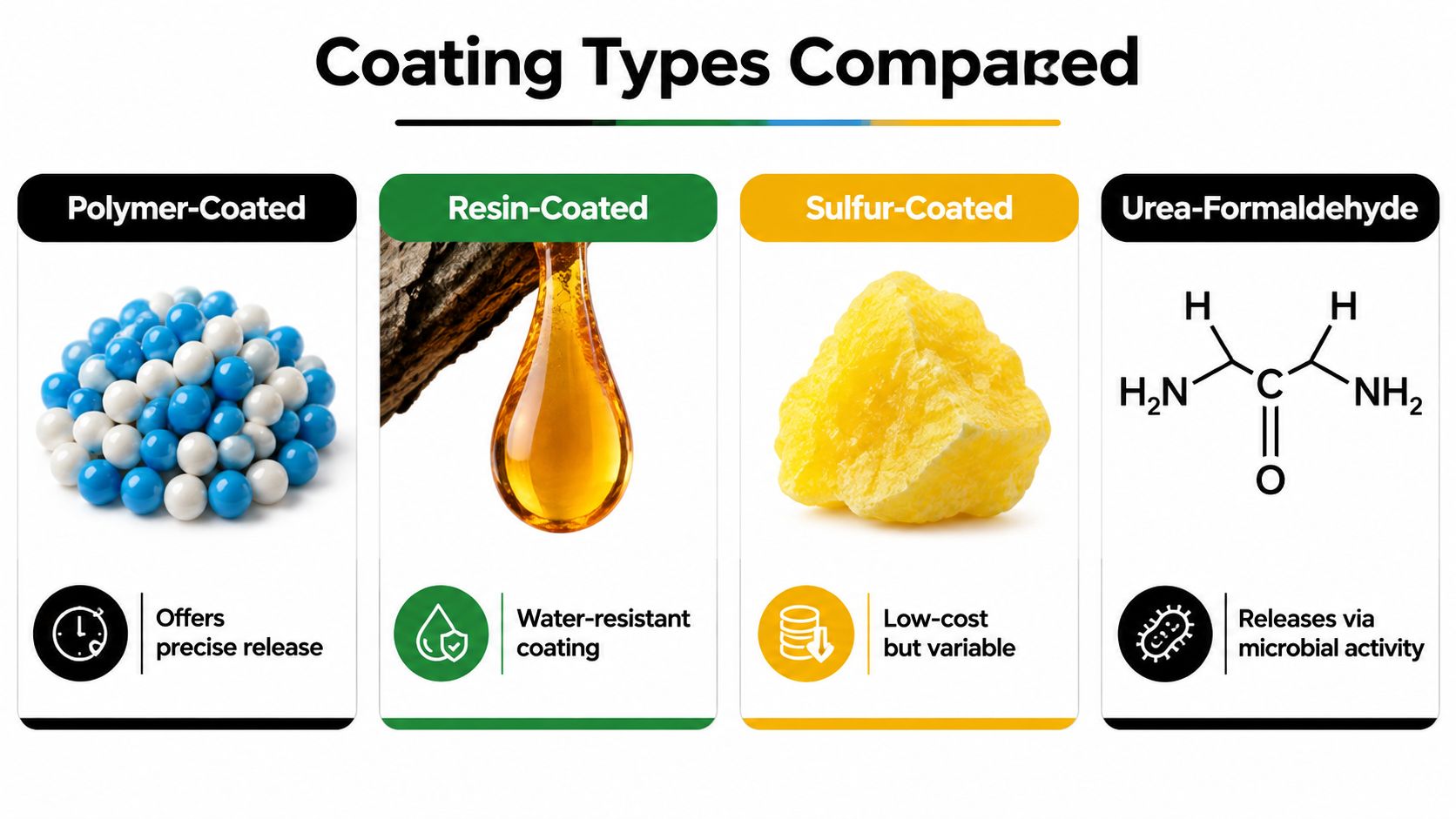
Polymer coatings regulate nutrient movement through diffusion. Water passes through the coating, dissolves the core, and carries nutrients outward. That usually produces a more defined feeding interval, which suits containers where you need to control both dose and timing.
A thicker polymer layer often delays early release, but thickness is only one variable. The coating's structure and permeability matter just as much. A thick, highly permeable layer can release faster than a thinner, denser one. Warm, wet potting mix also speeds access, while a dry, airy bonsai mix can slow it.
Resin and sulfur coatings
Resin-coated products use a water-resistant layer to limit rapid dissolution. They work best when the pellet receives regular moisture without staying saturated. Check the stated release conditions, because resin formulation and coating damage can change the result.
Sulfur-coated fertilizer can be effective and economical, but its release is less uniform. Cracks, uneven coating, moisture, and soil conditions can expose the nutrient core at different rates. That variability is manageable in a broad outdoor bed, but it demands caution in a small bonsai pot, where nutrients sit close to a limited root zone.
Urea-formaldehyde products
Urea-formaldehyde fertilizers release nutrients through slow solubility and microbial breakdown. Their history reaches back to 1948, when USDA recognized urea-formaldehyde reaction products as slow-release fertilizers. Commercial grades appeared in 1955, and the first polymer-coated controlled-release fertilizers were developed in the mid-1960s.
Early-flush rule: If a product's nutrient-release curve isn't available, assume its early behavior is less certain than its label suggests.
Check whether the manufacturer identifies the coating, expected longevity conditions, and early release pattern. A container grower needs more than a duration claim. You need to know how much nutrient becomes available at the start, especially in a warm, damp houseplant container.
The practical takeaway from the coated-fertilizer research is clear. Conventional urea released nutrients almost immediately, while a thick-coated sample released them much more gradually. That contrast explains why coating technology matters for sensitive roots. In a poorly draining pot or a container watered frequently, a predictable coating is safer than a pellet with an unclear release curve.
Best Slow Release Fertilizer by Use Case From Bonsai to Houseplants
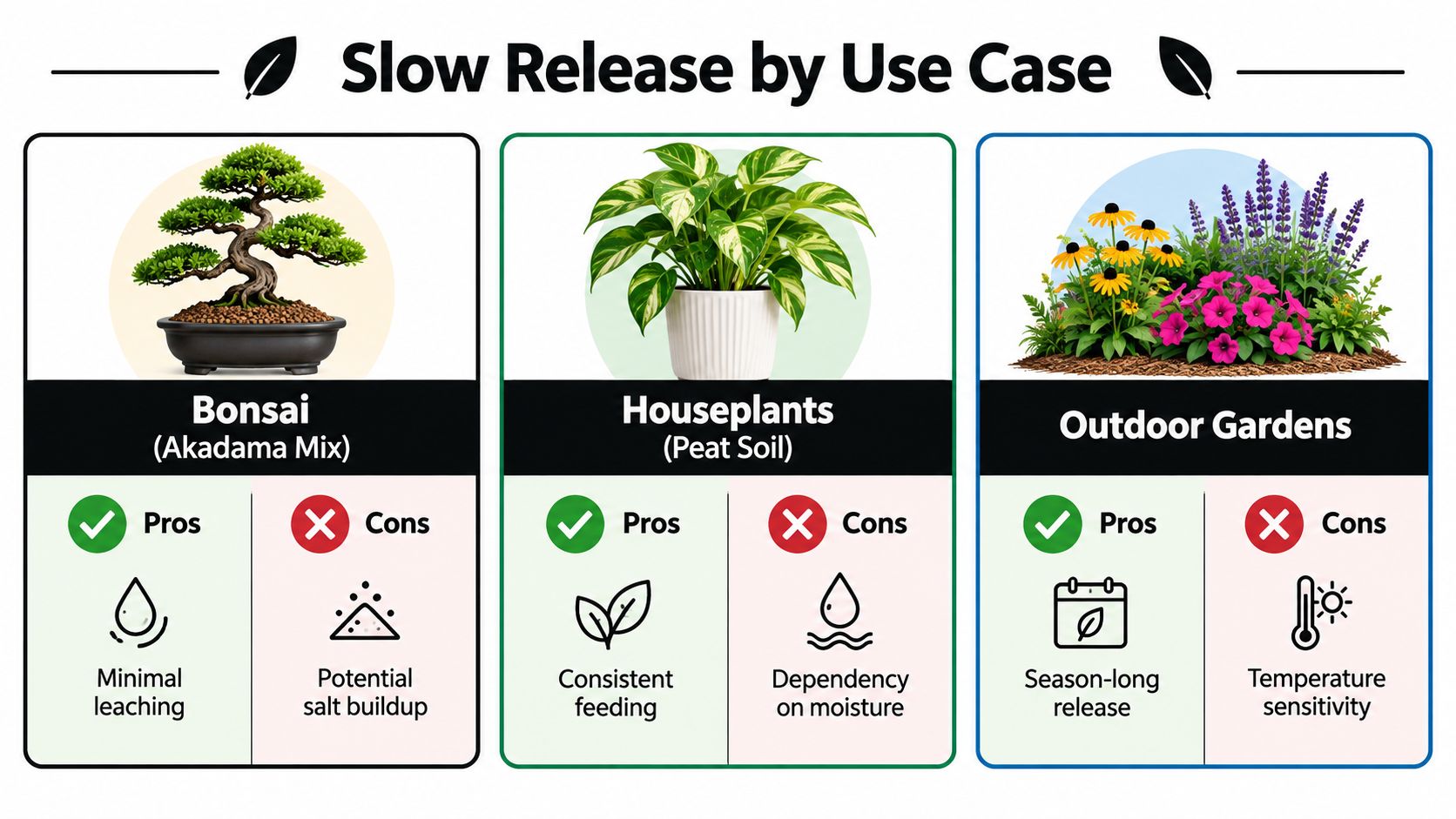
The best slow release fertilizer is the best fit for the pot, mix, temperature, and plant. A bonsai pot is not a small houseplant container. Its mix may contain large, fast-draining particles, the root zone is shallow, and the surface can dry quickly. Pellets left on top may receive uneven moisture. Pellets mixed into the medium sit closer to active roots and can release more steadily.
Houseplant containers follow a different pattern. Peat-based or organic-rich mixes hold moisture around pellets, especially in low-light rooms where plants use water slowly. Longer contact with wet media increases the risk of nutrient buildup, so choose a moderate formula and apply conservatively.
Outdoor beds tolerate more variation because soil volume, rainfall, and root spread are greater. Temperature and placement still affect nitrogen release. A pellet mixed into warm soil can behave differently from one left on a cool, exposed surface. A 2025 USDA ARS study found that improved urea formulations, including urea combined with gums and a urea-gypsum cocrystal, released nitrogen more slowly than market urea. The advantage varied with soil type and placement method, as reported in the USDA ARS-linked research record.
Bonsai
Use a controlled, moderate-release pellet when you want steady growth without repeatedly disturbing the roots. An 18-6-8 profile can support vegetative development, but reduce the amount for a small pot or rapidly draining mix. Keep pellets evenly spaced around the outer root zone, away from the trunk, and avoid fresh fertilizer before major root pruning.
Fiddle leaf figs and foliage plants
Fiddle leaf figs need consistent feeding rather than an aggressive dose. A foliage-oriented 16-5-11 pellet can suit an established plant in bright indoor light. A plant in weak light uses nutrients more slowly, so follow the lower end of the label range.
If the mix stays wet for long periods, monitor the root zone and reduce the chance of accumulation with restrained application. Slow release controls delivery. It does not prevent overfertilization.
Succulents, cacti, orchids, and edibles
Succulents and cacti need a light application in a fast-draining mix. Skip feeding while the plant is dormant or stressed. Orchids require closer attention to the medium because bark-based mixes dry and drain differently from peat-based soil. A product labeled 13-11-11 slow release for orchids is a more suitable starting point than a generic lawn or garden pellet.
Vegetables and outdoor ornamentals can use a longer release window when soil moisture stays even and the crop has sustained nutrient demand. Keep that outdoor pellet out of small indoor pots.
Match the pellet's release speed to the pot's moisture pattern, temperature, and root volume.
How to Apply Slow Release Pellets Safely and Effectively
Application starts with the pot, not the scoop. Measure the container diameter, read the product's label rate, and use the lower end of the recommendation for a small pot, recently repotted plant, weak plant, or sensitive species. Never estimate a concentrated dose by grabbing a random handful.
A safe first application
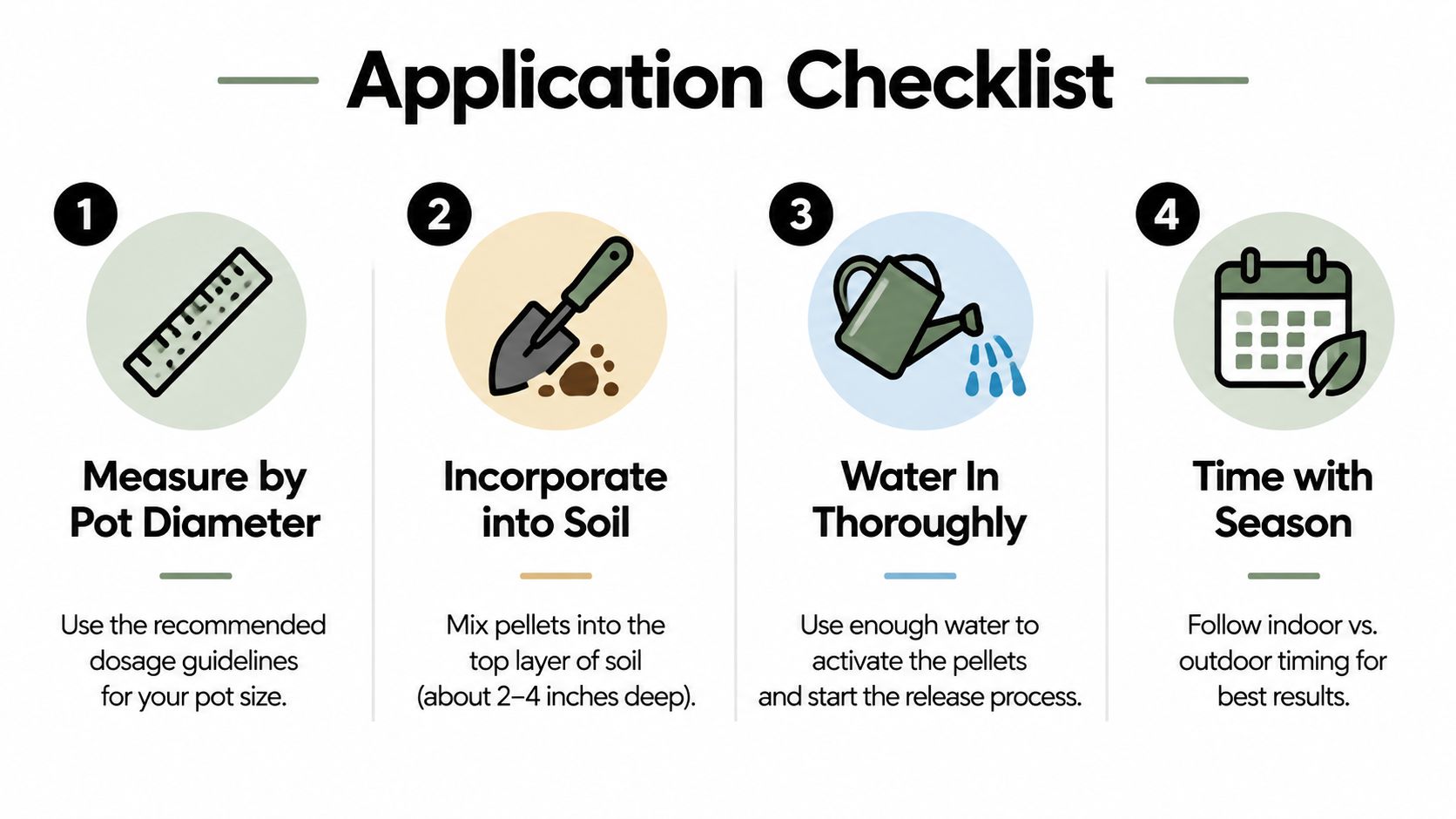
- Measure by pot diameter. Use the manufacturer's container guidance and scale cautiously for small bonsai and houseplant pots.
- Incorporate into soil when the label permits. Mix pellets through the upper root-zone soil rather than leaving one concentrated pile in one spot.
- Water in thoroughly. Moisture activates many release systems and helps distribute available nutrients through the medium.
- Time with the season. Apply during active growth, and be more conservative indoors where temperature and light may remain stable but growth can be slower.
Don't press pellets against the trunk, crown, or exposed roots. For a bonsai, distribute them around the outer root zone. For a fiddle leaf fig, apply evenly across the soil surface or incorporate gently during repotting without tearing established roots.
A fertilization schedule for gardens can help outdoor growers coordinate applications with seasonal growth, but indoor plants need observation rather than a calendar copied from a garden bed. Reapply according to the stated longevity window, not because the plant's leaves look slightly lighter after a few days.
Watch for an early nutrient flush. Browning leaf edges, a crust on the soil, sudden limpness despite adequate moisture, or unusually rapid soft growth can indicate that the plant is receiving more fertilizer than it can use. If salts accumulate, pause feeding, water thoroughly with clean water if the plant and drainage allow it, and let the medium dry according to the plant's normal care needs.
For a detailed walkthrough, use this guide to applying slow-release plant food. Slow growth doesn't automatically mean “add more.” Check light, roots, pests, watering, and temperature before increasing fertilizer.
Choosing Your Formula and Next Steps With Confidence
Choose the fertilizer by working from the growing situation outward:
- Identify the plant group. Start with bonsai, foliage houseplant, orchid, succulent, cactus, vegetable, or ornamental.
- Assess the container. Small pots and shallow bonsai containers need more careful dosing than large outdoor beds.
- Study the medium. Fast drainage, moisture retention, bark content, and soil texture all influence contact with the pellets.
- Check the release evidence. Look for a stated longevity window and information about coating or release behavior.
- Match N-P-K to the goal. Favor foliage-oriented feeding for leafy plants, restrained feeding for sensitive or slow-growing plants, and crop-specific guidance for edibles.
- Plan the placement. Surface and incorporated applications can release differently, so follow the label and avoid concentrated piles.
For a bonsai grower, a purpose-built 18-6-8 slow-release bonsai formula may be a logical shortlist option. For a foliage collection, a 16-5-11 houseplant profile may fit better. Orchid growers should look for a product labeled for orchids, such as a 13-11-11 slow-release pellet, rather than relying on a generic “all-purpose” claim.
Leaves & Soul offers these plant-specific pellet options alongside soils, liquid feeds, orchid products, bonsai accessories, and a 100% satisfaction guarantee. Store pellets sealed, dry, and away from temperature extremes, then record the application date on the container so you don't double-feed later.
Choose a formula for your actual pot, soil, plant, and growing temperature, not just the boldest label promise. Visit Leaves & Soul to compare purpose-built bonsai, houseplant, and orchid fertilizers and select the pellets that fit your plants' feeding routine.