


You water your ficus, watch some water escape into the tray, and assume the roots have had a good drink. Yet the pot still feels heavy later, the surface looks crusty, or the leaves droop despite damp soil. Before changing your watering routine again, check what's happening inside the pot.
A useful bonsai soil mix for ficus holds moisture inside its particles while leaving open spaces between them. Start with a repeatable recipe, test it in your own container, and adjust a single ingredient at a time. The right balance depends on your room, not just the name on the tree's label.
Starting Ratios for Ficus Bonsai Soil
A useful starting point is 50% akadama, 25% pumice, and 25% composted bark by volume. Treat it as a baseline to tune, not a fixed formula for every ficus or room. Measure each ingredient with the same scoop. Because bark and mineral particles have different densities, weighing them will not reproduce a volume-based ratio.
Ficus soil needs to balance moisture retention with open space around the roots. A shallow pot and a fast-drying room call for a different balance than a humid, low-light spot. Adjust one component at a time so you can tell what changed.
Adjust the balance, not everything at once
Start with the baseline, then make a small trial based on how quickly the pot dries.
Ficus bonsai soil ratios by growing condition
| Condition | Akadama | Pumice | Composted bark |
|---|---|---|---|
| Default starting mix | Half the batch | A quarter of the batch | A quarter of the batch |
| Dry heated room, fast drying | Increase slightly, replacing pumice | Reduce by the amount replaced | Keep the default share |
| Humid room, slow drying | Keep the default share | Increase slightly, replacing bark | Reduce by the amount replaced |
| Low light, slow drying | Increase slightly, replacing bark | Keep the default share | Reduce by the amount replaced |
In a dry heated room, replacing akadama with pumice can make the mix dry faster. If the pot is already drying too quickly, keep the akadama share steady and test a modest change rather than adding more drainage material.
In a humid room, reduce bark slightly and replace it with pumice. For a low-light shelf, reducing bark may help the mix dry more evenly, though improving the light may matter more than changing the soil.
Practical rule: Change one ingredient balance at a time, keep the rest consistent, and record how the trial dries before making another adjustment.
Mix a small batch and test it in a spare bonsai pot. Note how quickly water passes through and how long the mix stays damp, then adjust one component if the result does not suit your room.
Ingredients and Particle Sizes to Buy
Buy ingredients for the job they do, not because their names appear on a bonsai bag. Akadama manages moisture, pumice maintains an open structure, and composted bark adds moisture-holding organic material. Lava rock or crushed granite can provide a durable mineral alternative, though they won't hold water exactly like pumice.
Compare the texture of the ingredients before combining them.
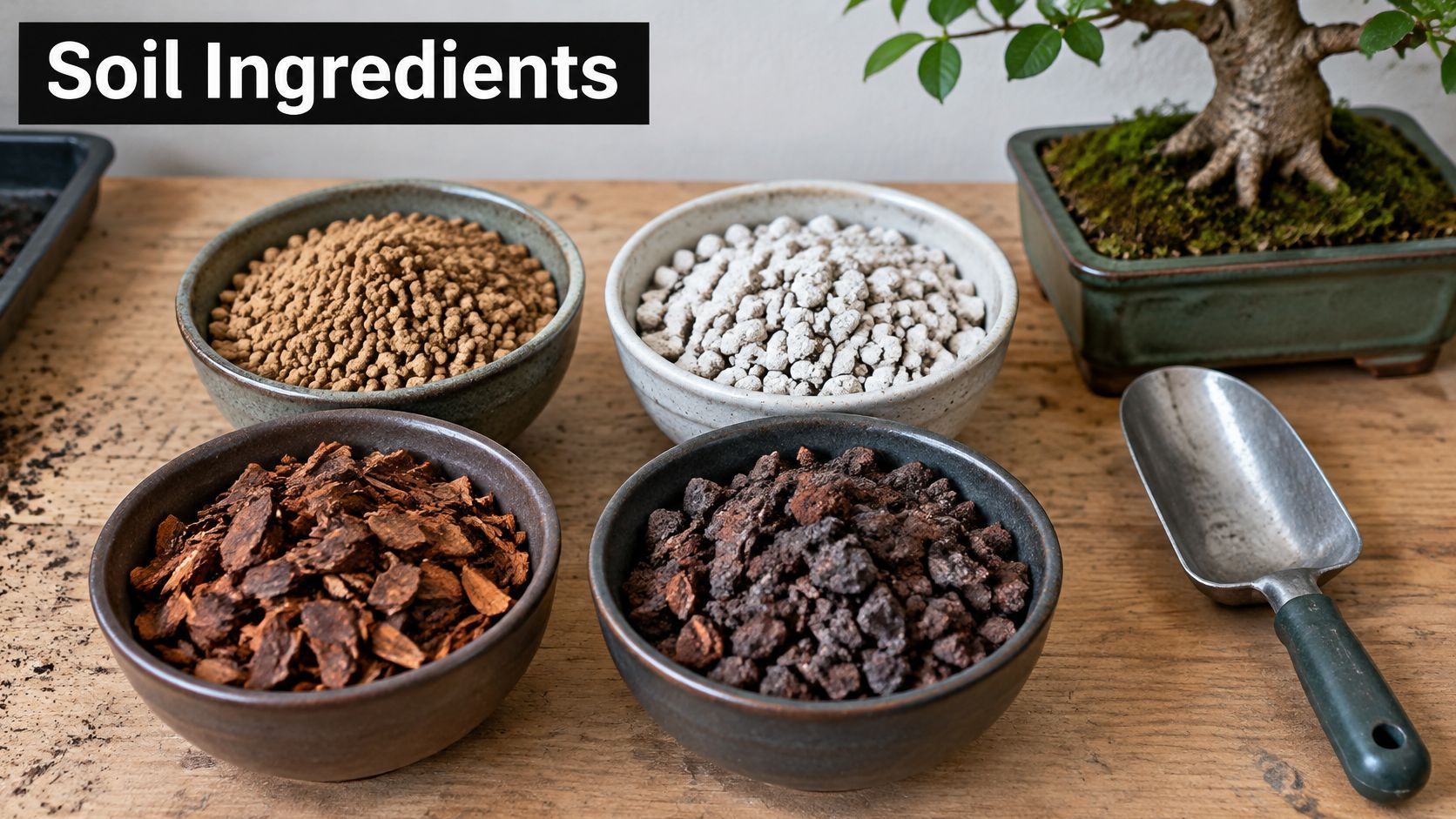
Ficus bonsai soil ingredients and what to buy
| Ingredient | Job in the mix | Particle size | What to check when buying |
|---|---|---|---|
| Akadama | Water retention and structure | Graded granules, without powder | Low dust, no mass of crumbled fines |
| Pumice | Drainage and air pockets | Match the akadama grade | Firm particles that don't readily crumble |
| Composted bark | Moisture hold and aeration | Screened chips comparable to the minerals | Well-composted pine bark, no fresh sap smell |
| Lava rock or crushed granite | Durable air pockets, pumice substitute | Similar grade to the other particles | No clay coating; rinse before use |
| Sieve or mesh screen | Removes dust before mixing | Openings that let dust fall through while retaining useful granules | Stable frame, easy cleaning |
Choose texture before price
Akadama that arrives mostly as powder won't give you the structure you paid for. Check the bottom of the bag as well as the visible surface, and avoid crushing damp granules while handling them.
Choose well-composted pine bark, not fresh landscaping nuggets or bark that has decomposed into sludge. Fresh bark can immobilize nitrogen as it decomposes; powdery organic material can fill the spaces between mineral particles. You want recognizable, stable chips.
Pumice is useful when you want structure without excessive weight. Crushed granite adds heft but has less internal water storage, while lava rock's texture and porosity differ between products. Treat substitutions as trials rather than assuming every mineral is interchangeable.
For more detail on grading, use this guide to how soil particle size affects drainage. Matching the ingredients matters more than buying an impressively coarse component and mixing it with fine compost.
Leaves & Soul offers professional-grade bonsai soil and bonsai accessories, including a ready-blended option for growers who don't want separate ingredient bags. Whether you buy a blend or mix your own, inspect its texture and test it; a bonsai label alone doesn't establish suitability.
How to Mix and Test Your Ficus Bonsai Soil
Prepare a sieve, mixing tub, scoop, watering can with a fine rose, drainage mesh, and an empty pot similar to the tree's intended container. A test in a deep nursery pot won't tell you exactly how the same blend behaves in a shallow tray.
Use this sequence to prepare the components without turning them into fines.

Prepare and combine the ingredients
- Screen the akadama and bark. Remove dust and oversized pieces with a sieve, working gently rather than grinding material against the mesh. Keep useful granules and discard the powder that would otherwise collect between them.
- Rinse pumice or lava rock until the runoff clears, then let it drain. Wash it separately so abrasive mineral particles don't break down softer akadama during preparation.
- Measure by volume with the same scoop. Level each scoop without compressing it, and put the measured ingredients into a clean tub. Record the recipe on a label so you can reproduce or adjust it later.
- Mix from the bottom of the tub until the color and texture look uniform. Separate pockets of bark or mineral material can produce uneven wetting within the same pot.
- Pre-moisten the blend until the particles are evenly damp. Allow resistant dry bark to take up moisture rather than assuming a quick spray has wetted everything.
- Cover the drainage holes with mesh and fill the test container loosely. Settle the material gently, but don't press it into a solid mass or create a separate gravel layer underneath.
Check flow and lasting structure
- Water evenly and watch the outlet. The Inside Grown ficus soil guide suggests particles roughly 2–6 mm, drainage beginning within seconds, and a slightly acidic-to-neutral target of approximately pH 6.0–6.5. Observe both surface absorption and outflow, because fast water escaping around the edges can disguise a dry center.
- Let the test pot drain, then follow its weight and texture through repeated watering. After several weeks, check whether recognizable particles and gaps remain or whether the blend has settled into a dense layer.
Persistent pooling calls for checking blocked holes, excessive dust, and poor grading before adding more stone. If the pot remains unusually heavy, compare a revised batch with less fine material and a greater durable mineral fraction. Don't stir new ingredients into an established root ball and expect an even correction.
Fast outflow is useful only when water has also reached the roots throughout the pot.
Poorly composted bark and dusty ingredients can undermine an otherwise sensible recipe. A shallow container also leaves little margin for uneven wetting, especially when low light reduces the tree's water use.
Test irrigation water and substrate separately before adding lime or other pH amendments. Use a substrate-testing method intended for potting media; a casual probe reading isn't a reason to amend blindly.
For a visual companion to the hands-on work, watch the demonstration below.
Repotting Timing and Watering Your Ficus
Schedule routine repotting for a reliably warm period when the ficus is growing actively. Avoid combining root disturbance with a cold windowsill, poor light, or an already stressed tree. Structural failure or rotting roots may require intervention sooner, but that's rescue work rather than routine maintenance.
Prepare the pot, anchoring wire, mesh, and damp substrate before lifting the tree. Gently loosen the outer roots with a root hook or chopstick, remove degraded material, and use clean shears for damaged or excessively long roots. Don't strip every trace of old soil from a weak ficus to achieve a completely uniform mix.
Settle the roots without crushing the mix
Secure the tree so it doesn't wobble and tear emerging roots. Work fresh particles between the roots with a chopstick, using small movements rather than force. Close large voids without crushing the substrate or packing the surface hard.
The practical details in this guide to repotting bonsai without damaging roots can help you plan the handling and anchoring before you begin. A stable tree and intact fine roots matter more than finishing quickly.
Water slowly across the whole surface until the substrate is thoroughly wetted and the runoff clears. Empty the collection tray afterward; don't leave the drainage holes standing in water.
- Learn the wet weight. Lift the pot after excess water has drained, supporting the container rather than pulling on the trunk.
- Compare before watering. Check the surface and the pot's weight together. A dry-looking top doesn't prove the center is ready.
- Water the whole root zone. When irrigation is needed, wet thoroughly rather than giving frequent small splashes that leave dry pockets.
Feed according to recovery
Don't use fertilizer to compensate for root disturbance. Resume gentle feeding when the tree shows active recovery and the fertilizer's directions allow it; a universal waiting period ignores how much root work was done.
A slow-release bonsai fertilizer can simplify maintenance, but it isn't automatically gentler than every liquid feed. Dose matters. Keep checking moisture during recovery, because a recently pruned root system may use less water even in the same room.
Common Ficus Soil Problems and How to Fix Them
A pot that stays wet long after watering is a common reason growers question their mix. Before blaming the ingredients, check that the drainage holes are open, the tray is empty, and the tree receives adequate light. Changing substrate won't correct a blocked outlet or a dark growing position.
Use symptoms together rather than treating a yellow leaf as a diagnosis. Root firmness, odor, moisture distribution, and water movement give you a more useful picture.
Ficus soil symptoms, causes and fixes
| Symptom | Likely cause | Fix |
|---|---|---|
| Mix stays wet for several days | Too much fine material or organic matter, or low light | Reduce watering frequency; use less bark and more pumice or lava in the replacement mix |
| Water sits on top and runs down edges | Compaction or a dense settled layer | Check the outlet, then repot in fresh, graded material without packing it |
| Yellow leaves, soggy soil, soft dark roots | Root rot associated with saturation | Remove rotten roots, repot in fresh mix, and match watering to reduced uptake |
| Sour smell from the soil | Anaerobic breakdown of organic matter | Inspect promptly and replace degraded substrate with properly composted material |
| Wilting while soil feels damp | Impaired roots or a clogged root zone | Check compaction and root condition before adding water |
| Dry, pulled-away mix that repels water | Substrate has become difficult to rewet | Briefly immerse the pot until bubbling subsides, then drain and check the center |
Separate urgent rescue from gradual tuning
Soft, deteriorating roots require prompt attention. Remove tissue that is clearly rotten with clean scissors, preserve firm roots, and avoid heavy pruning merely because some roots are naturally dark. This guide to root rot signs and fixes helps distinguish the warning signs from ordinary discoloration.
Wilting over damp soil isn't an instruction to water again. Check whether the center is saturated while the edges are dry, and whether damaged roots can still support the canopy.
Diagnosis first: A symptom tells you where to inspect, not which ingredient to add.
For a healthy tree with a merely inconvenient drying pattern, change a single variable and observe through repeated wetting and drying cycles. Keep light, container, and watering technique consistent during the trial.
Don't repeatedly repot a declining ficus to chase a perfect formula. If deterioration continues after corrective work, consult an experienced bonsai grower or plant-health specialist with photographs of the foliage, roots, container, and substrate.
Confirm Your Mix Before Your Next Repot
A bright window, a humid room, and a heated living space place different demands on the same substrate. Judge the mix by whether you can maintain even moisture and healthy growth without constantly rescuing the tree from saturation or drought.
Keep a short growing-season log. Record watering, pot weight, changes in light or heating, and the tree's response. Photos of the surface can help reveal settling, but they won't replace checking moisture below it.
Turn observations into a repotting plan
- Persistent wetness. Note whether the root ball dries progressively or remains uniformly heavy. If the ingredients are responsible, trial a more open mineral balance before the next repot.
- Water bypassing dry pockets. Check for water-repellent bark, channels, or poor contact around roots. Don't assume bypassing proves the entire blend is too coarse.
- Wilting despite damp soil. Inspect for compaction and impaired roots before changing the watering frequency.
The University of Illinois Extension discussion of ficus care supports a moist but well-drained approach rather than a universal recipe. Your observations should determine which part of that balance needs attention.
Write a proposed repotting date on the tree's care label for your next reliably warm growing period. Beside it, record the adjustment you intend to test and the symptom it should address. Confirm the revised batch in a comparable container before disturbing the roots.
Choose a purpose-built bonsai blend and suitable accessories if you'd rather skip sourcing individual ingredients. Visit Leaves & Soul to explore bonsai soils, fertilizers, and containers, then check your chosen mix against your ficus's watering needs at home.