


Bonsai soil can drain perfectly and still starve a tree. Water pours out of the drainage holes, the surface looks dry by mid-morning, and the tree sulks with weak growth and pale leaves. That result baffles growers who followed the beginner guides to the letter.
The confusion starts with treating drainage as the goal. In a shallow pot, drainage is only half the job. Every root needs water and oxygen at the same time, and the particles you plant in decide whether both are on offer.
What follows is the reasoning behind the bonsai tree soil requirements that matter: the balance of solids, water and air, the particle grades that produce it, a procedure for testing your own mix, and the signals that tell you a mix has failed. The rules bend to your tree, your pot and your climate, because the single universal recipe everyone quotes doesn't hold up.
Why Bonsai Soil Is Not Ordinary Garden Soil
Bonsai soil has one job garden soil cannot do: supply water and oxygen to the same root at the same moment, inside a container a few centimetres deep. Field soil is built for depth. Roots that run short of air near the surface of a garden bed can grow deeper, and in a bonsai pot there is nowhere deeper to go.
Lift a tree out in spring and the difference becomes visible in seconds.
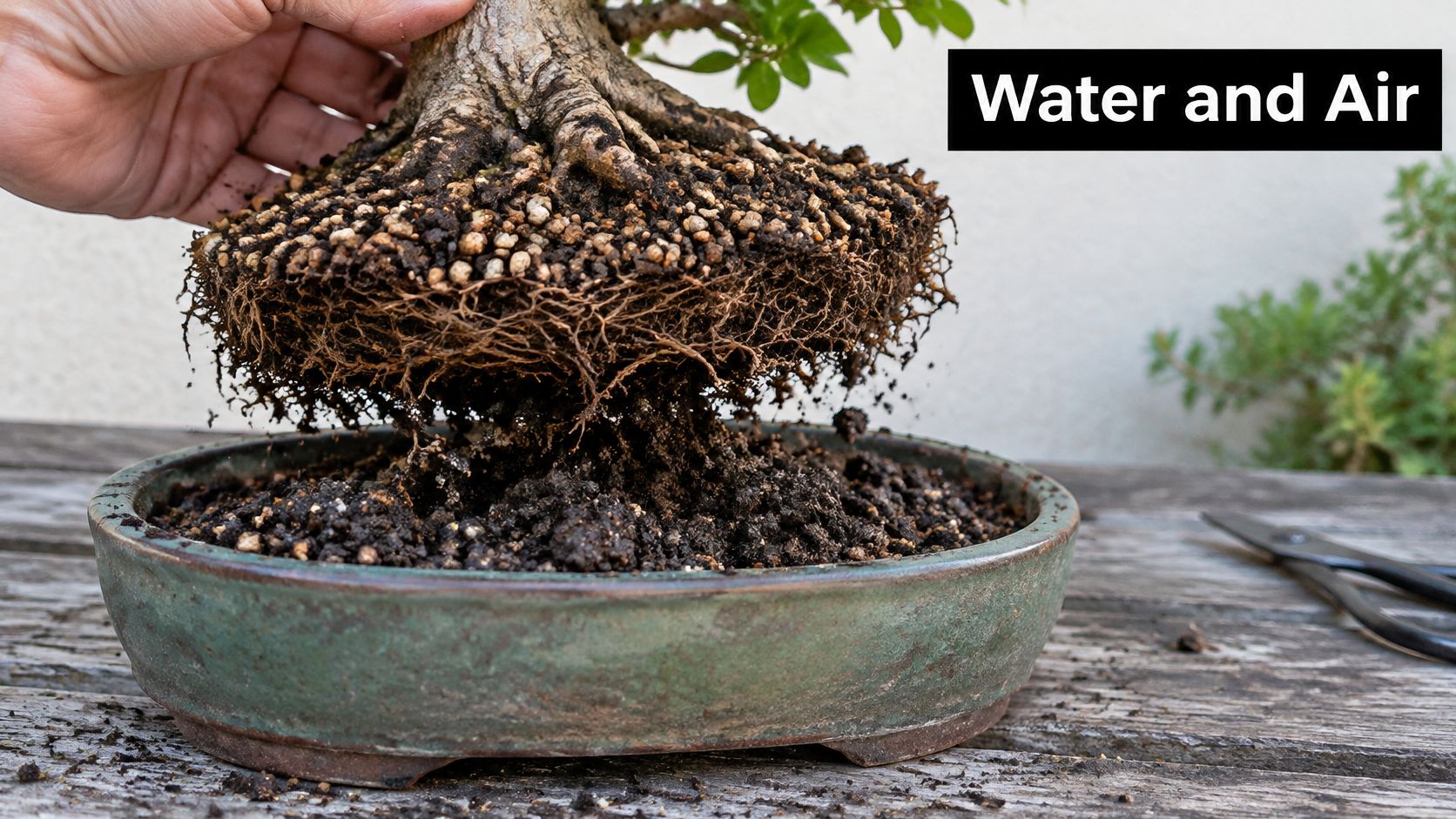
The reference balance for a well-structured growing medium is roughly 50% solid particles, 25% water-filled pore space and 25% air-filled pore space by volume, as set out in this analysis of bonsai growing media. Half the pot is structure. The other half is shared, and how it gets shared decides whether roots breathe.
Garden soil, particularly soil holding a substantial share of clay or silt, fails that test. Fine particles pack together, close the air spaces between them and slow drainage. A pot filled with it stays wet long after watering ends, so the roots run out of oxygen before they run out of moisture.
What Replaces Field Soil
Bonsai mixes lean on relatively coarse, similarly sized mineral particles instead of a large proportion of fine material. Pumice and lava rock give physical stability while keeping pore space open, and fired clay holds some water and nutrients of its own. The Huntington Botanical Gardens runs its collection on a blend of crushed and cleaned lava, pumice and naturally compressed clay aggregate, balanced for aeration, water availability and nutrient storage while encouraging root development.
Screened, single-grade material is the foundation of all of it, because mismatched particle sizes cut total porosity, water-holding capacity and air-filled porosity at the same time.
The test isn't speed. Water leaving the drainage hole tells you the mix drains. It doesn't tell you whether enough water stayed behind for the roots.
Regular potting soil behaves very differently in a shallow container, and can bonsai trees grow in regular potting soil covers exactly what changes in the root zone when you use it.
Target Particle Sizes for Each Tree and Pot
Particle size sets pore size, and pore size sets how much water stays and how quickly air moves. Pick the grade from the tree and the pot before you pick a single ingredient.
| Tree or Situation | Particle Size | What It Does |
|---|---|---|
| Standard bonsai in typical pots | 3-6 mm | Balances oxygen diffusion with moisture retention |
| Shohin or mame in shallow pots | 2-4 mm | Suits containers that dry rapidly |
| Large trees in deeper pots | 4-8 mm | Keeps aeration around a larger root mass |
| Training or developing trees | Coarse, fast-draining grade | Supports drainage while growth is shaped |
| Conifers such as pines | Larger particles | Gives greater drainage than water-retentive species |
| Hot, windy or heated indoor sites | Finer end of the chosen range | Holds more water where evaporation is fast |
Those ranges come from guidance on matching bonsai soil particle size to the tree, which treats the grade as a response to root-ball size, pot geometry, species water demand and irrigation frequency rather than a matter of taste.
Why the Middle Range Suits Most Trees
Standard bonsai in ordinary pots perform well at 3-6 mm, because that band balances oxygen diffusion against moisture retention. The pores are big enough to drain and exchange gas, and small enough to hold water through the interval between waterings.
Smaller grains form smaller pores, retain more water and dry more slowly, though they can reduce oxygen availability. Coarse grains form larger pores, drain fast and push you toward more frequent irrigation. Every row in the table is that one trade-off, moved in a different direction.
Where the Range Shifts
Shohin and mame trees sit in shallow containers that dry fast, so 2-4 mm keeps more water within reach of a small root ball. Large trees in deeper pots go the other way, at 4-8 mm, to keep air moving around a bigger mass of roots.
Conifers such as pines take a larger particle for greater drainage than moisture-loving species manage. Training trees get a coarse, fast-draining grade while their growth is being shaped, and the drainage holes stay covered with mesh so excess water exits while the medium stays put.
A hot, windy site or a heated room pulls the choice toward the finer end of whichever range you're using, because evaporation there is faster than the mix was designed for. A shaded, humid bench pushes you coarser.
Confirm the Grade With Two Observations
Watch the pot after watering. Note how quickly water leaves the drainage holes and how long the root zone takes to come close to dry. Those two observations tell you more about the correct grade for your bench than any ratio copied from a forum.
Sieve to one grade. Mixed sizes behave like a fine mix, because the small particles settle into the gaps the large ones opened.
Air, Water and Pore Space Targets
Three measurements decide whether a substrate works: air-filled porosity, water-holding capacity and particle-size distribution. None of them appears on the bag, and the soil type printed there doesn't settle the question either.
The targets below are what to aim for once water has drained through the pot.
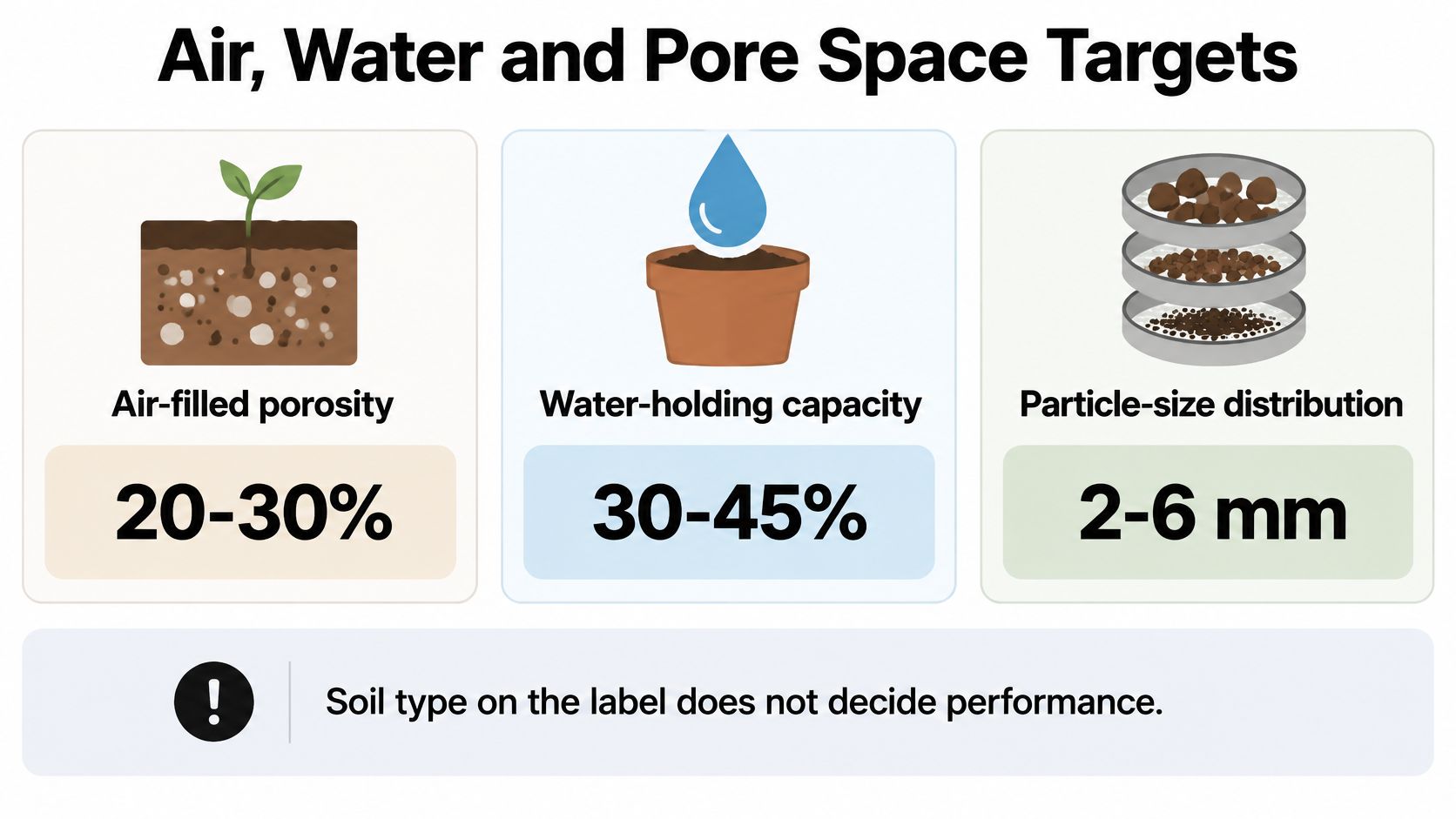
| Measure | Practical benchmark after watering and drainage |
|---|---|
| Air space | 10-30% |
| Total porosity | 50-85% |
| Available water | 25-35% |
Those figures come from a presentation on bonsai substrate performance that measures porosity instead of trusting the presence of soil in the conventional garden sense.
Why Air-Filled Porosity Decides Root Health
Air-filled porosity is the share of the mix occupied by air once the water has gone. Below about 10%, the medium is waterlogged and root oxygen is restricted, which is the condition most overwatered bonsai are sitting in when their leaves yellow.
Larger, uniformly graded particles create larger connected pores, and connected pores are what let water move down and gas move in. Fines fill those same pores. Water retention goes up, but so does the risk of a root zone that stays saturated for days.
Where the Benchmarks Disagree
Not every source draws the line in the same place. Different syntheses set the failure threshold higher than 10%, and the right level shifts with species and with the container system you're growing in. Treat the benchmarks as a band to test against, not a certificate to chase.
One practical starting specification covers a lot of ground: a predominantly mineral, porous mix, screened to a single consistent grade, moved finer for small containers or high evaporation and coarser for large trees or frequent rainfall.
Seeing a mix screened, watered and checked makes the pore argument land.
Matching Soil to Species, Climate and Watering
The most repeated line in bonsai writing is a recipe: equal parts akadama, pumice and lava. It's a reasonable starting point and a poor ending point, because species carry materially different moisture preferences and the site you garden in changes the balance, as an introduction to bonsai soils sets out.
The better question isn't "what's the best bonsai soil". It's "what substrate and water management system fits this tree on this bench".
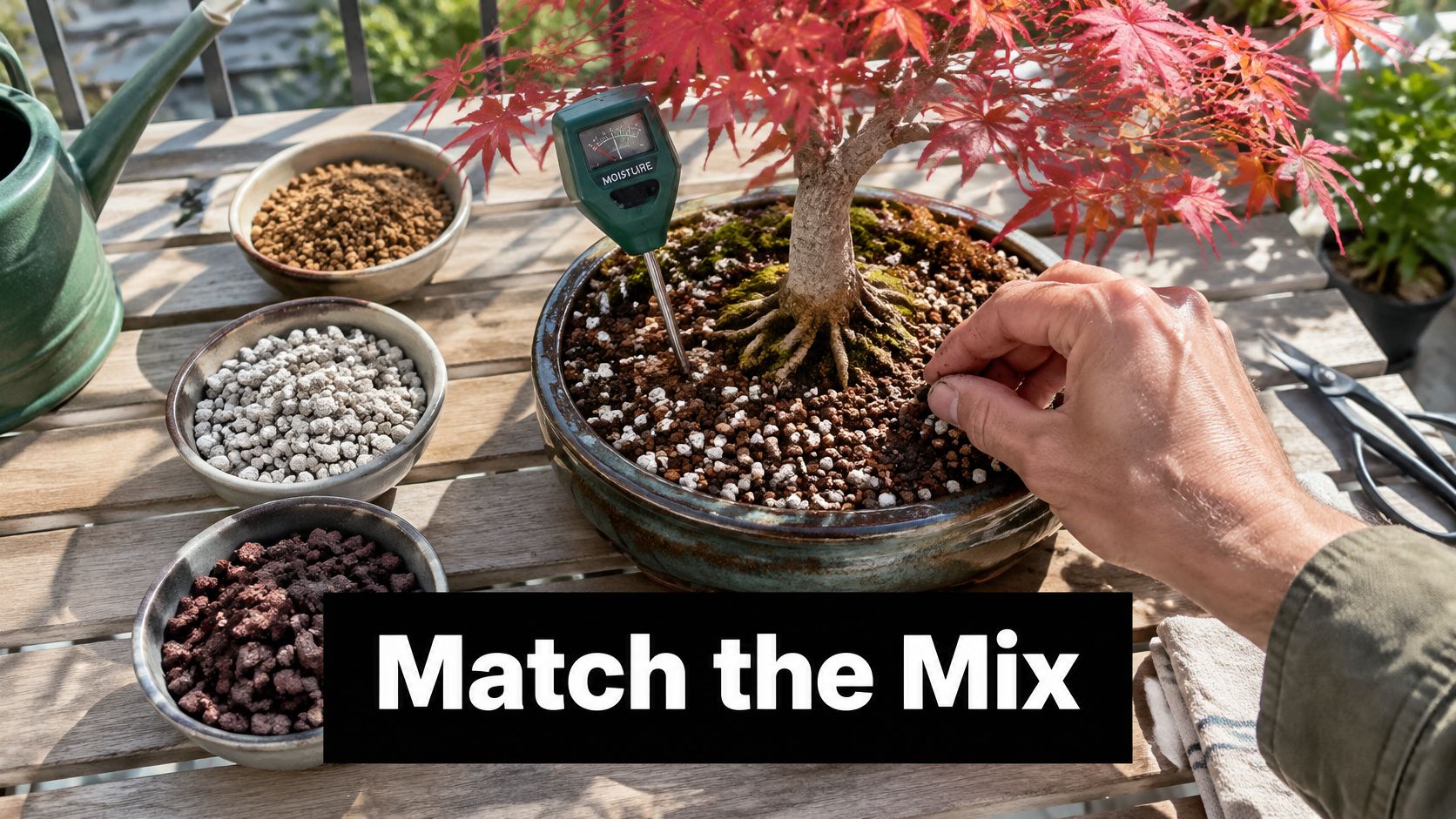
Three Decision Rules
- Drying too slowly: raise the particle size or the mineral share, so more air stays in the root zone between waterings.
- Drying too fast: keep more water-retentive material in the blend and check the tree more often.
- Watering too often: change the interval before you change the mix. Adding grit to a pot that gets soaked daily treats a habit as though it were a soil problem.
That third rule is the one most growers skip, and how often should you water a bonsai tree is the place to start when the root zone never seems to dry.
Three Trees, Three Answers
A pine in a deep pot on an outdoor bench is the easy case. It usually suits a larger, free-draining grain, because rainfall and a big root mass both push toward better aeration.
A small shohin in a heated, low-humidity room is the opposite. Its container dries within hours, so it wants a finer, more water-retentive mix and far closer checking than the pine gets.
A tree standing in full sun on a hot, windy site needs more water-retentive material again, even if it's the same species in the same pot size as a sheltered one. Species preference and site condition pull in different directions, and the site usually wins.
Japanese growers solved part of this with materials chosen per species. Kanuma, a lighter aggregate, is commonly associated with acid-loving azaleas, while akadama and the lava and pumice blends do the general work, as the Huntington Botanical Gardens collection notes describe.
Fast draining isn't automatically better. A mix that sheds water in seconds and holds little usable moisture produces drought stress, most often indoors and in small pots.
Rainfall, irrigation water, pot size and your own watering rhythm all shift the right answer, which is why the same bag performs differently on two benches.
Prepare, Test and Confirm Your Mix
Seven steps take a mix from bag to confirmed working substrate. The reason follows each one, because a step you don't understand is a step you'll skip.
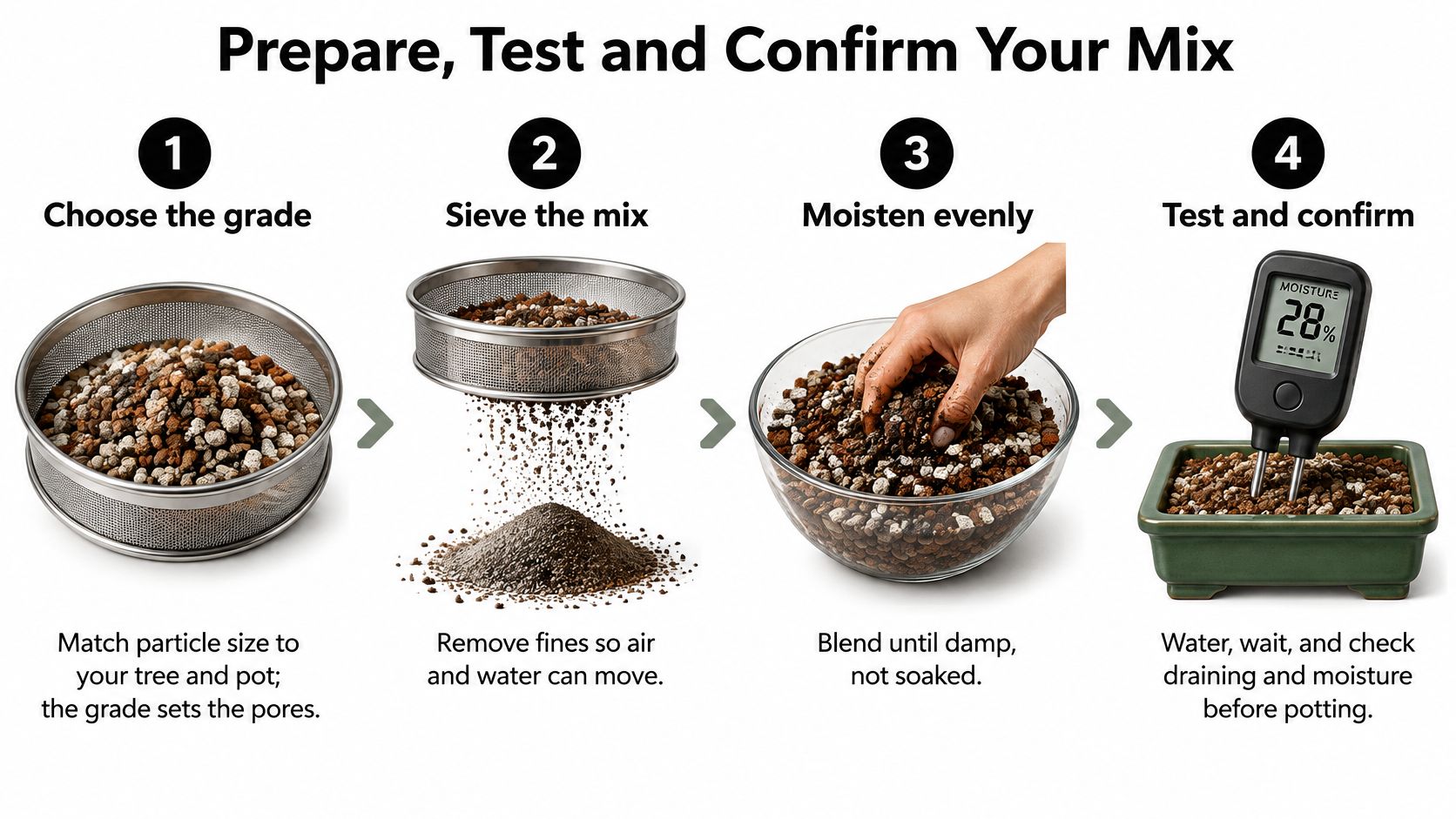
- Choose the grade for your tree and pot. The grade sets the pores you'll live with for the next two or three years, so it's the one decision worth making slowly.
- Sieve the mix through a 1-1.5 mm screen. Bonsai-en reported using a screen in that range in 2025 to pull fine, dusty particles out of its mixes, as the nursery explains, and those fines are exactly what collapse the macropores you selected for.
- Blend the mineral components and keep one grade. Mismatched sizes lower total porosity, so sift every component through the same screen before mixing.
- Pot the tree and water until it runs clear. Mesh over the drainage holes keeps the medium in place while excess water leaves, which is the whole point of the mesh.
- Time the drainage. Note how quickly water exits. Water standing on the surface for more than a moment is a failure, not a slow start.
- Record the drying interval. The time until the root zone is nearly dry is the number that proves the mix holds usable water for that particular tree.
- Adjust after the next watering. Slow drainage or a surface that stays wet means sieve more thoroughly and coarsen the grade. A small pot that dries out well before the next planned watering means go finer or more retentive.
If you're handling the root ball while the tree is out of its pot, repotting bonsai without damaging roots covers how much root you can safely remove and how to settle the tree back in.
If blending from separate components isn't practical, our Premium Bonsai Soil All Purpose Blend arrives pre-mixed in 2.2 and 8.2 dry quart sizes for $17.94 USD, ready to sieve to the grade your tree needs.
The mix passes when it drains freely, holds usable water through the interval you expect between waterings, and shows none of the decline signals that follow.
Warning Signs That Your Soil Has Failed
The first clue is rarely a sick leaf. It's a change in your watering rhythm. A pot that needed water every morning in June suddenly holds moisture into the second day, and by July you're watering half as often. Something in the substrate changed, not the weather.
Fine particles and broken-down granules fill the gaps between larger particles over time, reducing drainage and airflow even when the original mix was correct. That's why a mix that worked for two seasons can fail in the third without a single thing being done wrong.
Screening dust out isn't cosmetic housekeeping. It protects the pore structure you paid for.
A physical problem needs a physical fix. No fertilizer, root tonic or extra handful of grit restores pore space that has already collapsed.
The Numbers Behind a Failing Mix
Air-filled porosity is the proportion of substrate volume occupied by air after drainage. One recent synthesis reports that plants struggle when air-filled porosity falls below roughly 15% and perform better around 20-25%, with the precise target depending on species and container system, as this review of bonsai substrate and tree health notes.
Granular materials such as akadama also weather at different rates depending on freeze-thaw cycles, watering frequency and handling. Two pots of the same mix can be at different stages a year apart.
Symptom, Cause, Fix
| Symptom | Likely Soil Cause | Fix |
|---|---|---|
| Slow drainage or water standing on the surface | Fines filling the gaps between larger particles | Repot in freshly screened mix |
| Surface stays wet and algae appears | Lost air-filled pore space | Repot and sieve out dust before replanting |
| Roots dry out less between waterings | Fines raising retention, or degraded structure | Check the drying interval and adjust grade and watering frequency |
| Sudden need to water less often | Pore structure changing over time | Inspect the mix and repot if structure has collapsed |
| Salt crust or white residue on the surface | Salt accumulation | Flush thoroughly; repot if residue returns |
| Fertilizer added but pores still poor | Collapsed pore space is a physical problem | Repot; fertilizer cannot restore pore space |
Distinguish the physical problem from the chemical ones. Salt buildup responds to flushing, and a hungry tree responds to feeding. Collapsed pore space responds to nothing except fresh, graded mix and a root ball that gets room to breathe again.
When a pot shows these signs, screen the old mix or replace it and repot into a fresh, consistent grade. Adding more drainage material to a mix that's already full of fines just gives you coarse grains floating in dust.
A mix you trust removes one variable while you learn to read the rest. Leaves & Soul carries bonsai soils, slow-release fertilizer pellets, glazed ceramic pots and complete sets that bundle soil, fertilizer, pot and wire kit, so a first repot doesn't stall on a missing piece. Visit Leaves & Soul to see the bonsai range and start your next mix from a known baseline.