


Yes, cactus soil works for most succulents if it drains within about a minute and dries between waterings. If a mix is peat-heavy, amend it to 3 parts grit to 1 part potting soil to 1 part coir, peat or bark before you use it.
Popular advice says to trust any bag labeled cactus. Don't. Two bags with the same label can behave very differently in a pot, and that difference, not the label, decides whether roots stay healthy.
Cactus Soil Works for Most Succulents When It Drains Fast
Yes, you can use cactus soil for succulents in most cases, because both groups need a porous, fast-draining root zone rather than dense garden soil. The University of Minnesota Extension guide to cacti and succulents recommends one part potting soil and one part coarse sand for a basic indoor mix, producing a loose medium that should fall apart when squeezed rather than remain clumped.
That squeeze test matters. If moist mix holds a tight ball, it's holding too much water and too little air. If it crumbles, surplus water can escape and roots can breathe.
The Situation Decides the Answer
| Situation | Use as-is? | What to do |
|---|---|---|
| Coarse, gritty cactus mix that drains in under one minute | Yes | Water thoroughly, check drainage and repot as needed |
| Cactus mix that is mostly peat and holds water | No | Mix 3 parts grit or sand with 1 part potting soil and 1 part coir, peat or bark |
| Pre-mixed succulent blend | Yes | Confirm the pot has an open drainage hole |
| Standard garden or topsoil | No | Do not use; it is too dense and retains water |
| Cactus mix in a pot without drainage holes | No | Add a drainage hole or switch to a pot that has one |
Treat this table as a starting point, not a guarantee. Species, pot size, indoor humidity and your watering habits all change how long a mix stays wet. A tropical, thin-leaved succulent may prefer a little more moisture than a desert cactus, while a compact mix in a large pot can stay damp for days.
Non-negotiable: use a pot with an unobstructed drainage hole. Trapped water around roots can lead to rot and decay very quickly, no matter how good the soil is.
Why Drainage and Aeration Decide the Mix
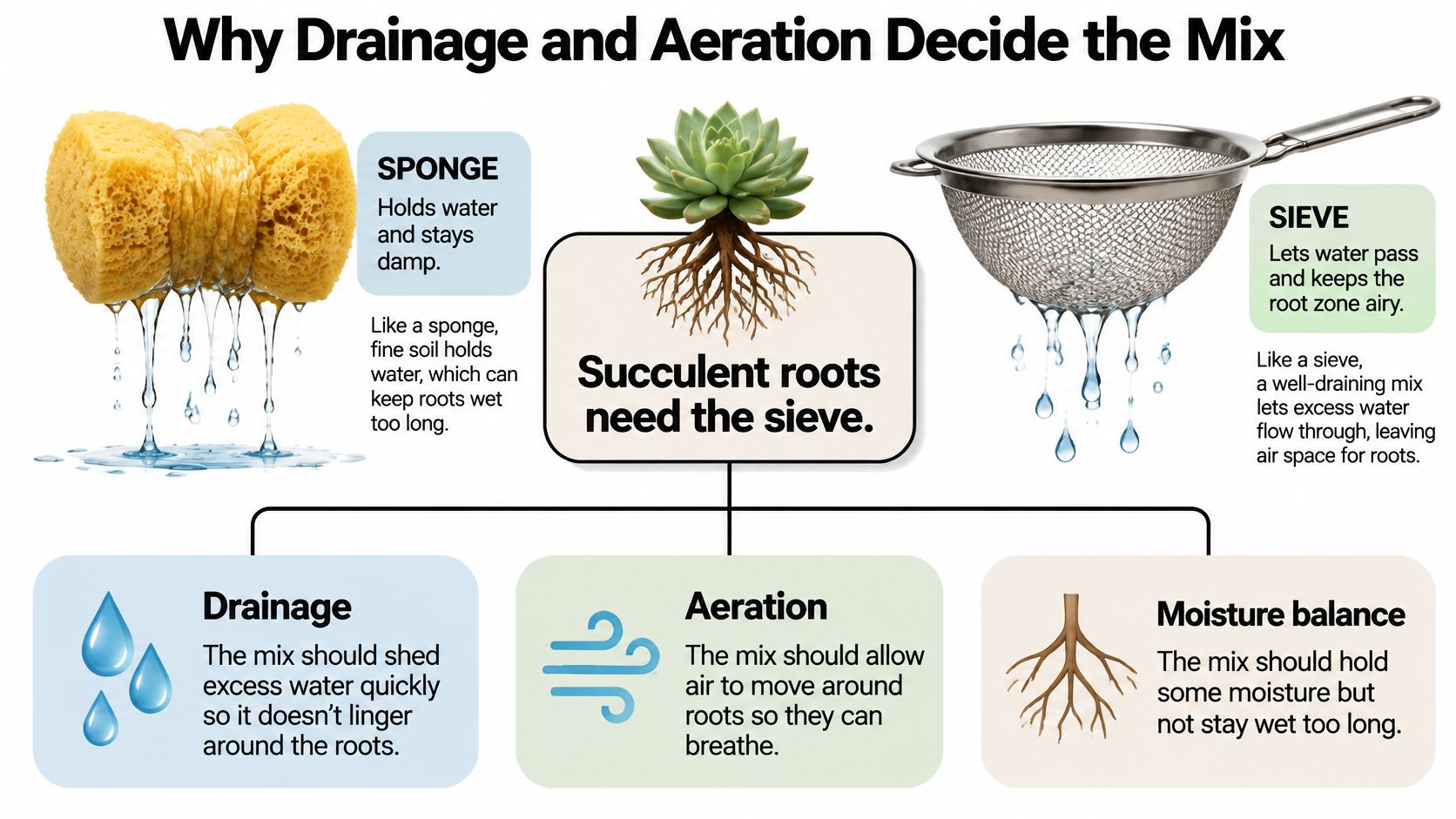
Think of two kitchen tools. A wrung-out sponge holds water in its pores and stays damp long after you squeeze it. A sieve lets water pass straight through and leaves air in its place. Succulent roots need the sieve, with just a brief drink as water passes.
The illustration below maps that comparison to the three properties that decide whether a mix works.
Particles Create the Pores
Particle size drives everything else. Large particles leave large pore spaces, so water and air move freely. Fine particles pack tightly, and high organic matter, such as peat, acts like the sponge and increases water retention.
That's why adding fine sand often backfires. Instead of opening the mix, tiny grains fill the gaps between larger pieces and can compact it. Coarse mineral material, such as perlite, pumice or grit, does the opposite. It holds pore spaces open so air returns to the root zone after watering. If you want the mechanics in more detail, see how soil particle size affects drainage.
| Property | What succulents need | What goes wrong |
|---|---|---|
| Drainage | Water leaves the pot within about a minute | Water pools and roots rot |
| Aeration | Air pockets between particles | A compacted mix starves roots of oxygen |
| Moisture retention | Holds little water and dries between waterings | Peat-heavy mixes stay wet for days |
| Particle size | Coarse grit and perlite | Fine sand and fine particles clog pore space |
Fast Is Not the Same as Balanced
A mix can drain quickly at the surface and still stay soggy deeper down, especially if fine material settles at the bottom of the pot. You're aiming for balance, not maximum speed. Water should exit freely, air should follow it in, and the root zone should dry before you water again.
That balance is the true test of whether you can use cactus soil for succulents. The word cactus on the packaging tells you the intended market. The particles inside tell you what your roots will experience.
How to Test Cactus Soil and Amend It
Test any bag before you repot a plant you care about. The steps below follow the order shown here.
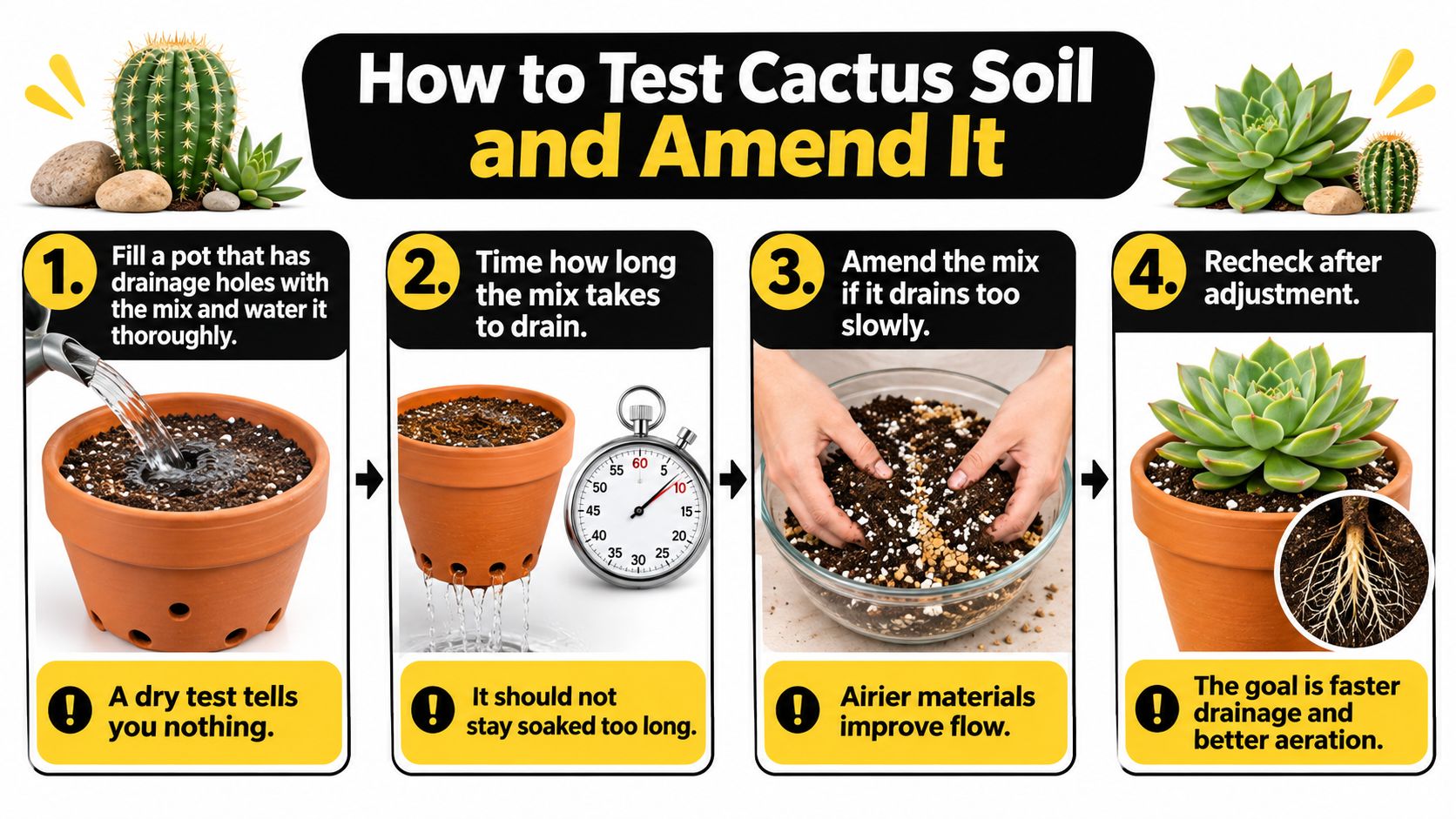
- Fill and soak: Fill a pot that has drainage holes with the mix and water it thoroughly. A dry test tells you nothing, because dry peat can shed water and look fast-draining when it isn't.
- Time the drainage: Watch the hole at the bottom. Water should start flowing freely and the bulk of it should pass through quickly.
- Squeeze a handful: Take moist mix and squeeze it. It should crumble apart when you open your hand, not stay in a clump.
- Watch it dry: Leave the pot in its usual spot and check daily. Note whether it dries evenly or stays wet at depth, since succulents need the root zone to dry between waterings.
- Amend if it's slow or heavy: The New York Botanical Garden guidance on cactus soil says suitable cactus soil should drain in less than one minute after watering, and gives a recipe of three parts grit or sand to one part potting soil plus one part coir, peat, or shredded bark. That recipe contains five stated parts overall, meaning the mineral component represents about 60% of the listed volume.
- Skip the gravel layer: Don't put gravel at the bottom of the pot. It doesn't improve drainage, and water can collect in the finer mix sitting above it.
The same guidance notes that many commercial cactus mixes rely too heavily on peat, which holds moisture longer than you want. If your bag feels dark, fine and springy, that's probably what you're holding. Mix in coarse grit or perlite rather than using it unchanged, and check soil amendments for succulents for material options.
This short video shows the drainage test in practice, so you can compare your pot against a working example.
A good result is easy to recognize. The mix drains freely, dries evenly between waterings and stays loose after several rounds of watering instead of slumping into a dense block.
Thin-leaved succulents often want slightly more moisture than desert cacti. For them, keep the structure coarse but lean a little more on coir or bark in the organic portion.
Matching Cactus Soil to Common Succulent Types
Start with echeveria and jade plants, since they're the most common houseplants in this group. Both do well in a coarse cactus mix used as-is, provided it passed your drainage test. Let it dry fully between waterings and you'll avoid most problems.
Aloe and haworthia are a step more forgiving. They tolerate a standard cactus mix or succulent blend, but their thick roots dislike a dense, soggy center. If the mix feels heavy in your hand, add grit before potting.
Move toward the desert end and the mix should get leaner. Golden barrel and columnar cacti want the sharpest drainage you can give them and sparing water, mostly during active growth. Extra grit is rarely wasted here.
At the other end, Christmas cactus comes from forest habitats, not open desert. It prefers a chunkier mix with bark or coir and somewhat more even moisture. String-of-pearls and other thin-leaved types sit nearby, needing a little more moisture than desert species without sitting wet.
| Succulent group | Default mix | Amend? | Watering note |
|---|---|---|---|
| Echeveria and jade plants | Coarse cactus mix | Only if the mix is peat-heavy | Let dry fully between waterings |
| Aloe and haworthia | Cactus mix or succulent blend | Add grit if the mix feels dense | Water when the top layer is dry |
| Golden barrel and columnar cacti | Lean cactus mix with grit | Add grit for sharper drainage | Water sparingly, mostly in the growing season |
| Christmas cactus and other tropical succulents | Chunky mix with bark or coir | Yes, add bark or coir | Keep slightly more evenly moist |
| String-of-pearls and thin-leaved succulents | Cactus mix with coir | A little coir | Need more moisture than desert types |
Let the Native Habitat Guide You
A plant's origin predicts its soil better than its leaf shape does. Desert species evolved in lean, mineral ground that dries fast after rare rain. Forest-edge species evolved among leaf litter and bark, where organic matter is plentiful but water still drains away.
Match the mix to the plant first and the bag second. Then watch the first month closely. If the mix is still damp when you'd normally water, or leaves shrivel soon after watering, adjust the ratio rather than changing your whole routine at once.
Diagnosing Problems After Switching to Cactus Soil
Faster drainage alone doesn't make a mix safe. That's the assumption worth dropping. The Illinois Extension guidance on container soil notes that container media must drain while still retaining enough moisture for plant growth, and that succulents generally prefer coarser media that don't remain wet for long periods.
So diagnose by symptom, not by product. One symptom can have several causes, and buying a different bag fixes only some of them.
| Symptom | Likely cause | Fix |
|---|---|---|
| Soil stays wet for several days | Fine particles, oversized pot or no drainage | Repot into a smaller pot with holes and add grit |
| Soft or blackened stem base | Root rot from trapped water | Cut away rotten roots, repot in dry mix and wait before watering |
| Leaves shrivel between waterings | Mix dries too fast or roots were damaged by earlier rot | Check the roots, add coir or bark and water deeply when dry |
| Water pools on the surface | Compacted or fine-textured mix | Loosen with perlite or coarse grit and repot |
| Water collects in a decorative pot | Cachepot with no drainage | Lift the plant out after watering and empty the saucer |
Check three things together before you change soil. First, confirm the drainage hole is open and not blocked by a stone or compacted mix. Second, check pot size, because a small root ball in a large pot leaves a large volume of mix holding water with no roots to use it. Third, inspect the roots. Healthy roots are pale and firm, while rotten roots are dark, soft and often smell sour.
Standing water in a decorative cachepot deserves special attention, since it can cause disease and plant death even when the inner pot drains well. If a plant is already declining, saving an overwatered succulent without repotting covers the less disruptive recovery steps.
Once the mix and pot are right, watering technique carries the rest. Many growers use the soak and dry watering method from Little Green Leaf, watering thoroughly, then waiting until the mix has dried before watering again.
Adjusting Cactus Soil Indoors and Outdoors
Indoors, your main risks are low light, still air and watering on a fixed schedule. All three slow drying. Keep the mix in a pot with an open drainage hole, set it on a tray you empty after watering, and let the top layer dry before you water again.
Check moisture at depth, not just at the surface. A bright windowsill can dry the top quickly while the center stays damp, and thin-leaved plants in that spot can also dry faster than you expect. A fingertip or wooden skewer pushed into the mix gives you a truer reading.
Outdoors, rain adds water you didn't choose. Keep succulents in containers rather than in the ground unless the bed is raised and sharply drained, and move pots under shelter during heavy rain.
Porous clay pots lose moisture faster than nonporous pots, which helps when drying is too slow. Changing the container is often easier than remixing soil. In winter, reduce watering, because cool, wet soil keeps roots wet far longer than warm soil does.
Choose Cactus Soil or a Succulent Blend Today
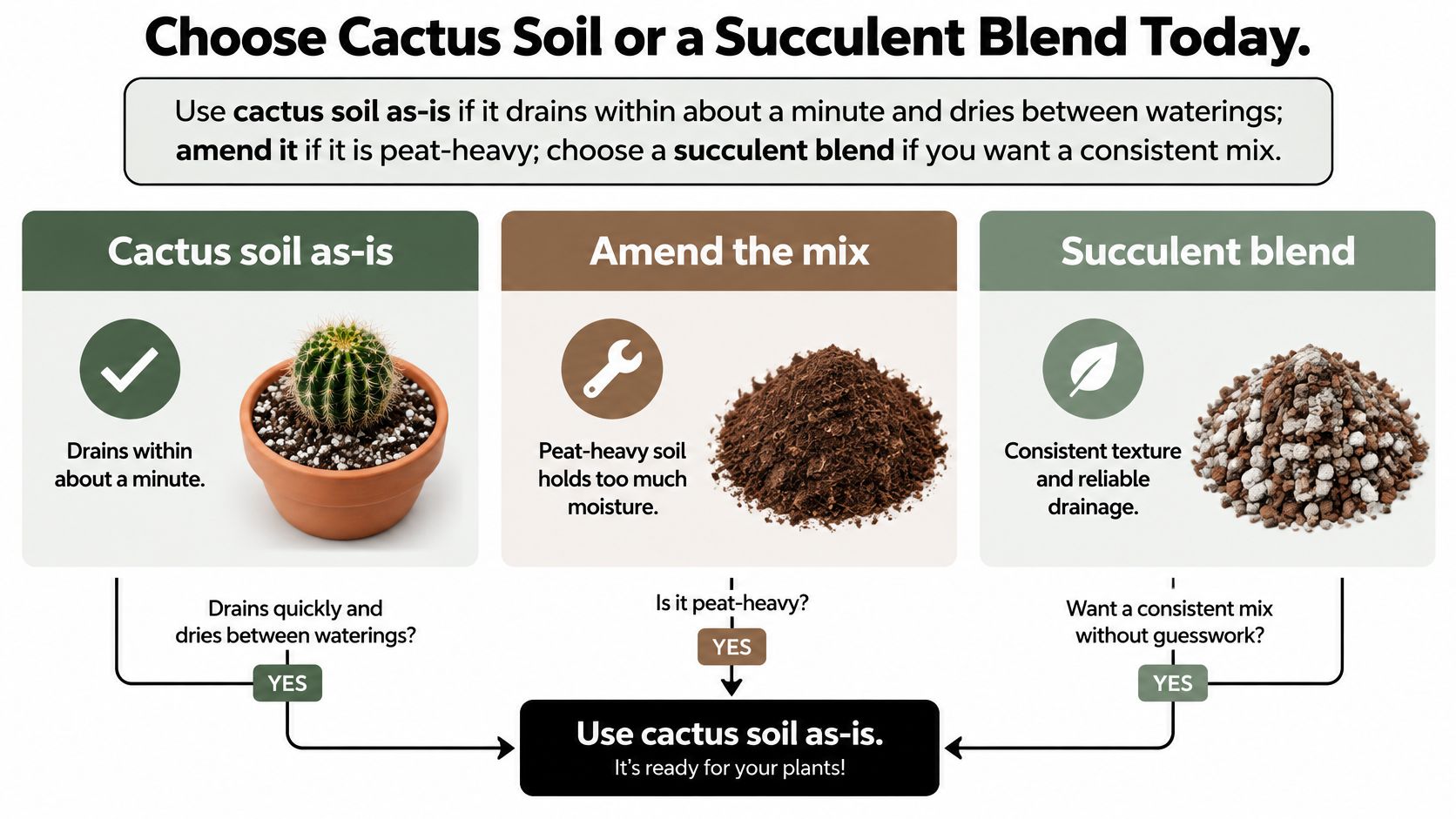
Use this rule. Use cactus soil as-is if it drains within about a minute and dries between waterings, amend it if it's peat-heavy, and choose a succulent blend if you want a consistent mix without mixing your own.
- Cactus soil pros: Widely available, often inexpensive, and well suited to desert species when it's coarse.
- Cactus soil cons: Quality varies between brands, peat-heavy formulas hold water, and many bags need amending before use.
- Succulent blend pros: Pre-mixed, consistent from bag to bag, and suitable for many succulent groups without extra work.
- Succulent blend cons: It may be richer and more moisture-retentive than strict desert species need.
For a practical next step, our Professional Cactus Soil is a large 2.2 quart, ready-to-use soil for cactus plants, priced at $16.47 USD, which suits cacti and desert-type succulents. For a mixed collection, our Premium Succulent Soil All Purpose Blend is pre-mixed and sold in 2.2 and 8.2 dry quart sizes for $13.47 USD.
Whichever bag you buy, run the drainage and squeeze tests on it first. Those two checks take minutes and tell you more than any label claim.
Ready to repot with a mix you don't have to fix first? At Leaves & Soul you'll find ready-to-use cactus and succulent soils, plus amendments and fertilizers for bonsai, houseplants and orchids. Pick the blend that matches your plants, test it in one pot, and give your roots the airy, fast-draining home they've been waiting for.