


The most popular winter advice, bring your bonsai inside and keep it warm, will save some trees and ruin others. A ficus wants that warm room. A juniper, maple, pine, or elm usually doesn't, because it needs winter cold to stay asleep. Caring for bonsai trees in winter therefore starts with a sort, not a chore list. Once you've placed each tree in the right row, its shelter, watering rhythm, and spring exit become much easier to judge.
Sort Each Tree Into Its Winter Row
Put a juniper and a ficus side by side on the same autumn bench and they look like one job. They aren't. The juniper is a temperate outdoor bonsai that needs a cool dormant period, while the ficus is a tropical bonsai that should keep growing indoors. Giving both trees the heated windowsill is kind to one and disruptive to the other.
Temperate trees include maples, elms, pines, and junipers. They slow down as days shorten, drop leaves if they're deciduous, and rest through winter. According to Backyard Boss, temperate and hardy bonsai typically enter dormancy at roughly 40°F (4°C). That figure isn't a switch that flips in one night, but it's a useful marker for when you should stop treating the tree like it's still in active growth.
Read the row before you move the pot
Tropical and subtropical trees such as ficus and jade follow the opposite rule. They don't need a cold rest, and lasting cold injures them. Plan to bring them indoors before a cold spell settles in, then give them bright light and a stable room. If you're unsure whether leaf drop means rest or trouble, our guide on whether bonsai really go dormant helps you separate a normal seasonal pause from stress.
Winter temperature and shelter by bonsai type
| Tree type | Winter job | Target range | Act below | Shelter |
|---|---|---|---|---|
| Tropical such as ficus or jade | Keep growing indoors | 10-20°C (about 50-68°F) | 40-45°F (4-7°C) causes damage | Bright indoor room, off radiators and cold glass |
| Cooler-tolerant indoor species | Slow growth, still indoors | 4-10°C | Sustained cold near 40°F (4°C) | Cool bright room, not a heated sill that spikes |
| Temperate deciduous such as maple or elm | Stay dormant | Dormancy near 40°F (4°C) | Protect below 28°F (-2°C) | Cold frame, pit, unheated shed, garage, or heel-in |
| Hardy evergreen such as juniper or pine | Stay dormant and cool | Dormancy near 40°F (4°C) | Protect below 28°F (-2°C) | Same cold shelter; ventilate on warm days |
The Virginia Cooperative Extension guidance recommends protecting temperate trees below about 28°F (-2°C) in a greenhouse, pit, or cold frame, while warning against overprotecting them because they must remain cool to stay dormant. Read that as two instructions, not one. Protect the roots from the hardest freezes, but don't move the tree into living-room warmth to do it.
Warmth isn't automatically protection. For a hardy tree, a stable cool shelter is often safer than a bright, heated sill that keeps waking it up.
What to do when you don't know the species
Label every tree before the first hard night. Write temperate or tropical on a tag, then write the chosen shelter beside the tree's name. If the species is unknown, use its broad habit as a temporary guide and identify it properly as soon as you can.
- Warm-climate broadleaf with fleshy or glossy leaves: Treat it as tropical until you know otherwise, and keep it indoors.
- Hardy conifer that lives outdoors all year: Treat it as temperate, and plan a cold shelter rather than a warm room.
- Leaf-dropping tree that colors and defoliates in autumn: Treat it as outdoor and dormant, not dead and not in need of rescue indoors.
Use your actual nights, not just a zone label on a map. A sheltered courtyard against a house wall can stay noticeably milder than an exposed roof terrace a few streets away. Put a simple minimum thermometer near the pots for a few nights if you can, because the microclimate at pot height is the one your roots experience.
Roots explain why this sorting matters so much in containers. A shallow bonsai pot holds far less soil than garden ground, so it cools faster, warms faster, and dries faster. Branches that tolerate winter air easily can sit above roots that are swinging between frozen and thawed. Your winter job is to steady that root zone while keeping each tree in the temperature pattern its row requires.
How to Shelter Hardy Outdoor Bonsai
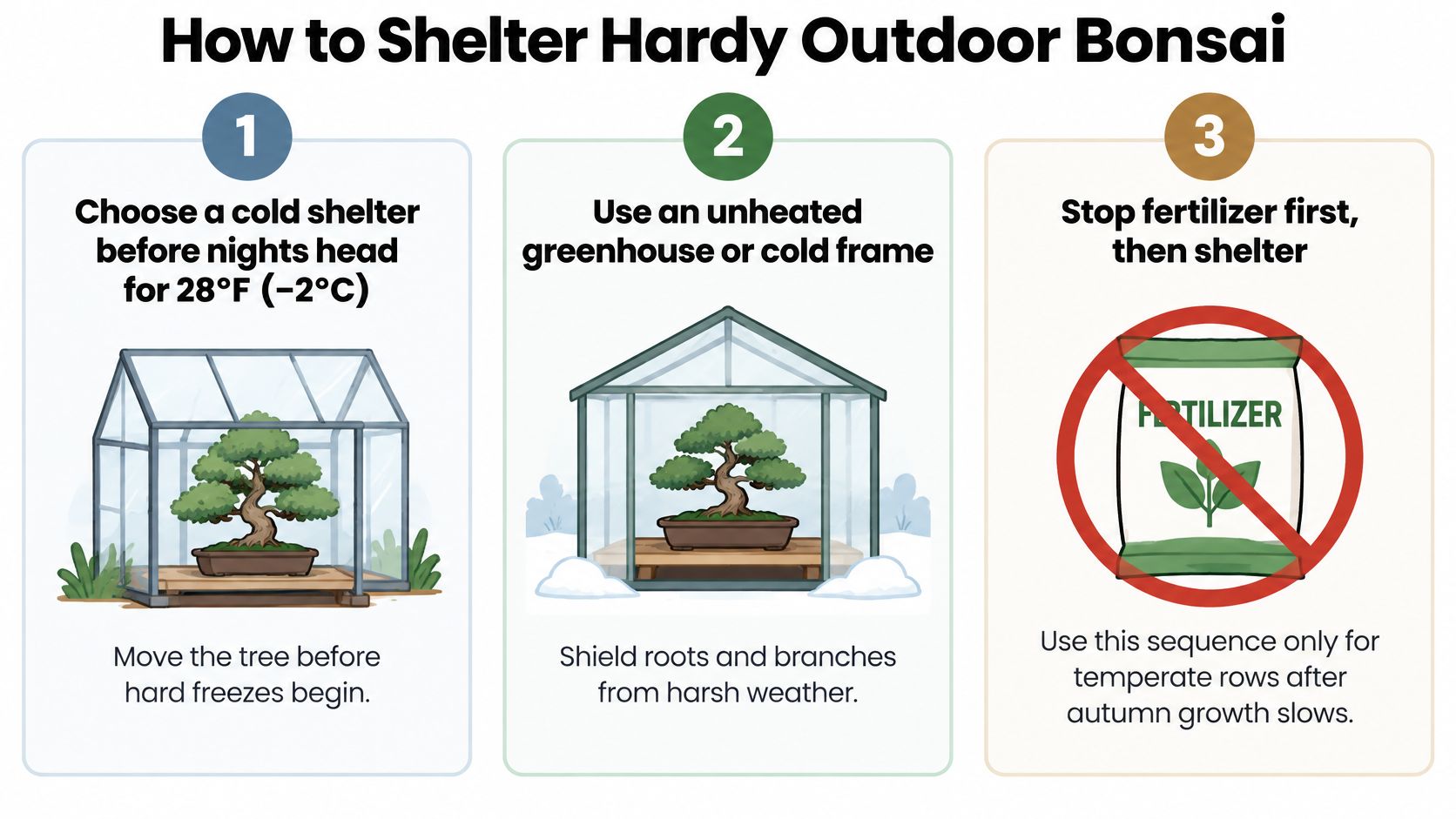
Sheltering a hardy tree means moderating the worst cold, not removing winter. You want a place that's protected from bitter wind and repeated hard freezes, but still cold enough for dormancy to hold. Think of it as a buffer for the pot, not a holiday indoors for the whole tree.
The Chicago Botanic Garden guide to overwintering bonsai identifies 28°F (-2°C) as a critical threshold, below which bonsai should be protected in a greenhouse, pit, or cold frame. It also notes that most tropical bonsai can suffer damage after exposure below 40-45°F (4-7°C) for any length of time, which is why this cold-shelter sequence belongs only to the temperate rows. Stop fertilizer first as autumn growth slows, then work through the steps below before hard nights become routine.
A six-step shelter sequence
- Choose the shelter early: Pick an unheated greenhouse or cold frame, a pit, a shed or garage that stays cold, a window well, or a garden spot where you can heel the pot into soil.
- Buffer the root zone: Bury the pot to its rim, bank soil around it, or group pots together and cover the root zone with light mulch.
- Keep the trunk clear: Don't bury the trunk flare or pack wet mulch tight against bark, because trapped moisture invites rot at the base.
- Keep drainage open: Set a sunk pot so water can still escape, and never leave it sitting in a frozen saucer or a hollow that fills with meltwater.
- Leave the tree cold: Aim for a steady chill around dormancy rather than a cozy corner that warms every sunny afternoon.
- Ventilate mild days: Open the cold frame lid, garage door, or cover when the shelter warms up, then close it again before the next hard night.
Heeling in is the lowest-cost option if you have garden soil. Dig a hole slightly deeper than the pot, set the pot in, and fill around it with soil so the ground's steadier temperature surrounds the roots. A layer of loose mulch over the surface adds insulation without sealing the pot. Raised beds and the sheltered side of a fence work well, while low frost pockets in open lawn are poor choices.
If you don't have soil to dig, use a crate or larger outer container. Set the bonsai pot inside it and pack soil, coarse bark, or dry leaves around the sides. Grouping several pots this way gives the cluster more thermal mass than one thin pot standing alone on concrete. Keep the arrangement off a wind-scoured patio edge if you can.
Practical rule: Protect the pot first and the branches second. Most winter shelter work is really root insulation.
A worked balcony example
Say you keep a small juniper on an exposed balcony. Once forecasts settle below the protection threshold, you move it into an unheated garage and sink its pot into a crate of soil against an interior wall. On a mild afternoon you crack the garage door so the space doesn't heat up and coax the buds, then you close it before evening. The tree stays dormant, but its roots no longer take the full force of wind and hard freeze in a thin pot.
Snow complicates the picture in a helpful way outdoors. A blanket of snow around an exposed pot insulates it, so you don't need to brush every flake away in a panic. A pot under a roof, inside a frame, or in a garage gets none of that blanket, which is why the crate, soil, or mulch still matters there. Sheltered doesn't mean forgotten, either, so check the root ball during thaws rather than on a fixed weekday, and don't water a pot that's frozen solid.
Watch for the shelter doing too much. Buds swelling and opening in midwinter, soft pale growth, or a frame that feels warm at noon all tell you the tree is being pushed out of rest. Ventilate first, and if warm spells keep overheating the spot, move the tree to a cooler but still protected position. Broken dormancy is dangerous because the new soft tissue is exactly what the next freeze will kill.
Keeping Tropical Bonsai Growing Indoors
Your indoor trees are still working in winter, just more slowly. Place them where light and temperature stay steady, as in this bright windowsill setup.
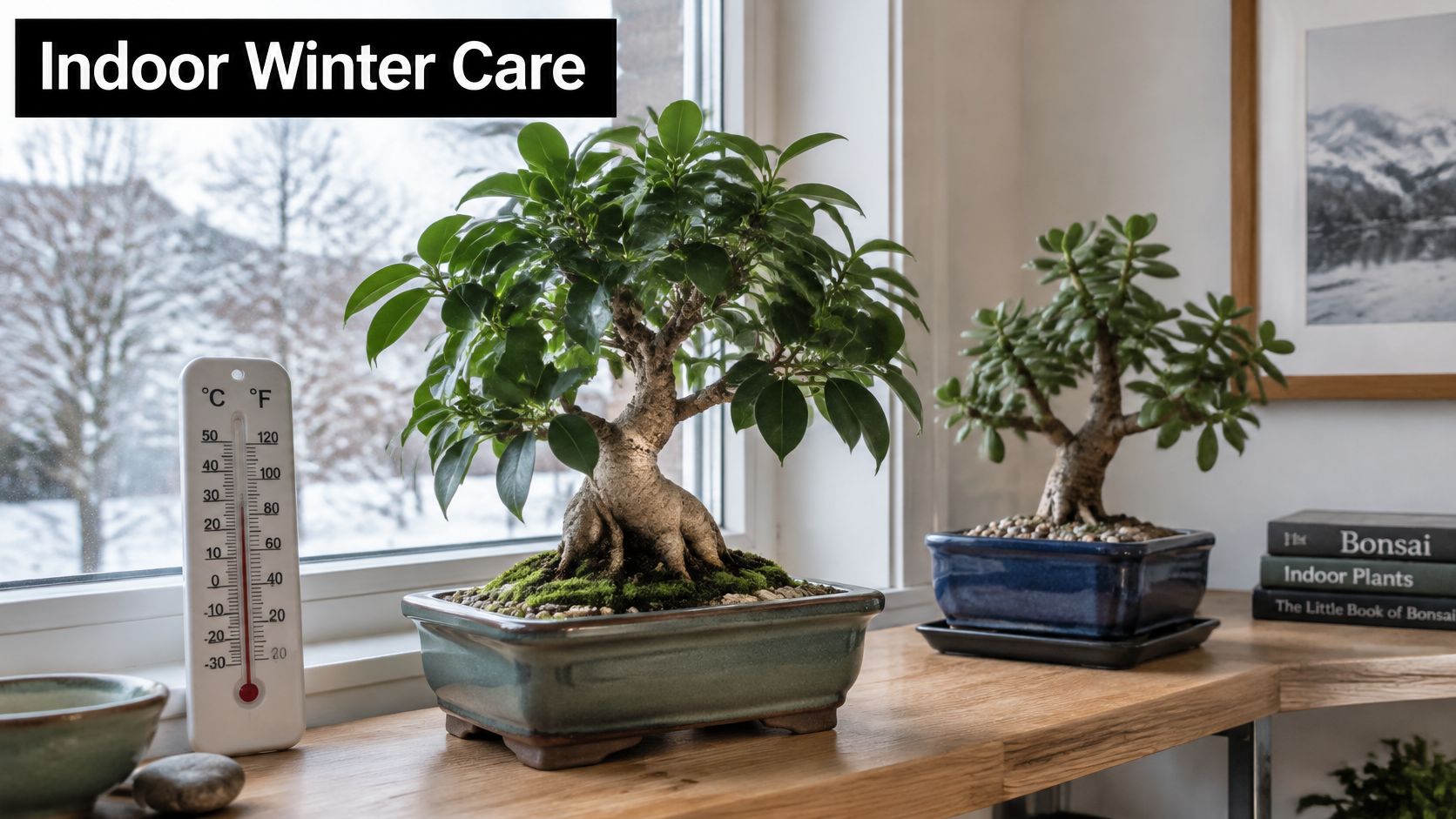
The Bonsai Shop care page recommends approximately 10-20°C for indoor species such as ficus and jade, while some cooler-tolerant species are recommended at 4-10°C. That split matters when you choose a room. A ficus in a normally heated living room may be fine if light is strong, while a cooler-tolerant species often does better in a bright spare room that doesn't spike every evening when the heating comes on.
Light first, then placement details
Give tropical bonsai the brightest window you have. Short days and low sun mean even a south-facing sill can be marginal, so add a grow light if growth turns leggy, leaves shrink, or the tree leans hard toward the glass. Rotate the pot a quarter turn at each watering so the far side doesn't thin out while the window side stays dense.
Keep foliage off cold single-pane glass. Leaves touching the pane can chill on a frosty night even when your room thermostat reads comfortably. Keep the pot away from radiators, heat vents, and frequently opened exterior doors, since hot dry blasts followed by cold drafts stress the tree from both directions. A small gap from the glass and a steady room temperature beat the sunniest but draftiest spot in the house.
This short video walks through indoor winter placement and the signs that a tree needs more light or a steadier spot.
Don't assume winter means the mix stays wet. A small pot in a bright, heated room can dry faster than the familiar slogan suggests, especially near a vent. Check the substrate with a fingertip or wooden skewer, water when it's approaching dry, and let excess drain away fully. Don't leave the pot standing in water inside a decorative cachepot, because low light plus saturated roots is a common route to decline.
Growth slows, so feeding should slow with it. Don't push high-nitrogen fertilizer through the darkest months to force flushes the light can't support. If the tree is actively growing under good light, a very light feed is enough, and if it's stalled in a dim corner, fix the light before you reach for fertilizer.
Reading leaves after the move indoors
A ficus that drops some older interior leaves in the first weeks inside is usually adjusting to lower light. Keep its routine steady and don't repot it in response. Blackened, water-soaked new leaves after a night beside an open window point to cold shock instead, so move the tree to a warmer draft-free place and let it recover before trimming damaged growth.
Check the undersides of leaves weekly. Spider mites and scale thrive in dry heated rooms and build up on indoor trees. Wipe small infestations off with a soft damp cloth, isolate an affected tree from its neighbors, and move it away from the heat source that's drying the air. Our guide on how to care for an indoor bonsai tree covers year-round indoor placement if your tree lives inside beyond winter.
One boundary protects both groups. Hardy outdoor trees don't belong on this windowsill just because there's space and light. If a subtropical tree's hardiness is uncertain, keep it on the indoor path until you've identified it and know whether it can take frost. Guessing in the warm direction risks one season of weak growth, while guessing in the cold direction can kill the tree in a single night.
When to Water and When to Stop Feeding
The test that settles most winter watering arguments has two parts. Is the root zone unfrozen, and is the mix approaching dry? If both answers are yes, water thoroughly and let it drain. If either answer is no, wait and check again during the next thaw.
The Virginia Cooperative Extension bonsai publication states that winter watering may be necessary only once a week, but moisture must still be monitored in a cold frame or other protected site. Treat that frequency as a rough ceiling for dormant trees, not an appointment. A large pot in a cold garage may need less, while a tiny pot in a windy frame may dry sooner.
Why sheltered pots go thirsty
Shelter blocks precipitation. A tree under a cold frame lid, porch roof, garage ceiling, or mulch layer receives no rain and little or no snow melt, so the bench and paths can look wet while the root ball dries out. Dormant roots use little water, but they still desiccate if the mix stays dry for weeks. Probe below the surface with a skewer or lift the pot to judge its weight, because a damp-looking top layer often hides dry soil underneath after windless cold days.
Snow misleads in the other direction. Snow piled around an outdoor pot insulates the roots, which is useful, but it doesn't prove the mix inside a covered or roofed pot is moist. It also isn't permission to water frozen soil, since frozen mix can't absorb or distribute water normally. Wait for a thaw, check the substrate itself, and water only if it's drying and unfrozen.
Winter water and feed decisions
| What you find | Water | Fertilizer | Why |
|---|---|---|---|
| Unfrozen mix drying in a shelter | Yes, then drain | No while temperate trees are dormant | Sheltered pots miss rain and can desiccate |
| Frozen root ball | No | No | Frozen soil cannot absorb water |
| Snow on an outdoor pot | Only if the mix itself is dry and unfrozen | No | Snow insulates; it may not wet a covered root ball |
| Saturated mix before another hard freeze | No | No | Ice-cold, waterlogged roots are easily damaged |
| Indoor tropical, top of mix drying, good light | Yes, less often than summer | Only a light feed if it is still growing | Heated rooms dry small pots; excess water rots roots |
The two failures you're steering between
Drought is only half the risk. Watering heavily just before another hard freeze leaves roots sitting in saturated, ice-cold mix, and a cold pot with poor drainage keeps roots wet long after a growing-season pot would have dried. That excess moisture encourages root rot, which often shows up in spring as a tree that never wakes properly. If a thaw is brief and a hard freeze follows the same night, a modest watering early in the day beats a soaking at dusk.
Indoor tropicals need the same test with a warmer twist. They generally use less water in winter than in summer, yet a small container in a bright heated room can still dry between checks. Water when the mix is drying, drain the pot, and empty the saucer. Overwatering a light-starved indoor tree is a frequent cause of root decline, yellowing, and leaf drop that owners then try to fix with more water.
Water the soil condition, not the calendar. Unfrozen and nearly dry means yes, frozen or saturated means no.
Feeding follows growth, not habit. Stop fertilizer on temperate trees as growth slows in autumn and leave them unfed while fully dormant, then resume when growth starts again in spring. Roots that aren't growing can't use the nutrients, and salts sitting in cold mix help nothing. Tropicals that are still growing in good light can receive a very light feed, while stalled indoor trees should get better light first. When spring feeding resumes, our overview of the best fertilizer for bonsai trees explains how to match the feed to the growth stage.
Pruning Timing, Damage Checks, and the Spring Exit
Midwinter is a holding season for hardy trees, and most of your restraint happens here. The checklist below separates work you should postpone from small jobs that are safe to do now.
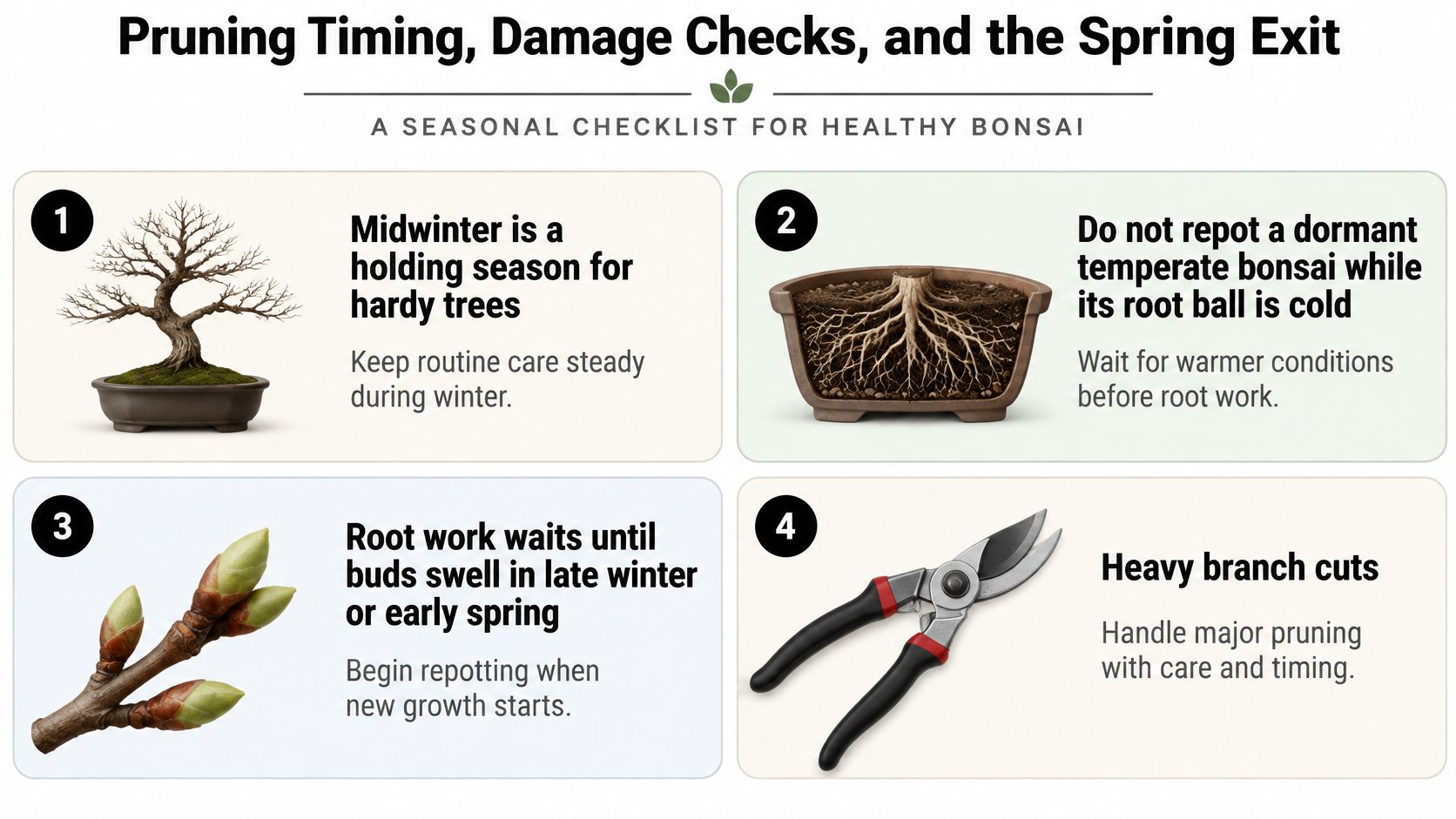
Don't repot a dormant temperate bonsai while its root ball is cold. Root work waits until buds swell in late winter or early spring, when the tree is about to grow and can replace cut roots. Heavy branch cuts and major wiring wait too, because a resting tree responds slowly and you can't yet see which buds will drive the new season. Snipping obviously dead twigs is fine anytime, and it keeps you from mistaking old dieback for fresh winter damage later.
Tropical trees allow a little more freedom, with limits. A light tidy on a strong ficus in a bright room is reasonable if it's growing steadily. Don't strip or heavily prune a stressed tropical that just came in from the cold, dropped leaves, or sat in the dark, because it needs its remaining foliage to recover. Stabilize light, temperature, and watering first, then prune once new growth shows the tree has settled.
Match each damage signal to one correction
- Buds opening in midwinter on a maple or juniper: The shelter's too warm, so ventilate it or move the tree to a cooler protected spot, and don't feed it.
- Blackened leaves on a tropical after one cold night: That's chill injury, so move the tree away from glass and drafts and let it recover rather than repotting in a panic.
- Mushy roots or a sour smell from a sunk pot: Drainage has failed, so improve the exit path, lift the pot out of standing water, and let the mix dry to barely moist.
- A cold frame that's hot at noon: Open the lid, because daily cooking followed by freezing nights is harder on roots and buds than steady cold.
- Fine webbing or stippled leaves indoors: Check for spider mites, wipe the foliage, and move the tree away from dry heat.
Notice that none of these corrections is fertilizer. Feeding a cold-damaged or prematurely waking tree pushes growth it can't support. Correct the shelter, light, or drainage first, give the tree time, and reassess when conditions have been stable for a while. Patience is a real input here, because winter damage often declares itself slowly and hasty root work compounds it.
When buds do swell and growth restarts, that's when supplies earn their place again. Our Bonsai Fertilizer Pellets | 18-6-8 Slow Release cost $10.38 USD, and our pre-mixed Premium Bonsai Soil All Purpose Blend is sold in 2.2 and 8.2 dry quart sizes for $17.94 USD for the repotting window. If you'd rather study the timing before you cut, the Leaves & Soul app is downloadable and gives access to professional bonsai courses, lessons and tips for bonsai and plant care.
Exit in stages, not in one afternoon
Hardy trees leave the cold frame, garage, or heel-in after the worst nights are done and buds are starting to move. Harden them off over several days, moving from full shelter to a shaded, wind-sheltered outdoor spot before full sun. A tree that's sat in a dim garage can scorch or dry out if it goes straight to a bright windy bench, even though it's fully hardy.
Tropicals stay indoors until outdoor nights stay reliably mild, then they also move out gradually through shade. Reverse the shelter slowly for every tree and be ready to pull pots back under cover for one late hard night. Finish by marking one line per tree on its tag, temperate or tropical, its shelter, and the temperature signal that tells you it's time to come out, so next autumn starts from a record instead of a memory.
Winter Care Calendar From Autumn to Spring
A calendar only helps if each row tells you what to do, not just when to worry. Keep this table beside the pots and tick each stage as you complete it, adjusting the timing to your nights rather than to the month name. A mild coastal garden and a cold inland balcony will reach the same rows weeks apart.
Start in late autumn, while you can still choose shelters calmly. Sort each tree, reduce watering as growth slows, stop feeding temperate trees, and bring tropicals indoors before cold nights settle in. Don't wait for the first hard freeze to discover that the cold frame lid is cracked or the garage corner is full.
Winter routine by season
| Stage | Task | Water | Feed | Shelter |
|---|---|---|---|---|
| Late autumn, growth slowing | Sort trees and choose shelters | Reduce watering | Stop feeding temperate trees | Move tropicals in before 40-45°F nights |
| Nights nearing 28°F (-2°C) | Move hardy trees into cold frame, pit, garage, or heel-in | Check moisture before the move | None on temperate trees | Protect but keep cold |
| Midwinter, dormant hardy trees | Check on thaws; skip frozen pots | About once a week or less | None | Ventilate on warm days |
| Midwinter, indoor tropicals | Check mix and light | Only when mix is drying | Light feed only if still growing | Bright room away from glass and radiators |
| Late winter, buds swelling | Begin repotting and structural pruning | As needed | Restart slow-release feed when growth starts | Harden hardy trees gradually |
| Spring, nights safely above 40-45°F | Move tropicals out; bring hardy trees out gradually | Resume regular watering | Feed as growth returns | Reverse shelter slowly |
Midwinter is mostly monitoring. Check hardy trees on thaws, skip any pot that's frozen, and ventilate shelters during warm spells so dormancy holds. Indoors, check the mix and light on tropicals, rotate them, and look under leaves for pests while you're there. Ten calm minutes a week beats one frantic rescue after a month of neglect.
Late winter is where the season turns. Buds swelling on hardy trees signal the repotting and structural pruning window, and feeding restarts only once growth begins. In spring, move tropicals out after mild nights are reliable, bring hardy trees out in stages, and let watering rise with new growth rather than jumping straight to a summer schedule. Caring for bonsai trees in winter ends the way it began, with each tree following its own row instead of a single date for the whole bench.
Sort your trees tonight, tag each one with its shelter and trigger temperature, and stock up before the repotting window opens. At Leaves & Soul you'll find professional-grade bonsai soils, slow-release fertilizers, glazed ceramic pots, and accessories for both indoor tropicals and hardy outdoor trees. Visit us to get your winter setup and spring supplies ready in one place.