


Yes, orchids in bark or other low-nutrient media usually need fertilizer: use a dilute complete fertilizer only during active growth, about weekly in summer, starting around 1/4 teaspoon per gallon, and feed less often in winter. More fertilizer is the usual mistake, not the shortcut to better flowers.
The popular advice to feed weakly every week leaves out an important detail: your irrigation water already contains dissolved minerals. A dose that suits an orchid watered with low-mineral water may be excessive when added to mineral-rich tap water.
A better feeding plan starts with the potting medium, visible growth, and salt exposure. The calendar helps, but the roots get the final vote.
Do Orchids Need Fertilizer Right Now
Orchid feeding schedule by season and setup
| Setup | How often | Amount per gallon | Nitrogen target |
|---|---|---|---|
| Summer active growth | About weekly | 1/4 to 1/2 teaspoon | 75-125 ppm in the final solution |
| Winter or slow growth | Weekly weak dose, or longer intervals as growth slows | 1/8 to 1/4 teaspoon | Toward the low end of the active-growth target |
| Bark medium | Follow the season and visible growth; consider a higher-nitrogen formula | Weak end of the product's orchid dilution instructions | Conservative active-growth target, adjusted for water |
| Mounted or richer mix | Less often than bark when nutrient demand is lower | Weaker than the bark rate | Low end of the active-growth target |
| Resting plant or dry roots | Pause fertilizer; plain water only | None | None |
| Seedlings under lights | Low dose at regular waterings when growing | Very dilute feed or appropriately labeled slow-release fertilizer | Continuous low level rather than concentrated doses |
For mixed orchid collections, the American Orchid Society's fertilizing guidance recommends approximately 1/4 to 1/2 teaspoon per gallon weekly in summer and 1/8 to 1/4 teaspoon per gallon weekly in winter. These are useful starting amounts, not proof that every fertilizer reaches the same nitrogen concentration at the same spoon measurement.
Choose the plant's condition before the season
Most potted orchids need supplemental nutrients because their growing mix primarily supports the roots rather than supplying a dependable mineral reserve. That doesn't mean every orchid needs fertilizer today.
Look for an advancing root tip, an expanding leaf, or another clear sign of growth. A firm plant that's resting needs a different response from a plant actively building new tissue, even if they sit beside each other.
Use the table by matching the plant's condition first, then its medium:
- Growing in bark: Choose the active-growth approach, keeping the concentration conservative.
- Growing in a moisture-retentive mix: Don't add extra water just because a feeding date has arrived.
- Mounted or lightly rooted: Begin cautiously rather than copying the rate used for an established bark-grown plant.
- Resting or dehydrated: Attend to watering and root condition before nutrition.
Teaspoons aren't a universal strength
A measuring spoon tells you how much product you added. It doesn't tell you how much nitrogen reaches the roots unless you also know the product's analysis and dilution instructions.
That distinction matters when switching brands. A spoonful of one fertilizer isn't automatically equivalent to a spoonful of another, and a ready-to-use spray isn't interchangeable with a concentrate.
Starting rule: Choose the weakest suitable dilution for the plant's current growth, not the strongest rate printed for any plant on the package.
Winter also isn't an automatic stop signal. An orchid growing under suitable indoor conditions may continue producing roots, while another plant slows noticeably. Reduce feeding according to that response rather than treating the month as the deciding factor.
Why Potting Mix Decides the Answer
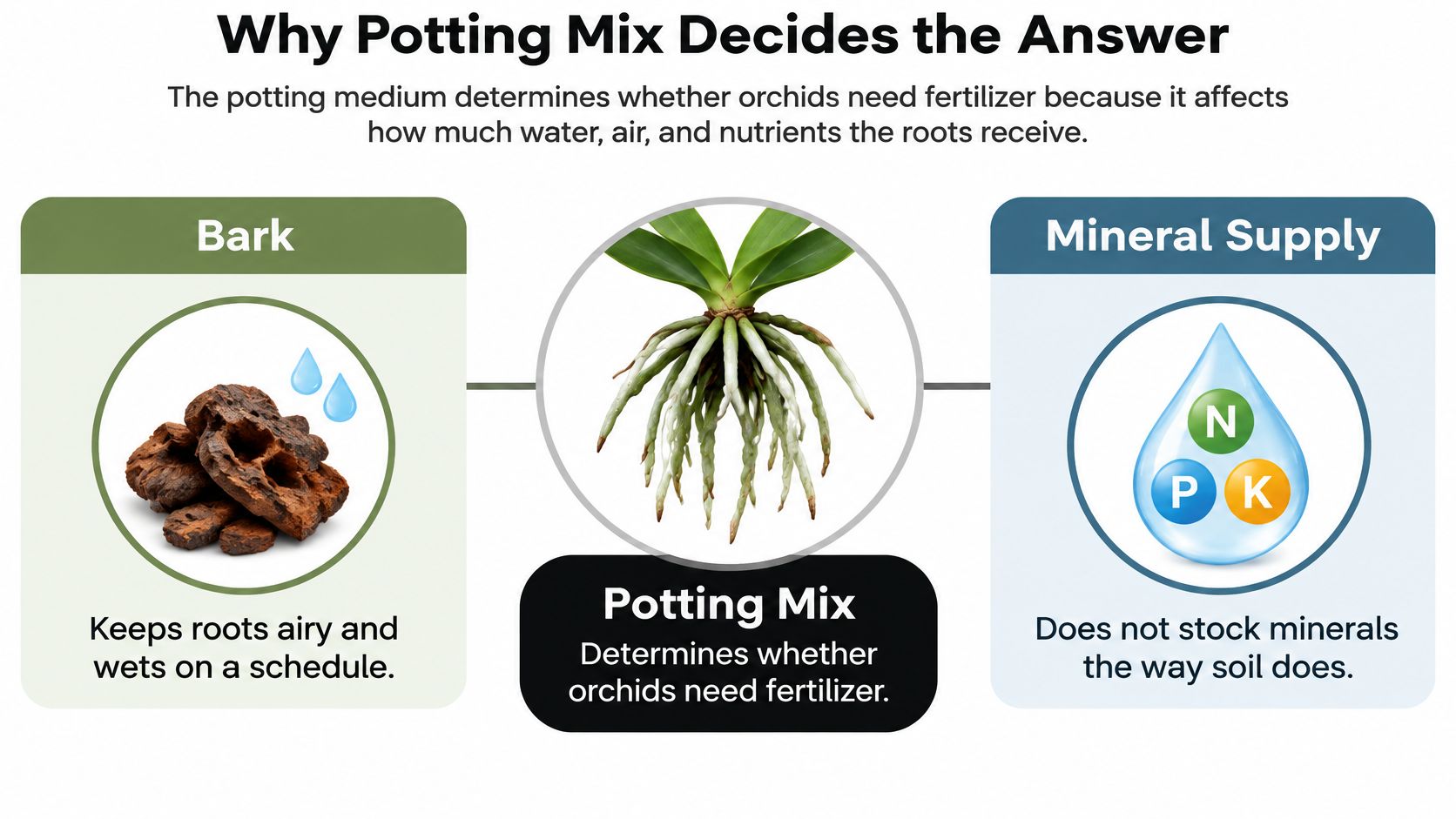
Think of bark as a kitchen sponge. It helps create an airy root environment and holds water temporarily, but it doesn't stock minerals the way a garden soil can.
Say you have similar orchids in chunky bark and tightly packed sphagnum. The bark may be ready for watering while the moss remains damp. Giving both plants fertilizer whenever you water the bark ignores what's happening around the second plant's roots.
The medium comparison is simple, but it changes the feeding decision.
What the bark trials tell a home grower
A controlled study published in HortTechnology recommended a 30N-4.4P-8.3K nitrogen-rich fertilizer when bark was the sole medium and found dramatically improved vegetative growth when a 20N-8.6P-16.6K fertilizer increased from 0.25 to 1.0 grams per liter of irrigation water.
The useful lesson isn't to copy the highest experimental concentration. It's that nutrient availability can materially affect growth, and the medium helps determine what supplementation is appropriate.
Bark-grown orchids can become short of nitrogen when feeding is inadequate. Yet a nitrogen-rich analysis still needs careful dilution. A higher proportion of nitrogen and a stronger overall solution are different decisions.
Match feeding to the watering pattern
Compare how your pot behaves rather than relying only on the bag's ingredient list:
- Open bark mixes: Pair feeding with necessary watering, allowing excess solution to leave freely.
- Sphagnum-heavy mixes: Wait until watering is appropriate instead of repeatedly wetting the pot to deliver fertilizer.
- Richer mixtures: Account for nutrients already included in the mix before adding another source.
- Mounted plants: Consider rapid drying and exposed roots rather than assuming they can tolerate a stronger solution.
If you're changing the root environment, an orchid soil mix recipe can help you understand how bark and moisture-retaining ingredients work together. Changing the mix may also mean changing the watering and feeding routine.
Don't try to correct a poorly draining medium by withholding all nutrients indefinitely, or compensate for a depleted mix with increasingly concentrated fertilizer. Choose an appropriate root environment, then match nutrient delivery to its watering pattern.
How Feeding Changes Through Growth and Flowering
An orchid's growth rate can be slow enough to hide its nutrient demand. A developing leaf or root still requires minerals, even when the change is barely noticeable from day to day.
Follow the plant's development rather than switching bottles whenever a flower appears. The broad progression looks like this.
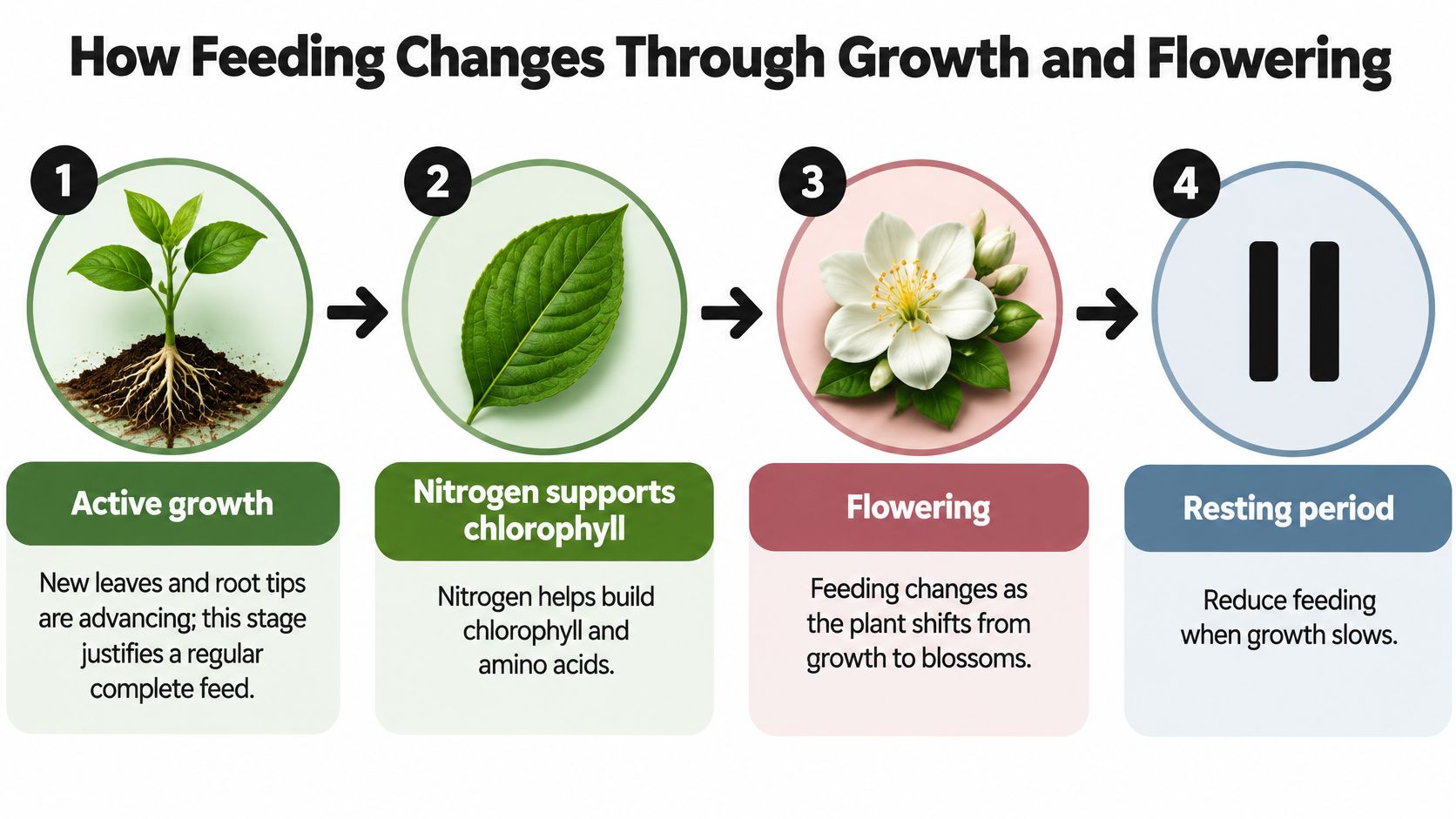
Active growth needs complete nutrition
Nitrogen helps build chlorophyll, amino acids, proteins, enzymes, and DNA. Phosphorus participates in energy transfer, while potassium helps regulate water balance and the opening and closing of leaf pores.
Those functions work together. Feeding only for greener leaves or only for flowers overlooks the rest of the plant.
The Washington State University plant nutrition guidance describes an orchid feeding target of approximately 75-125 ppm nitrogen in the final weekly irrigation solution and notes the Michigan State University program's use of 125 ppm nitrogen with its well-water formula.
Parts per million describes the diluted solution, not the percentage on the package. The fertilizer analysis describes the product before you mix it with water, so these measurements aren't interchangeable.
During active growth, use a complete feed that supplies more than nitrogen alone. Check whether the formula includes secondary nutrients and micronutrients, and whether it's intended to work with your water source.
Spike and bud development don't require a phosphorus-heavy switch
A developing flower spike still belongs to a whole plant with leaves and roots to maintain. There's no good reason to abandon complete nutrition because buds are forming.
Potassium can influence flowering performance, but that doesn't make an isolated potassium dose a universal orchid recipe. In a 2025 study of Zygopetalum maculatum, weekly fertigation with 100 mg potassium per liter produced approximately 167% more flower spikes per plant than the no-potassium treatment.
That result demonstrates the cost of an inadequate nutrient supply under the tested conditions. It doesn't establish the same potassium requirement for a household Phalaenopsis, a mounted orchid, or a plant receiving mineral-rich tap water.
Species, substrate, water chemistry, and the fertilizer's other nutrients all affect the appropriate program. Support flowering with adequate overall nutrition, not an automatic increase in concentration.
For a visual companion to orchid feeding, the following video can help you connect the routine with the plant in front of you.
Open flowers and the period afterward
Open blooms alone aren't a reliable instruction to increase or stop feeding. Check whether the plant is also developing roots or leaves, and maintain a conservative program if it's still growing.
After the flowers fade, examine the plant again. Some orchids slow down; others begin another period of vegetative growth. Reduce frequency when growth slows rather than assuming every flower drop marks dormancy.
- New roots or an expanding leaf: Continue appropriately diluted nutrition.
- Firm foliage without developing tissue: Allow for rest instead of trying to force activity.
- Shriveling or deteriorating roots: Investigate water uptake and root health before adding fertilizer.
Flowers falling isn't a diagnosis of nutrient deficiency. Don't answer a normal change in the plant's cycle with a stronger feed.
Seedlings also need restraint. Their small size isn't a reason to use an adult plant's concentrated dose in a smaller pot. Keep nutrient delivery gentle and judge the response by healthy development, not by how quickly you can make the plant grow.
Choosing a Formula and Reading the Label
Start with a complete fertilizer, not a product chosen solely because its label promises flowers. Look for nitrogen, phosphorus, and potassium, then check the guaranteed analysis for secondary nutrients and micronutrients.
“Balanced” doesn't have to mean identical numbers. It means supplying an appropriate combination rather than emphasizing a nutrient without considering the rest of the formula.
Read the product before measuring it
Use this label-reading sequence:
- Identify the product form. Determine whether it's a concentrate, a water-soluble powder, a ready-to-use liquid, or a controlled-release product.
- Find the orchid dilution instructions. Use those rather than a stronger rate intended for other plants.
- Check water compatibility. A formula designed around minerals in well water may not suit a different water source.
- Trial the change cautiously. Observe a plant's response before changing the routine for your whole collection.
Don't convert teaspoons to nutrient concentration by guesswork. Powder density differs between products, so use the manufacturer's conversion information or a gram scale when the directions specify weight.
Organic fertilizer still needs a measured dose
An organic label doesn't remove the need for dilution or salt management. Product composition and release behavior still matter.
A 2024 Universitas Slamet Riyadi study found that liquid organic fertilizer at 10 mL/L produced the best Dendrobium growth among the tested fertilizer treatments. That result applies to the tested product and conditions, not to every organic concentrate sold for orchids.
Choose a product with clear instructions and a declared nutrient analysis. Avoid treating homemade mixtures or an unfamiliar concentrate as equivalent to a complete, measured feeding program.
How to Apply Fertilizer Without Burning Roots
Prepare a dedicated measuring spoon or gram scale, a clean mixing container, and a pot that drains freely. Accurate mixing is easier when you aren't trying to estimate a partial scoop over the sink.
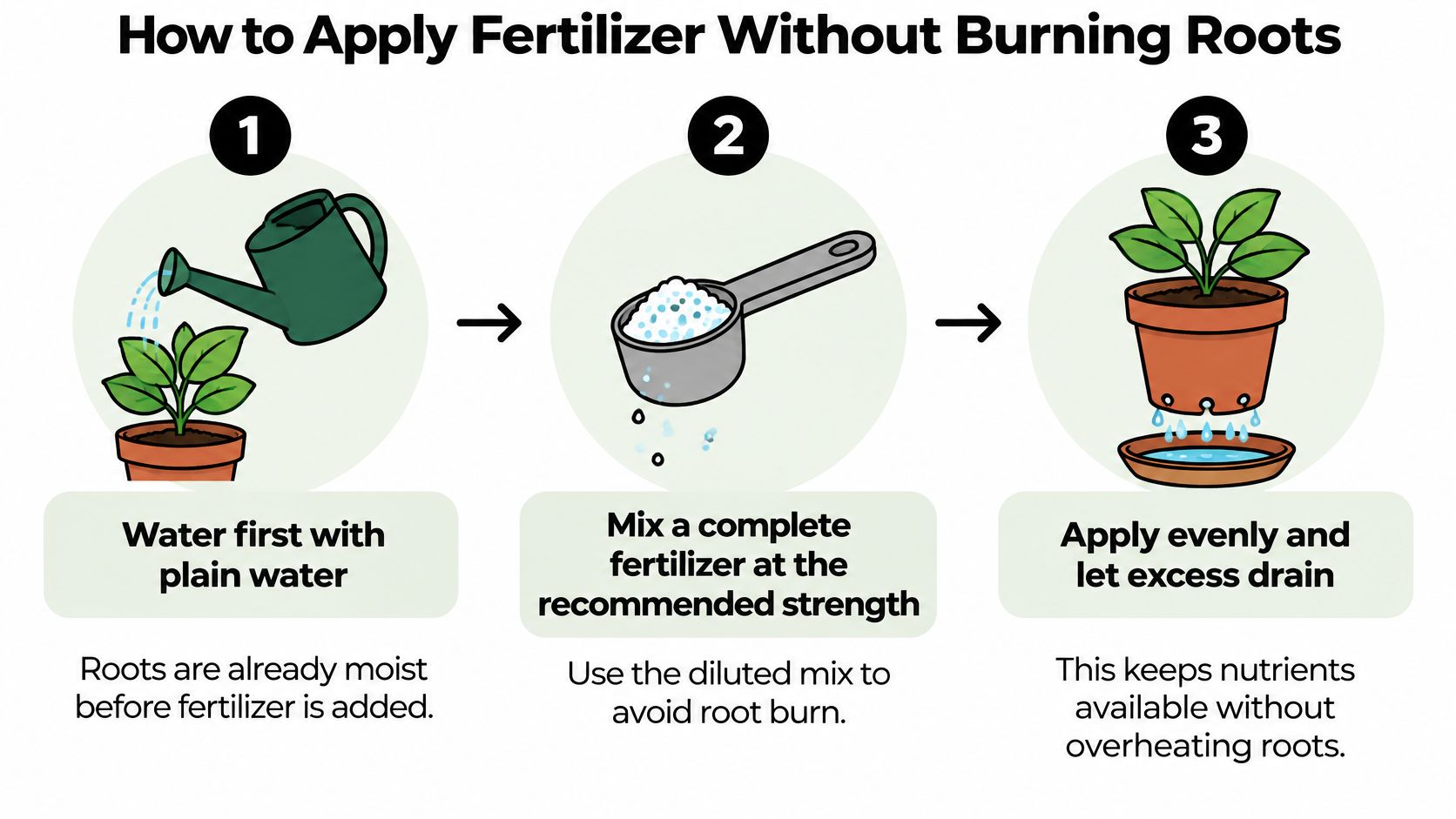
The safe application pattern is to hydrate the roots, prepare the dilution, and let excess solution escape.
Use a repeatable application procedure
- Water first with plain water. Moisten the root zone before fertilizing. If the bark has become difficult to wet, take time to hydrate it evenly rather than pouring fertilizer through dry channels.
- Mix a complete fertilizer at the recommended weak dilution. Measure the water before adding the fertilizer, then stir thoroughly. Don't add extra powder because the mixture looks clear; appearance doesn't indicate nutrient strength.
- Apply evenly and let excess drain. Wet the medium throughout rather than concentrating the solution in a single spot. Empty the saucer or decorative outer pot so the roots aren't left soaking in runoff.
- Use a separate plain-water rinse. Clemson Extension's orchid guidance recommends a monthly plain-water rinse to remove accumulated salts. Let water pass through the medium and escape rather than merely dampening the surface.
- Skip fertilizer when conditions are wrong. Dehydrated roots, resting growth, or newly darkened tips call for assessment, not another scheduled dose. If the plant needs hydration, give plain water and reconsider feeding after it has recovered.
Avoid turning a routine into an obligation
A feeding calendar should remind you to inspect the plant, not compel you to fertilize it. If the pot is still wet, don't add solution just to keep an appointment.
Likewise, don't compensate for a missed feeding by doubling the next application. Return to the normal conservative routine when the plant and medium are ready.
Before you pour: Check that the roots are hydrated, the mixture is measured, and the drainage route is open.
Keep the measuring equipment separate from kitchen tools, and rinse it after use. Residue in a mixing container can make the next batch less predictable.
If you suspect injury, compare the symptoms with these signs of over-fertilizing plants. Judge the result through healthy developing tissue and an absence of fresh damage, not an expectation of immediate flowers.
Water Quality Salt Buildup and Leaf Tips
Hard water changes the feeding calculation. Your fertilizer adds dissolved salts to whatever is already present in the water, so copying another grower's weekly dose can produce a different root-zone exposure.
Hardness isn't a complete measurement of water quality, but mineral-rich water is a reason to be conservative. Obtain a water analysis before copying a specialized well-water formula, especially if you're repeatedly seeing deposits or damaged tips.
Read symptoms as clues, not proof
The American Orchid Society's Phalaenopsis guidance identifies pale or canary-yellow foliage and weak growth as signs associated with nitrogen deficiency, and blackened leaf tips as a salt-related symptom to which potassium excess can contribute. It also summarizes better results for Phalaenopsis seedlings under artificial light when slow-release fertilizer supplied low nutrient levels at each watering.
Orchid feeding symptoms and what to change
| What you see | Likely cause | What to change |
|---|---|---|
| Pale or canary-yellow leaves and weak growth | Possible nitrogen shortage | Check root health, then resume dilute feeding on moist roots if appropriate |
| Blackened leaf tips | Excess salts, often involving potassium | Stop fertilizer, flush, then resume more weakly after recovery |
| White crust on the medium | Mineral or fertilizer salt buildup | Rinse thoroughly with suitable plain water and reduce added fertilizer |
| Brown root tips | Possible salt injury or feeding dehydrated roots | Pause feeding, flush, and wait for healthy root development |
| No new leaves but a firm plant | Possible natural rest | Pause rather than increasing fertilizer |
Yellow foliage can also accompany root problems. If the roots are damaged and unable to take up water, adding fertilizer won't correct the underlying issue.
White deposits likewise don't prove that fertilizer alone caused the problem. Your tap water may contribute substantially, which is why reducing the scoop size without considering irrigation water sometimes fails.
Change the water decision as well as the dose
Use this guide to water quality for plants to assess your water source and decide whether testing would help. A conductivity meter can track total dissolved-salt exposure, but it won't identify which nutrients are present.
If tips darken after feeding, stop fertilizer and flush with low-salt water. Resume at a lower concentration only when the plant has healthy roots and renewed activity.
Don't respond to poor flowering by doubling the dose. Reassess the feeding choice whenever crust, fresh tip injury, or a change in water source appears.
Set a Weak Feed and Watch the Roots
Before the next watering, write down the medium, the plant's current growth, and the water source. Those observations are more useful than a generic reminder saying to fertilize every weekend.
Choose a routine you can measure and repeat. Consistency makes it easier to recognize whether a change helped or created a problem.
Make the next feeding deliberate
- Identify the situation: Record whether the orchid is in bark, moss, a richer mix, or mounted, and whether it's actively growing.
- Choose the delivery method: Use a conservatively diluted soluble feed or a labeled controlled-release approach, rather than automatically combining both.
- Check readiness: Confirm that watering is needed and that the roots are hydrated before adding nutrients.
- Record the response: Note new tissue, fresh tip damage, deposits, and changes in how quickly the pot dries.
Take a photograph of the roots and newest leaf before changing the routine. Comparing images later is more reliable than trying to remember whether a tip was already brown.
Consider convenience without giving up observation
For growers who prefer controlled release, our Orchid Fertilizer Pellets are a 13-11-11 slow-release fertilizer for orchids, bromeliads, and all epiphytes. A single application lasts up to 180 days, and every purchase is covered by a 100% Money Back Guarantee.
Controlled release can reduce mixing work, but it doesn't remove the need to monitor salts or follow the application directions. If damage appears, stop additional feeding and assess the root environment rather than assuming a long-lasting product can be ignored until replacement time.
Keep a simple log with the date, product, measured amount, water source, and visible response. Change a single part of the routine at a time so you can understand the result.
A successful feeding plan supports healthy new roots without creating fresh injury. Faster growth isn't the only measure of success.
This week, inspect your orchid before reaching for fertilizer, choose a conservative routine, and schedule the next plain-water rinse. Let the plant's response guide the next decision.
At Leaves & Soul, we offer orchid soils and fertilizers to help you match nutrition with the root environment you're growing in. Visit Leaves & Soul to explore orchid care options, then choose the approach that fits your medium, water, and plant's current growth.