


Yes, you can fertilize succulents, but only during active growth and at a heavily diluted rate. For most indoor plants, feeding once per year, usually in spring, is enough, while outdoor container succulents may tolerate one or two additional feedings during warmer months.
The popular advice to fertilize every month treats succulents like leafy tropical houseplants. That's the wrong starting point. A succulent in bright light and active growth may use a modest nutrient supply, but a plant sitting in a dim room isn't asking for more fertilizer. It's asking for better light, careful watering, and time.
I learned this through the usual grower's route, by watching overfed plants produce soft, weak growth and then trying to repair the damage. Succulents store water and resources in fleshy leaves, stems, or roots, and they generally grow more slowly than vigorous foliage plants. With these plants, underfeeding is usually safer than overfeeding.
The Truth About Feeding Succulents
Succulents aren't automatically healthier because you give them plant food. Their natural growing conditions are often low in nutrients, and their tissues already act as storage organs. Fertilizer can support active growth, but it can't compensate for insufficient light, a waterlogged mix, poor drainage, or a plant that has entered dormancy.
Indoor conditions make this distinction especially important. A plant on a bright windowsill may produce new leaves, offsets, or roots and have some use for a diluted feed. The same species in a shadowed corner may remain nearly inactive. Adding fertilizer to that second plant doesn't create the energy needed for growth. It can leave unused salts around the roots instead.
Light comes before nutrition
Before reaching for a bottle, inspect the plant's environment. Look for firm new growth, normal coloration, and a gradual response to watering. Stretching toward a window, unusually wide spacing between leaves, or pale growth usually points first to a light problem, not a fertilizer shortage.
The guidance on indoor feeding isn't completely uniform. Some sources recommend feeding indoor succulents only about once yearly, while others describe monthly feeding during the active growing season. That disagreement is useful because it shows why a fixed schedule isn't reliable for every room, container, or species. Guidance on indoor succulent feeding highlights the need to consider light intensity, plant vigor, and container conditions rather than treating fertilizer as an automatic chore.
Practical rule: If the plant isn't actively growing, fertilizer is a guess. Improve the growing conditions before adding nutrients.
High-nitrogen products are particularly easy to misuse. They may encourage rapid, soft growth that looks impressive briefly but lacks the compact structure you want from many succulents. Excess feeding can also increase the chance of root injury and salt accumulation, especially in small pots.
For a healthy indoor succulent in moderate or low light, I'd rather see no fertilizer than a strong dose applied out of habit. If the plant is growing slowly but steadily, that may be normal. Succulents don't need to behave like fast-growing foliage plants to be healthy.
Timing Your Fertilizer Applications by Season
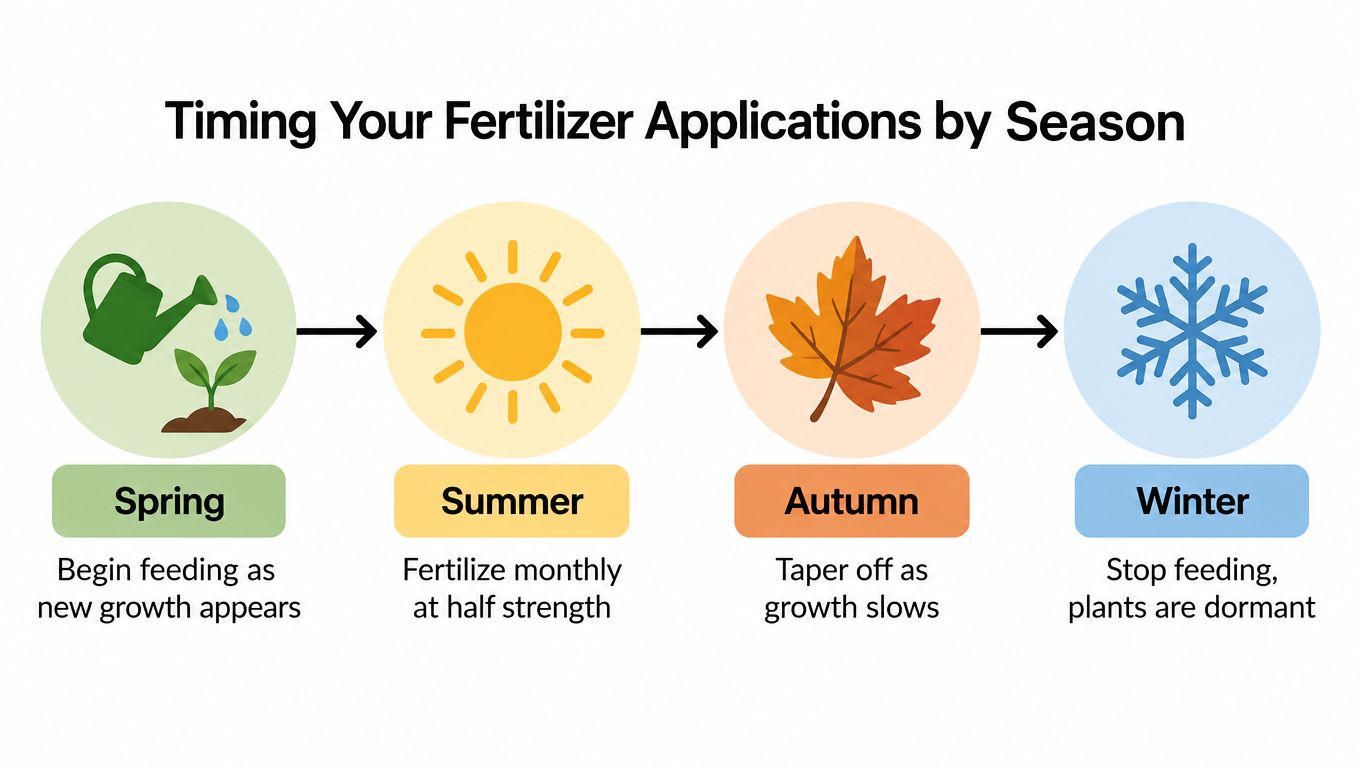
Succulent fertilizing belongs to the active growing season, not to a year-round houseplant calendar. For many plants, that means beginning in spring when new growth becomes visible, applying modestly through brighter summer conditions, and stopping as growth slows in autumn. Winter feeding should stop entirely when the plant is dormant.
Start with the plant, not the calendar
Spring is the right time to inspect roots, refresh compacted soil, and watch for signs that growth has resumed. New leaves, an expanding rosette, fresh offsets, or visible root activity are more useful signals than a date on the calendar. Once growth is clearly underway, you can consider a diluted application.
Summer can support feeding when the plant receives enough light and continues to grow. Some care protocols use a half-strength liquid feed every few waterings, while other guidance recommends feeding indoor succulents only about once a year, usually in spring. Epic Gardening's succulent fertilizing guidance reflects the broader consensus that indoor plants need restraint, while outdoor container plants may tolerate extra feeding during warmer growth.
Autumn is the tapering period. Don't keep applying fertilizer at the same rate just because the weather remains mild. If new growth slows, reduce or stop feeding. A plant that receives less light indoors may slow earlier than an outdoor plant, so room conditions matter as much as season.
Winter is the easiest decision. Don't fertilize a dormant succulent. Low light and cool conditions reduce growth and water use, leaving nutrients in the potting mix when roots aren't actively taking them up. That combination raises the risk of salt buildup and root stress.
For broader houseplant feeding principles, compare this seasonal approach with guidance on fertilizing indoor plants, then adapt the timing to the succulent's actual growth rather than copying a foliage-plant routine.
Choosing the Best Nutrient Formulations
The safest succulent fertilizer is usually low in nitrogen, measured easily, and simple to dilute. Don't choose a product because the label promises dramatic green growth. Succulents need nutrients, but their compact form and slow pace make aggressive feeding a poor match.
Fertilizer labels use an NPK analysis. A label marked 16-4-8 indicates 16% nitrogen, 4% phosphorus, and 8% potassium. The ratio helps you understand what the product emphasizes, but it doesn't tell you how much your particular succulent needs. Dose and frequency still matter.
Read the label with restraint
Low-nitrogen or balanced formulas are generally safer starting points than high-nitrogen foliage feeds. Excess nitrogen can produce stretched, weak growth and increase the risk of fertilizer burn. A balanced-to-phosphorus-leaning profile may suit container succulents better, provided you apply it at a reduced concentration.
Liquid concentrates offer control. You can mix a smaller dose for a single pot, observe the response, and stop quickly if the plant reacts poorly. The drawback is that measuring errors are easy, especially when growers pour by eye.
Slow-release granules are convenient because they release nutrients gradually, but they're less forgiving. Once mixed into the potting medium, you can't immediately remove each granule if the plant shows stress. They make more sense in a bright, actively growing container than in a dim room.
Organic amendments can be gentler, but “organic” doesn't mean risk-free. Compost, worm castings, and other materials can add nutrients and retain moisture, which may not suit a succulent mix that already holds water. Choose the medium and the plant's drainage needs before choosing the fertilizer format.
| Format | Best For | Burn Risk |
|---|---|---|
| Liquid concentrate | Growers who want precise, adjustable feeding | Moderate if mixed too strongly |
| Slow-release granules | Bright containers with reliable active growth | Higher if overapplied or used during dormancy |
| Organic amendments | Improving a suitable growing mix gradually | Variable, especially if the mix stays damp |
| Ready-to-use liquid | Occasional, measured applications | Moderate if applied too often |
A dedicated product such as DIY succulent fertilizer guidance can help you compare approaches, but the same principle applies to every brand: start weak, feed only when growth justifies it, and observe the plant afterward.
How to Dilute and Apply Fertilizer Safely
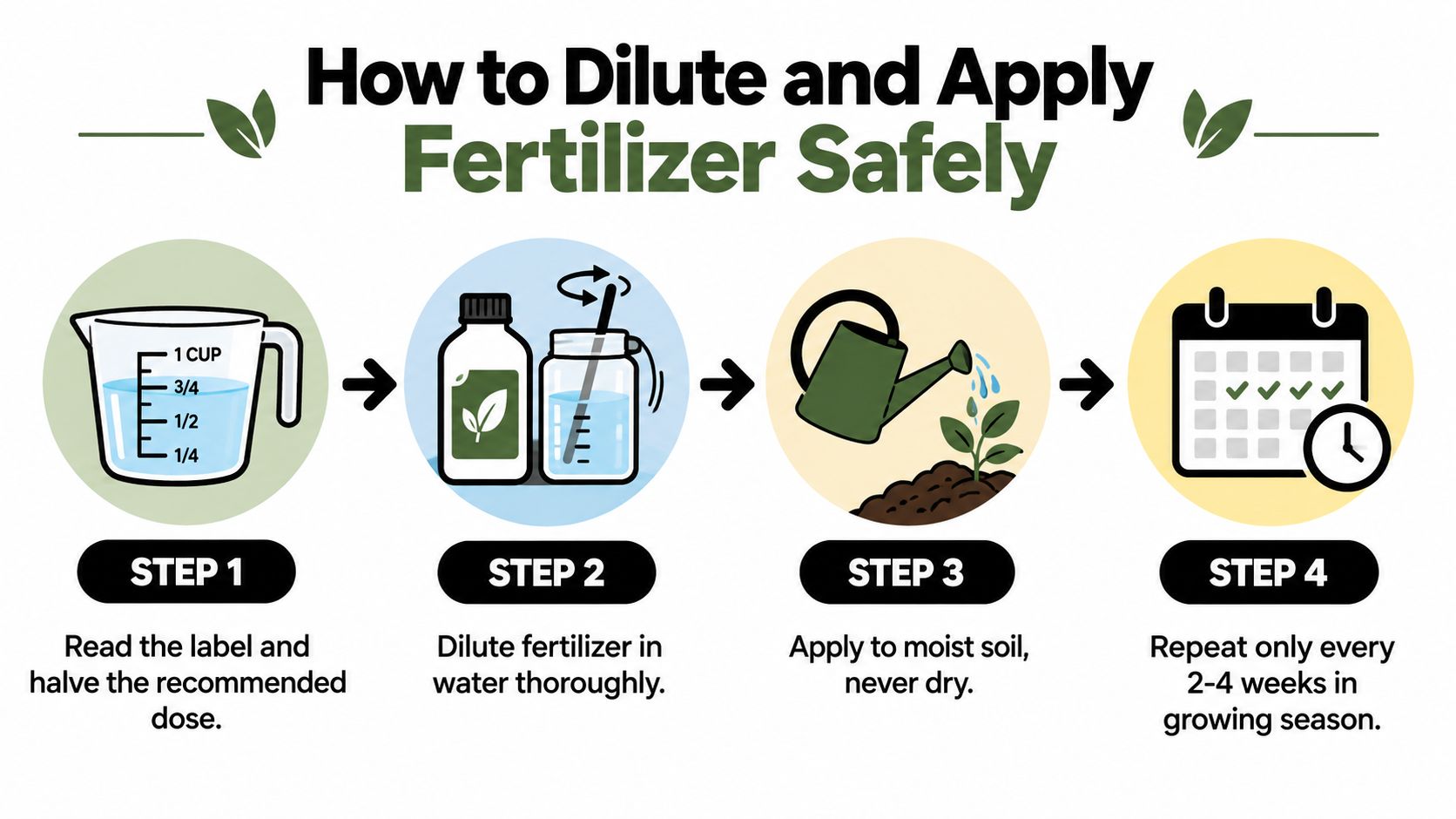
Even a suitable fertilizer can damage roots when applied at full strength. Extension guidance from Iowa State recommends cutting succulent fertilizer to one-half to one-quarter of the manufacturer's recommendation, or 25% to 50% of the labeled dose. Iowa State's indoor succulent guidance supports this reduced-strength approach for spring and summer feeding.
A safer feeding routine
- Confirm active growth. Don't feed a dormant plant, a freshly stressed plant, or one sitting in poor light. Look for new growth and normal water uptake.
- Flush with plain water first. Water the pot thoroughly with plain water so accumulated salts can move through the drainage holes. Let excess water drain completely. Applying fertilizer to bone-dry, salt-loaded mix gives the roots a concentrated chemical solution all at once.
- Measure the label dose, then reduce it. If the bottle recommends a full-strength amount, use half or less. For a plant in lower light, a quarter-strength application is the more cautious choice. Measure with a clean syringe, small measuring cup, or marked spoon rather than estimating.
- Mix thoroughly. Add the reduced amount to water and stir or shake until evenly distributed. Don't pour concentrated fertilizer directly onto the soil.
- Apply to moist mix. Spread the solution around the root zone without leaving the plant sitting in runoff. Avoid splashing concentrated solution onto leaves, especially in strong sun.
- Space applications widely. A common protocol uses a half-strength water-soluble feed every third or fourth watering, while other guidance favors monthly feeding or less. Treat those intervals as upper boundaries, not obligations.
The goal isn't to keep nutrients constantly available. It's to provide a small amount while the roots are active, then allow the potting mix to dry according to the plant's normal watering needs.
Salt management matters: A weak solution applied too often can still accumulate. Occasional plain-water flushing is part of the feeding routine, not an optional extra.
The alternative to liquid feeding is a single slow-release application at the start of spring. That option reduces measuring work but requires more caution because the nutrients remain in the potting mix. Never combine a strong liquid feed with slow-release granules unless you have a clear reason and a strong understanding of the plant's conditions.
Recognizing the Signs of Overfeeding and Underfeeding
Overfeeding usually announces itself more clearly than underfeeding. Look for crispy leaf edges, brown tips, white crusts on the soil surface, and a sudden decline after fertilizing. Those symptoms can indicate soluble salts concentrating around the roots, particularly in a small container.
Excess nitrogen creates a different pattern. New growth may become soft, elongated, or unusually green, while the plant loses the compact shape that made it attractive. If the plant is stretching, check light first, but if stretching follows repeated feeding, reduce or stop fertilizer as well.
Compare the symptoms before changing the routine
Underfeeding is more subtle. A succulent may show slow growth, but slow growth alone isn't evidence of deficiency. Many succulents naturally grow slowly, and a plant in low light won't use fertilizer efficiently even if nutrients are present.
Consider feeding only after checking the basics:
- Light: Is the plant receiving enough brightness to support new growth?
- Roots: Does the pot drain freely, or is the mix staying wet?
- Watering: Is the plant receiving a consistent wet-dry cycle suited to its species?
- Container: Has the mix become compacted or exhausted?
- Growth: Is there no progress during a period when the plant should be active?
If those conditions are sound and the plant remains weak or stalled, a cautious diluted feed may be reasonable. Don't respond to every cosmetic change with fertilizer. Older leaves can decline naturally, and color shifts may reflect light, temperature, or seasonal behavior.
South Dakota State University recommends active-season feeding with a water-soluble fertilizer diluted to half strength every three to four waterings, while also presenting a single slow-release application at the start of spring as an alternative. Its indoor succulent care guidance reinforces the central distinction, feed during active growth and avoid turning nutrition into a weekly reflex.
If you suspect fertilizer injury, stop feeding and flush the potting mix with plain water. Move the plant into suitable light, remove severely damaged material only when necessary, and wait for fresh growth before deciding whether it needs nutrition again. For a visual troubleshooting reference, see these signs of over-fertilizing plants.
Essential Rules for Long-Term Succulent Health
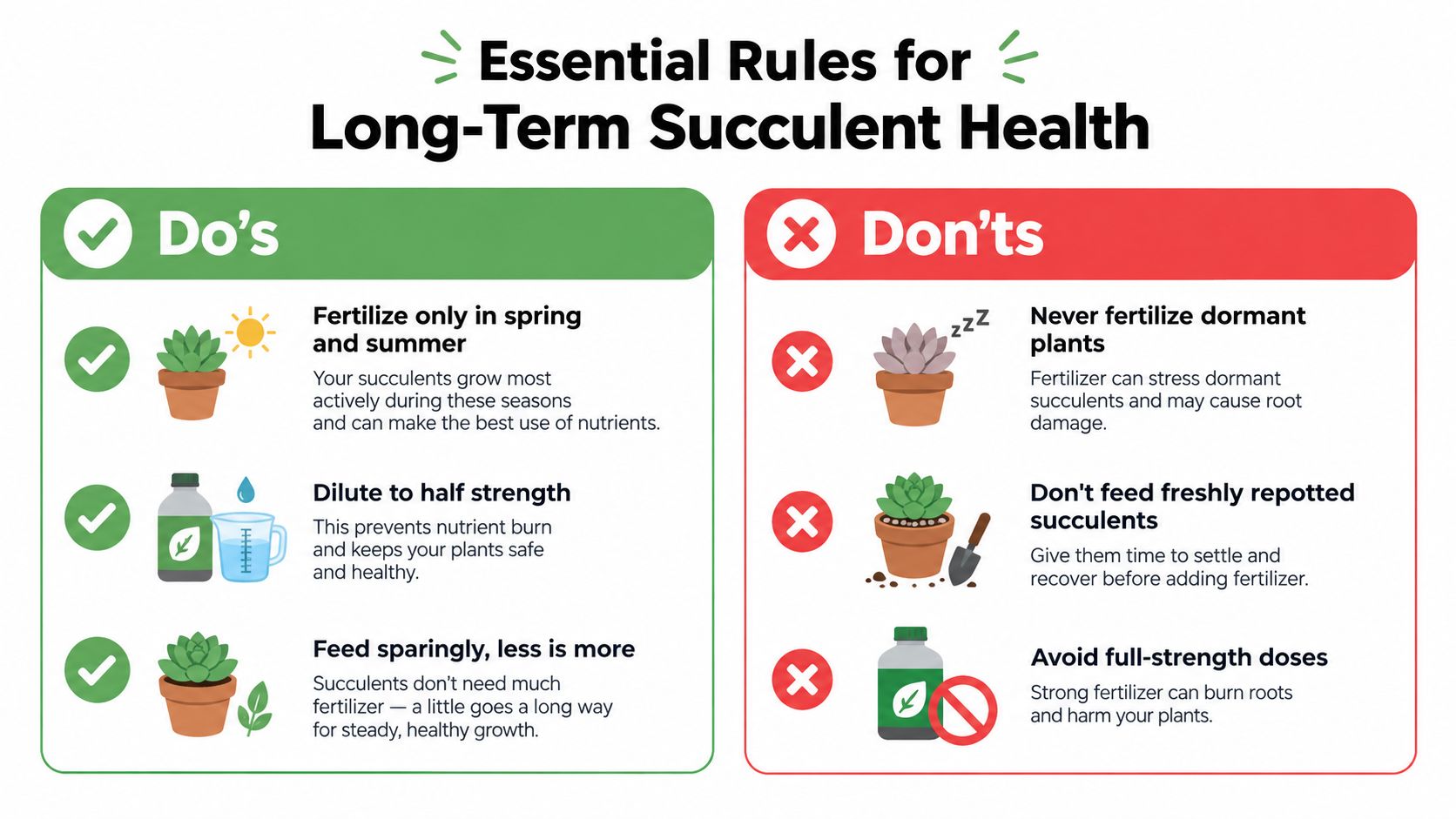
Succulent fertilizing works best as a response to conditions, not as a recurring household chore. Put light, drainage, and watering ahead of nutrition, then use the smallest effective dose when the plant is actively growing.
Keep this checklist near your fertilizer:
- Do feed active plants: Spring and summer growth are the appropriate windows.
- Do dilute heavily: Start at half strength or less, and use a quarter-strength dose when conditions are marginal.
- Do flush first: Plain water helps reduce accumulated salts before a nutrient solution reaches the roots.
- Do observe afterward: New growth, leaf firmness, and normal water use matter more than a calendar reminder.
- Don't fertilize dormant plants: Winter feeding adds risk without a clear growth benefit.
- Don't use high-nitrogen products casually: Fast, weak growth isn't a sign of successful succulent care.
- Don't feed a stressed plant: Correct light, drainage, watering, or root problems first.
- Don't assume monthly is mandatory: Indoor succulents may need only an occasional spring application.
Gardeners working in hot, dry regions can also compare succulent care with broader plant choices in this guide to drought tolerant plants for Texas. The same practical lesson applies: choose plants suited to the conditions, then avoid compensating for a poor environment with excessive inputs.
A succulent that grows slowly and stays firm may be doing exactly what it should. Respect that pace, feed only when the plant has the light and energy to use nutrients, and you'll avoid the most common fertilizer mistakes.
Leaves & Soul offers succulent and cactus fertilizers, professional growing media, liquid feeds, slow-release pellets, and soil amendments for indoor and outdoor plant care. If you're ready to replace guesswork with a measured feeding routine, visit Leaves & Soul and choose a product that fits your plant's growth conditions.