


You've placed a fiddle leaf fig beside the sofa, wiped its broad leaves clean, and stepped back to admire the room. The space feels taller, softer, and more finished. Then the practical questions arrive: Does it purify the air? Can it help with dry indoor air? Is the visual impact worth the care?
The honest answer is yes, but not in the same way for every benefit. A fiddle leaf fig delivers its strongest results as a statement plant, a layout tool, and a visible piece of living greenery. It can also contribute to a small, local humidity effect and support a more comfortable atmosphere. Its air-cleaning role, however, is much more limited in an ordinary home than popular plant lists suggest.
Why Homeowners Are Bringing the Fiddle Leaf Fig Indoors
A tall fiddle leaf fig can organize a living room. Set it beside a worn armchair, and it creates a natural reading nook. Place it near a window, and its upright trunk and oversized leaves soften the hard geometry of glass, walls, and furniture. Tuck it beside a sofa, and the plant can make an empty corner feel intentional rather than unfinished.
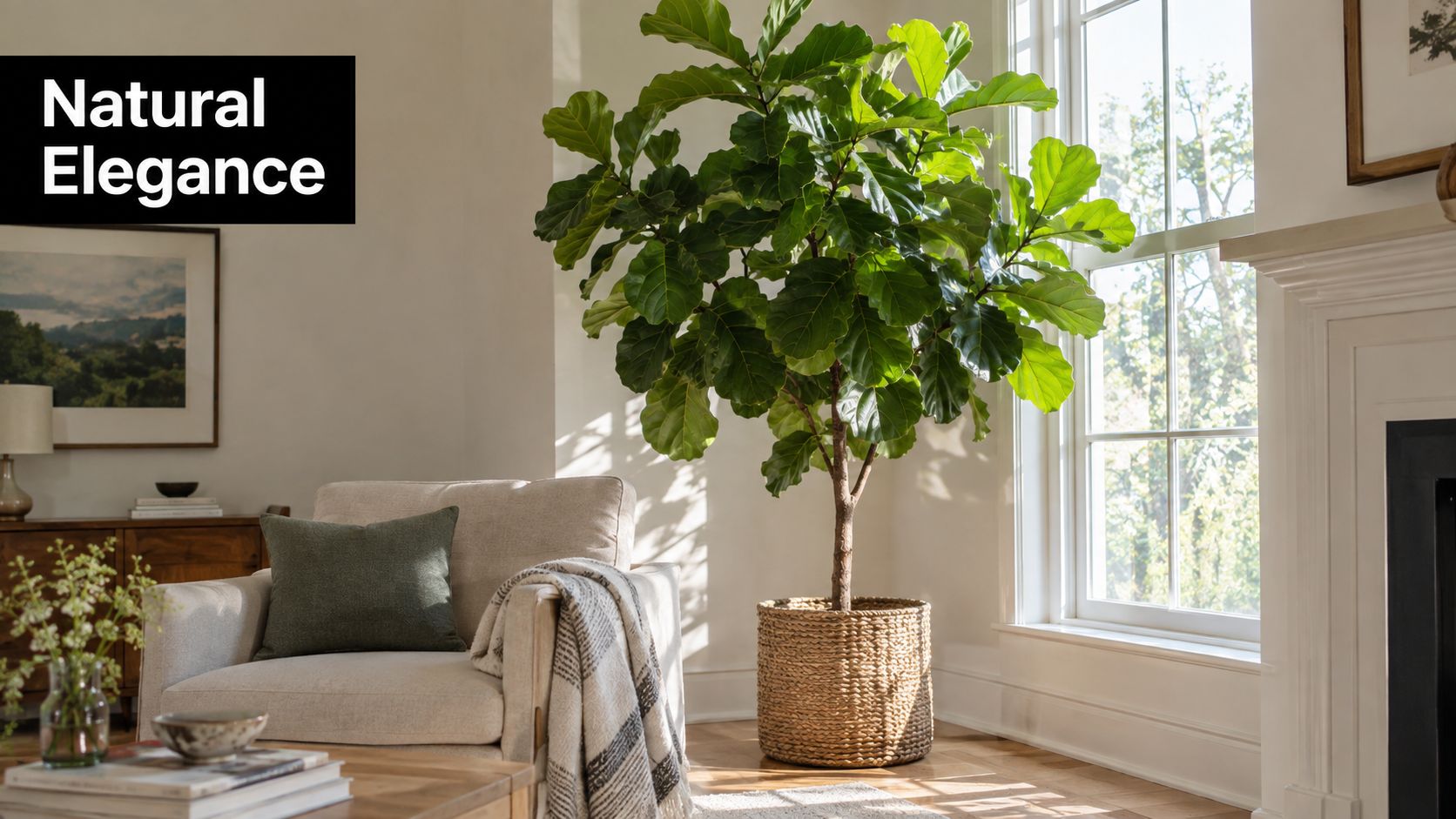
The most reliable fiddle leaf fig benefits fall into four groups:
- Visual impact: Large, glossy leaves and a tree-like form create a strong focal point without adding more furniture.
- Microclimate comfort: Leaves release water vapor, which may improve humidity close to the plant.
- Psychological value: Visible greenery and a small care routine can make a room feel calmer and more connected to nature.
- Practical styling: The plant can anchor a corner, frame a window, separate zones, or balance a tall blank wall.
The plant's popularity makes sense because it solves a common decorating problem. Many homes need height, softness, and visual movement, yet homeowners don't want another sculpture, lamp, or bulky cabinet. A healthy Ficus lyrata supplies all three through living form.
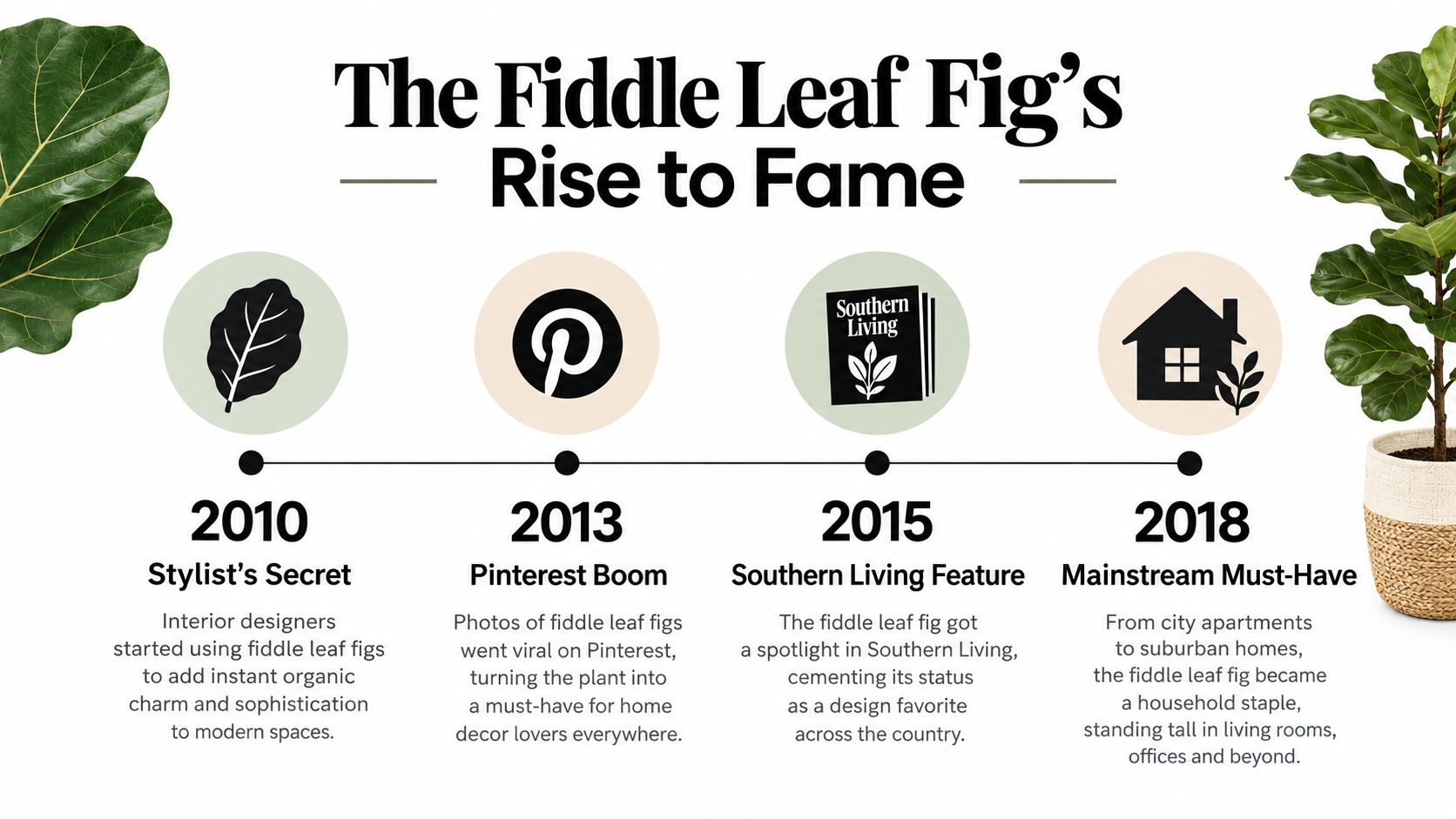
Its design reputation grew during a broader shift toward nature-inspired interiors. The New York Times described the fiddle leaf fig as the design world's “it” plant by 2016, connecting its visibility to Pinterest's launch in 2010 and IKEA's 2013 sale of small plants priced at $13.99 (The New York Times' history of the fiddle leaf fig). Those milestones helped move it from a specialty stylist's choice into rentals, offices, new builds, and styled apartments.
Practical rule: Treat the fiddle leaf fig first as a living design anchor, then consider its environmental effects as useful supporting benefits.
That framing prevents disappointment. The plant won't replace ventilation, solve a dry whole-home climate, or thrive in a dark corner because the pot looks good there. But in the right position, it can transform how a room looks and feels.
A Brief Look at the Design Icon's Rise
The fiddle leaf fig didn't become famous because it was easy. It became famous because its silhouette photographed exceptionally well.
Interior stylists began using the plant as a vertical counterpoint to low sofas, wide artwork, and clean architectural lines. Its leaves looked bold in editorial rooms and natural in otherwise restrained spaces. Pinterest, launched in 2010, gave homeowners a way to collect and repeat those interiors, while IKEA's sale of small plants in 2013 helped bring the broader houseplant trend into mass-market homes (The New York Times' account of the plant's rise).
By 2016, mainstream coverage was calling the fiddle leaf fig the “it” plant of the design world. Image-heavy interiors on Pinterest and Instagram reinforced the same visual formula: one tall plant, one bright room, and a simple container that made the leaves look even more architectural.
The plant also fitted the pandemic-era “green revolution” in home styling. As people spent more time indoors, houseplants became part of rooms designed for comfort, work, and wellness. A fiddle leaf fig offered something a small shelf plant couldn't: a sense of maturity and permanence.
Then came the backlash. Plant owners and creators began discussing the species' sensitivity to sudden changes, inconsistent watering, poor drainage, and insufficient light. That criticism didn't destroy its appeal. Instead, it gave the plant a more realistic role. Today, it's best understood as a high-payoff design anchor for attentive owners, not a carefree accessory.
If you're building a nature-led room and want ideas beyond a single potted plant, Galleryy's guide to botanical and landscape wall art ideas can help you layer living greenery with nature-inspired artwork. The combination works especially well when the wall art repeats the plant's organic shapes without competing with its leaves.
The Air-Purification Question What Science Actually Shows
The air-purifying reputation has a real historical foundation, but homeowners often apply laboratory findings too broadly.
The classic 1989 NASA research examined how indoor plants could remove volatile organic compounds, or VOCs, such as benzene and trichloroethylene in sealed chambers. That work helped popularize the idea that houseplants, including ficus species in later summaries, could clean indoor air. The controlled setup matters because a sealed chamber behaves very differently from a ventilated living room.
Later analysis from Drexel University researchers reported in 2019 that matching the air-cleaning effect of opening windows would require at least 10 plants per square meter of floor space, and possibly as many as 1,000 plants, depending on plant efficiency (a review of the indoor plant air-quality evidence). That finding doesn't mean plants have no effect. It means one fiddle leaf fig shouldn't be presented as a substitute for fresh-air exchange.
| Claim | What the Research Shows | Realistic Home Outcome |
|---|---|---|
| A fiddle leaf fig purifies a room | Plants can remove some VOCs under controlled, sealed conditions | A single plant may offer a modest supplemental effect |
| The plant replaces ventilation | Opening windows can exchange indoor air more effectively than relying on a small number of plants | Keep ventilation and source control as the primary strategy |
| More leaves automatically mean clean air | Results depend on plant efficiency, roots, soil microbes, airflow, and room conditions | A healthy plant contributes, but the effect varies |
| Any air benefit is meaningless | Phytoremediation can involve plant tissue, roots, and associated soil microbes | The mechanism is credible, but ordinary-home impact is limited |
A technical explanation called phytoremediation helps clarify the middle ground. Plants, roots, and soil microbes can metabolize or sequester pollutants such as formaldehyde and benzene, but the effect is strongest in controlled environments. An independent review also describes the overall effect of houseplants on everyday indoor air quality as small (peer-reviewed review of plants and indoor air quality).
For practical planning, improve ventilation, reduce VOC-emitting materials where possible, and use houseplants as part of a broader indoor environment. If you're comparing species, this guide to top plants for cleaner air offers a useful starting point, while this overview of indoor plants that purify the air naturally provides additional context.
Humidity and Microclimate Comfort Around the Plant
A fiddle leaf fig affects humidity through transpiration. Its leaves take up water through the roots and release some of that water vapor into the surrounding air. Stand near a large, healthy plant in a warm room, and the air immediately around it may feel slightly less dry.
That effect is local, not magical. Plant size, total leaf area, airflow, and room volume all determine whether you notice a difference. A single specimen beside a chair may create a gentler microclimate around that seating nook, but it won't humidify an entire open-plan home.
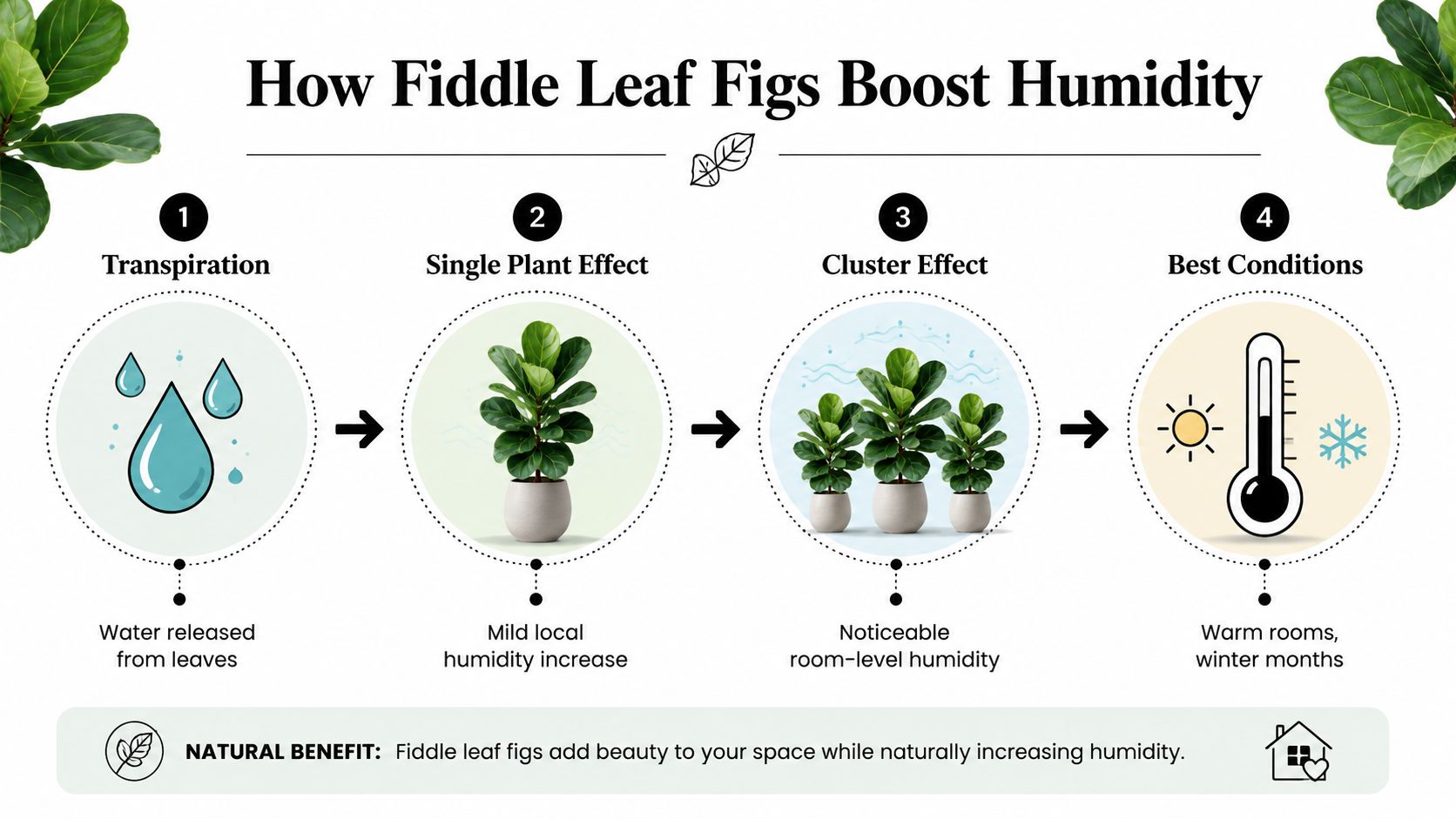
Broader houseplant research has found that combinations of potted plants can reduce room CO2 concentrations and increase relative humidity, although the result depends heavily on the environment (research on how houseplants influence indoor air quality). That makes grouping more useful than treating one pot as a whole-room appliance.
Where the effect is most useful
A dry winter living room, a bright bedroom, or a home office near a radiator can provide favorable conditions for a noticeable local effect. Keep the plant near, but not directly against, the area where you sit. Avoid placing it in the path of forced-air heating or cooling, because fast-moving dry air can stress the leaves and disperse moisture before it affects the immediate nook.
Try these adjustments:
- Group the fiddle leaf fig with other healthy tropical plants to increase total leaf area.
- Place a pebble tray beneath the pot, ensuring the container sits above the water rather than in it.
- Use a humidifier during especially dry periods if the room itself needs more consistent moisture.
- Maintain airflow, since excessive humidity around stagnant leaves can encourage fungal problems.
Brown, crispy edges can be an early sign that the surrounding conditions are too dry, although inconsistent watering, salt buildup, and direct sun can create similar symptoms. Check the soil and light before assuming humidity is the only cause.
The best expectation is modest: a fiddle leaf fig can support local comfort, especially when grouped with other plants, but it isn't a replacement for a room humidifier.
Psychological and Wellness Benefits You Can Feel
The wellness value of a fiddle leaf fig begins with what it changes in your attention. Its tall form draws the eye upward, while broad leaves break up a room's hard surfaces. In a busy living room, that organic shape can give your gaze a calmer resting point than a screen, stack of papers, or empty wall.
The plant also creates a visible care ritual. You notice a dusty leaf, check the soil, turn the pot slightly, or spot a new leaf unfurling. None of these actions is dramatic, but they give routine a physical focus. For someone working from home, that brief pause can separate the end of a task from the start of the next one.
A reading chair beside a fiddle leaf fig feels different from the same chair against a blank wall. An entryway plant can offer a softer visual welcome. At a desk, a glimpse of green may make the workspace feel less sealed off from the natural world. These are environmental and psychological benefits, not guaranteed medical outcomes, and the experience varies from person to person.
Turn visual greenery into a habit
Place the plant where you'll see it from the seat you use most. A beautiful specimen hidden behind a curtain can't provide much visual relief. Give the crown enough space that its leaves remain readable rather than pressed against a wall.
You can make care more mindful without turning it into a chore:
- Rotate the pot during a weekly reset. A quarter-turn helps distribute light and gives you a reason to inspect the leaves.
- Record new growth. A simple note or photo can make gradual progress visible.
- Pair care with an existing routine. Check the soil after watering another plant, cleaning the room, or finishing your workday.
The broader connection between indoor greenery and stress relief is explored in this practical guide to indoor plants for stress relief. The fiddle leaf fig adds a particular design advantage because its growth is easy to notice. A new leaf doesn't merely add greenery. It changes the plant's silhouette, which can create a small but satisfying sense of progress.
Practical Home Uses From Corner Anchor to Living Room Divider
A fiddle leaf fig earns its place most easily when it solves a layout problem. Before buying one, identify the empty or visually weak area you want to improve. Then match the plant's eventual shape with the room's light, circulation, and furniture scale.
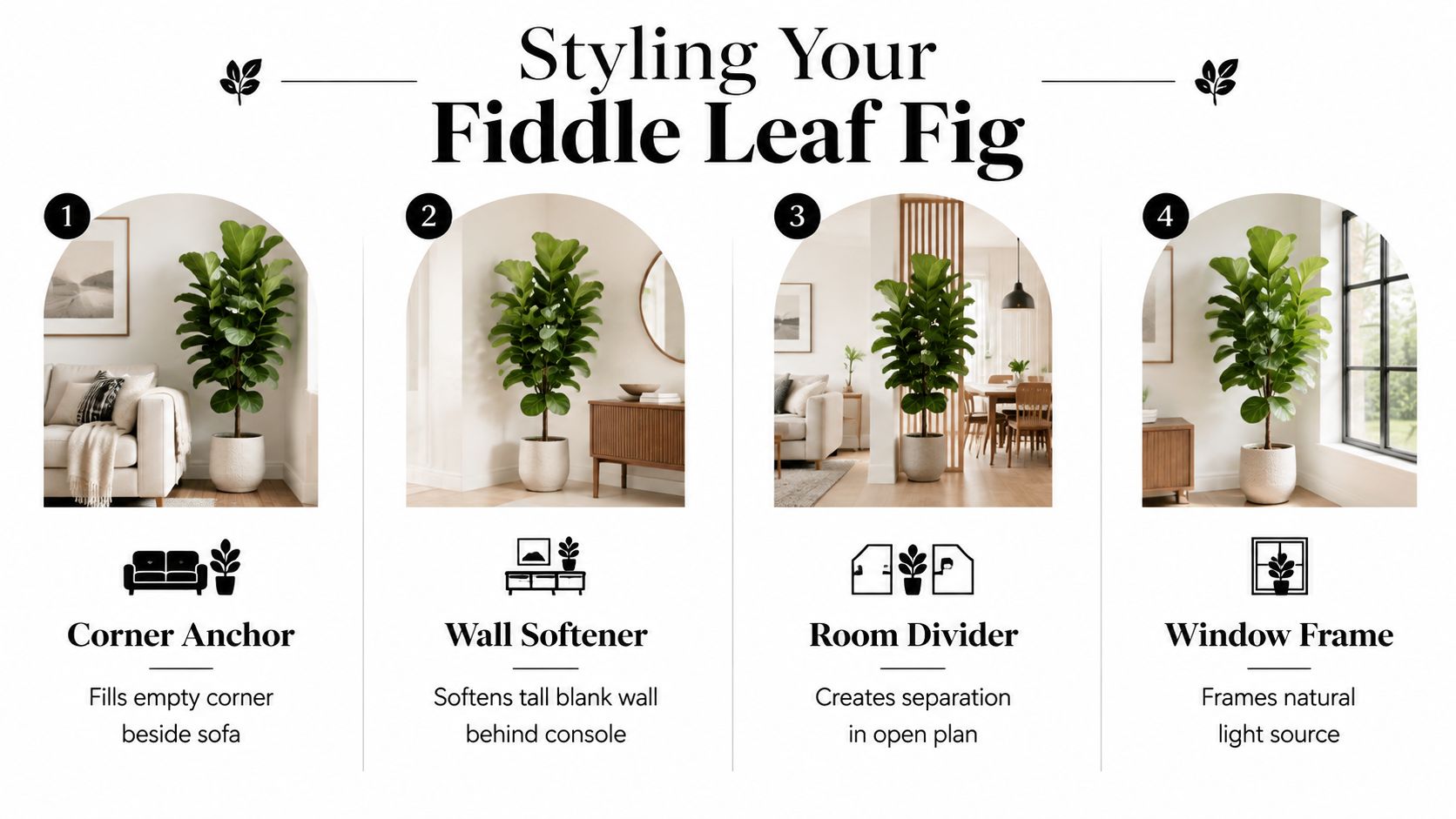
Four placements that work
Corner anchor. Beside a sofa or armchair, a tall plant fills vertical space without making the seating area feel crowded. Choose a stable container with a broad enough base, and keep the foliage outside the main walking path. Bright, filtered light near a window will support the dense crown that makes this placement effective.
Wall softener. A blank wall behind a console can feel severe when all the furniture is low. Place the fig to one side rather than directly in front of the console, leaving enough wall visible for balance. A woven basket adds texture, while matte ceramic gives the arrangement a cleaner contemporary line.
Room divider. In an open living and dining area, the plant can mark a transition without blocking sightlines. Use it to suggest separation, not create a solid barrier. Position it where light reaches both the foliage and the surrounding room, and avoid a narrow passage where leaves will be brushed.
Window frame. A fiddle leaf fig can emphasize a window's height and soften the boundary between indoors and outdoors. Keep the plant close enough to benefit from strong natural light, but watch for harsh direct rays that may scorch leaves.
Match the container to the room
A woven basket cover suits relaxed, layered interiors and hides a functional nursery pot. Plain terracotta brings warmth and a handmade feel, but it can dry faster and may need a waterproof saucer. Matte ceramic works well in minimal rooms, provided the plant remains in a pot with drainage or the decorative vessel safely accommodates one.
Avoid dark corners, drafty doorways, and positions directly behind curtains. At a nursery, inspect the underside of leaves for pests, check that the stems stand firmly, and look for fresh growth and evenly colored foliage. A plant that already suits your available light will reward you more reliably than a larger specimen forced into the wrong spot.
Care and Placement Habits That Protect Every Benefit
The plant's visual and microclimate benefits depend on one foundation: stable care. A fiddle leaf fig that loses leaves, leans toward a window, or sits in wet soil can't serve as a polished focal point.
Start with light. Give it bright, indirect light, such as the area near an east-facing window or a position several feet back from strong south-facing glass. The exact distance depends on the window, season, and curtain, so watch the leaves for scorch while making sure the plant still receives enough brightness for steady growth.
A simple weekly routine
Check the top two inches of soil before watering. If that layer is dry, water thoroughly and allow excess moisture to drain. Don't follow a rigid calendar, because pot size, soil mix, light, temperature, and airflow change how quickly the plant dries.
Rotate the pot by a quarter-turn during your weekly check. Clean broad leaves gently with a damp cloth when dust accumulates, and inspect both leaf surfaces for pests. Feed during active growth with a diluted balanced fertilizer according to the product label. Leaves & Soul's 16-5-11 Fiddle Leaf Fig and House Plant Fertilizer Pellets are one slow-release option designed for supplying nutrients to fiddle leaf figs and other houseplants.
Humidity support works best as a combination of sensible measures. Group plants, use a pebble tray beneath a draining pot, or run a humidifier when dry air persists. Keep air moving, and don't aim a heater or cooling vent directly at the crown.
Use the leaves as diagnostic signals:
- Brown edges: Check dry air, direct sun, watering consistency, and mineral or fertilizer buildup.
- Yellow lower leaves: Review watering frequency and drainage before adding more light or fertilizer.
- Leaf drop: Consider recent relocation, temperature swings, drafts, low light, or root stress.
For a fuller care reference covering soil, placement, watering, and feeding, use this guide to fiddle leaf fig care. Place the plant where you can see it from your usual seat, but keep it away from HVAC vents and cold drafts. That position protects the foliage while preserving the local comfort effect that makes a healthy plant more pleasant to live beside.
Is the Fiddle Leaf Fig the Right Plant for You
A fiddle leaf fig suits a home with strong natural light, enough vertical space, and an owner who enjoys steady routines. It's a good choice if you want one commanding plant rather than a crowded collection, or if your room needs height and softness more than another decorative object.
It may not be the right match for a dim apartment, a room dominated by heavy curtains, or a household where nobody can check soil moisture consistently. Frequent travelers should consider how the plant will be cared for during absences. Pet owners should also research its safety before bringing one home, since the plant's sap can irritate cats and dogs if they chew or ingest it.
Use this quick self-assessment:
- Do you have a bright position with stable light?
- Can you keep watering consistent without relying on a fixed schedule?
- Are you comfortable with occasional leaf drop after a move or environmental change?
- Will the plant remain visible, rather than becoming an afterthought in a dark corner?
- Do you have room for the crown to expand without blocking circulation?
If the answers are mostly yes, the fiddle leaf fig can be worth the attention. Its visual payoff is distinctive, its humidity contribution is modest but useful near the plant, and its presence can make everyday rooms feel more grounded. It rewards an attentive owner with a living focal point that changes gradually instead of going out of style.
Leaves & Soul offers purpose-built soils and plant nutrients for indoor growers, including products intended for fiddle leaf figs and other houseplants. Visit Leaves & Soul to explore soil blends, slow-release fertilizers, and practical supplies that can help you protect the plant's health and keep its benefits visible at home.