


You walk past your fiddle leaf fig, glance over, and there it is. A yellow leaf. Maybe just one. Maybe two. Maybe a whole lower section that looked fine a week ago and now suddenly looks tired, off, and a little alarming.
If you've been searching for answers, you've probably already run into the usual mess. One guide says water more. Another says water less. One blames fertilizer. Another says never fertilize a stressed plant. That confusion is part of why fiddle leaf fig leaves turning yellow feels so frustrating. The symptom is obvious. The cause usually isn't.
The good news is that yellow leaves are diagnosable. You don't need random tips. You need a calm process that tells you what to check first, what matters most, and what to ignore. That's how you stop making the plant's problem worse while trying to help it.
That First Yellow Leaf and the Panic It Causes
The first yellow leaf rarely looks dramatic on paper. In real life, it feels dramatic immediately.
A fiddle leaf fig usually isn't a throwaway plant. It's a statement plant, a corner-filler, the one you rotate carefully so it grows evenly and inspect more often than you'd admit. So when one leaf turns yellow, it's hard not to assume the whole plant is about to collapse.
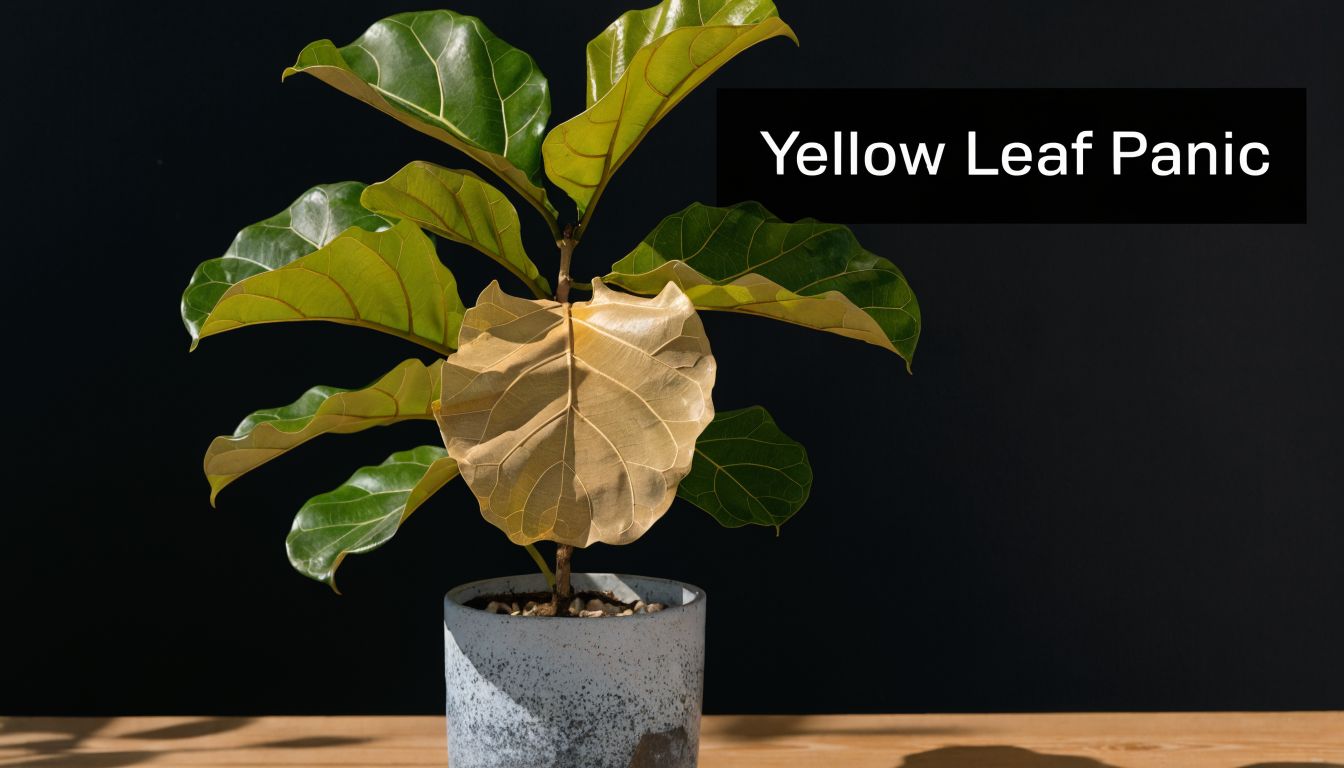
One yellow leaf doesn't always mean disaster
A small amount of yellowing can be normal. About 1 to 2 lower leaves naturally turning yellow and falling can be part of healthy aging, especially when the plant is redirecting energy into new growth, as noted by Rogers Gardens on common fiddle leaf fig issues.
That matters because people often react too fast to normal leaf drop and create a real problem by changing everything at once. They move the plant, change the watering routine, fertilize heavily, and repot in a panic.
The real red flag
The issue stops being minor when yellowing is widespread across old and new leaves. That's when the plant is signaling real stress, not routine aging.
Practical rule: Don't diagnose from one leaf alone. Diagnose from the pattern.
If your fiddle leaf fig leaves turning yellow are showing up across multiple levels of the plant, or if the newest leaves look weak, pale, or discolored, it makes sense to move quickly. The fix starts with identifying the cause before you reach for the watering can or fertilizer bottle.
Your Five Minute Fiddle Leaf Fig Diagnosis
Treat this like triage, not guesswork. The fastest way to help a yellowing fiddle leaf fig is to answer a few simple questions in order.
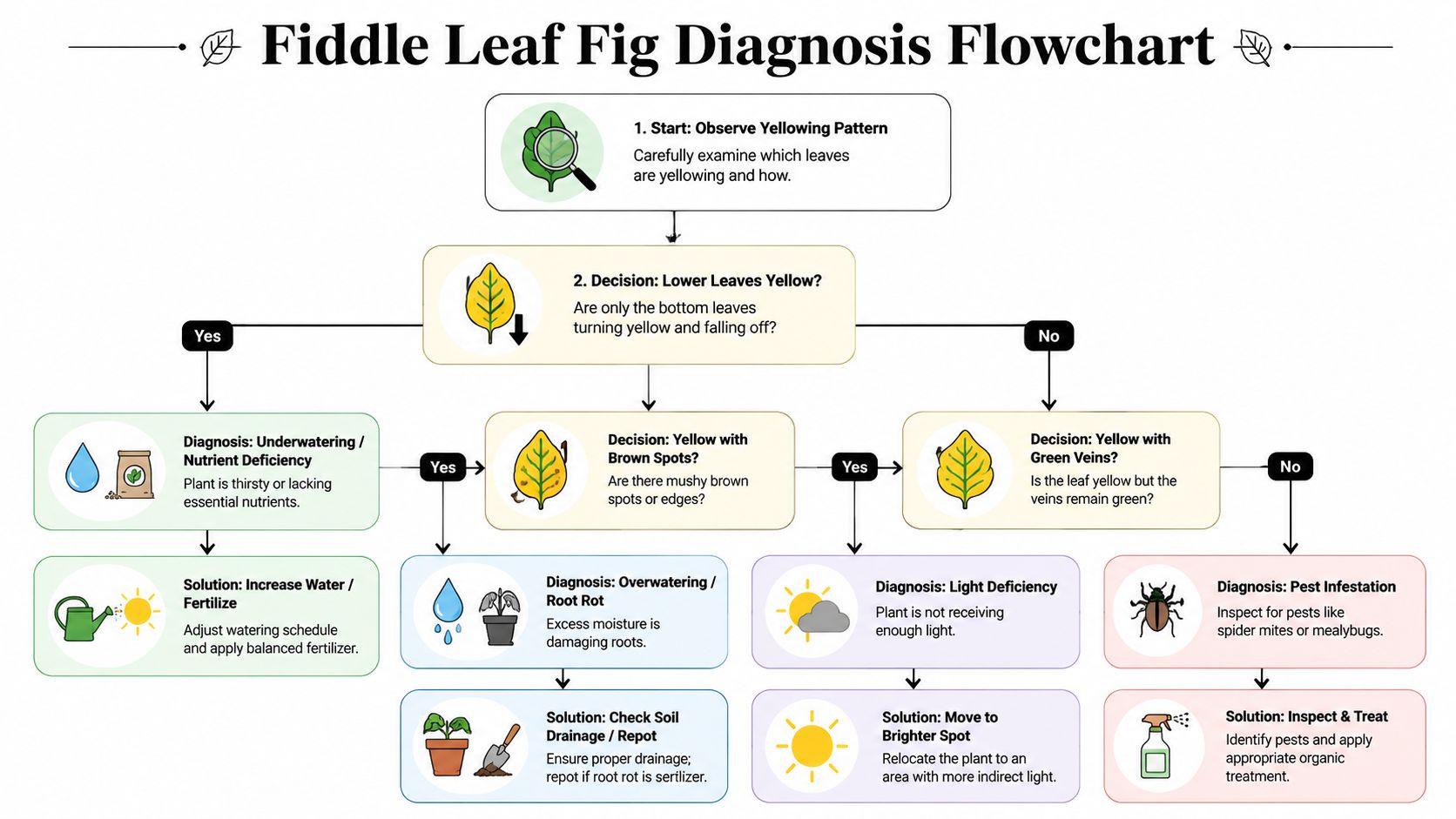
A structured diagnostic approach works because the main causes aren't equally likely. Yellowing is attributed to nutrient lockout from soil pH imbalance in 60 to 70% of cases, root rot from overwatering in 40% of cases, and low light in 30% of cases. Early intervention leads to an 85% recovery rate within 4 to 6 weeks, according to this diagnostic guide for yellow fiddle leaf fig leaves.
Question one: where are the yellow leaves?
Start by looking at location, not color intensity.
-
Only the bottom leaves are yellowing
This can point to normal aging, but it can also suggest watering inconsistency or nutrient stress if more than a small number are affected. -
Yellowing appears throughout the plant
Think bigger-picture stress. Water, root health, light, and soil chemistry move to the top of the list. -
New growth is yellowing
This deserves attention fast. New leaves usually show trouble when the roots can't function well or the plant can't access nutrients.
Question two: what does the yellowing actually look like?
Leaf color isn't enough. Texture and pattern tell you more.
| What you see | What it suggests |
|---|---|
| Solid yellow leaf that feels soft | Too much moisture or root stress |
| Yellow leaf with crispy edges | Drying out, inconsistent watering, or environmental stress |
| Yellowing between green veins | Often points to nutrient uptake problems |
| Yellow plus brown, mushy areas | Likely excess moisture and possible root rot |
Question three: what does the soil feel like right now?
This question rules out a lot of bad advice quickly.
Insert a finger into the soil past the surface. The most useful guideline is to water only once the soil dries to the second knuckle depth, which Rogers Gardens describes in its care guidance for fiddle leaf figs. If you want fewer judgment calls, use a moisture meter probe.
If the top layer looks dry but the root zone still feels wet, the plant is not ready for more water.
If the soil is soggy, dense, or sour-smelling, move overwatering to the top of your list. If it's bone-dry and pulling from the pot edges, the plant has likely gone too far between waterings.
Question four: how much light does it really get?
A plant can sit in a bright room and still not get enough useful light. That's especially common when it lives across the room from the window, behind curtains, or in a spot that only feels bright to us.
Low light often doesn't act alone. It usually teams up with poor watering habits and slow nutrient use. If you want a strong visual framework for symptom-reading before you move the plant or change care, this guide on how to read your plant's leaves like a pro is genuinely useful.
Question five: have you ruled out soil pH?
This is the missed step in a lot of yellow leaf troubleshooting.
If you're watering carefully and the light is decent, but the plant still looks chlorotic or stalled, soil pH may be blocking nutrient uptake. A fiddle leaf fig does best in a soil pH range of 6.0 to 7.0, and when soil becomes too acidic, nutrients can be present but unavailable to the roots.
Fast diagnosis summary
Use this short decision list if you're in a hurry:
- A couple of lower leaves only. Likely normal aging unless the pattern spreads.
- Soft yellow leaves plus wet soil. Think overwatering and root trouble.
- Yellowing with dry soil and crisp edges. Think underwatering or inconsistent watering.
- Yellowing despite decent water and light. Check feeding history and soil pH.
- Whole plant looks dull and stalled. Assume a care-system problem, not a single bad leaf.
Immediate First Aid to Stop the Yellowing
Once you've got a likely cause, act quickly but don't overcorrect. Most fiddle leaf fig rescues go sideways because the owner changes five variables at once.
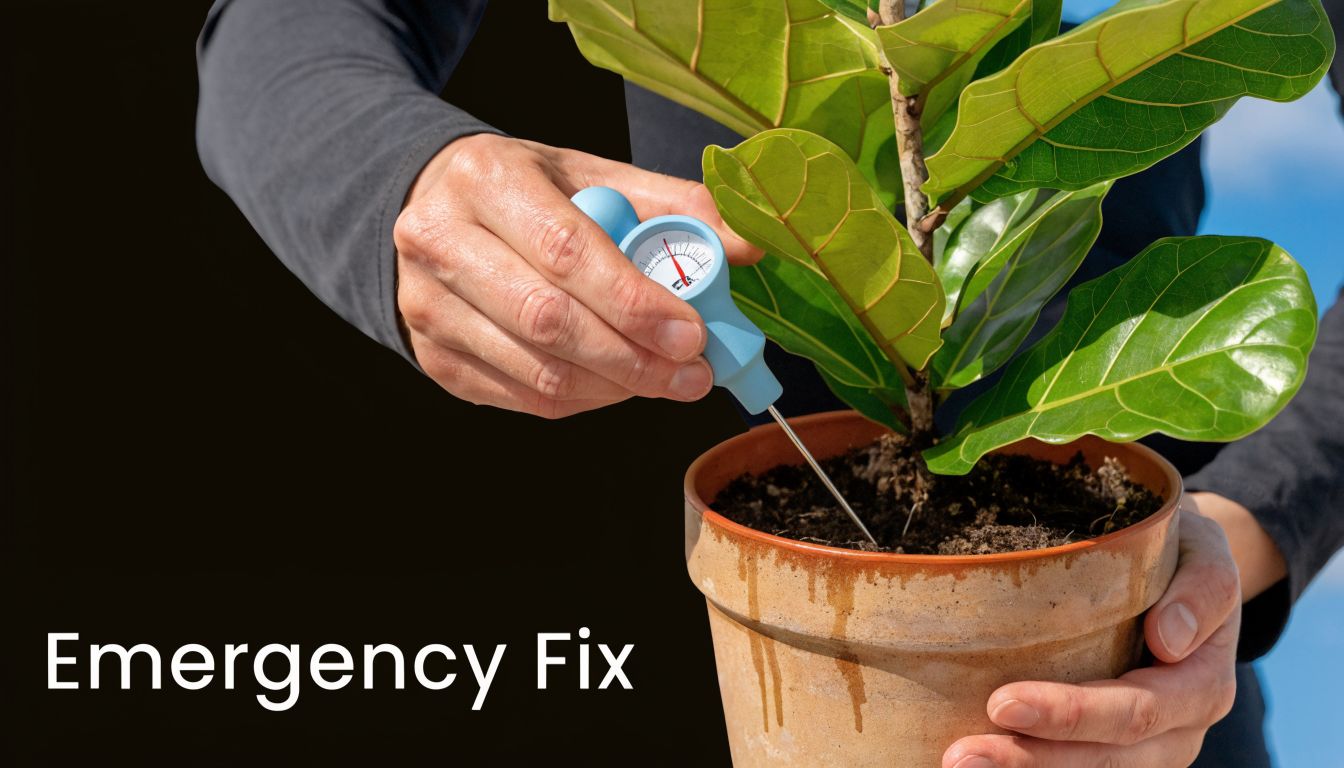
Overwatering is the single most prevalent cause of yellow leaves in fiddle leaf figs, and the best practice is to water only after the top two inches of soil have dried out, according to Rogers Gardens' fiddle leaf fig care advice.
If you diagnosed overwatering
Stop watering immediately. Then check whether the pot drains freely.
Do this next:
- Loosen compacted soil carefully with a chopstick or skewer. You're not stirring the root ball. You're creating a bit of airflow.
- Empty any cachepot or saucer that's holding runoff.
- Move the plant into brighter indirect light so the root zone can dry more evenly.
- Inspect the pot weight over the next few days. A pot that stays heavy for too long often means the mix is retaining too much moisture.
If the plant smells musty, the soil stays wet for days, or several leaves are yellowing at once, prepare for a root inspection rather than adding any fertilizer.
If you diagnosed underwatering
Don't give tiny sips. Rehydrate thoroughly.
Water until excess drains from the bottom, then let the pot drain fully before putting it back in place. Dry soil can become hydrophobic, so one quick pour isn't always enough. Sometimes it takes a slow, complete soak to reconnect the root ball with moisture.
If you suspect nutrient stress or pH lockout
Hold off on random feeding. Yellow leaves caused by nutrient issues don't improve from more product alone if the roots can't absorb what's already there.
Do these things first:
- Check your recent care history. Has the plant gone a long time without feeding during active growth?
- Assess the soil age. Older potting mix often becomes depleted and less cooperative.
- Get a pH test if watering and light look reasonable but yellowing continues.
This video gives a helpful visual reference for hands-on troubleshooting before you start repotting.
What not to do in the first hour
Don't repot, fertilize heavily, prune aggressively, and move the plant across the house on the same day.
That kind of rescue attempt often creates transplant stress on top of the original issue. Stabilize first. Then make one meaningful correction at a time.
Building a Long-Term Recovery and Prevention Plan
A recovering fiddle leaf fig doesn't need heroic care. It needs consistent care. The plants that bounce back best usually live in an environment where light, moisture, and nutrition are boringly predictable.
Get the light right first
Bright, indirect light solves more problems than people expect. A fiddle leaf fig in weak light uses water more slowly, grows more slowly, and becomes harder to read because every correction takes longer to show up.
If the plant is far from a window, move it closer in stages. A spot with strong ambient light for most of the day is usually far better than a dim corner that happens to be convenient.
Build a watering rhythm, not a schedule
Calendar watering causes trouble because your plant doesn't use water at the same rate every week. Season, room temperature, pot size, and soil type all change the pace.
A better routine looks like this:
- Check the soil, don't check the date. Finger-test before watering.
- Water thoroughly when it's time. Partial watering creates uneven root moisture.
- Let excess drain completely. Standing water undoes good intentions.
If you're still struggling with moisture swings, the potting mix may be part of the problem. A dense, slow-drying mix keeps roots wet too long. A very loose one can dry faster than your home allows for. This breakdown of fiddle leaf fig soil type is worth reading if your plant keeps cycling between soggy and thirsty.
Feed like the plant you're growing
Fiddle leaf figs are not light feeders. They require fertilization at least every other week during the spring and summer growing season, and a balanced 16-5-11 blend provides the nitrogen and magnesium needed to prevent chlorophyll breakdown and yellowing, as described in this Houzz discussion on yellow bottom leaves.
That matters because yellowing from nutrient stress often doesn't mean the plant is dying. It means the plant has started breaking down chlorophyll and reallocating resources. By the time leaves look pale, the plant has been running short for a while.
A stable routine that works
Here's the version I trust most in real homes:
| Care area | What works | What usually fails |
|---|---|---|
| Light | Consistent bright indirect exposure | Deep-room placement with hope |
| Water | Soil-based decision making | Watering every Saturday no matter what |
| Nutrition | Regular feeding in active growth | One random fertilizer dose after yellowing starts |
Healthy fiddle leaf figs usually improve because the owner becomes more consistent, not more intense.
Recovery also takes patience. Existing yellow leaves may not return to full green, even when the plant is back on track. The better sign is healthy new growth and a stop to the spread.
Advanced Care Pruning and Repotting
Pruning and repotting make people nervous because both feel irreversible. That's fair. They are intervention steps, not routine maintenance. But when a fiddle leaf fig keeps declining, these are often the moves that make a difference.
When pruning helps
If a leaf is fully yellow, badly damaged, or mostly dead, it's not doing useful work for the plant anymore. Remove it with clean scissors or pruners, cutting close to the stem without tearing tissue.
Keep the pruning selective. You're trying to reduce drag on the plant, not strip it bare.
A simple approach works best:
- Remove fully yellow leaves first because they won't contribute much going forward.
- Leave partially functional leaves alone if the plant is already stressed.
- Disinfect tools before and after so you don't spread problems from leaf to leaf.
When repotting is the right call
Repot when the roots or the soil are the issue. If the plant stays wet too long, smells sour, or has a compacted root ball that won't take up water evenly, fresh soil can be the reset it needs.
Open the pot and inspect carefully. Healthy roots are firm. Black, mushy roots need trimming before repotting.
Soil quality matters more than pot size
A lot of people assume yellowing means the plant needs a bigger pot. Often it needs a better potting mix, not a bigger container.
Repotting into the wrong soil just gives the same problem more room.
One overlooked reason yellowing continues after fertilizing is soil pH imbalance. Fiddle leaf fig soil should sit between 6.0 and 7.0, and when the mix becomes too acidic over time, roots can't absorb available nutrients properly, as explained in this video on soil pH and fiddle leaf fig yellowing.
If you're preparing to repot, this guide on the science of repotting and how to do it right is a practical reference.
A no-drama repotting checklist
- Choose a pot with drainage. Non-negotiable.
- Remove old soil gently if rot or compaction is present.
- Trim compromised roots with clean tools.
- Use a well-draining, pH-aware mix rather than generic heavy potting soil.
- Water in lightly and monitor instead of drowning the plant after repotting.
After repotting, don't expect instant cosmetic improvement. Watch the new growth. That's the true report card.
When Your Plant Needs a Lifeline Beyond Home Care
Sometimes the plant is telling you more than a home fix can handle. If yellowing is spreading quickly, multiple leaves are dropping, roots are badly rotted, or you also see signs of pests, it may be time to stop improvising.
Pests can complicate the picture because they weaken the plant while mimicking watering or nutrient problems. Sticky residue, webbing, cottony clusters, or distorted new leaves point away from a simple care issue.
At that stage, bring the plant to a local nursery or experienced houseplant shop for an in-person diagnosis. A second set of eyes is useful when several stressors are stacked together.
There is also a point where starting over is the sensible choice. That isn't failure. If you've learned how to read soil moisture, evaluate light accurately, and pay attention to soil condition instead of reacting to every yellow leaf, you'll do much better with the next plant.
Frequently Asked Questions About Yellowing Leaves
A few questions come up almost every time fiddle leaf fig leaves turning yellow starts stressing someone out.
Quick Answers to Common Questions
| Question | Answer |
|---|---|
| Can yellow fiddle leaf fig leaves turn green again? | Sometimes mild chlorosis improves, but fully yellow leaves often don't recover completely. Focus on stopping the spread and improving new growth. |
| Should I cut off yellow leaves right away? | Remove leaves that are fully yellow or clearly failing. Leave partly green leaves if the plant is already under stress and still getting some use from them. |
| Is one yellow bottom leaf normal? | Yes, a small amount of lower leaf loss can be normal aging. Worry when the yellowing spreads or affects many leaves at once. |
| Should I water more when leaves turn yellow? | Not automatically. Yellowing can come from too much water, too little water, or nutrient uptake problems. Check the soil first. |
| Why is my plant yellowing even though I fertilize? | Soil pH may be off, the roots may be stressed, or the light may be too weak for the plant to use nutrients properly. |
| What's the best tool to avoid guesswork? | A moisture meter is helpful, especially if you're prone to overwatering or your potting mix dries unevenly. |
The main thing to remember
Yellow leaves are a symptom, not a diagnosis. The best caretakers don't react to color alone. They look at leaf position, soil moisture, root condition, light, and soil quality before making a move.
If you're calm and methodical, most fiddle leaf fig problems become much easier to fix.
If your fiddle leaf fig needs better support from the roots up, Leaves & Soul offers purpose-built soils and fertilizers for houseplants, including blends made specifically for fiddle leaf figs. It's a solid place to find professional-grade growing media and plant nutrition without overcomplicating your setup.