


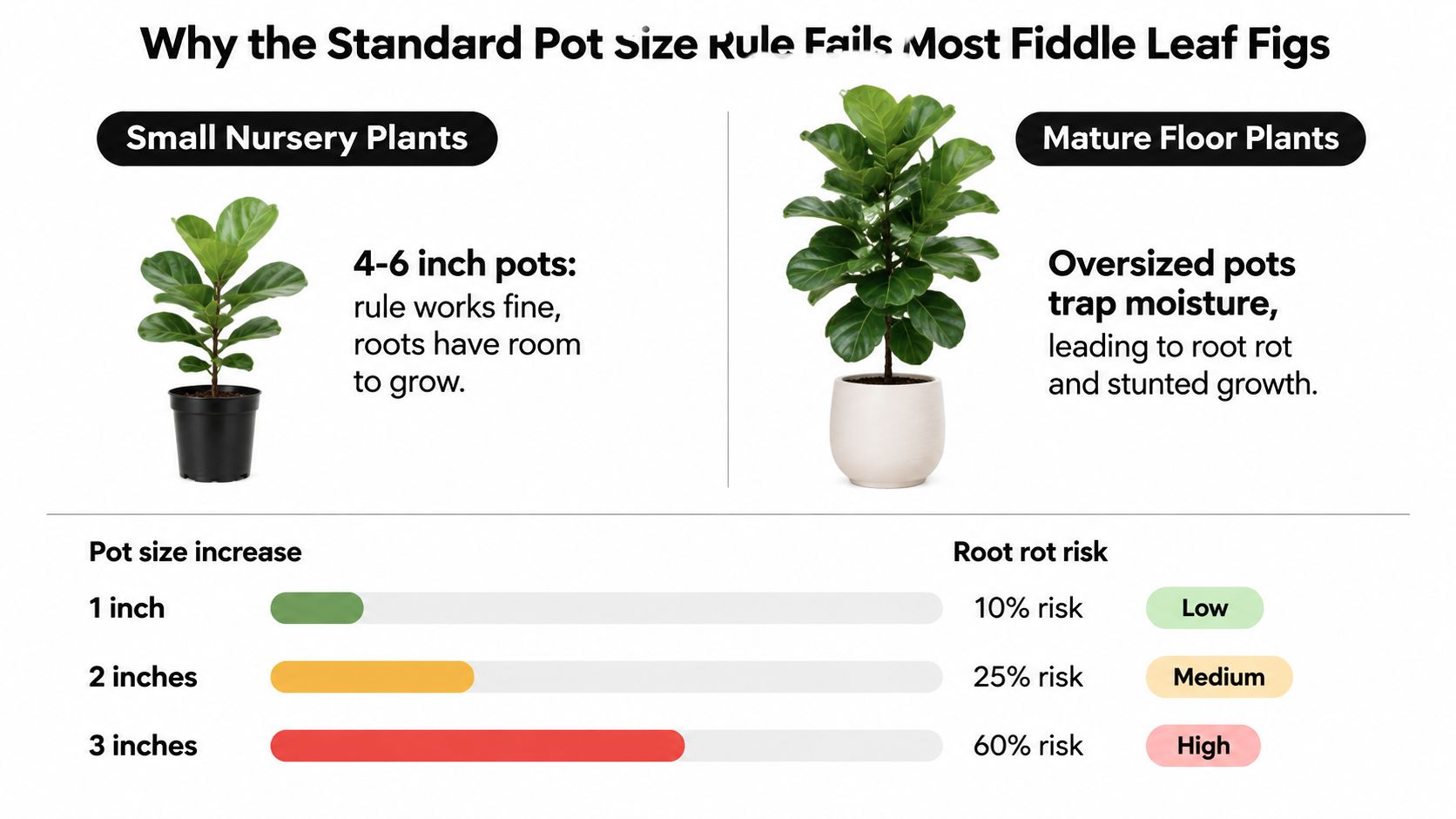
Most fiddle leaf fig advice starts with the same command: move the plant into a pot only 1 to 2 inches wider. That rule works for a small nursery plant with a compact root ball. It becomes poor advice when you're handling a tall floor tree, a top-heavy trunk, or a severely root-bound plant that already dries out too fast.
The right fiddle leaf fig pot size depends on more than the current container diameter. You need to consider root-ball width, root occupancy, plant height, trunk stability, soil volume, drainage, and how quickly the mix dries in your room. A modest increase is usually safer, but mature trees sometimes need a deliberate change in both diameter and depth.
Use the guide below as a grower's framework, not a decorative pot-shopping shortcut. Measure first, choose second, and let the roots determine how much fresh soil your plant can handle.
Why the Standard Pot Size Rule Fails Most Fiddle Leaf Figs
The popular small-step rule is incomplete rather than wrong.
For smaller fiddle leaf figs, increasing container diameter by 1 to 2 inches usually works. Larger specimens are often moved up no more than 2 to 3 inches to limit excess wet soil around the roots, as described in this fiddle leaf fig transplanting guide. That method suits a young plant with a dense, manageable root ball and enough room for gradual expansion.
Mature floor trees require a different reading of the problem. A tall fiddle leaf fig with a heavy canopy may need greater soil volume, a deeper container, or a broader base for stability. A stressed, root-bound plant may need root pruning and only a modest replacement pot. Diameter gives you one measurement. Root occupancy, root-ball depth, plant height, trunk size, and drying speed determine the usable pot volume.
Match the pot to the plant's actual job
A container has three jobs:
- Support the tree: A tall trunk and broad canopy need a stable base that resists tipping.
- Hold an appropriate root zone: The pot should contain the existing roots with a reasonable band of fresh mix, not a large empty reservoir.
- Dry at a workable pace: Unoccupied soil stores moisture without giving the plant useful growing space.
Practical size charts commonly pair plants under 2 feet with 6 to 8 inch pots, plants from 2 to 4 feet with 10 to 12 inch pots, plants from 4 to 6 feet with 14 to 16 inch pots, and plants 6 feet or taller with 18 to 22 inch pots. Use those ranges as a starting point, then adjust for root occupancy and trunk stability.
My rule: Give a small plant a small step up. Give a tall tree enough volume and ballast to stay upright, while keeping unused soil low enough for the root zone to dry.
For furniture styling, a correctly scaled planter makes a large plant look intentional rather than crowded. This guide to trendy houseplants for new furniture offers useful visual context. Choose the decorative outer planter after determining the internal pot size, never the other way around.
Measure the Root Ball Before You Pick a Pot
Don't carry the plant to the garden center and guess. Remove the root ball first, because the roots tell you whether the plant needs space, pruning, or a smaller replacement container.
Choose a calm day when the soil is slightly moist. Bone-dry mix may crumble away from the roots, while saturated soil can make the root ball heavy and difficult to inspect. If the container is flexible, squeeze the sides. If it's rigid, tip the plant carefully while supporting the trunk near the soil line.
Use this measuring sequence
- Slide out the plant. Support the root mass rather than pulling hard on the trunk.
- Measure the widest root-ball diameter. Measure across the broadest point, not the old pot's rim.
- Measure root-ball height. Record the distance from the base to the top of the soil-covered roots.
- Inspect the root pattern. Look for firm roots, mushy sections, circling roots, and loose soil.
- Choose the smallest container that solves the problem.
For a smaller container, target a new diameter roughly 1 to 2 inches wider than the root ball. For a larger specimen, a slightly broader increase can be appropriate when the existing roots occupy the container densely, but don't jump to a dramatically larger planter just because the tree is tall. Some guides recommend moving up only when roots fill approximately 70 to 80% of the current pot, and they advise choosing a container around 2 to 3 inches wider than the root ball. This pot-size and root-occupancy guidance also highlights why oversized containers can keep unused mix wet.
Read the root signals correctly
- White or firm circling roots: The plant is using the available space. Upsize modestly and loosen the outer roots.
- A dense, solid root mass: The plant may need root pruning rather than a much larger pot.
- Loose soil falling away: The plant may not have occupied the current container. Replace it with a similar-size pot or only a small step up.
- Brown, soft, foul-smelling roots: Remove damaged tissue and correct the wet conditions before adding more volume.
For a useful explanation of what root-bound means and how to recognize it, review this root-bound plant guide. Measure depth as carefully as diameter. The new container should provide fresh mix beneath the root ball without burying the trunk or leaving a deep reservoir of empty soil.
Pot Size Charts by Plant Height and Trunk Size
Height gives you a quick starting point, but trunk thickness decides whether a tall plant will stand securely. A bushy young fiddle leaf fig may look proportionate in a smaller pot, while a narrow single-stem tree can become unstable even when its roots haven't filled the container.
The reference ranges below combine commonly used height-based guidance with practical container progression. They should narrow your search, not override the root-ball measurement.
Height-based reference chart
| Plant Height | Trunk Caliper | Pot Diameter | Approx. Volume |
|---|---|---|---|
| 1 to 2 feet | Fine young stem | 6 to 8 inches | Starter range |
| 2 to 3 feet | Young to moderate stem | 10 to 12 inches | Small floor range |
| 3 to 5 feet | Moderate stem | 10 to 14 inches | Young adult range |
| 5 to 7 feet | Thickening stem | 14 to 16 inches | Large indoor range |
| 7 to 10 feet | Mature trunk | 18 to 20 inches | Mature floor range |
Independent care references commonly converge around 10 to 14 inch pots for young adult plants and 16 to 20 inch pots for mature specimens. One reference describes a full-grown plant near 10 feet in a container about 18 inches wide and 24 inches deep, while also favoring substantial depth for extensive roots. See the mature fiddle leaf fig pot guidance for that broader comparison.
Trunk-based stability guide
| Plant Height | Trunk Caliper | Pot Diameter | Approx. Volume |
|---|---|---|---|
| 1 to 2 feet | Slender | 6 to 8 inches | Compact |
| 2 to 4 feet | Noticeably firm | 10 to 12 inches | Moderate |
| 4 to 6 feet | Thick or branching | 14 to 16 inches | Heavy base preferred |
| 6 to 8 feet | Thick single stem | 16 to 18 inches | Deep, stable container |
| 8 to 10 feet | Mature floor tree | 18 to 20 inches | Broad, heavy container |
These rows overlap on purpose. When the height chart and trunk chart point to the same range, follow the root ball and choose that range. When they disagree, prioritize root occupancy for moisture management and add stability through a heavier planter, cache pot, or discreet brace rather than filling the container with unnecessary soil.
Pot Material and How It Changes Your Size Choice
The same diameter doesn't behave the same way in every material. A porous terracotta pot allows more evaporation through its walls, while plastic and glazed ceramic retain moisture longer. That difference changes how much soil volume your fiddle leaf fig can safely occupy.
Compare the common materials
| Material | Porosity | Dry-Down Time | Stability for Tall Trees | Size Adjustment |
|---|---|---|---|---|
| Terracotta | High | Faster | Moderate if thick and heavy | Consider a smaller size |
| Glazed ceramic | Low | Slower | Strong | Use measured size, avoid excess volume |
| Plastic nursery pot | Low | Slower | Low unless placed in a heavy cover pot | Follow root-ball measurement closely |
| Fiberglass | Low | Slower | Good when weighted | Don't oversize for appearance |
| Self-watering planter | Low to moderate, depending on design | Reservoir-controlled | Often stable | Scale down in dim rooms |
Terracotta can give you a wider margin against stagnant moisture, but it also dries the outer root zone quickly. For that reason, I often choose a slightly smaller terracotta container than I would choose in plastic, particularly in a room with modest light or inconsistent watering.
Glazed ceramic is my default for tall floor trees. It provides useful ballast without forcing you to use an oversized internal soil volume. Use a draining nursery pot inside the decorative vessel when you want easier inspection and controlled watering.
Treat self-watering systems as conditional
Self-watering planters aren't automatically safer. In bright, warm rooms with a highly aerated mix, a reservoir can work well. In dim conditions, the plant may use water slowly, leaving the lower zone persistently wet.
Material decision: Bright light and fast dry-down can support more volume. Dim light, cool conditions, or a moisture-retentive mix require a smaller root zone.
Before buying clay, read this practical discussion of the benefits of clay pots versus plastic. The important choice isn't the finish. It's how the material changes oxygen availability, watering frequency, weight, and the time the mix stays wet.
Repotting a Fiddle Leaf Fig Without Triggering Root Rot
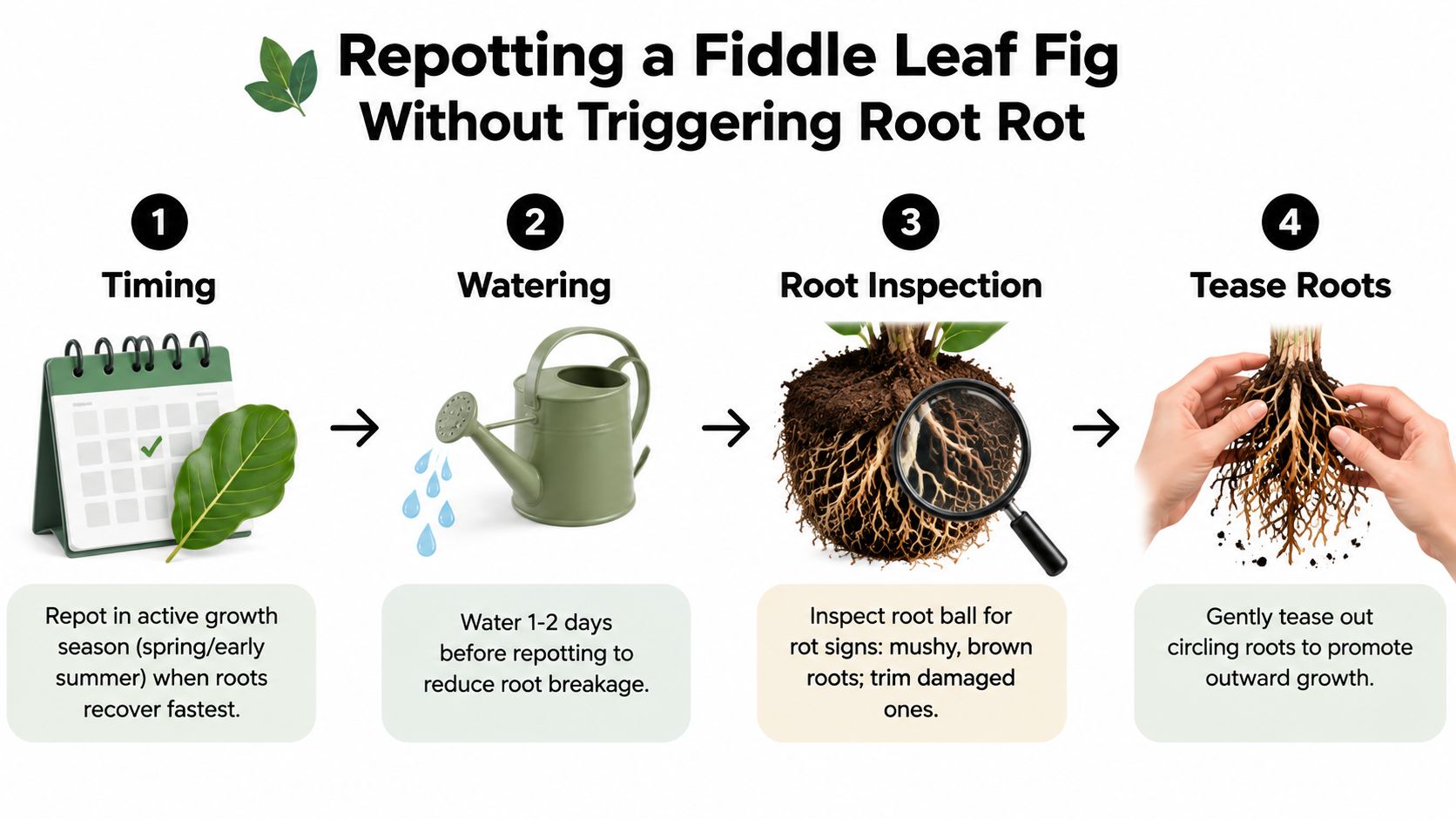
Repotting is not routine maintenance. Do it during active growth, preferably in spring or early summer, when light, warmth, and new root growth support recovery. A stable plant does not need a larger container because a decorative pot looks better.
Prepare a draining container, fresh mix, clean snips, a support stake if needed, and a surface that can handle spilled soil. Water the plant 1 to 2 days before repotting. The root ball should hold together, not arrive saturated.
Follow the root-first process
- Remove the plant gently. Tip the container while supporting the root ball. Never pull on the trunk.
- Inspect before cutting. Keep firm roots. Remove mushy, dark, decayed sections with sterilized snips.
- Loosen only the outer roots. Tease circling roots with your fingers. If the exterior is tightly wrapped, make a few shallow vertical cuts. Do not shred the entire root ball.
- Set the planting height. Keep the trunk at its original soil line. Extra buried stem creates a damp, vulnerable crown.
- Backfill lightly. Fill gaps around the root ball and press only enough to stabilize the plant.
- Water thoroughly once. Let excess water drain completely, and never leave the pot standing in runoff.
Use a loose blend that drains while retaining moderate moisture. My practical recipe is 5 parts indoor potting mix, 2 parts perlite, and 3 parts pine bark or coco coir, with pine bark for slower dry-down and coco coir when the room dries quickly. Mix the ingredients evenly before planting. Skip gravel in the base. It reduces usable soil depth and does not correct poor drainage.
Control the first weeks after repotting
After the initial soak, wait until the top 2 inches of mix have dried before watering again. This pause lets new roots enter the surrounding media instead of keeping the full container wet.
Place the plant in bright, consistent light, while avoiding harsh exposure for 1 to 2 weeks as it settles. Skip fertilizer for at least a month. Fresh mix and disturbed roots do not need an immediate nutrient push. Brace a tall tree if the trunk shifts, because disturbed roots can lose contact with the new soil.
For diagnosis after repotting, use this guide to root-rot signs and fixes. The recurring mistakes are clear: choosing a pot with too much unused soil, over-loosening healthy roots, watering repeatedly because leaves droop, and raising the soil line around the trunk. Each one keeps the root zone wetter or less stable than the plant can tolerate.
Troubleshooting Signs Your Pot Size Is Wrong
A fiddle leaf fig usually tells you when the container and root zone don't match. Don't diagnose from one yellow leaf or one drooping afternoon. Look at the combination of soil moisture, root condition, stability, and growth.
| Symptom | Likely Cause | Fix |
|---|---|---|
| Lower leaves yellow while soil stays soggy | Too much unused soil volume or poor drainage | Move down a size if roots are sparse, and replace wet mix |
| Plant wilts quickly and water runs straight through | Root-bound mass or severely dry channeling | Inspect roots and up-pot modestly, or root-prune before replanting |
| Trunk leans or the tree topples | Container lacks ballast or canopy exceeds the base | Add a heavier cache pot, brace the trunk, or choose a stable container |
| Roots form a mat on the surface or exit the drainage hole | Roots have occupied the available space | Upsize modestly and loosen the outer root mass |
| Growth slows despite suitable light and feeding | Root restriction, compacted mix, or root damage | Inspect the roots and refresh soil without automatically increasing pot size |
Separate a root problem from a watering problem
Yellowing with wet soil points toward excess moisture, not an urgent need for more space. A larger pot would add even more damp mix. Check the roots first and reduce the container volume if the root ball hasn't occupied the existing pot.
Fast wilting and water racing through the drainage hole suggest the roots may have filled the container or that the mix has pulled away from the sides. In that case, increase the pot only after confirming a dense root mass. If the roots are sparse, rehydrate and refresh the mix without upsizing.
Solve top-heaviness structurally
A leaning tree doesn't always need a bigger pot. A heavy glazed cache pot, a discreet stake, or a more stable location may fix the problem without exposing the roots to unnecessary moisture. If the plant has clearly outgrown the container, combine a modest size increase with a heavier base.
Don't treat every symptom with a larger pot. First identify whether the missing resource is root space, dry-down speed, or physical ballast.
A Quick Pot Size Checklist You Can Reuse
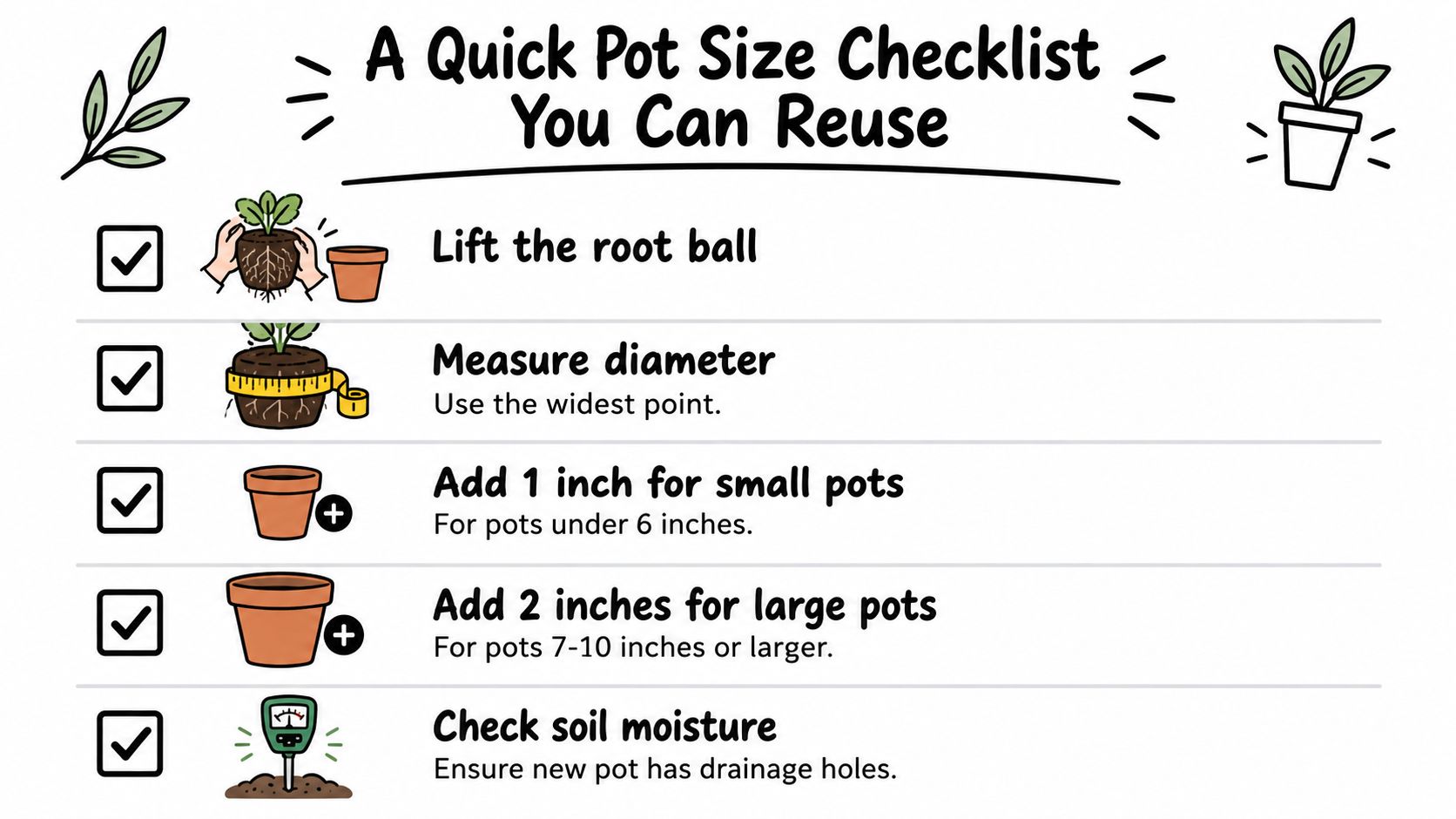
A larger planter is not automatically safer. Use this checklist to match the container to the root ball, available soil volume, and tree's stability.
Your reusable sizing checklist
- Lift the root ball: Inspect the roots before choosing a new diameter. The planter's appearance is secondary.
- Measure the widest point: Measure across the root ball, not across the old pot.
- Add a modest amount: Choose about 1 inch for smaller pots and around 2 inches for larger pots. This gives expanding roots room without surrounding them with excess wet mix.
- Check depth: Add fresh mix beneath the roots only as needed. Keep the trunk at its original soil line.
- Match height and stability: A container near one-third of the plant's above-soil height can look balanced, but root occupancy and trunk weight decide the size. A tall tree may need a heavier base rather than a much larger root container.
- Confirm drainage: Every drainage opening must release water freely.
- Blend the mix first: Use the mix ratio from the repotting section to create an airy root zone.
- Water once after planting: Soak the mix thoroughly, let excess water drain, then wait until the top 2 inches dry.
- Skip fertilizer: Leave disturbed roots unfertilized for at least 30 days.
Keep checking the pot after repotting. Lift it every few weeks. A lighter container usually means the mix has dried and may be ready for water, while a heavy container means you should wait and inspect the soil. Re-measure the root ball annually instead of assuming the tree needs a larger home.
For purpose-built soil amendments and fiddle leaf fig nutrients, Leaves & Soul offers mixes, fertilizers, and related indoor gardening supplies, including fiddle leaf fig and houseplant pellets. Visit Leaves & Soul to compare products with your plant's root space and watering routine.
Measure the root ball, select the smallest container that allows healthy expansion, and use a heavier outer pot when stability is the problem. Remember: pot size should match the roots, not the room.