


You're standing in the garden center with a cart, a few empty pots, and a row of soil bags that all seem to promise the right answer. Should you grab one small bag, two large ones, or something in between? The answer to how much potting soil do I need starts with your containers, not the label on the bag.
A pot is a three-dimensional shape. Measure its length, width, diameter, and fill depth, then convert that space into quarts or cubic feet. Once you know the volume, you can choose bag sizes with much less guesswork. The process is easier than it sounds, and planning a few minutes before shopping can prevent a second trip, an unfinished planting project, or a pile of unused mix taking up space in your shed.
Why Estimating Potting Soil Matters Before You Buy
Most gardeners have made the same garden-center mistake. You look at a planter, estimate that it needs “about a bag,” and load soil into the car. At home, the bag runs out before the container is filled, or you discover that you bought far more mix than the project requires.
That guesswork creates two problems. Buying too little interrupts planting when the roots are ready to go into their new home. Buying too much leaves you with heavy bags to store, and opened mix can become damp, messy, or difficult to use later. A simple volume estimate gives you a more practical shopping list before you spend money.
The underlying idea is geometric. A rectangular planter is measured as length × width × fill depth. A round pot uses the space inside a cylinder, calculated as π × radius² × depth. A tapered flowerpot needs a truncated-cone calculation because its top and bottom have different widths. These formulas are explained in detail in the next section, but you don't need advanced mathematics. You need a tape measure, a calculator, and measurements taken from the inside of the container.
Practical rule: Measure the space you plan to fill, not the decorative shape you see from outside.
A useful estimate follows three steps:
- Measure the pot: Record inside dimensions and decide how much headspace you'll leave below the rim.
- Calculate volume: Convert the measurements into cubic inches, quarts, gallons, or cubic feet.
- Match the result to bags: Compare your total with the bag sizes available at the store, then round up sensibly.
If you're planning an entire planting area as well as individual pots, a best free garden design software tool can help you organize container locations and plant choices before you buy materials. For a single planter, a calculator and a scrap of paper are enough.
The goal isn't to fill every pot to the brim. You want enough suitable mix for the root zone, space for watering, and a small allowance for settling. Once you treat each container as a measurable shape, the shelves of soil bags become much easier to understand.
The Simple Math Behind Pot Volume
Start with the shape that causes the most confusion, the round pot. A straight-sided round container is a cylinder, so use π × radius² × depth. Measure the diameter across the inside of the pot, divide it by two to get the radius, and measure the fill depth from the bottom to the planned soil line.
For a 12-inch-diameter pot filled to a depth of 10 inches, the radius is 6 inches. The calculation is approximately 3.14 × 6 × 6 × 10, or about 1,130 cubic inches. Since one U.S. gallon contains roughly 231 cubic inches, that works out to about 4.9 gallons. A tapered pot with the same top diameter may hold less because its base is narrower.
A rectangular window box is more direct. Multiply length × width × fill depth. A 24 × 8 × 8-inch box contains 1,536 cubic inches, which is approximately 6.6 gallons. If the box is tapered, use the actual inside width at the top and bottom rather than treating it as a perfect rectangle.
| Pot Shape | Formula | Measurements Needed | 12 in Round × 10 in Tall Example | 24 × 8 × 8 in Window Box Example |
|---|---|---|---|---|
| Round cylinder | π × radius² × depth | Inside diameter and fill depth | About 1,130 cubic inches, or about 4.9 gallons | Not applicable |
| Rectangular planter | Length × width × depth | Inside length, width, and fill depth | Not applicable | 1,536 cubic inches, or about 6.6 gallons |
| Tapered pot | Truncated-cone formula | Top radius, bottom radius, and depth | Use top and bottom widths for a more accurate result | Use top and bottom widths if the box flares |
Tapered flowerpots use the formula ((1/3) × π × depth × (r² + r × R + R²)), where r and R are the smaller and larger radii. You don't need to calculate this by hand every time. The pot size chart for different plants can help you connect container dimensions with plant needs, while a potting-soil calculator can handle the arithmetic once you enter the measurements.
Leave room for watering
Don't automatically use the outside height of the pot as the fill depth. Measure from the inside bottom to the intended soil line, and leave headspace below the rim so water doesn't spill over during watering. The verified guidance for estimating potting soil specifically emphasizes measuring inside dimensions and accounting for container shape, rather than relying on a one-size-fits-all estimate (potting soil volume guidance).
For a straight-sided pot, subtract the space you plan to leave empty from the inside height before calculating. Also remember that a root ball displaces some mix. Calculate the container's usable volume first, then make a modest allowance for the plant and for settling after watering.
Turning Volume Into the Right Bag
Once you have a total in gallons or cubic feet, compare it with the package sizes on the shelf. Potting mix commonly comes in 8-quart, 12-quart, 1-cubic-foot, 1.5-cubic-foot, 2-cubic-foot, and 3-cubic-foot bags (standard potting-soil sizing). A practical conversion is that 1 cubic foot equals about 7.5 gallons, so a 2-cubic-foot bag contains roughly 15 gallons of loose mix.
The table below uses approximate conversions to make shopping easier. Bag counts are planning estimates, not guarantees, because brands compress mix differently and containers vary in shape.
| Total Volume Needed | Approx. Cubic Feet | Small Bags (8 qt) | Standard Bag (1 cu ft) | Large Bag (2 cu ft) | Typical Use Case |
|---|---|---|---|---|---|
| 2 gallons | About 0.27 | About 2 | A small portion | Not needed | One small houseplant |
| 5 gallons | About 0.67 | About 5 | One bag | Not needed | One medium round pot |
| 10 gallons | About 1.33 | About 10 | About 2 bags | One bag | Several small containers |
| 15 gallons | About 2 | About 15 | About 2 bags | One bag | A larger container group |
| 22 gallons | About 2.9 | About 22 | About 3 bags | About 2 bags | A long box or mixed pots |
For example, the 12-inch round pot calculated earlier needs about 4.9 gallons before accounting for headspace, root-ball displacement, and settling. One 1-cubic-foot bag gives you roughly 7.5 gallons, so it should provide a workable amount for that container with some mix left over. Three pots of that approximate size would need close to 15 gallons before adjustments, making one 2-cubic-foot bag a practical starting point.
Choose for cost and handling
Large bags usually offer more volume per package and can reduce packaging and handling. They can also be awkward to lift, difficult to pour neatly, and inconvenient if you have only a few indoor plants. Smaller bags cost more per unit of mix in many stores, but they make sense when you need a limited quantity or don't have a dry storage area.
A 1.5-cubic-foot bag can fill about twelve 12-inch flower pots, according to the verified potting-soil guidance (flower-pot filling reference). Treat that as a useful retail benchmark rather than an exact promise, since pot shape, headspace, and plant root balls change the result.
Buy enough to cover the calculated volume, then add a small allowance for settling and the mix that remains around the root ball. Rounding up is safer than rounding down, but don't buy an entire extra large bag when a small bag or a few quarts will cover the difference.
Matching Soil Type to Your Plants
The volume calculation tells you how much space to fill. It doesn't tell you which material belongs in that space. Plant-specific substrate strategy matters because a moisture-retentive houseplant mix behaves differently from a coarse orchid medium or a gritty cactus blend.
Tropical houseplants generally suit a light, moisture-retentive potting mix that still drains freely. Leave the planned headspace and avoid packing the mix tightly. For succulents and cacti, a gritty blend containing materials such as perlite or pumice takes up part of the recipe, so the amount of finished mix you prepare still needs to equal the usable pot volume. You're not reducing the container size. You're changing what goes into each scoop.
Bonsai mixes are often granular and contain materials such as akadama, lava, and pumice. They may settle and pack differently from a peat-based mix, and bonsai products are frequently sold by the quart or liter rather than by the cubic foot. Orchids commonly use bark-based media with large air gaps, so a bag of bark doesn't compare directly with the same labeled volume of a fine potting blend.
| Plant Type | Typical Mix | Density / Air Space | Volume Adjustment vs. Standard Potting Soil |
|---|---|---|---|
| Tropical houseplants | Moisture-retentive peat-based mix with drainage material | Fine to medium texture | Calculate the usable pot volume, then leave watering headspace |
| Succulents and cacti | Gritty blend with perlite or pumice | More open and fast-draining | Use the full finished-mix volume, accounting for the amendment ratio |
| Bonsai | Granular akadama, lava, and pumice | Granular, with structured air spaces | Buy by the quart or liter when that matches the product packaging |
| Orchids | Coarse bark-based medium | Large air gaps between pieces | Compare finished media volume rather than assuming it behaves like peat |
Calculate the dry finished mix volume you need, then allow extra for settling, top-dressing, and gentle compression during watering. Don't mistake an amendment for a substitute for the whole root zone. If you add mycorrhizal products or biochar, follow the product directions and include them within the blend rather than piling unrelated materials into the pot.
A decorative container can also affect how you prepare the planting setup. If you're placing a nursery pot inside a boho style macrame planter, calculate soil for the draining inner pot, not the outer cover. For broader container-growing guidance, see this resource on choosing soil for container gardening.
Buying and Prepping Soil Without Waste
A pot doesn't need to be filled to the rim. Leaving headspace below the rim gives water somewhere to collect briefly while it soaks into the mix, and it reduces spills over the edge. Don't compress dry soil forcefully to make more fit. Fill gently, settle the plant, water thoroughly, and add mix if the level drops.
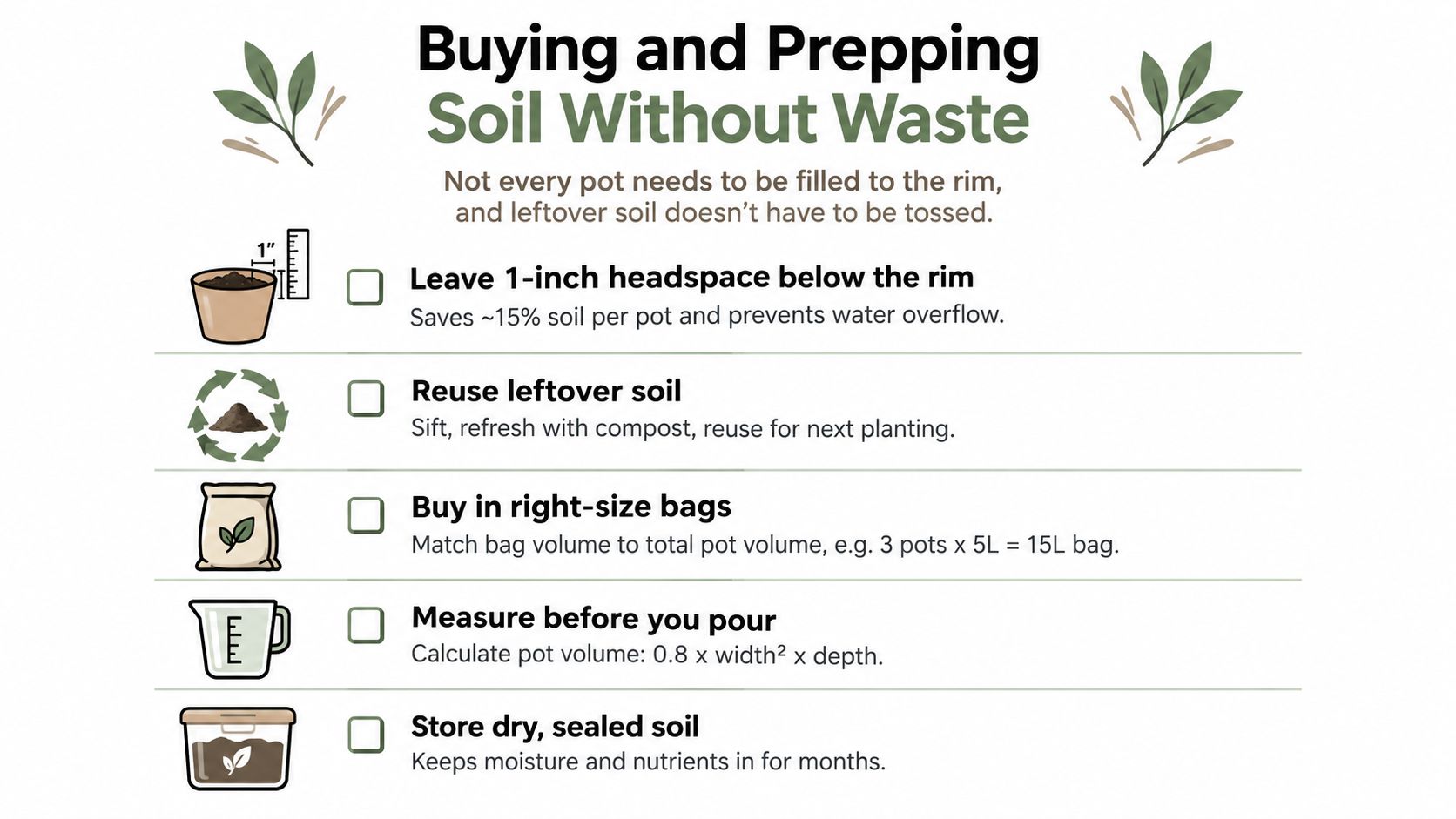
Leftover mix doesn't automatically belong in the rubbish. Screen old mix to remove roots and debris, check its smell and texture, and refresh it when appropriate before reusing it. Most houseplant mixes can be refreshed periodically, while a container that held a disease-prone crop should receive fresh mix rather than passing possible pathogens to the next plant. For more warning signs, use this guide on how to tell if potting mix has gone bad.
Store opened bags carefully
An opened bag can retain excess moisture and create conditions that attract unwanted pests. Seal the bag tightly or transfer the mix to a lidded bin, garbage can, or other clean container, then keep it in a dry shed or sheltered storage area. Avoid leaving soil bags open on a damp patio.
Before shopping, write down:
- Pot count: Include every container you plan to fill now, not just the largest one.
- Inside measurements: Record diameter, length, width, and usable fill depth.
- Drainage setup: Check whether each pot has a drainage hole and whether an inner liner changes the volume.
- Plant list: Match tropical plants, succulents, orchids, bonsai, and vegetables with suitable media.
- Bag options: Compare the total volume with quarts and cubic-foot sizes already available.
Compressed products deserve careful label reading. A compressed bale may expand substantially after opening, so use the package's stated expanded volume rather than guessing from the bale's physical size. For small projects, bulk delivery is rarely convenient, and a specialty blend may cost more than needed when a suitable standard mix can be amended for the plants you already own.
A Real Example From Pot List to Checkout
Suppose your shopping list includes three 10-inch patio planters for tomatoes, two 8-inch herb pots, four 6-inch flower pots, and one 4-inch orchid that needs fresh bark media. Start by measuring each container inside and using the round-pot formula. For one 10-inch pot with a planned 9-inch fill depth, the radius is 5 inches, so the cylinder calculation is approximately 3.14 × 5 × 5 × 9, or 707 cubic inches.
Repeat that process for the herbs and flowers, using their actual fill depths rather than copying the tomato measurement. Add the results, subtract the space occupied by root balls, and keep the orchid separate because bark media has a different structure from standard potting soil. A shopping plan for a mixed list like this can approach 5.5 cubic feet, depending on the measured pot shapes, fill lines, and plant displacement.
For the main containers, two 2-cubic-foot bags give 4 cubic feet. If your measured total is close to the larger figure, add a smaller bag or another appropriate package rather than automatically buying a third 2-cubic-foot bag. The orchid should be matched with a small quantity of orchid bark, so you aren't left with a large bag of unsuitable material.
Shopping shortcut: List every pot, calculate each usable volume, separate specialist media, total the standard mix, and round up only where the next bag size genuinely covers the shortfall.
That workflow turns “how much potting soil do I need?” into a clear checkout decision. Measure first, choose the plant-appropriate mix, account for headspace and settling, and keep a little extra available for topping up after watering.
Leaves & Soul offers purpose-built soils, fertilizers, bonsai accessories, and plant-specific products for houseplants, succulents, cacti, orchids, and bonsai. Visit Leaves & Soul to compare suitable mixes and amendments once you've calculated the volume your containers require.