


You bought a bonsai, or maybe you've had one for a year, and the feeding advice keeps sounding like ordinary houseplant care. Add a capful. Feed monthly. Use an all-purpose fertilizer. Then your tree either sulks, throws long ugly shoots, or burns at the roots in a pot shallow enough to fit in one hand.
That's the gap most care guides miss. Bonsai don't respond to fertilizer like regular potted plants, because they aren't growing in deep reserve soil. They live in a tight, fast-draining root zone where every feeding choice shows up quickly, for better or worse. If you want to learn how to fertilize bonsai properly, stop thinking like a houseplant owner trying to boost growth. Think like a grower managing vigor in a very small container.
Why Bonsai Need a Different Feeding Mindset
A bonsai isn't starving because it's small. It's constrained because its root system lives in a shallow tray with very little buffering capacity. A tree can forage outward through a large volume of soil. A bonsai can't. It gets what you give it, when you give it, and it also suffers from what you overdo.
That changes what fertilizer means. In bonsai culture, fertilizer is less about making a tree grow fast and more about controlling the kind of growth you get. You're trying to keep internodes tighter, foliage in scale, and energy balanced across a small canopy and compact root mass.
What the nutrients actually do
At the practical level, the big three matter because they push different responses.
- Nitrogen pushes leafy, shoot-heavy growth.
- Phosphorus supports roots and is useful when the tree needs recovery or flower support.
- Potassium helps strengthen tissue and supports seasonal hardening.
If you feed a bonsai the way people feed patio annuals, you often get the wrong result. The tree grows, sure, but it grows coarse. Long internodes. Oversized leaves. Soft extension growth when you wanted density and control.
Practical rule: Feed to shape growth, not to maximize it.
Why shallow pots punish sloppy habits
Bonsai substrate drains fast and dries unevenly. That's good for oxygen at the roots, but it also means fertilizer salts can concentrate quickly if you're careless. A little too much in a nursery pot is often forgiven. A little too much in a shallow bonsai pot can show up as burnt feeder roots, weak color, and stalled growth.
Modern bonsai guidance has settled around feeding through the active growing season, usually from early spring through mid-fall, because that's when the tree can use nutrients for leaves, branches, and root recovery. Many guides recommend liquid fertilizer every 1 to 2 weeks or 2 to 4 weeks, depending on product and vigor, with lower-nitrogen formulas in autumn and winter such as 3-10-10 or 0-10-10 as noted in Bonsai Outlet's fertilizing guidance.
Your job isn't to pour in more food. It's to choose the right strength and timing for the kind of bonsai you're trying to build.
Pellets vs Liquid Fertilizer for Bonsai
This isn't a brand war. It's a workflow choice.
Some growers swear by pellets because they're steady and forgiving. Others prefer liquid because it gives faster control. Both camps are right, depending on the tree, the season, and how disciplined you are with watering.
Where pellets work better
Organic pellets or cakes suit outdoor benches and growers who want a slow, even baseline. They sit on the soil surface, break down gradually, and keep feeding between waterings. They're also easier on people who miss the occasional schedule by a day or two.
Independent bonsai guidance commonly treats pellets as a repeated surface application that gets refreshed every 4 to 6 weeks in this bonsai fertilizing guide. That lines up with how most experienced growers use them in practice. They're not dramatic. That's the point.
If you want a product-format overview before choosing, this guide to bonsai fertilizer pellets is a useful starting point.
Where liquid wins
Liquid fertilizer is better when you want precision. You can nudge a tree lightly, back off quickly, or target a species that responds better to frequent low-dose feeding. It's also more useful for tropical bonsai indoors, where your growing conditions are controlled and your watering rhythm is different from an outdoor bench.
Many bonsai guides converge around using liquid fertilizer at about half label strength every 2 to 4 weeks according to Bonsai Trader. That's one reason liquid is popular in refinement. You can keep the dose gentle.
Pellets are a background feed. Liquid is a steering wheel.
What most good growers actually do
Most don't choose just one. They use a hybrid approach. Pellets provide the base. Liquid handles adjustment.
One straightforward option in that category is Leaves & Soul's Professional Liquid Bonsai Plant Fertilizer, a 3-1-2 liquid concentrate meant to be mixed with water and used every other watering cycle. That doesn't make it the only valid choice. It just shows the kind of measured liquid program that suits bonsai better than random heavy feeding.
Pellets vs Liquid Fertilizer for Bonsai
| Attribute | Organic Pellets | Liquid Fertilizer |
|---|---|---|
| Release time | Slow, refreshed every 4 to 6 weeks | Fast-acting, applied on a repeating schedule |
| Best use case | Outdoor benches, steady baseline feeding | Precision control, tropicals, refinement work |
| Risk of burn | Lower if used correctly on moist soil | Higher if mixed strong or applied to dry soil |
Building a Seasonal Feeding Calendar
The worst feeding calendar is the one printed in permanent ink. Bonsai don't care what month the label says. They care whether they're actively growing, slowing down, or resting.
The cleanest way to learn how to fertilize bonsai is to follow the tree's stage, not the human calendar on the wall.
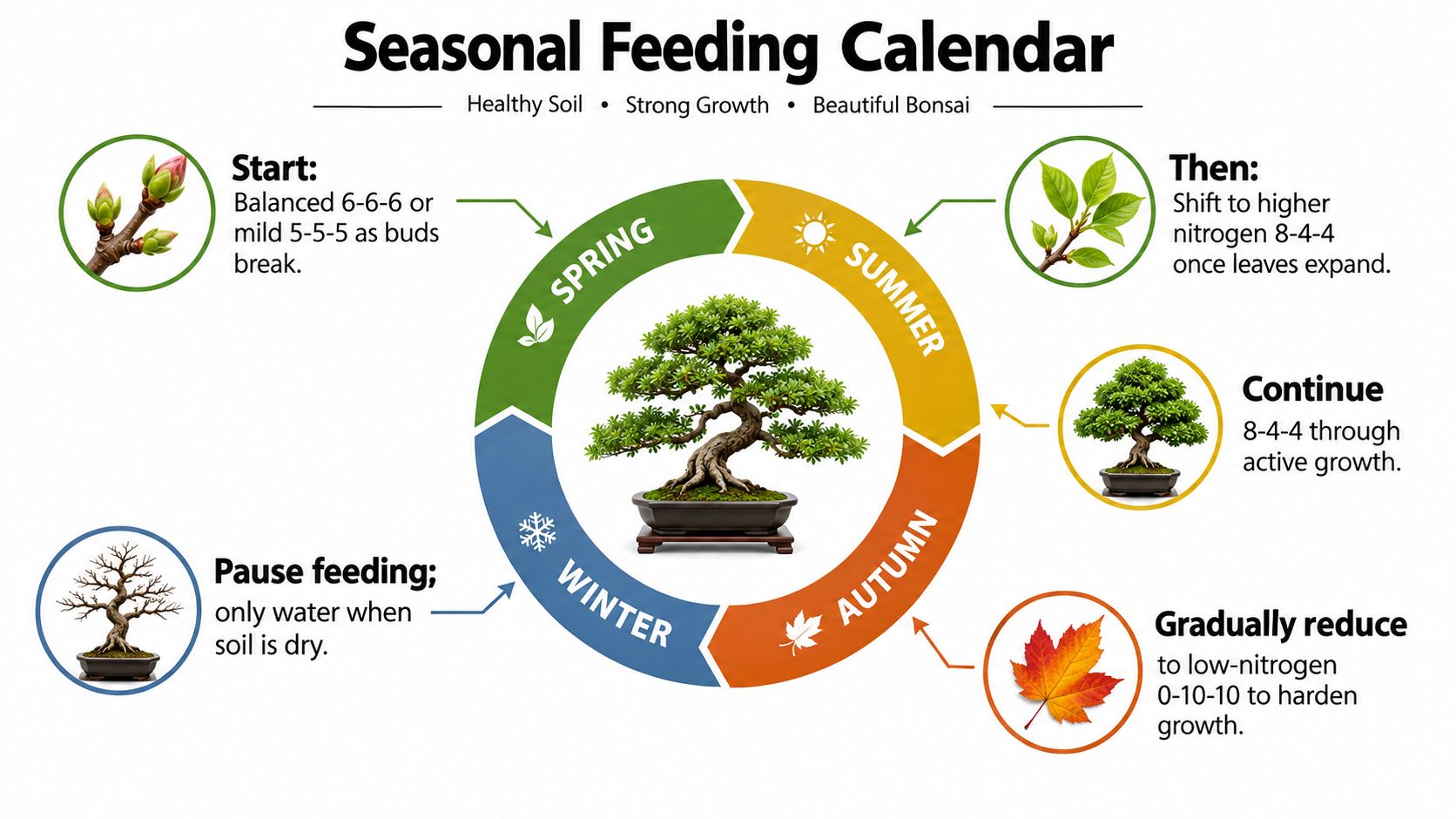
Spring and early growth
Start when buds swell and the tree is moving. A respected bonsai guide recommends fertilizing from early spring through mid-fall, using a higher-nitrogen formulation in spring at about 10:6:6, shifting to a balanced summer mix around 6:6:6, then reducing nitrogen in autumn to about 3:6:6 in Bonsai Empire's fertilizing basics.
That structure matters more than the exact label on the bottle. Early growth is when the tree can turn feed into useful extension, leaf production, and root recovery.
If you're coming from general houseplant habits, this broader guide on how to fertilize indoor plants helps clarify why bonsai need a more precise schedule than a typical foliage plant.
Summer and autumn adjustments
Summer isn't the time to get greedy. Keep feeding steady, but don't push lush soft growth during heat stress. Mature trees usually respond better to lighter, more frequent doses than a big single application. That's especially true in shallow containers that dry fast and salt up even faster.
By early autumn, reduce nitrogen and shift the tree toward stronger tissue and root support rather than soft top growth. Lower-nitrogen autumn formulas are widely recommended in bonsai culture for that reason.
If a late-season feeding program gives you long soft shoots, it wasn't a strong program. It was bad timing.
Winter and the trees that should sit out
Dormant deciduous bonsai generally shouldn't be fed through winter. Tropical bonsai kept indoors under warmth and light can continue on a light schedule, but they still don't need the same push as active summer growth.
There are exceptions worth remembering:
- Freshly repotted trees shouldn't be pushed right away.
- Weak trees don't respond well to strong fertilizer.
- Refined mature bonsai usually need lighter feeding than development trees.
- Flowering bonsai may need a different emphasis when setting buds and carrying blooms.
The tree tells you when to start, when to taper, and when to stop. A calendar is only useful if it follows that reality.
How to Apply Fertilizer Without Damaging Roots
Most bonsai fertilizer problems aren't caused by the fertilizer itself. They're caused by application. Good product, bad technique, dead fine roots.
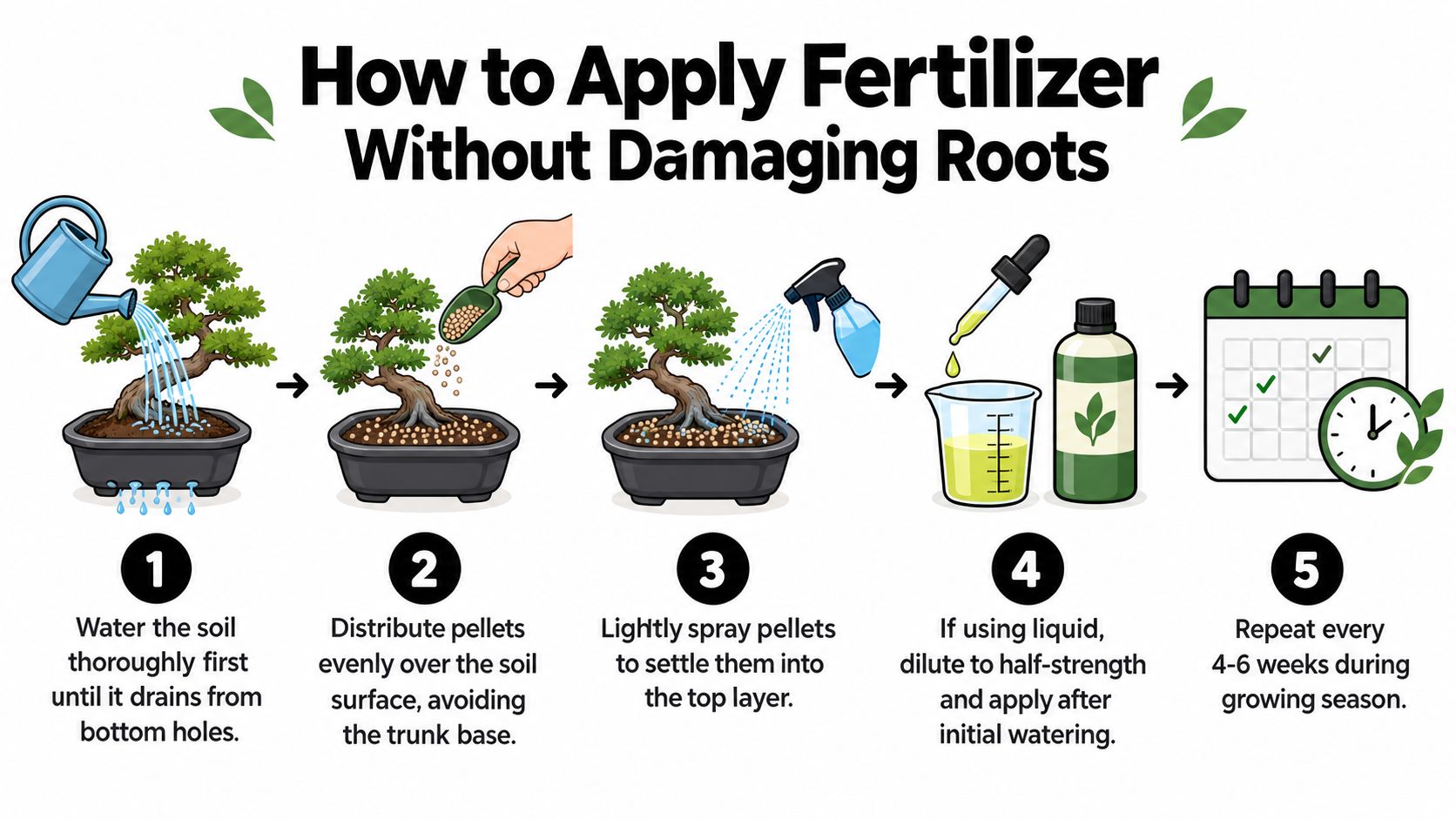
Start with the watering can, not the feed scoop.
The routine that prevents burn
Water first until the pot drains freely. That isn't optional. Several bonsai references warn that fertilizing dry soil concentrates salts around fine feeder roots and can damage them quickly. Guidance also commonly recommends applying fertilizer after watering and flushing the pot periodically with plain water if salt buildup is suspected as explained in Bonsai Trader's fertilizing article.
Then choose your method.
- For pellets. Place them on the soil surface, not buried. Space them evenly rather than piling them against the trunk.
- For liquid. Mix in a separate container, then apply slowly across the whole surface so one side of the root ball doesn't get all the concentrate.
- For either format. Don't fertilize a tree that's bone dry, weak, or freshly worked at the roots.
Placement matters more than people think
Granular and organic material should stay on the soil surface rather than being buried as Bonsai Empire notes in its feeding guidance. That gives a cleaner breakdown pattern and avoids creating hot spots inside the root zone.
I also prefer spreading pellets toward the outer root area instead of right at the trunk base. The active feeder roots are out in the working soil, not hugging the trunk.
Here's a visual walkthrough if you want to mirror the routine on your next watering day.
When to skip feeding
Skip it after repotting, after heavy root work, or when the tree is plainly under stress. Several bonsai references caution against pushing weak, freshly repotted, or dormant trees with strong fertilizer because it can create weak growth or stress roots further in this Bonsai Empire reference.
A stressed tree doesn't need more ambition from the grower. It needs less pressure at the roots.
If you top-dress with moss or a little sphagnum, pellets tend to stay put better during frequent summer watering. That's one of those small bench habits that saves a lot of mess.
Getting Dosage Right for Your Pot Size
The fastest way to overfeed a bonsai is to dose by instinct. A handful of pellets means nothing. A capful means nothing. In a shallow pot, container size is the only sane place to start.
This part of bonsai has become more standardized over time. Older practice leaned on organic materials and observation. Modern instruction got much more precise, with examples like 12 to 15 pellets for a 6-inch pot and 30 to 40 pellets for a 12-inch pot, while liquid fertilizer may be mixed at 1 tablespoon per gallon or 1 1/3 teaspoons per quart in this historical and practical fertilization guide.
Use the pot, not the tree's ego
A dense-looking canopy doesn't always mean the roots can handle more feed. In bonsai, the root system is physically constrained. The dose should reflect that.
If you want a practical way to think about rates at home, scale by pot diameter and stay conservative. The old habit of doubling pellets to force growth usually backfires. Slow-release fertilizer doesn't work like stepping harder on a gas pedal.
Fertilizer Dose by Bonsai Pot Size
| Pot Diameter | Pellets (per application) | Liquid Dilution | Frequency |
|---|---|---|---|
| 6-inch pot | 12 to 15 pellets | 1 tablespoon per gallon or 1 1/3 teaspoons per quart | Follow product schedule conservatively |
| 12-inch pot | 30 to 40 pellets | 1 tablespoon per gallon or 1 1/3 teaspoons per quart | Follow product schedule conservatively |
For a broader look at measuring and scaling rates, this guide on fertilizer application rates is useful.
The trade-off nobody likes hearing
More fertilizer doesn't create better bonsai. It often creates coarser bonsai. If your tree is in refinement, lighter repeated feeding is almost always the better move than one heavy application. That keeps growth usable.
Common Bonsai Feeding Mistakes and Fixes
Most feeding mistakes come from treating fertilizer like a rescue tool. Yellow leaves? Feed it. Slow growth? Feed it. Freshly repotted? Feed it. That reflex kills more bonsai than underfeeding does.
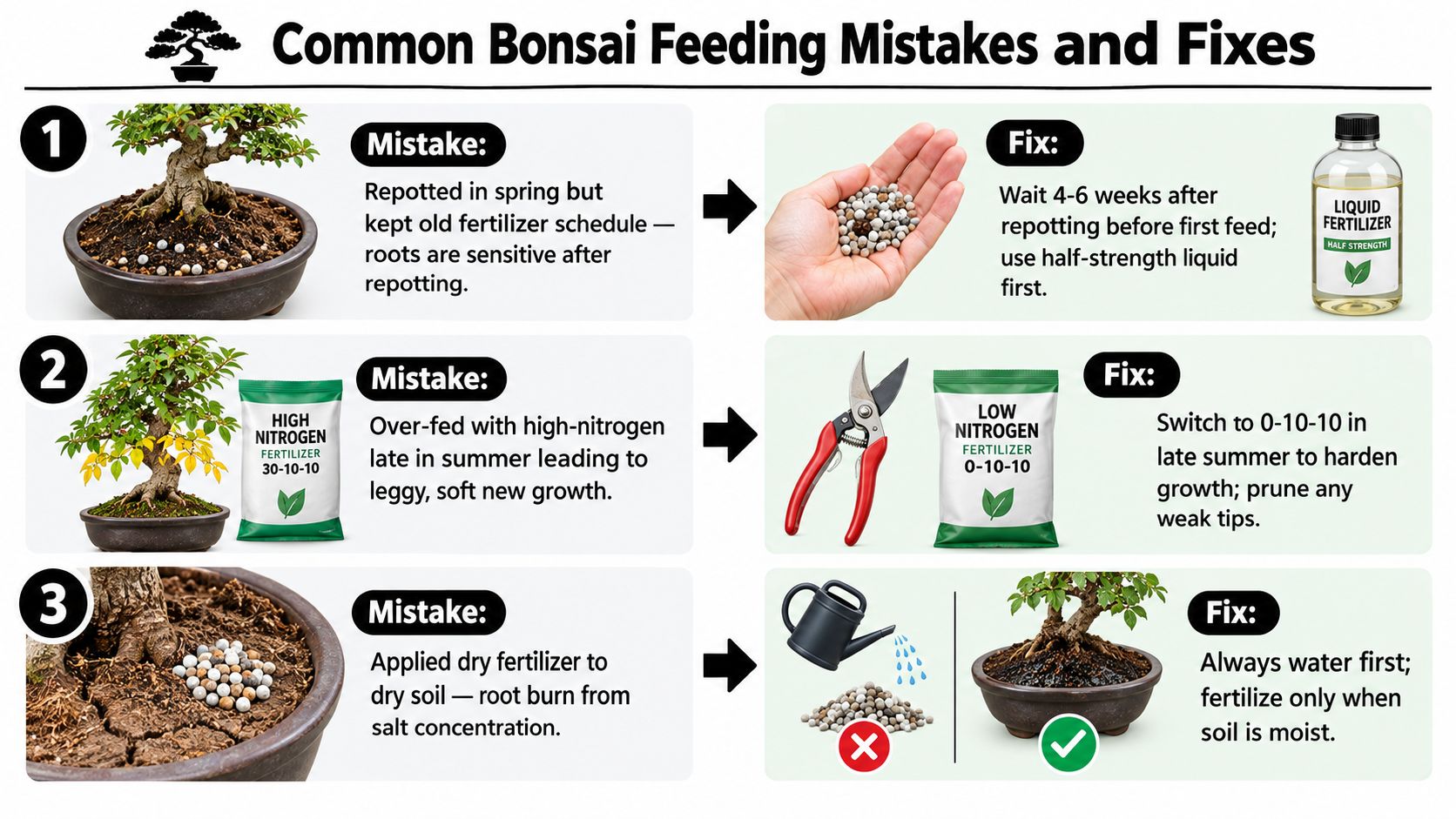
The repotting mistake
A common spring scenario goes like this. The tree gets root work, gets potted into fresh substrate, then receives the same fertilizer schedule it had before. The result is often weak, stretched growth because the root system is still trying to recover.
The fix is simple. Let the roots settle before resuming feed, then restart gently instead of trying to “make up” for the pause.
The salt buildup mistake
Another familiar one is midsummer yellowing that gets blamed on deficiency. Sometimes the issue isn't a lack of nutrients. It's leftover salts from repeated feeding in a shallow container.
One practical recommendation when burn or accumulation is suspected is to flush the pot with plain water at 2 to 3 times the pot volume from Bonsai Trader's application guidance. That's a useful reset when a tree has been fed steadily and starts looking dull rather than hungry.
The seasonal timing mistake
Then there's the grower who pushes hard too late in the season. They want the tree stronger before cold weather, so they keep feeding nitrogen-heavy formulas. What they often get is soft growth that doesn't mature cleanly.
The fix is to taper the program with the season and stop treating every slowdown like a problem.
- If the tree is sick or pest-stressed, pause feeding until healthy new growth returns.
- If the tree was recently repotted, hold back and restart mild.
- If the soil has been fed for months, consider a plain-water flush before adding more.
- If growth is long and soft, the answer usually isn't extra fertilizer.
Most bonsai feeding corrections come from reducing pressure, not increasing it.
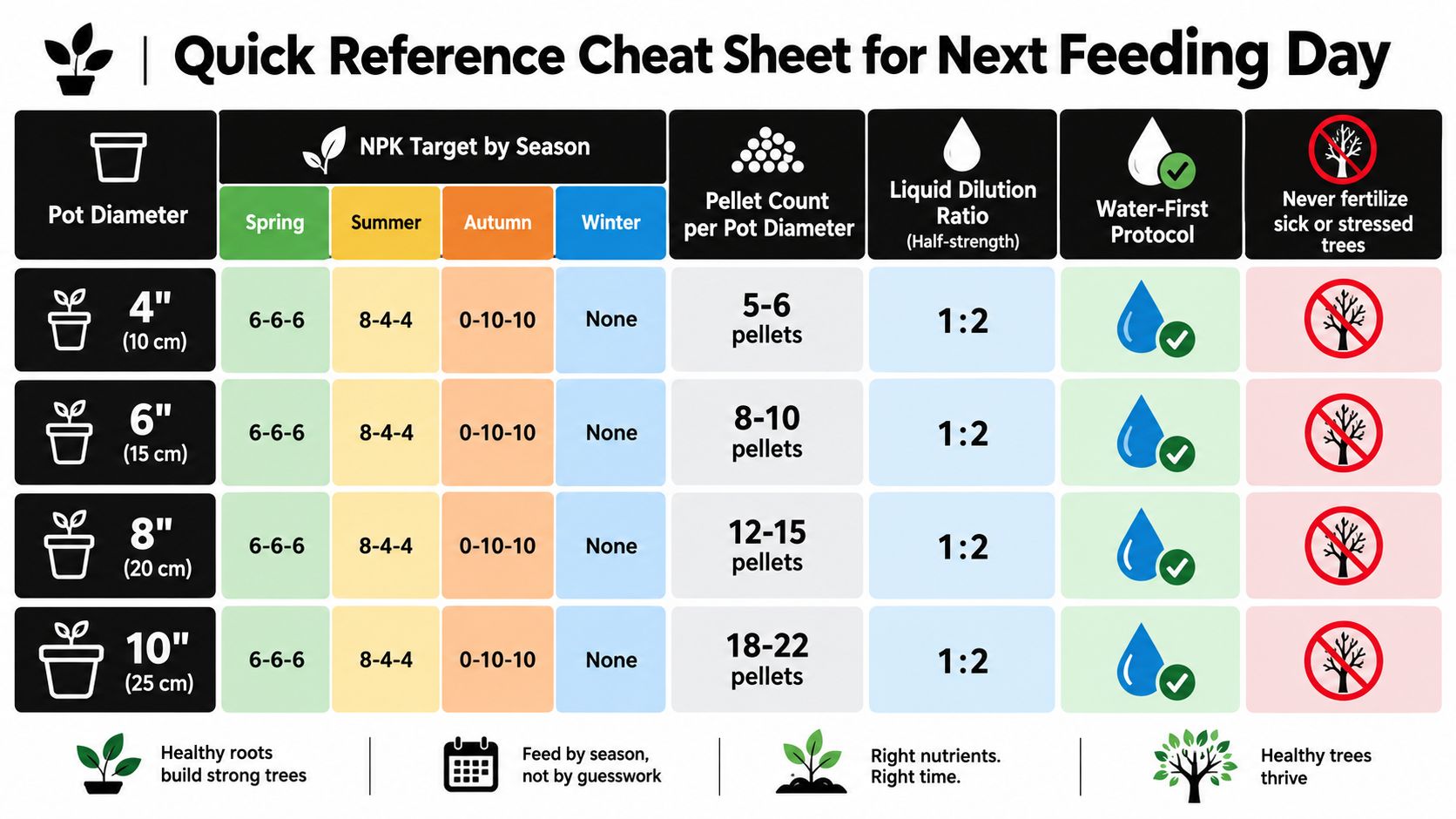
Quick Reference Cheat Sheet for Next Feeding Day
Keep this simple and bench-ready.
What to do before you feed
- Check growth stage. Buds swelling or active extension means the tree can use fertilizer.
- Check the soil first. If it's dry, water thoroughly before any feeding.
- Check tree condition. Skip sick, pest-stressed, weak, dormant, or freshly repotted trees.
What to use and when
- Spring. Start feeding when active growth begins. A spring program can lean higher in nitrogen, such as 10:6:6 in early active growth from Bonsai Empire's feeding guide.
- Summer. Shift to a more balanced approach, such as 6:6:6 during active growth from Bonsai Empire's feeding guide.
- Autumn. Reduce nitrogen. Lower-nitrogen formulas like 3:6:6, 3-10-10, or 0-10-10 fit the season from Bonsai Empire and Bonsai Outlet.
- Winter. Don't feed dormant deciduous trees.
Quick dosage reminders
- 6-inch pot. Use 12 to 15 pellets per this bonsai dosing reference.
- 12-inch pot. Use 30 to 40 pellets per the same dosing reference.
- Liquid feeds. Many guides use about half label strength every 2 to 4 weeks according to Bonsai Trader.
Emergency override
- Yellowing in midsummer after repeated feeding. Flush with plain water, skip the next feed, then resume lighter.
- Long, weak shoots. Cut back on nitrogen and stop trying to force growth.
- No response to fertilizer. Check roots, light, and watering before blaming the product.
Leaves & Soul offers bonsai fertilizer pellets, liquid plant foods, soils, and accessories that fit the kind of controlled feeding bonsai need in shallow pots. If you want supplies that match the methods in this guide, from measured nutrients to bonsai-ready tools, visit Leaves & Soul.