


Your fiddle leaf fig is sitting beside the brightest window in the house, yet the newest leaf has stalled and the lower leaves are beginning to drop. Before you move it, water it again, or add a stronger dose of plant food, check whether it's actually growing. Fertilizer works best as a response to active growth, adequate light, moist soil, and healthy roots, not as a fixed ritual.
The safest answer to how to fertilize fiddle leaf fig plants is simple: choose a foliage-oriented fertilizer, dilute it, apply it only to moist soil during active growth, and stop when the plant stops using nutrients. That approach prevents the salt buildup and leaf-edge scorch that cause many feeding problems.
Why Fiddle Leaf Figs Actually Need Feeding
A fiddle leaf fig can look healthy for a long time while relying on the nutrients already held in its potting mix. Then spring arrives, a new bud opens, and the plant begins drawing on its limited supply of nitrogen, phosphorus, potassium, calcium, magnesium, iron, and other micronutrients. Each new leaf flush increases that demand.
I've seen this with plants that receive plenty of water and bright light but produce no meaningful growth for months. Their owners often assume the plant needs more water. Sometimes the issue is that the roots are sitting in an old, depleted mix and the plant has no fresh nutrient supply to support another flush.
What fertilizer supports
Fertilizer doesn't replace light, drainage, or consistent watering. It supplies mineral nutrients that roots absorb from the growing medium, helping the plant maintain chlorophyll, build new tissue, support cell walls, and recover after pruning.
Nitrogen is especially important for a leaf-focused plant, while potassium supports general plant function and phosphorus contributes to root and new-tissue development. Calcium, magnesium, and iron also matter, but adding more of any nutrient won't compensate for poor roots or insufficient light.
Indoor plants usually grow more slowly than plants in greenhouse conditions because household light is less intense and less consistent. Their nutrient demand is therefore moderate, not absent. An academic horticulture study reported an acclimatized Ficus lyrata nitrogen rate of about 24 kg N per 100 m², which demonstrates measurable demand without suggesting that this houseplant should be treated like a heavy-feeding crop. The horticultural study on Ficus lyrata provides useful context for that balance.
Practical rule: Feed the plant that's growing, not the pot that happens to contain it.
When nutrition, light, and moisture line up, the visible payoff is gradual. New leaves emerge with better color, growth points stay active, and the plant has more capacity to replace older foliage instead of slowly relying on its reserves.
Choosing the Right Fertilizer and NPK Ratio
For most fiddle leaf figs, start with a foliage fertilizer near a 3-1-2 NPK ratio, or an equivalent concentration such as 9-3-6. This ratio places more emphasis on nitrogen than phosphorus, which suits a plant grown primarily for strong, abundant foliage. A balanced feed such as 10-10-10 can also be used cautiously during spring and summer, but concentration and frequency still matter more than the label's marketing language.
Avoid lawn fertilizers, highly concentrated bloom formulas, and the assumption that a stronger product will produce faster growth. Fiddle leaf figs are generally treated as light feeders, and authoritative care guidance warns that overfeeding can burn leaf margins. The safer benchmark is approximately half the label strength, particularly when the plant is indoors or receiving modest light. Penn State Extension's fiddle leaf fig guidance also emphasizes that more fertilizer isn't automatically better.
Comparing the available formats
| Format | NPK Example | Best For | Watch For |
|---|---|---|---|
| Liquid concentrate | Near 3-1-2 or 9-3-6 | Precise, adjustable feeding during active growth | Overdosing and applying to dry soil |
| Slow-release pellets | A foliage or houseplant formula | Caretakers who prefer a less frequent routine | Salt buildup and difficulty reversing a dose |
| Foliar spray | Diluted micronutrient or foliage spray | Supplemental support when roots are stressed | Leaf spotting, uneven coverage, and treating symptoms instead of causes |
Liquid fertilizer offers the most control. You can reduce the concentration for a dim room, skip a dose after repotting, or adjust when growth slows. Pellets are more convenient, but they continue releasing nutrients after application, so they're less forgiving if the plant later enters low-light dormancy.
Foliar sprays can be useful as a supplement, particularly when a nutrient deficiency is suspected, but they shouldn't become the main feeding system. Leaves absorb nutrients differently from roots, and wet foliage can spot if the product is too concentrated or applied in strong light.
A healthy home nutrient cycle also depends on what goes into your soil and compost. If you're building your own organic inputs or learning how to reduce household plant waste, these composting tips for beginners can help you understand the basics without treating homemade compost as a substitute for a measured houseplant fertilizer.
A Simple Step-by-Step Feeding Routine
The most reliable feeding routine starts with water, not fertilizer. Dry potting mix can expose roots to a concentrated nutrient solution, increasing the chance of root stress and scorched leaf edges.
Follow this sequence
- Check the plant first. Don't fertilize a fiddle leaf fig that's wilting, recently suffered root damage, or is sitting in soggy soil. Correct the stress before adding nutrients.
- Pre-water the pot. Apply plain water slowly across the soil until water begins draining from the bottom. This moistens the root zone and reduces the risk of fertilizer salts hitting dry roots.
- Mix the fertilizer. Use a liquid foliage fertilizer near the recommended ratio, but dilute it to approximately half the label strength. The practical guidance on caring for Ficus lyrata supports watering first, using diluted fertilizer, and allowing complete drainage.
- Apply evenly. Pour the diluted solution across the entire root zone, not just beside the trunk. Keep the stream off the leaves, and wear gloves if the product label recommends them.
- Let the pot drain fully. Empty the saucer after watering. Standing water keeps roots oxygen-starved and allows unused salts to remain around the root zone.
- Record the date. Add the feeding date to a plant tag, calendar, or phone reminder. A simple log prevents accidental repeat applications when several people care for the same plant.
Fertilizer belongs in moist, well-drained soil. It doesn't belong in a dry root ball or a full saucer.
The next watering should be plain water. That break gives the plant access to moisture without adding another nutrient load, while drainage carries some residual salts away from the roots.
Matching Your Fertilizer Schedule to the Seasons
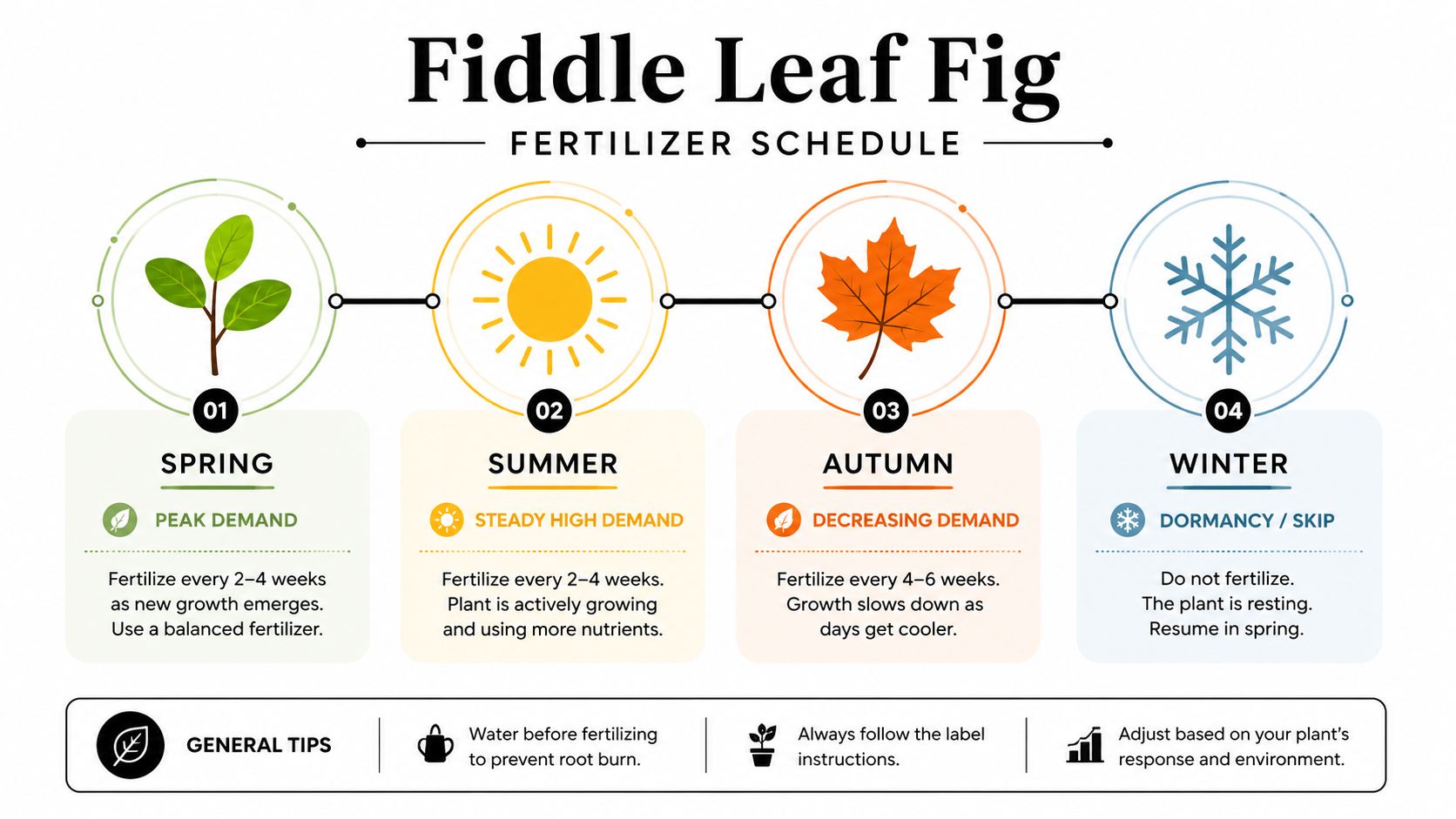
A calendar gives you a starting point, but visible growth and available light should make the final decision. Independent care guidance generally places the active growing season around March through September, with feeding reduced or stopped during winter as growth slows or stops. A seasonal fiddle leaf fig fertilizing guide describes monthly half-strength feeding as a standard approach, while university guidance allows for feeding only once or twice in spring and summer. Those recommendations differ because indoor conditions differ.
Spring is the clearest restart point. Look for bud break, swollen nodes, or a leaf that's visibly beginning to unfurl. If the plant has adequate light and the soil is drying normally, a diluted liquid feed every two to three weeks can support active growth. In brighter conditions, the plant may use nutrients steadily. In a dim room, the same schedule can create excess salts.
Let indoor conditions override the calendar
Summer usually supports the most consistent uptake when warmth, bright indirect light, and active leaf production coincide. As autumn arrives, reduce feeding to a less frequent routine, commonly once per month, then stop when growth clearly slows.
Winter is normally a no-fertilizer window. Lower light and slower growth mean nutrients are less likely to be used, increasing the risk of salt accumulation. A plant in a very bright south-facing window may continue growing during winter, while a plant in a dim corner may need no fertilizer even if the calendar says spring has arrived.
For a broader comparison of indoor feeding practices, see this guide to how to fertilize indoor plants. The same principle applies here: adjust the dose to growth, light, and soil moisture rather than repeating a monthly reminder automatically.
Reading Leaf Signals of Over- and Under-Fertilizing
Leaves rarely identify fertilizer trouble by themselves. Brown edges can come from salt injury, inconsistent watering, dry air, root damage, or poor drainage. Start by checking the soil moisture and the pot's weight before adding anything.
Under-fed plants may produce pale new growth, smaller leaves, longer gaps between leaves, or gradual lower-leaf drop. Those signs become more meaningful when the plant has adequate light, the roots are healthy, and the potting mix is old or depleted. Return with a diluted foliage fertilizer at the next appropriate watering, rather than trying to correct the problem with a heavy dose.
Over-fed plants often show crispy brown margins, yellowing between veins, sudden leaf drop, or a white crust on the soil surface. If you see salt residue and the soil feels dry or compacted, fertilizer burn becomes more likely than simple underwatering. Flush the pot with plain water through the drainage holes, allow it to drain completely, and pause feeding for four to six weeks before reassessing.
| Leaf Signal | Likely Cause | Corrective Action |
|---|---|---|
| Pale new leaves and stalled growth | Possible nutrient shortage, low light, or root stress | Check light and roots, then resume diluted feeding only during active growth |
| Brown, crispy margins | Salt injury, dry roots, or inconsistent watering | Check moisture, flush suspected salts, and pause fertilizer |
| White crust on the soil | Accumulated fertilizer salts or hard-water residue | Flush thoroughly and consider refreshing the mix if buildup returns |
| Sudden leaf drop after feeding | Overconcentration or stressed roots | Stop fertilizer, inspect drainage, and stabilize watering |
| Small leaves with long gaps | Insufficient light, limited nutrition, or both | Improve light first, then use a mild foliage feed when growth resumes |
The signs of over-fertilizing plants are useful to review when symptoms overlap. Flushing is the reset button when salt buildup is suspected. Extra fertilizer is not.
Pairing Fertilizer With Soil and Watering
Fertilizer can't repair a root system that stays wet for too long or dries into a hard, water-repellent mass. Fiddle leaf figs do best in a chunky, well-draining mix that combines indoor potting soil with perlite and pine bark fines. The goal is enough moisture retention for roots to absorb nutrients, with enough air space for those roots to breathe.
A porous mix also helps prevent concentrated salts from remaining around tender root hairs. If water runs straight down one side of a compacted root ball, fertilizer may distribute unevenly and leave dry pockets untouched. If the pot drains poorly, the plant may remain wet long after feeding, creating a different form of root stress.
Build the routine around moisture
Let the top two inches of mix dry between thorough waterings, then water slowly until excess exits the drainage holes. The soil should be moist before fertilizer arrives, never bone-dry. If the plant is still soggy from its last watering, postpone feeding until the mix reaches the appropriate moisture level.
This sequence matters because roots absorb dissolved nutrients through water. Pre-watering spreads moisture through the pot and reduces the chance that a concentrated solution will scorch dry roots. Complete drainage then removes some unused salts instead of leaving them in the saucer or lower root zone.
After a flush day, allow the mix to return to a normal watering rhythm before feeding again. If salts keep returning, refresh part of the potting mix and inspect whether the container has adequate drainage. The best fertilizer schedule can fail when soil and water work against it, while a modest feeding plan succeeds when the root zone stays balanced.
For help selecting a suitable medium, compare the recommendations in this guide to fiddle leaf fig soil type.
Seasonal Cheat Sheet and Quick Answers
Use this chart as a starting point, then adjust it to the plant's light and visible growth.
| Season | Fertilizer Form | Dilution | Frequency |
|---|---|---|---|
| Spring | Liquid foliage fertilizer | Half strength | Every two to three weeks during active growth |
| Summer | Liquid foliage fertilizer | Half strength | About every two weeks when growth and light remain strong |
| Fall | Liquid fertilizer or carefully measured pellets | Half strength for liquid | Monthly, then taper as growth slows |
| Winter | None in most homes | Not applicable | Skip, unless clear new growth continues |
Should I fertilize a fiddle leaf fig year-round?
Usually, no. Feed during active growth, generally from spring through early fall, and stop during winter dormancy unless the plant remains visibly active in strong indoor light. University guidance for fiddle leaf figs supports seasonal rather than aggressive year-round feeding.
When should I pause after repotting?
Skip fertilizer while the plant settles into fresh mix, particularly if the new soil already contains nutrients. Wait until the roots have recovered and new growth resumes before restarting a diluted program.
Which fertilizer supports leaf recovery?
Choose a foliage fertilizer near a 3-1-2 ratio with micronutrients, then apply it lightly alongside consistent watering and good light. Fertilizer won't reverse damaged tissue, but it can support healthy new leaves once the underlying moisture or root problem is corrected.
Leaves & Soul offers fiddle leaf fig fertilizers, including liquid nutrients and slow-release houseplant pellets, along with soils and amendments for building a more reliable root-zone routine. Visit Leaves & Soul to compare feeding options and choose a product that fits your plant's growth pattern, light, and watering habits.