


Yellow leaves don't automatically mean your houseplant needs fertilizer. They can signal poor light, overwatering, damaged roots, dormancy, or several other problems, and feeding a plant under stress can make the decline worse. Fertilizer supports healthy growth, but it can't compensate for a waterlogged pot or a plant trying to survive in insufficient light.
The safest approach is to treat feeding as a precise maintenance task, not a cure-all. Container volume, soluble-salt accumulation, light, watering, and active growth matter as much as the fertilizer ratio on the bottle. Here's how to fertilize houseplants without turning a useful nutrient source into a root problem.
Understanding Fertilizer Labels and Plant Needs
Start with the label, but don't stop at the label. The familiar three-number analysis shows the percentage by weight of nitrogen, phosphate expressed as P₂O₅, and potash expressed as K₂O. A 10-6-4 fertilizer contains approximately 10% nitrogen, 6% phosphate, and 4% potash, so a 5-pound bag contains about 0.50 pounds of nitrogen, 0.30 pounds of phosphate, and 0.20 pounds of potash. These figures describe concentration in the product, not the amount your particular pot needs. University of Minnesota Extension explains how fertilizer analysis works and why higher numbers aren't automatically better.
Nitrogen primarily supports leafy vegetative growth. Phosphorus participates in energy-transfer and reproductive processes, while potassium supports numerous enzyme-regulated functions. Many plants use these nutrients in approximate ratios near 5-1-2 or 5-1-3, although the appropriate balance changes with species, growth stage, light level, and growing medium. A balanced 10-10-10 product isn't universally superior because all three numbers match.
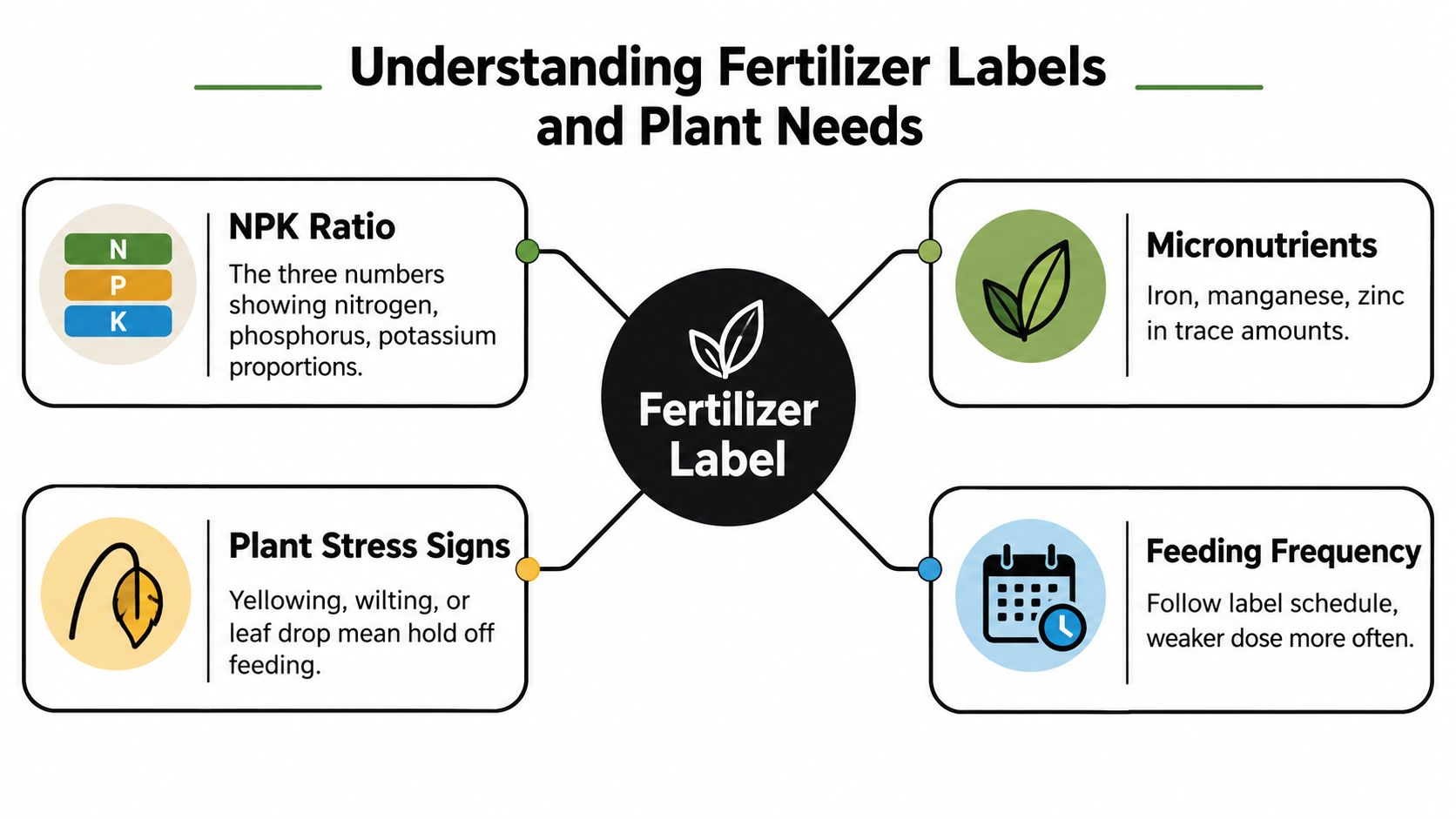
Read the label in context
An indoor pot has a restricted root zone. Outdoor soil and rainfall can distribute and leach nutrients across a much larger area, but a container concentrates fertilizer salts around a comparatively small amount of growing medium. That makes a strong formula or repeated full-strength application much less forgiving.
Before choosing a product, check whether the plant is actively producing leaves, stems, roots, or flowers. Examine the light and moisture conditions first. If you're comparing organic versus synthetic cannabis nutrients as part of learning how different fertilizer systems work, this organic vs synthetic cannabis nutrients guide provides useful background on formulation differences, but houseplants still need a routine matched to their own container and growth rate.
For a quick explanation of how the numbers translate into everyday plant care, use this guide to understanding plant fertilizer numbers. The practical rule is simple: choose a formula that fits the plant, then apply less rather than assuming a higher concentration will produce better growth.
Choosing the Right Formulation for Your Houseplants
The best fertilizer format is the one that lets you control delivery without losing track of what the root zone receives. A liquid concentrate gives immediate control, slow-release granules reduce routine effort, and water-soluble powder offers accurate mixing when you want a dry product that dissolves completely.
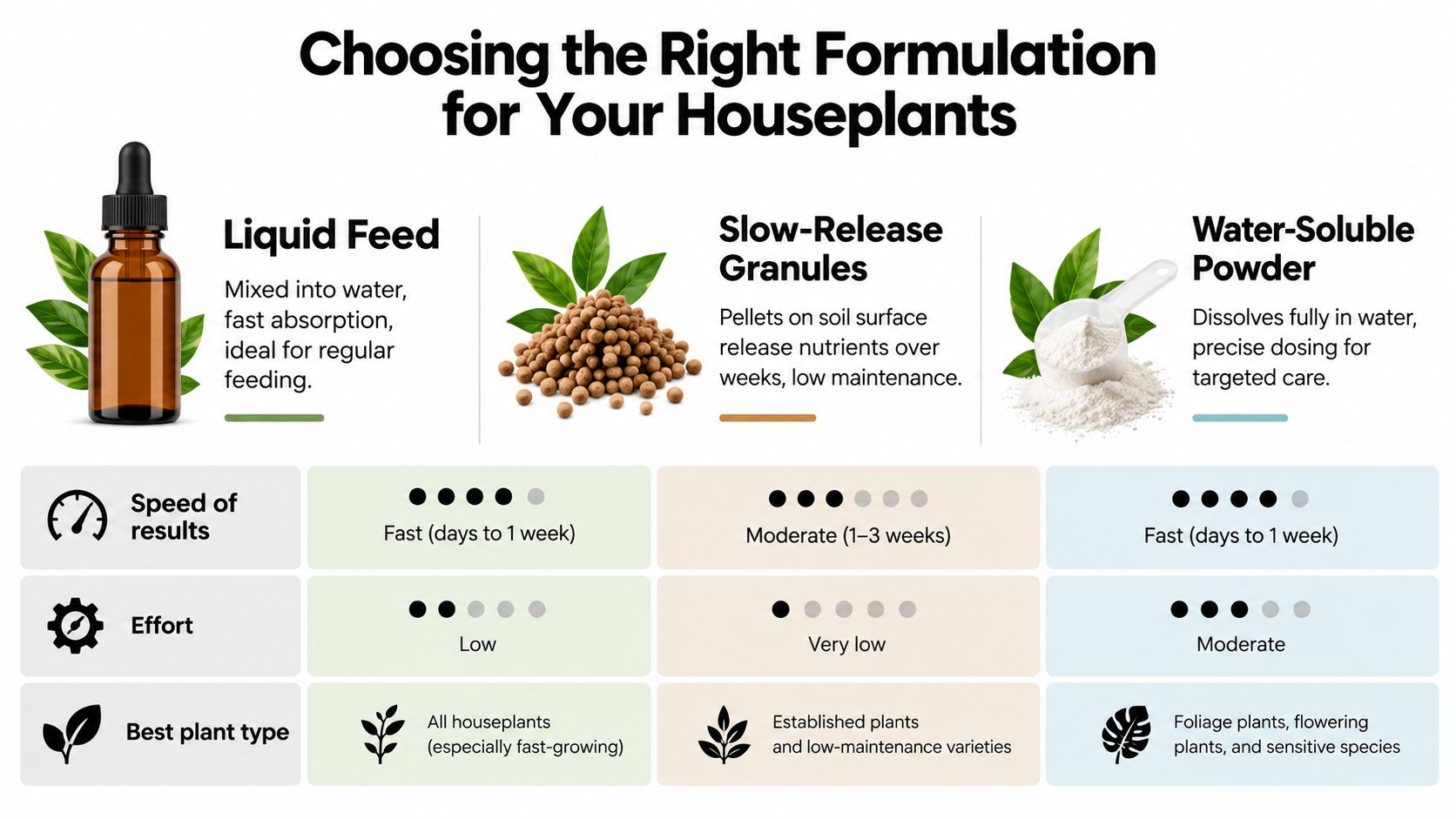
Liquid fertilizer
Liquid feed suits growers who inspect plants regularly and want to adjust feeding as conditions change. You can reduce the concentration for a low-light foliage plant, pause after repotting, or resume when strong new growth appears. It also works well for plants that grow vigorously in bright indoor positions, provided the medium is already moist and the solution is mixed according to the label.
The trade-off is consistency. A liquid product doesn't protect a plant from an overly enthusiastic application, and missed waterings can lead to irregular feeding. Keep a dedicated measuring spoon or syringe, use clean water, and never estimate concentrate by sight.
Slow-release granules
Slow-release pellets release nutrients gradually instead of delivering everything in one watering. They can work well for growers who prefer a low-maintenance routine, especially when a plant remains in the same container and its growth is steady. Bonsai containers and other small pots still require careful observation, because a slow-release product can continue supplying nutrients after the plant's light or water conditions have changed.
Slow release doesn't mean risk free. Follow the application directions for the specific container, distribute the product evenly rather than piling it against the stem, and record when you applied it. A label schedule matters because the release pattern depends on the formulation and surrounding conditions.
Water-soluble powder and foliar products
Water-soluble powder can be practical when you want a dry product with precise dosing. Dissolve it fully before application and don't leave undissolved material sitting on the soil surface. It offers much the same control as liquid feed once mixed, but it can be easier to store and measure for a larger collection.
Foliar sprays belong in a narrower toolkit. Leaves can absorb some nutrients, but spraying doesn't replace sound root-zone care, and residue or concentrated droplets can damage foliage. Orchids in porous media, succulents, and cacti deserve particular restraint because their specialized substrates and growth patterns don't behave like a constantly growing tropical foliage plant. Match the delivery method to your watering habits, container size, and plant activity, not to the product's marketing language.
Mixing and Applying Fertilizer Safely
A safe feeding routine begins before you open the bottle. Fertilizer should reach a plant that has adequate light, functioning roots, and active growth. Poor light, overwatering, and dormancy can resemble nutrient deficiency, so adding fertilizer before checking those conditions can compound the original problem.
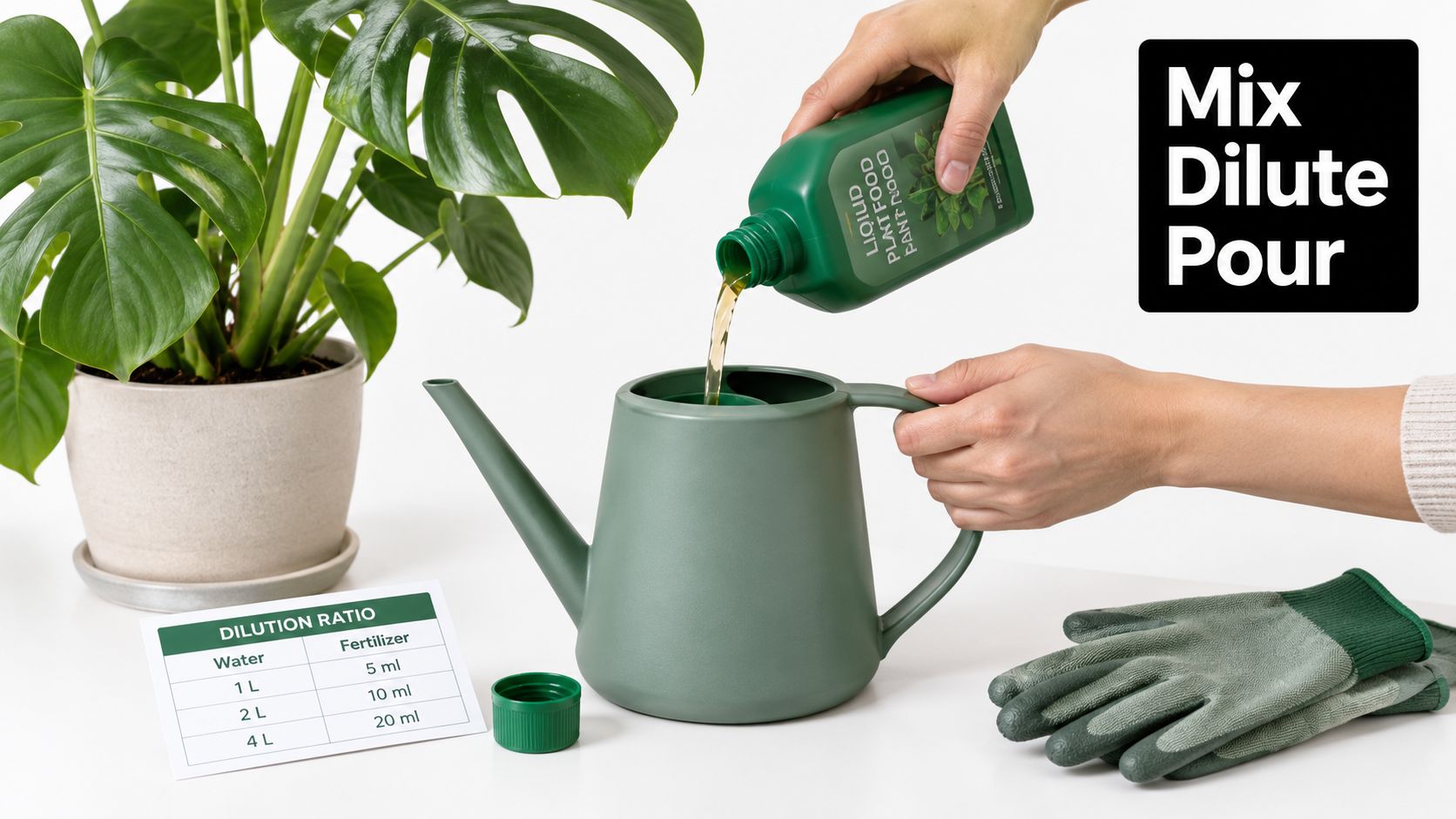
Use a condition-first protocol
- Inspect the plant. Look for fresh growth, firm stems, healthy roots, and a normal moisture pattern. Hold off if the plant is wilting from dry soil, sitting in saturated mix, recently repotted, or showing signs of root damage.
- Check the light. A plant in weak light uses fewer nutrients. Improve the growing conditions before trying to push growth with fertilizer.
- Moisten the medium. Water the plant with plain water first and let excess drain. Applying concentrated fertilizer to bone-dry roots can increase the risk of injury.
- Start conservatively. For an unfamiliar plant, use about one-quarter to one-half of the label concentration, then observe new growth for several weeks before changing the routine. The University of Nebraska's houseplant fertilization guidance supports a cautious approach and emphasizes that plant type, light, growth rate, soil mix, watering, and fertilizer form all affect the correct dose.
- Apply evenly. Pour the diluted solution over the moistened medium, not onto dry roots or directly over the crown. Continue until some solution exits the drainage holes. This helps distribute nutrients through the root zone and reduces the chance of concentrated salts remaining in one pocket of soil.
- Clean up. Empty the saucer after watering and wipe splashes from leaves, stems, and the pot rim. Store the concentrate securely and label any mixed solution clearly.
Practical rule: The label rate is an upper limit, not a command to use the strongest possible mixture in every indoor container.
A monthly routine can be adequate for many actively growing houseplants, but more frequent feeding isn't automatically better. If you want a closer look at the handling details, this guide to liquid fertilizer for house plants offers additional practical context. Reduce or stop feeding when growth slows, and never use fertilizer to force recovery from environmental stress.
Seasonal Scheduling and Plant-Specific Routines
Calendar dates are a poor feeding signal for houseplants. Light, temperature, and active growth determine demand. Spring and summer often provide stronger indoor light and faster growth, while fall and winter can slow both, especially beside a cold or dim window. Reduce feeding as growth declines rather than continuing by habit.
Build the schedule around growth
A fiddle leaf fig producing leaves in a bright, warm room may benefit from a weak liquid feed during active growth. The same plant under short, dim winter light may need plain water and observation. Expanding leaves, new shoots, and sustained growth are more useful signals than a fixed monthly reminder.
Container volume changes the risk. A small pot holds less mix, so repeated fertilizer applications can raise soluble-salt concentration faster than they would in a larger container. That matters for bonsai, whose compact root zones and quickly draining media leave little margin for excessive feeding. Choose the interval and product release rate together, and account for how much growing medium surrounds the roots.
A slow-release hydro-complex fertilizer applied at 15 grams per plant every four months produced the strongest results across several measured traits in an indoor Dracaena marginata experiment, including height, leaf number, leaf dimensions, stem diameter, root volume, and root dry weight. The result does not establish a universal dose for bonsai or another species. It shows why a product's release pattern, container volume, and plant type must be assessed together. The published indoor-plant experiment explains the formulation and its limits.
Orchids may keep growing under stable indoor conditions, but their roots and porous media dry differently from those of foliage plants. Succulents and cacti generally need a more restrained routine, particularly when cool conditions or low light reduce growth. Check the roots, moisture level, and new growth before each application.
| Plant category | Spring and summer routine | Fall and winter routine |
|---|---|---|
| Foliage plants | Feed only during active growth, using a complete formula at a conservative dilution suited to the light and container. | Reduce or pause when growth slows and light declines. |
| Fiddle leaf figs | Use controlled liquid or slow-release feeding while bright conditions support new growth. | Avoid forcing growth in dim conditions. |
| Bonsai | Account for small substrate volume, drainage, and the product's release rate. | Reduce or stop feeding during dormancy or weak growth. |
| Orchids | Match the formulation and schedule to the medium, roots, and active growth. | Pause or reduce applications as light and growth decline. |
| Succulents and cacti | Feed sparingly only when growth is clearly active and drainage is free. | Usually reduce or stop feeding during slow growth. |
Review this guide on when to fertilize houseplants when adjusting applications to seasonal light and growth. Keep a written log of dates, product, dilution, and plant response, but let current conditions override the reminder. Fertilizer supports active growth. It cannot compensate for insufficient light, poor drainage, or stressed roots.
Troubleshooting Nutrient Deficiencies and Salt Buildup
A plant that looks hungry can be suffering from excess fertilizer. Soluble-salt concentration is the main technical risk in a container, not merely the NPK percentage printed on the package. Repeated high-concentration applications, insufficient drainage, and a small root zone allow salts to accumulate where roots must grow.
Salt injury often appears as burned or dried leaf margins, unexplained wilting, declining growth, or a white crust on the potting medium. Don't diagnose nitrogen deficiency from yellow leaves alone. Old leaves, new leaves, roots, light, watering, and the overall growth pattern all matter, and adding more fertilizer without that context can turn uncertainty into root damage.
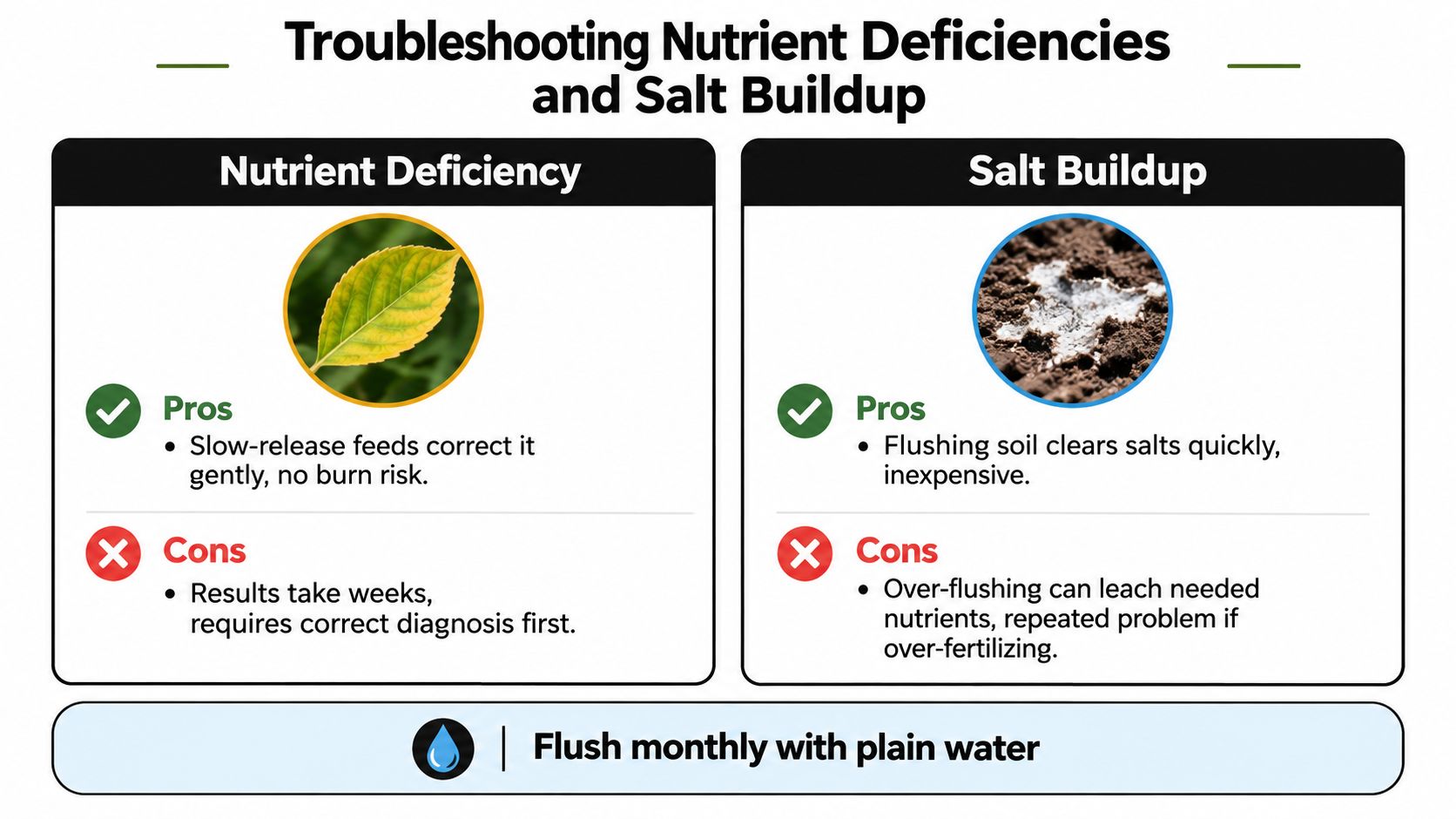
Separate deficiency from excess
If the plant has poor light, compacted mix, damaged roots, or inconsistent watering, fix those conditions first. Nitrogen supports leafy growth, but a plant can't use nutrients effectively when its roots lack oxygen or the foliage can't produce enough energy.
When salt buildup seems likely, stop fertilizer and flush the container:
- Prepare the pot: Place it in a sink, tub, or tray where drainage can run freely.
- Use plain water: Slowly apply enough water to pass through the entire medium and exit the drainage holes. Avoid pouring rapidly, which can create channels and leave dry pockets.
- Repeat carefully: Allow the pot to drain thoroughly. If a crust remains on the surface, remove it and replace it with fresh, clean medium where practical.
- Reset the routine: Resume feeding only after the plant shows stable growth, and use a weaker concentration or less frequent application.
The flushing response must also be plant-specific. A controlled horticultural study found strong differences between species and light levels: Maranta dry weight decreased and leaf necrosis increased at a medium electrical conductivity of 4.2 mmho/cm under low light, while Stromanthe shoot dry weight declined above 0.5 mmho/cm under high light. Brassaia and Dieffenbachia tolerated broader electrical-conductivity ranges in the same experiment, so one universal “safe” dose is unreliable. Washington State University Extension summarizes the container salinity risks and species-dependent responses.
A flush can remove excess salts, but repeated overfeeding will recreate the problem. Adjust the dose, improve drainage, and keep records of applications instead of responding to every yellow leaf with another feed.
Building a Long-Term Feeding Philosophy
Successful indoor nutrition is mostly an exercise in restraint. Fertilizer supports a plant that already has suitable light, breathable soil, reliable watering, and healthy roots. It doesn't replace those conditions, and it won't make a dormant or waterlogged plant recover faster.
Use a simple feed or fix first checklist whenever a plant looks unwell:
- Is it making new growth?
- Is the light strong enough for the species?
- Does the pot drain freely?
- Is the medium too wet or too dry?
- Do the roots look healthy?
- Has fertilizer already been applied recently?
- Could pests, temperature, or repotting explain the symptoms?
If the answers point to environmental stress, fix the environment and wait. If the plant is actively growing and the roots are healthy, begin with a conservative dose, observe the response, and change one variable at a time. That method produces better information than switching products repeatedly or chasing a perfect NPK ratio.
A sustainable collection doesn't require constant feeding. It requires observation, accurate measuring, and respect for the limited volume of an indoor container. Feed growth, not anxiety.
For a practical way to support this routine, Leaves & Soul offers professional-grade soils, liquid feeds, slow-release pellets, and targeted products for houseplants, bonsai, succulents, cacti, and orchids. Choose a formulation that matches your plant and container, then use the conservative, condition-first method described above.