


Most bonsai soil recipes are presented as if the percentages are sacred. They aren't. The same blend can keep one grower's tree healthy and leave another's roots either dry or waterlogged, because particle size, pot depth, climate, species, and watering habits control how the substrate behaves after it goes into the pot.
A good homemade mix isn't a secret formula. It's a managed balance between water retention, drainage, oxygen, and stability. The recipes below give you dependable starting points, but the more useful skill is learning when to make the mix finer, coarser, more moisture-retentive, or more porous.
Why One Bonsai Soil Recipe Never Fits Every Tree
A fixed recipe fails when it ignores the growing environment. A small bonsai pot in a hot, dry location can lose moisture quickly, while the same mix in a humid room may remain wet for much longer. A grower who waters frequently needs a different margin for drainage from someone who can check the tree only occasionally.
Pot depth matters, too. Shallow containers contain less substrate and offer less moisture reserve. A larger training container gives roots more room and usually dries differently from a refined tree in a shallow display pot. Species add another layer of variation. A conifer generally benefits from a more open structure, while a deciduous tree may suit a mix that holds a little more water.
Practical rule: Choose the mix for the tree in its actual pot and location, not for the species name alone.
The core ingredients are straightforward. Akadama holds water and nutrients, pumice stores moisture while keeping air around the roots, and lava rock supports drainage and long-term structure. Those materials can be combined in proven ratios, then adjusted by changing particle size or shifting a modest portion of the blend.
This approach also explains why ordinary garden soil usually disappoints. Fine material can compact in a shallow pot, reducing the air spaces roots need. A successful batch should be screened, rinsed, tested, and observed after planting rather than trusted because it matches a recipe printed on a label.
By the end, you'll have a deciduous formula, a conifer and pine formula, a practical 10-liter batch, and a decision process for adapting both to your conditions. You'll also know how to identify a mix that drains too slowly, dries too fast, or has begun to collapse.
The Science Behind Granular Bonsai Soil
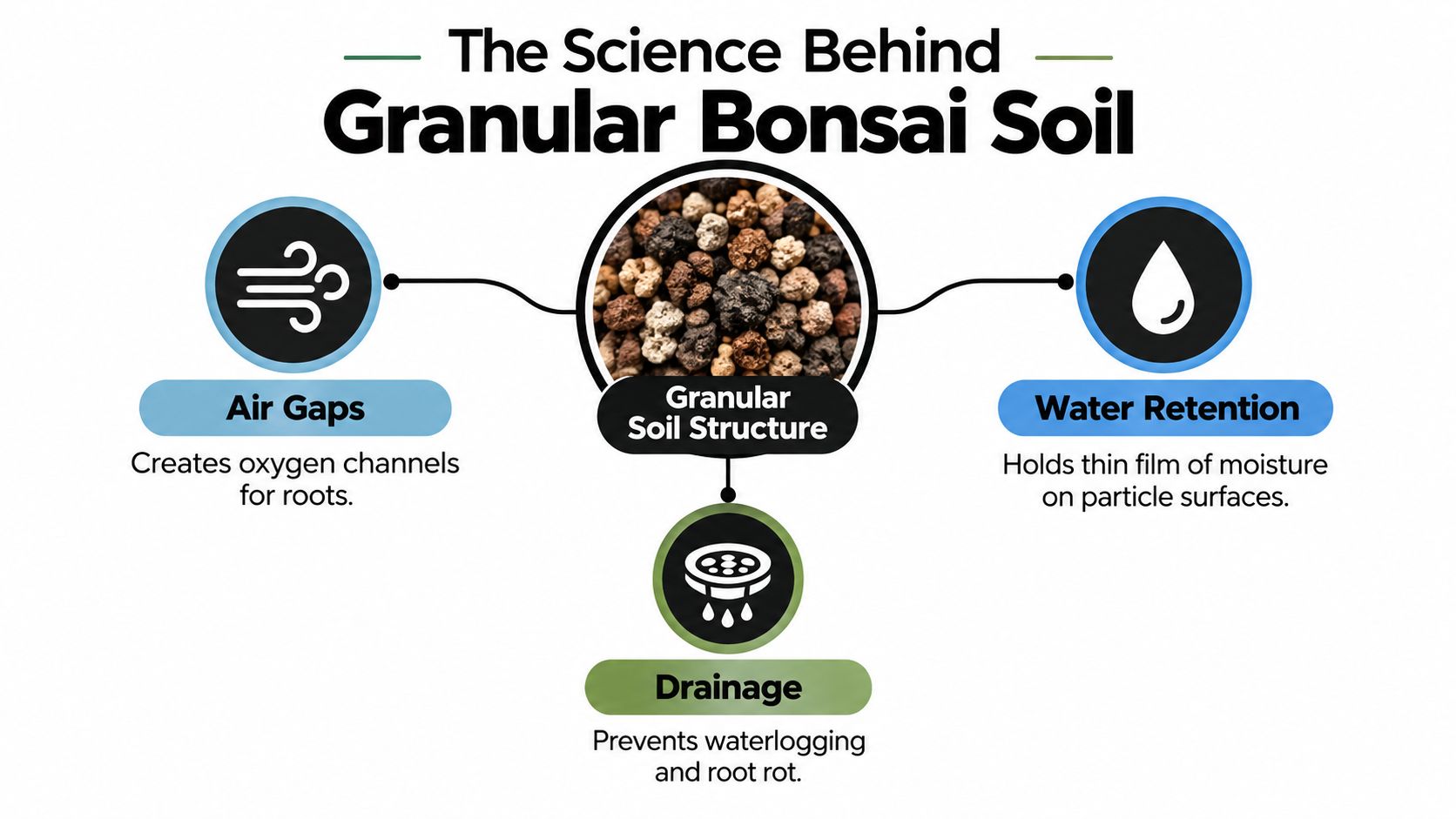
Bonsai soil looks unusual because bonsai roots need two things at once: water held on particle surfaces and oxygen moving through spaces between particles. Granular mineral media provide that combination. Each particle creates a small gap around itself, while its surface retains a thin film of moisture that feeder roots can access.
Garden soil behaves differently in a shallow container. Fine particles settle into the available spaces, and compost-heavy material can collapse as it becomes wet and decomposes. The result is a dense root zone that holds water but leaves too little air, especially where the container is shallow and drainage is limited.
Particle size controls the balance
Larger granules generally drain faster and preserve larger air spaces. Smaller granules retain more moisture, but too many small particles reduce the open pore space that roots depend on. This is why a mix can be technically “well-draining” yet still dry too quickly for a small pot, or retain too much water when screened too finely.
A useful starting point is:
- Shohin bonsai: Approximately 2–4 mm particles, as described in this guide to bonsai particle size and drainage.
- Standard bonsai trees: Approximately 3–6 mm particles, a practical middle range for many containers.
- Larger trees: Approximately 4–8 mm particles, where a coarser structure can improve drainage and airflow.
These ranges aren't universal instructions. A small tree in a hot, exposed position may still need careful moisture retention, while a larger tree in a wet environment may require a more porous grade.
Why screening makes the mix predictable
Random gravel, sand, garden soil, and unscreened compost create inconsistent pore spaces. Dust settles downward, oversized stones leave unusable gaps, and the finished pot behaves differently from one watering to the next.
Screen each ingredient into a reasonably narrow range. That single step makes the relationship between water, air, and drainage easier to understand and adjust. You aren't trying to produce a decorative gravel blend. You're building a stable root environment.
Choosing Your Core Ingredients
A reliable homemade substrate starts with three mineral components, each doing a different job. Substituting intelligently means replacing a function, not just matching a color or texture.
Akadama is the moisture and nutrient-retaining component. Its fired-clay granules hold water around their surfaces and provide cation-exchange capacity, which helps retain plant nutrients. Akadama also has a limitation: it can break down over time, particularly when repeatedly wet and dry. As it softens, the mix may lose pore space and drain more slowly.
Pumice contributes both moisture storage and root aeration. Its porous structure can hold water without turning into a dense mass, while its shape helps preserve open spaces. Pumice is useful when you want moisture buffering without relying heavily on organic material.
Lava rock supplies drainage and structural stability. It helps maintain macropores and gives the blend a durable mineral framework. Lava rock doesn't replace akadama's nutrient-holding role, but it can keep a mix open as other particles change.
| Component | Main Function | Bonus Benefit | Watch-Out |
|---|---|---|---|
| Akadama | Water and nutrient retention | Cation-exchange capacity | Breaks down over time |
| Pumice | Moisture storage and root aeration | Helps maintain porous structure | Excessively fine grades can clog spaces |
| Lava rock | Drainage and structural stability | Maintains macropores | Very large pieces create uneven contact around roots |
What to look for when buying
Choose material with consistent grading and limited dust. Harder akadama is generally more useful for a longer-lived mix, while soft, easily crushed granules deserve closer monitoring. Pumice and lava rock should be free of excessive powder and sorted closely enough that the finished batch doesn't contain both mud-like fines and oversized stones.
If you consider peat or another organic amendment, treat it as a moisture-management tool rather than a mineral equivalent. This peat moss guide from Colorado Cultures is useful background for understanding why organic materials can hold substantial moisture, but bonsai growers should use them conservatively and screen out fine fibers.
The best substitute is the one that preserves the missing function. A material that holds water may replace part of akadama's moisture role, but it won't automatically provide the same structure or nutrient retention. Test the finished mix instead of assuming the replacement behaves identically.
Recipes for Conifers and Deciduous Bonsai
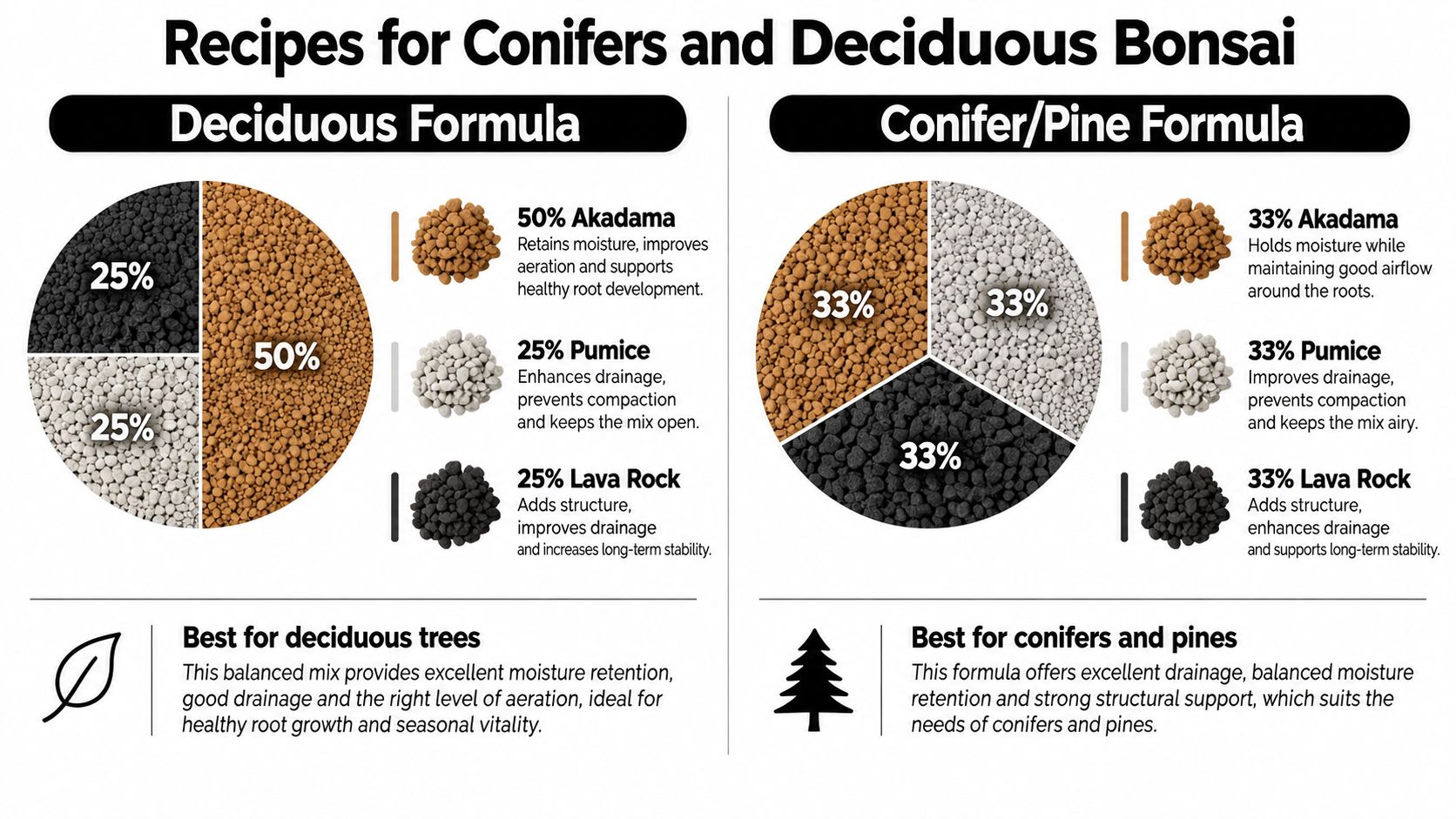
Start with a recipe that matches the broad behavior of the tree, then adjust it for the pot and your watering routine. For deciduous bonsai, a widely used starting formula is 50% akadama, 25% pumice, and 25% lava rock, as outlined in this practical bonsai soil reference.
For conifers and pines, an equal share of the three materials is often used. That means approximately 33.3% akadama, 33.3% pumice, and 33.3% lava rock. The more mineral-balanced structure gives you a useful starting point for trees that benefit from strong aeration and dependable drainage.
A measured 10-liter batch
Measure by volume with the same container each time. For the deciduous formula, combine:
- 5 liters of akadama
- 2.5 liters of pumice
- 2.5 liters of lava rock
That produces a 10-liter deciduous mix, provided the ingredients have been screened to a comparable particle range. Mix the components only after preparation so dust from one material doesn't settle through the others.
Adjusting the recipe to conditions
In a hot, dry climate, or with a tree that dehydrates quickly, increase moisture retention modestly. You can shift part of the mineral mix toward screened akadama, or replace a modest portion with screened, aged pine bark. Remove dust and very fine fibers from bark before use.
Don't turn the blend into a bark-heavy potting mix. Organic material decomposes and shrinks, which can reduce air space and make the substrate less stable. In a frequently watered setup, a humid room, or a rainy climate, move in the opposite direction by favoring more pumice and lava rock and using a coarser grade.
The correct question isn't “Which percentage is best?” It's “How long does this blend stay evenly moist while still draining freely?” A recipe that dries before your next available watering needs more retention. A recipe that remains saturated needs more open mineral structure, fewer fines, or both.
Screening Rinsing and Mixing Your Batch
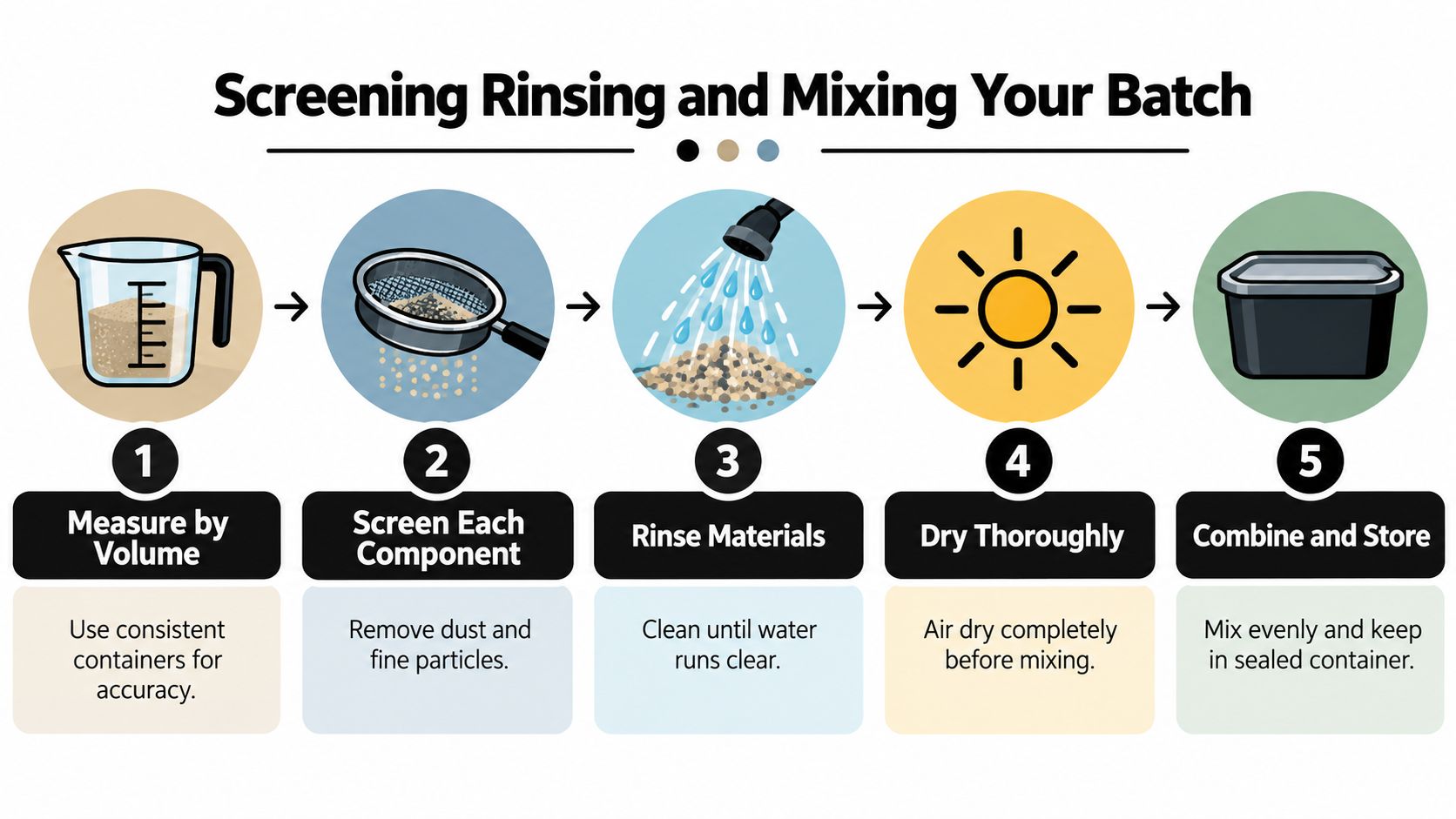
Prepare each ingredient separately. Measuring and mixing dusty material first spreads fines through the whole batch, making them harder to remove and leaving you with a substrate that can clog as soon as it gets wet.
Prepare the components
Use a sieve that separates dust and very small particles from the usable grade. Remove particles below approximately 1–2 mm, because they can fill the spaces between larger granules and restrict drainage, as described in this volume-based bonsai soil preparation guide.
Work outdoors, over a tray, or above mesh so you can collect usable material without losing it into the ground. Keep separate containers for different grades. The material you reject may look harmless in a dry bag, but it becomes a dense layer once repeated watering moves it downward.
Rinse akadama, pumice, and lava rock individually until the runoff is substantially clear. Rinsing removes loose fines that would otherwise settle in the pot. Let the components drain and dry thoroughly before measuring the final batch, especially if you want consistent volume.
Combine without compacting
Measure by volume, using one scoop or container for every component. Tip the prepared materials into a clean tub and turn them gently until the distribution looks even. Don't knead or crush the akadama while mixing.
Fill the pot without pressing the substrate down. The roots need the spaces you've just protected through screening. Settle the mix with thorough watering after planting rather than forcing it into place with your fingers.
This demonstration shows the same general preparation principle in practice:
Store leftover screened components in dry, sealed containers. Label each grade and material, then keep the bins clean so your next batch starts with prepared ingredients instead of a second round of dust removal.
Testing Your Mix Before and After Planting
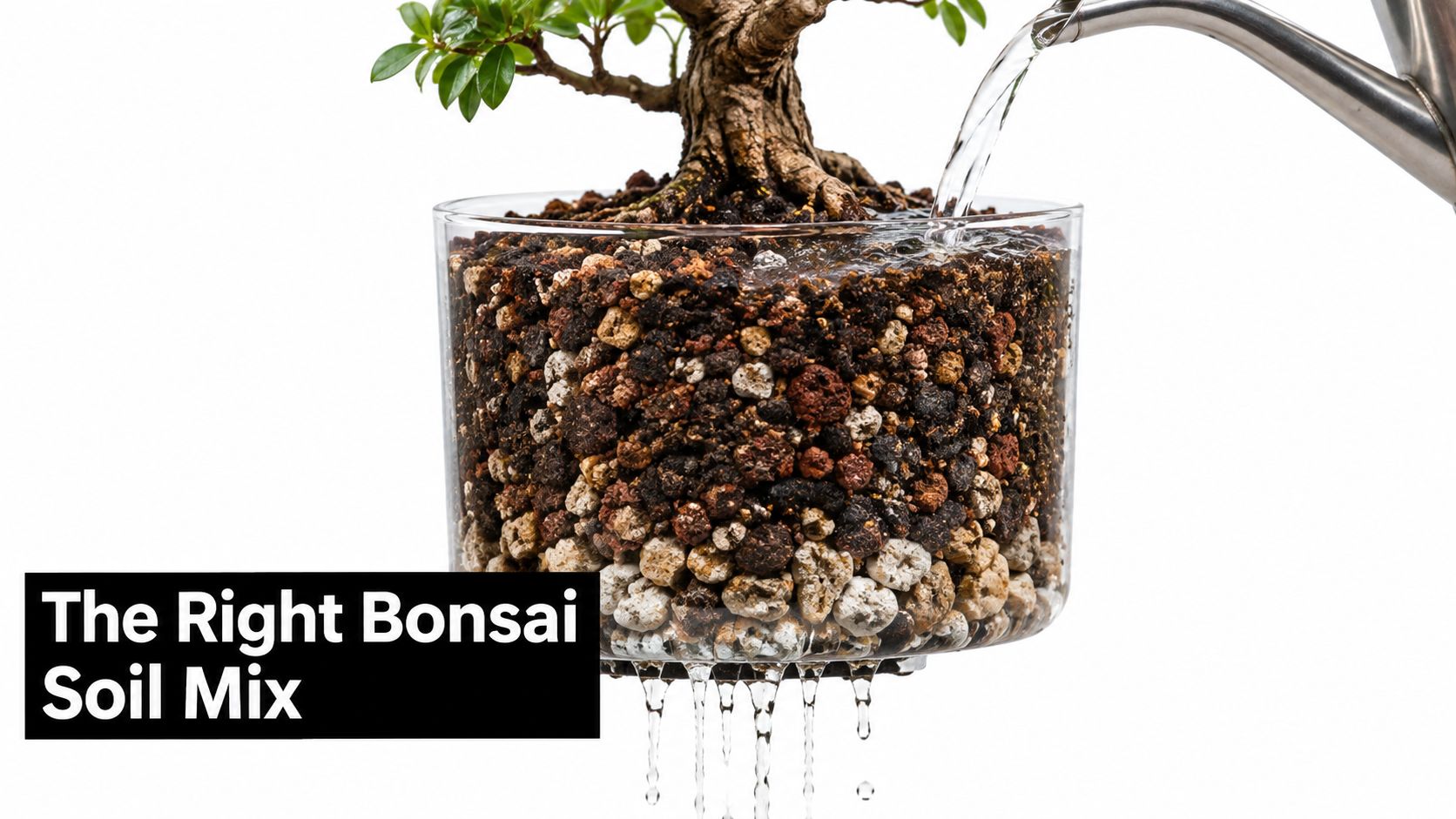
A mix should earn its place in the pot through testing. Before planting, moisten a sample and place it in a container similar in depth and size to the bonsai pot. Pour water through it and watch whether it exits freely or lingers on the surface.
Persistent pooling or sluggish flow usually points to excessive fines or too much organic material. A fast initial drain isn't automatically a problem, but the mix shouldn't behave like dry gravel that sheds water without becoming evenly moist.
A simple container test
Use the same watering method you expect to use after planting. Observe the surface, the runoff, and the container's weight after drainage. Then check the sample again over the following days.
- Surface remains pooled: Screen more aggressively or increase open mineral material.
- Mix stays heavy and saturated: Reduce moisture-retentive material.
- Mix dries almost immediately: Use a finer grade or increase the moisture-holding fraction.
- Water bypasses dry pockets: Pre-moisten the substrate and improve the uniformity of the particle range.
The test should mirror the actual pot. A shallow container and a deep training pot won't dry at the same pace, even when filled with identical material.
Skip the drainage-layer shortcut
A bottom layer of coarse material doesn't repair a poorly structured mix. An abrupt change from fine material to coarse material can create a perched-water zone instead of improving drainage. Use a uniform screened substrate from top to bottom and cover drainage holes with mesh so the mix stays in place.
After planting, pour water through the pot and look for the same warning signs. Track pot weight and drying time across several days. That record tells you more about suitability than a fixed recipe can, because it captures your tree, container, placement, and watering pattern together.
Long-Term Care and When to Refresh Your Soil
Homemade bonsai soil changes after it enters the pot. Irrigation water can gradually alter the root-zone chemistry, particularly when tap water contains bicarbonates and carbonates that buffer pH changes. The materials themselves also influence runoff chemistry, and University of Florida substrate data reports leachate pH values ranging from 6.31 to 7.95 depending on the media used, as summarized in this container-substrate reference.
That makes maintenance part of the recipe. Watch the runoff and the surface rather than assuming the original blend remains unchanged.
A practical maintenance routine
- Inspect for white deposits: Salt crust on the substrate or pot can indicate soluble salts accumulating.
- Flush when needed: Run plenty of clean water through the container when deposits appear or feeding has been heavy.
- Check runoff periodically: A pH check can reveal drift, but remember that pH and total dissolved salts measure different conditions.
- Feed conservatively: Porous, low-organic mixes can retain fewer nutrients between applications, so avoid compensating with unnecessarily heavy fertilizer doses.
- Review the structure: If akadama has visibly collapsed or watering has become unusually slow, the root zone may need refreshing.
Water chemistry deserves attention because a mix that starts balanced can behave differently after repeated irrigation and feeding. The University of Maryland Extension identifies bicarbonates and carbonates as important water-quality factors because they buffer pH changes in growing media, a point covered in this water-quality guide for container plants.
Organic additions need the same restraint. If you use aged pine bark for a hot, dry location, keep the fraction modest and monitor whether the substrate shrinks or stays wet. Basic home composting tips from Fillaree can help you understand organic material management, but unfinished or fine compost isn't a substitute for screened bonsai media.
Use this guide to when to repot a bonsai when the mix has visibly collapsed, drainage has slowed, or the root environment no longer matches the tree's conditions. The decision should come from the substrate's behavior, not from a universal calendar.
Leaves & Soul offers bonsai fertilizer pellets, ready-made bonsai blends, pots, and wiring accessories for growers who want to complement a carefully mixed homemade substrate. Visit Leaves & Soul to choose the supplies that fit your tree, container, and feeding routine.