


You’re probably looking at your bonsai right now with shears in hand, seeing three things at once. A branch that feels too long, a silhouette that has gone soft, and a hundred ways to make a mistake.
That hesitation is normal. Bonsai pruning feels permanent because every cut changes the story of the tree.
The useful shift is this. Pruning is not punishment, and it is not random tidying. It is editing. You are not trying to force a tree into obedience. You are choosing what growth serves the design, what growth strengthens the tree, and what growth belongs to another season.
When people ask how to prune a bonsai, they often want a formula. Bonsai does use rules, but rules only matter when they support intent. A good cut has a reason. It improves health, reveals structure, creates scale, or directs energy where the tree needs it most.
A neglected branch can hide a beautiful trunk line. A single removed shoot can open light into the interior. A branch you keep today may become the future apex, the future first branch, or the branch that gives the whole tree movement.
That is why experienced growers pause before they cut. Not from fear, but from purpose.
The Art of the First Cut Understanding Your Goal
A beginner usually starts with the wrong question. “What can I cut?” sounds practical, but it leads to nervous trimming around the edges.
The better question is, “What is this tree trying to become?”
Read the tree before you touch it
Set the bonsai at eye level. Turn it slowly. Look at the trunk first, not the foliage. The trunk tells you where the movement lives, where the front wants to be, and where the design already has character.
Then look for these tensions:
- Strength versus clutter: Strong growth often creates the most visual mess.
- Health versus style: A branch may be awkward, but still useful while the tree develops.
- Scale versus vigor: Long internodes and coarse extensions can make a small tree feel oversized.
A good pruning session starts when you can name your priority. Are you refining an existing silhouette? Are you correcting structure? Are you opening the tree so you can finally see its bones?
Think in purposes, not in cuts
Most pruning falls into two very different kinds of work.
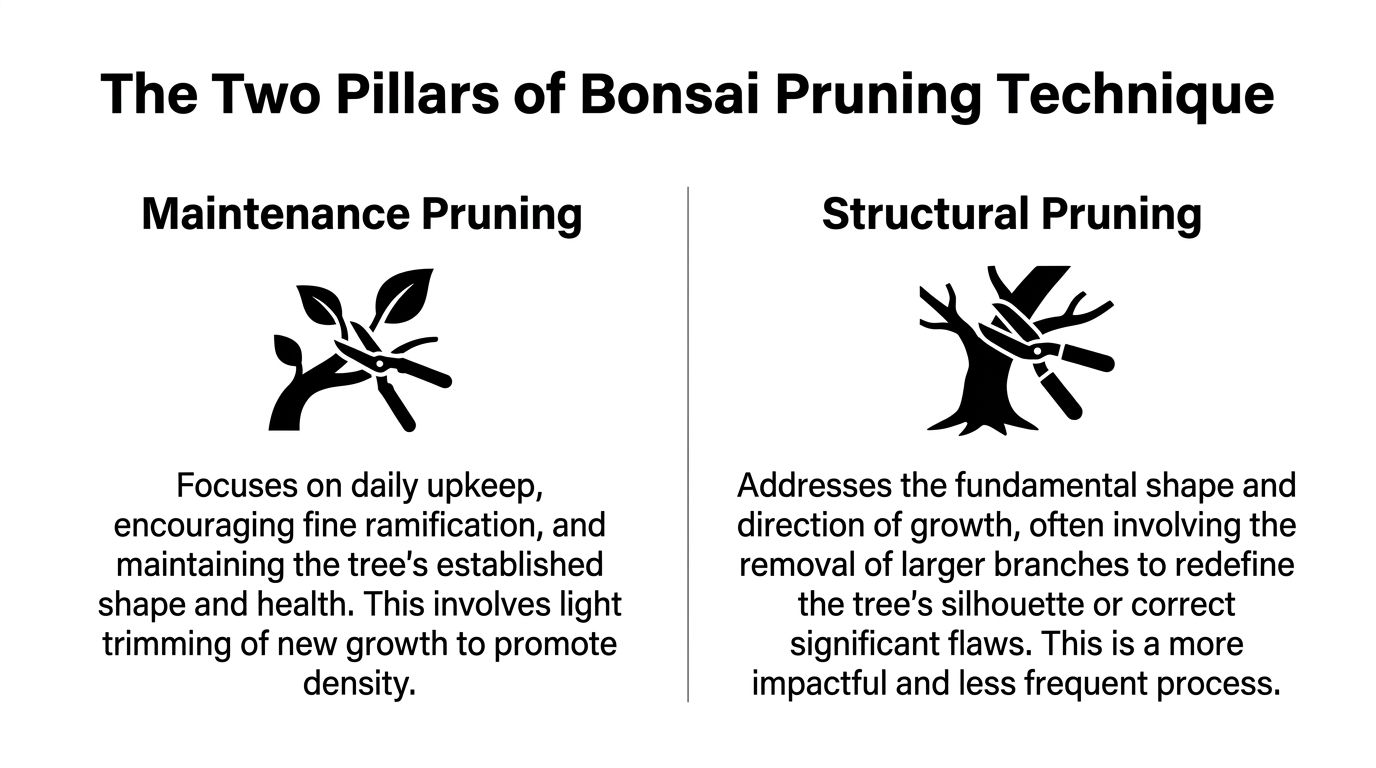
One is maintenance pruning, where you trim fresh growth to keep shape, improve ramification, and preserve proportion. The other is structural pruning, where you remove larger or more important branches to define the tree’s long-term architecture.
Those are different conversations with the tree. Maintenance pruning is a whisper. Structural pruning is a commitment.
A branch should stay for one of three reasons: it strengthens the tree, it improves the design now, or it will improve the design later.
Here, artistic intent matters. A branch that looks ugly today may still be valuable if it helps thicken a section or fill an empty space in the future. Another branch may look healthy and full, yet ruin the flow of the design because it blocks the trunk or creates confusion in the canopy.
The hand learns by doing. The eye learns by asking why.
Gathering Your Essential Pruning Tools
Bad tools leave bad wounds. Bonsai forgives many beginner errors, but crushed tissue and ragged cuts are not among them.
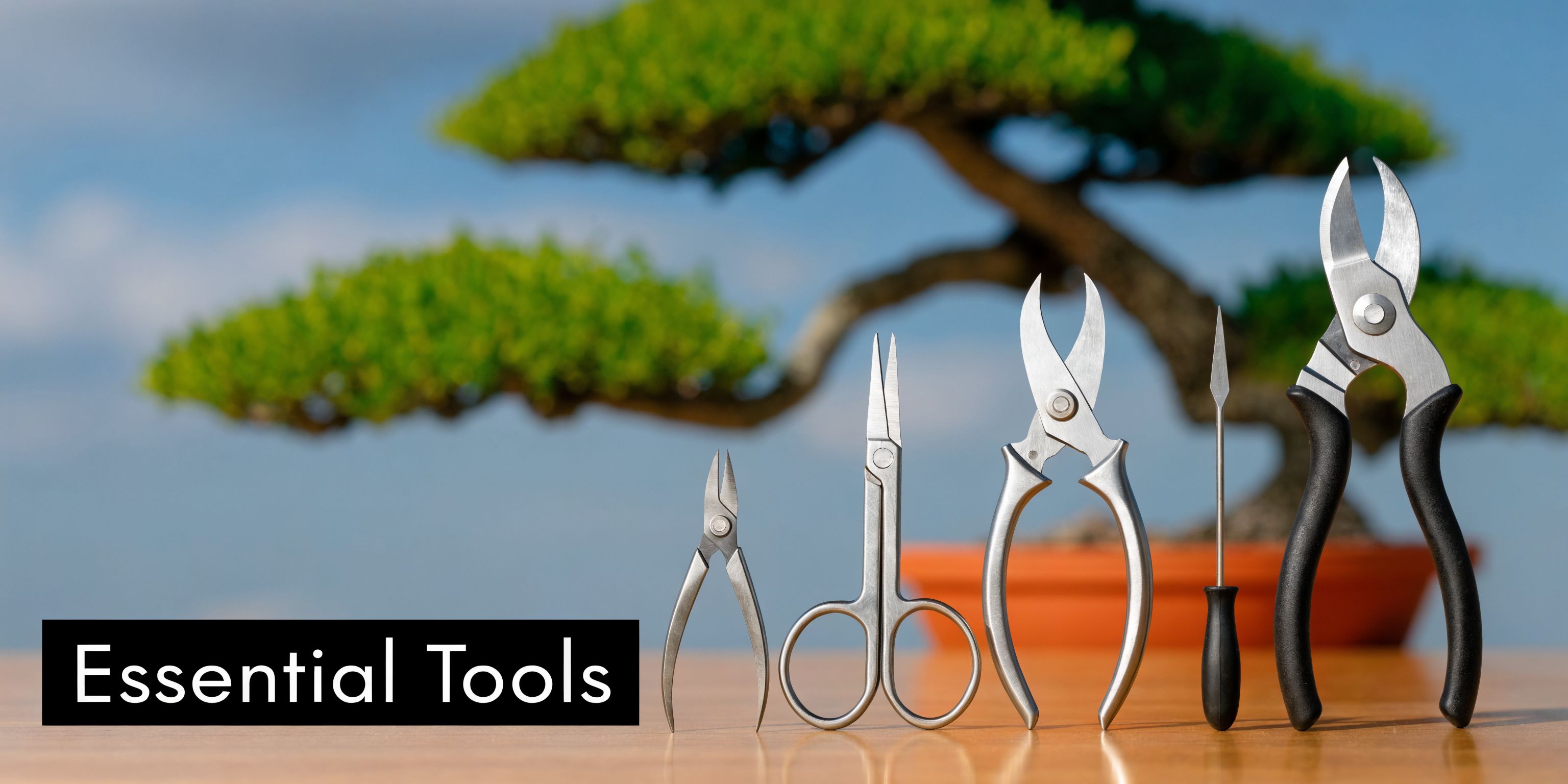
A small, disciplined toolkit does more for your tree than a drawer full of generic garden tools. If you want a practical overview of tool roles and care, this guide on bonsai tools and pruning basics is useful: https://leavesandsoul.com/blogs/news/bonsai-tools-pruning-shaping-care
The tools that matter most
- Twig shears: These handle fine canopy work. Use them for trimming shoots, refining pads, and making precise cuts in tight spaces.
- Concave cutters: These are for thicker branches. They remove wood in a way that leaves a cleaner, slightly hollowed wound.
- Wire cutters: If a branch is wired, use the proper cutter and remove the wire piece by piece rather than unwinding it through foliage.
- Jin pliers: More relevant for styling than routine pruning, but helpful when bending, twisting, or working deadwood features.
- Cleaning cloth and sanitizer: Sharp is only half the job. Clean tools reduce the chance of spreading problems from one tree to another.
Why the cut shape matters
On larger branches, concave cutters are not optional luxury. They create a wound profile that closes more cleanly over time. According to Homegrown Garden’s bonsai pruning guidance, wounds made with proper concave cutters can heal 20-30% faster than cuts made with standard flat-bladed shears.
That matters because bonsai is a long game. Every scar sits in the design for years.
What does not work
Many people start with household scissors or bypass pruners from the shed. Those tools often tear soft shoots, bruise bark, or block your view when you need precision. They also encourage lazy cutting because they feel oversized in a tiny canopy.
Use the smallest tool that can make the cut cleanly. If a branch resists, stop and switch tools. Forcing a cut is one of the fastest ways to turn a thoughtful session into damage control.
Decoding the Bonsai Pruning Calendar
Timing is not a side detail. It decides whether a cut redirects energy cleanly or asks the tree to recover at the wrong moment.
A bonsai does not respond to pruning according to your weekend schedule. It responds according to stored energy, sap flow, species habits, and the season.
Work with the tree’s rhythm
For many deciduous species, light maintenance work happens during active growth. Bonsai Trader notes that light maintenance pruning can be done 2-4 times during the growing season, typically March to September for outdoor trees, while structural pruning is best in late winter to reduce excessive sap bleeding.
That rhythm makes practical sense. During active growth, the tree can replace fine shoots and respond to small edits. In late winter, structure is easier to read, and major cuts fit better into the tree’s broader cycle.
Bonsai pruning calendar by tree type
| Tree Type | Maintenance Pruning (Shape Refinement) | Structural Pruning (Major Branches) | Notes |
|---|---|---|---|
| Deciduous outdoor bonsai | During active growth, often from March to September | Late winter | Leafless periods make branch structure easier to judge |
| Indoor bonsai | Light refinement can be done year-round if the tree is actively growing | Use caution and time bigger work around strong growth periods | Indoor conditions vary, so watch vigor more than the calendar |
| Conifers | Light refinement depends on species and growth stage | Often timed differently from deciduous trees | Avoid treating all conifers the same. Pines in particular need species-specific handling |
Species matters more than enthusiasm
A maple that is pushing hard in spring asks for a different approach than a pine. Deciduous trees usually show you their structure clearly once leaves are gone. Conifers hold their foliage differently, and some react poorly to the wrong kind of cut at the wrong time.
That is why “prune in spring” is too vague to be useful.
Use the calendar as a framework, then read the tree in front of you:
- Strong new extension: good for light refinement
- Dormant structure visible: good time to assess major design choices
- Weak growth or recent stress: delay ambitious work
- Heat, drought, or poor recovery: favor restraint over styling ambition
Good timing feels less like catching a date and more like meeting the tree when it is ready to answer.
If you learn that, the whole practice becomes calmer. You stop imposing work. You start choosing moments.
The Two Pillars of Bonsai Pruning Technique
Most confusion comes from mixing two jobs into one session. You reach in to tidy the outline, then suddenly remove a major branch, then keep trimming until the tree looks thin and uncertain.
Separate the work. Bonsai pruning becomes far clearer when you treat maintenance pruning and structural pruning as distinct disciplines.
If you want to deepen the design side of branch placement and silhouette, this companion piece on shaping a bonsai adds useful context: https://leavesandsoul.com/blogs/news/shaping-a-bonsai
Maintenance pruning keeps the story coherent
Maintenance pruning is the regular act of preserving proportion. The tree already has a direction. Your job is to stop vigorous growth from blurring it.
You shorten extending shoots, thin obvious congestion, and guide the eye back to the trunk line and primary branch structure. At this stage, bonsai begins to look intentional rather than overgrown.
Maintenance pruning helps you do three things at once:
- Preserve silhouette: Long shoots can quickly make a small tree look coarse.
- Encourage finer branching: Repeated, careful trimming supports denser ramification.
- Let light into the interior: Inner buds need access if you want growth close to the trunk.
On deciduous trees, cut just above a leaf node or bud when refining. On conifers, especially pines, species technique matters. You are not merely reducing volume. You are deciding where future growth will emerge.
Structural pruning changes the architecture
Structural pruning is heavier and slower. Here you decide which branches build the design and which ones fight it.
You may remove crossing branches, branches that block the front, or branches low on the trunk that weaken the intended image. The point is not to make the tree smaller. The point is to make the design legible.
Structural pruning often begins with hard questions:
- Does this branch improve trunk movement or hide it?
- Does this branch create balance or confusion?
- Is this branch part of the final image, or just temporary growth?
- If I remove this branch, does the design become clearer?
A strong structural cut usually makes the tree look simpler at first. That can be unsettling. Simplicity is often the first sign that the design is improving.
The rule that protects the tree
There is one limit that should stay in your hands every time you prune. The foundational 1/3 foliage removal rule advises that a healthy bonsai can safely have up to one-third of its foliage removed in a single session. Exceeding that risks shock, while staying under it supports denser ramification, as explained in Bonsai Empire’s pruning guide.
That rule matters most when you are excited. A tree can look better with every cut right up until you cross the line from editing into depletion.
Stop while the tree still has enough strength to answer your design with new growth.
How the two methods feel in practice
Maintenance pruning is close work. You lean in, scan pads and nodes, and make many small decisions. It rewards patience and consistency.
Structural pruning is more like composition. You step back often. You remove less frequently, but each removal carries more visual and biological weight.
One teaches control. The other teaches courage.
A useful way to think about it is this:
| Aspect | Maintenance Pruning | Structural Pruning |
|---|---|---|
| Main purpose | Refine shape and density | Define long-term form |
| Typical target | New growth and minor clutter | Major branches and design flaws |
| Frequency | More frequent | Less frequent |
| Visual effect | Subtle improvement | Noticeable change |
| Risk level | Lower if done lightly | Higher because each cut is more consequential |
A visual demonstration helps when these ideas still feel abstract.
What to remove first
When you are unsure, do not start at the tips. Start with what is clearly wrong.
Remove in this order:
- Dead or damaged growth
- Crossing branches
- Growth that blocks the chosen front
- Strong shoots that distort proportion
- Secondary clutter
That order keeps you from wasting energy refining branches that may not belong in the design at all.
Many beginners cut too timidly during structural work and too aggressively during maintenance work. They reverse the disciplines. Learn the difference, and your trees will start to look older, calmer, and more convincing.
Aftercare and Supporting Healthy Regrowth
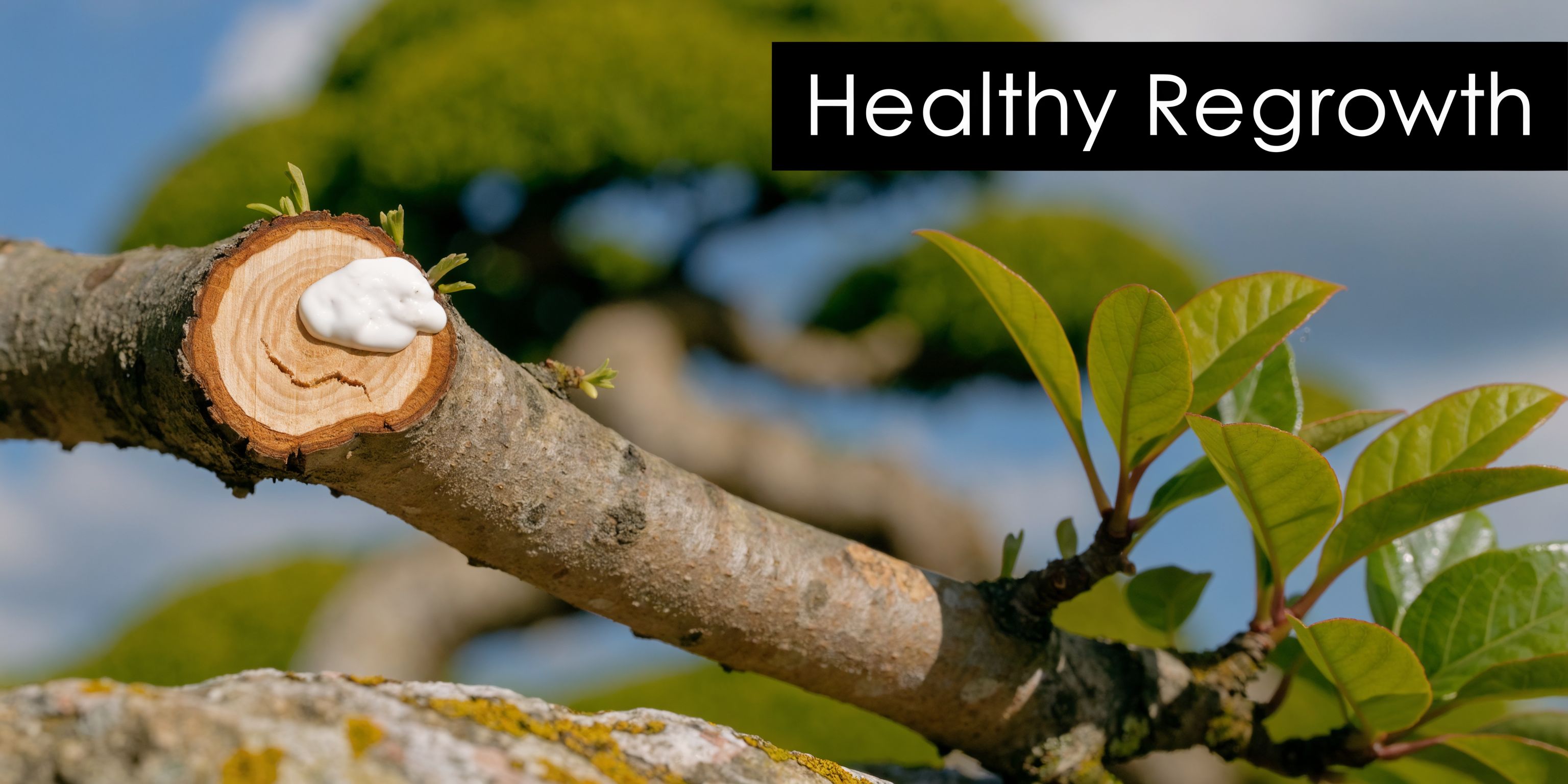
Pruning ends when the tree begins to recover, not when you put the shears away. Fresh cuts change the tree’s balance immediately. There is less foliage pulling water, fewer growing tips directing energy, and sometimes a major wound asking to close cleanly.
For a broader look at why trees respond the way they do after pruning, this plant response article gives good background: https://leavesandsoul.com/blogs/news/why-plants-respond-to-pruning
The first few days matter
After pruning, keep conditions steady. Do not compound fresh cuts with neglect or sudden extremes.
Use this checklist:
- Watch watering carefully: The tree may use water differently after foliage reduction. Avoid watering by habit alone.
- Protect from harsh exposure: Strong wind and intense sun can push a freshly pruned tree harder than it needs.
- Inspect larger cuts: On substantial branch removals, apply wound sealant if that is part of your practice.
- Delay extra stress: Avoid piling on other major work when the tree is already allocating energy to recovery.
Feed recovery gently
After pruning, the goal is support, not stimulation for its own sake. Gentle, balanced feeding works better than trying to force explosive growth.
If you make a large branch cut, think in terms of healing and controlled regrowth. If you perform lighter maintenance work, think in terms of steady support and clean follow-up growth.
Recovery should look calm. Strong buds, healthy color, and even response matter more than fast, unruly extension.
The artist’s mistake after pruning is often impatience. You shape the tree one day and expect the next stage to appear immediately. Bonsai does not work that way. It answers over weeks and months. Aftercare is where you prove that your cuts were made for the tree, not just for your own satisfaction in the moment.
Common Pruning Mistakes and How to Avoid Them
Most pruning mistakes come from one of two urges. Fear makes people nibble around the edges until the design stays muddy. Impatience makes them strip too much and call it refinement.
Both produce weak results.
Using the wrong technique on pines
One of the most common examples is treating pine growth like broadleaf growth. A common mistake is using scissors on pine candles instead of pinching them by hand. In the demonstration cited in this bonsai video, that error can lead to 25% of the cut needles turning into brown stubs, while proper pinching results in only 5% browning.
That difference is not cosmetic trivia. Brown stubs interrupt the look of a finished tree and signal rough handling.
Cutting for neatness instead of design
A bonsai can look cleaner after a bad pruning session. That does not mean it was improved.
Watch for these errors:
- Removing obvious “mess” without checking branch function: The untidy branch may be the one building future depth.
- Creating symmetry too early: Real trees rarely read as mirrored. Over-balancing can make a bonsai feel artificial.
- Ignoring taper: If upper growth becomes as heavy as lower growth, the tree loses age and credibility.
- Leaving stubs: Unless a stub is intentional for a deadwood feature, unfinished cuts distract the eye and heal poorly.
Over-pruning from excitement
The first good cut often gives false confidence. The canopy opens, the trunk appears, and suddenly every branch seems negotiable.
That is when discipline matters. If your tree starts looking transparent rather than refined, stop. If every branch tip sits at the same outline, stop. If you are cutting because “one more snip might improve it,” step back and look from a distance.
Dull tools and dirty habits
Crushed tissue heals badly. Dirty tools invite trouble. Bonsai rewards neatness in process as much as neatness in silhouette.
A practical habit is to pause halfway through a session and inspect your own work. Are cuts clean? Are you still following the original design intent? Has the session shifted from purposeful editing to compulsive reduction?
That small pause prevents a lot of regret.
Frequently Asked Questions About Pruning Bonsai
Can I prune roots and branches in the same session
Sometimes, but caution matters. Major root work and major top pruning both draw on the tree’s reserves. If the tree is strong and the work is modest, growers may combine them. If either side of the work is heavy, it is safer to space the jobs so the tree can recover without stacked stress.
How do I decide which branch to remove when two compete
Choose the branch that better supports the trunk line and the intended image. Keep the branch with better direction, better placement, and more future value. If one branch blocks the front or creates confusion where the eye should move cleanly, that branch usually loses.
What if I already pruned too much
Stop immediately. Do not keep cutting to “balance” the mistake. Move the tree into stable conditions, avoid extra stress, and let it recover. Your next task is observation, not correction.
How do I know if I am maintaining or redesigning
Ask what would happen if you skipped this session. If the tree would look shaggy, you are doing maintenance work. If a branch must be removed to clarify the design for years ahead, you are doing structural work.
Should every awkward branch go
No. Some awkward branches are temporary sacrifices that help thicken an area, fill a gap, or preserve options. Pruning well means distinguishing between a branch that is ugly and a branch that is useful.
The more you practice that distinction, the more your bonsai stops looking trimmed and starts looking composed.
Leaves & Soul offers bonsai soils, fertilizers, tools, pots, and starter-friendly accessories for growers who want reliable materials without guesswork. If you’re building your pruning kit or supporting a tree through recovery and refinement, browse Leaves & Soul for practical bonsai supplies that fit both first projects and long-term trees.