


Most indoor-plant fertilizer advice starts with the bottle. That's backwards. Before you ask how to use liquid fertilizer for indoor plants, ask whether the plant has enough light to use the nutrients at all. A slow pothos in a dim corner usually needs better growing conditions, not a stronger dose of plant food.
Liquid fertilizer can help when a plant is actively growing in a container with limited nutrient reserves. It can also burn roots, leave white salt crust on the soil, and make a struggling plant worse when the underlying problem is drought, overwatering, poor drainage, or insufficient light. The safest routine is simple: diagnose first, dilute carefully, feed only when growth justifies it, and watch the plant's response.
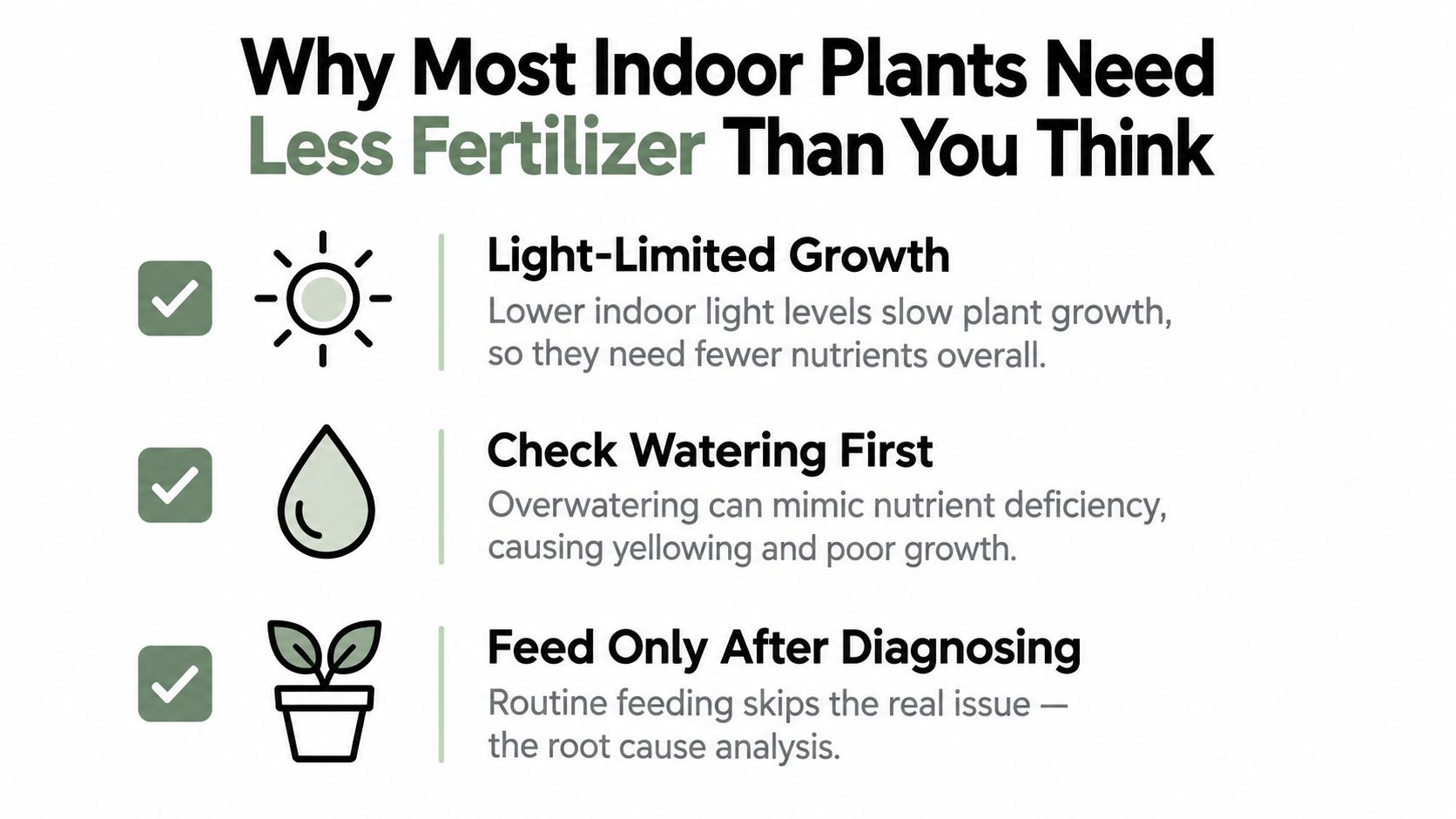
Why Most Indoor Plants Need Less Fertilizer Than You Think
Many indoor plants grow slowly because they're light-limited, not because they're starving. A plant in low light can't turn extra fertilizer into healthy new growth efficiently. The nutrients remain in the potting mix, where repeated applications may increase soluble-salt buildup instead of solving the original problem.
A summary of a controlled 2022 houseplant study reported that 78% of 120 common houseplants showed no measurable growth improvement from monthly rather than quarterly fertilizing when light and watering were already adequate, as described in this houseplant fertilizer analysis. That doesn't mean fertilizer never helps. It means routine feeding shouldn't replace an environmental diagnosis.
A pothos beside a north-facing window and a fiddle leaf fig near an east-facing window may sit in the same room but operate on very different nutrient budgets. The fig may be producing leaves and using more resources, while the pothos may just be maintaining itself. Neither plant benefits from receiving the same dose on autopilot.
Run a pre-feed check
Before mixing anything, look for:
- Recent growth: New leaves, expanding stems, or fresh roots indicate that the plant is using resources.
- Leaf color: Pale growth can relate to nutrition, but it can also reflect weak light, damaged roots, or poor watering.
- Root and pot condition: A severely root-bound plant may need repotting rather than more fertilizer.
- Stable care: If light and watering have been erratic, correct those variables before adding another one.
Practical rule: Fertilizer is a supplement to active growth, not a substitute for light, drainage, or consistent watering.
Skip feeding during a slow period unless the plant is clearly growing under strong natural or supplemental light. When you're unsure, delay the application and improve the environment first. A plant rarely suffers from waiting, but a stressed root system can suffer from one unnecessary concentrated dose.
Choosing the Right Liquid Fertilizer for Houseplants
Start with the N-P-K label. Nitrogen supports leafy growth, phosphorus contributes to root and reproductive development, and potassium supports general plant function and water regulation. For a mixed foliage collection, a balanced formula such as 1-1-1 or a foliage-oriented 3-1-2 is a practical starting point.
High-nitrogen products can encourage soft, stretched growth when indoor light is weak. That doesn't make nitrogen bad. It means the formula should match the plant's light, growth rate, and purpose. A bright, actively growing fiddle leaf fig has different needs from a shaded, slow-growing succulent.
Concentrates give you control and usually make more sense when you're feeding several plants. Ready-to-use bottles reduce measuring work and can suit beginners, but they offer less flexibility when one plant needs a weaker solution than another. Read the label before buying, especially the dilution instructions and whether the product is intended for soil, foliage, or both.
| Format | Typical N-P-K | Pros | Cons |
|---|---|---|---|
| Concentrate | Often balanced, such as 1-1-1 or 3-1-2 | Flexible dilution, useful for collections, less packaging per feeding | Requires accurate measuring |
| Ready-to-use solution | Product-specific | Convenient, fewer mixing steps | Less control over strength, can cost more per application |
| Specialty formula | Plant-specific | Suits orchids, cacti, or flowering plants with distinct needs | Easy to misuse on unrelated plants |
Synthetic fertilizers deliver readily available mineral nutrients but can contribute to salt accumulation when applied too heavily. Organic liquid products may feed more gradually and can behave differently depending on the ingredients and growing medium. Neither category removes the need to dilute, water properly, and observe the plant.
For broader plant-care context, The Green Advantage plant health resource is useful when fertilizer questions overlap with root, soil, or general plant-health problems. You can also compare application formats in this guide to liquid plant food.
A straightforward decision rule is to choose a balanced 1-1-1 or 3-1-2 synthetic concentrate if you want one adjustable product for a mixed foliage collection. Choose a specialty formula only when the plant's growing medium or feeding sensitivity gives you a clear reason.
Dilution Ratios and the Weekly Feeding Rhythm
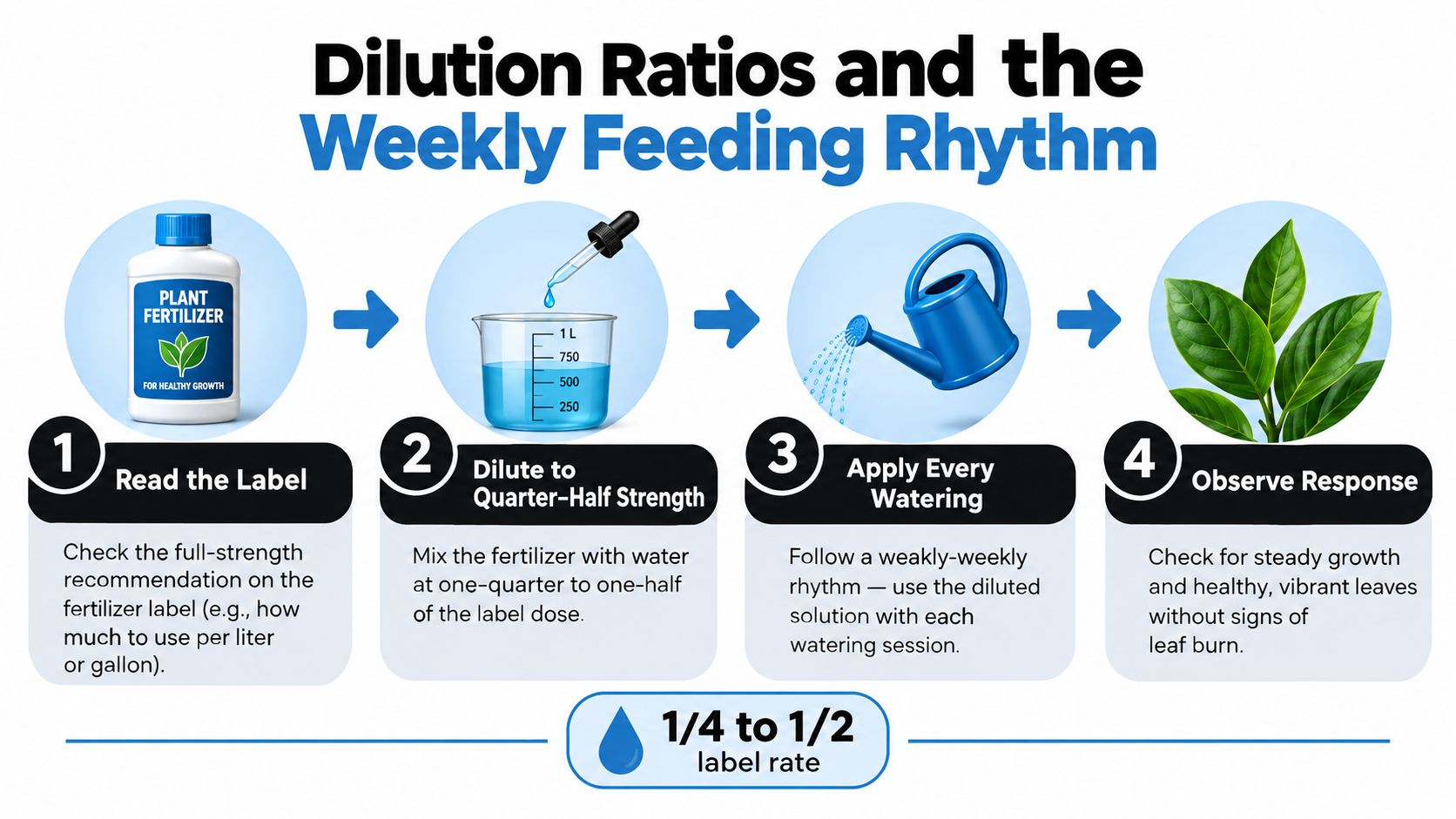
The safest liquid-fertilizer habit is weakly, weekly, although “weekly” should mean during active growth and only when the plant needs watering. Instead of applying a full-strength solution once a month, use a smaller dose more consistently. This reduces the sharp concentration change around the roots and makes mistakes easier to catch.
UConn Extension gives a useful example: a product labeled at 1 teaspoon per quart for monthly feeding can be reduced to 1/2 teaspoon per quart for feeding twice monthly, or 1/4 teaspoon per quart for weekly feeding. The same guidance explains why this works particularly well in containers, where potting media have limited nutrient reserves and nutrients can leach during watering. See the liquid-fertilizer dilution guidance for that baseline.
For a standard 1-1-1 concentrate, a cautious working range is roughly 1/4 teaspoon per gallon to 1/8 teaspoon per quart, depending on the label's full-strength recommendation. Don't treat that conversion as permission to ignore the bottle. Product concentrations vary, so reduce the label dose rather than transferring a measurement from one brand to another.
Mix it consistently
Use a dedicated 1-gallon watering can or a marked container. A clean measuring spoon or small syringe is more reliable than a bottle cap, whose volume can vary and often carries residue from previous mixes.
- Fill the container with water.
- Measure the reduced fertilizer dose separately.
- Add the fertilizer to the water and mix thoroughly.
- Label the can or note the dilution in your plant-care log.
- Use the solution promptly, and don't keep mixed solution longer than a week.
Water the plant first if the soil is completely dry. Once the root ball is lightly moist, apply the diluted fertilizer slowly around the soil. Let some solution drain from the bottom, then empty the saucer. This helps distribute the feed and reduces the chance of concentrated salts remaining at the root zone.
The main symptom of excessive soluble salts is brown or crispy leaf tips, sometimes accompanied by a white crust on the soil. Underdosing is usually easier to correct than overconcentrating. Track every application on a calendar so a forgotten feeding doesn't become a doubled dose the next time you water. For a closer look at measurement and rate decisions, use this guide to fertilizer application rates.
Soil Drench vs Foliar Spray Methods Compared
A soil drench is the dependable default. It places diluted fertilizer in the growing medium, where healthy roots can absorb nutrients during normal watering. Pre-moisten the mix if it's dry, pour slowly across the surface, allow drainage from the bottom, and let the excess escape completely.
Foliar feeding works differently. A dilute spray is applied to the leaves, often including the undersides, where uptake can be faster but usually less sustained. It can make sense for a leafy tropical plant in active growth when the foliage is healthy and environmental conditions are gentle. It isn't a shortcut for damaged roots or poor soil moisture.
Spraying in direct sun or beneath strong grow lights can scorch leaves. Foliar feeding is also rarely worth the effort for succulents, cacti, orchids with thick leaves, or dormant plants. Their foliage and growth patterns don't make routine spraying an efficient replacement for appropriate root-zone care.
| Factor | Soil Drench | Foliar Spray |
|---|---|---|
| Main route | Root uptake through the potting mix | Uptake through leaf surfaces |
| Best use | Regular, sustained feeding | Occasional support for healthy leafy plants |
| Preparation | Moisten dry soil, dilute, apply until drainage | Use a more dilute spray and cover foliage lightly |
| Main risk | Salt buildup or root injury from concentration | Leaf scorch, spotting, or residue |
| Avoid when | Roots are damaged or the plant is severely stressed | Leaves are dusty, damaged, dormant, or exposed to strong light |
Soil drench by default. Use foliar feeding only when the foliage is the active sink and the light, temperature, and leaf condition are suitable.
Don't spray a wilted plant and call the problem solved. Restore hydration and root function first. For a more detailed comparison of delivery options, see fertilizer application methods.
Seasonal Feeding Schedule for Indoor Plants
Plants respond to growth conditions, not the calendar alone. A warm room with strong light can keep a tropical plant growing outside the usual pattern, while a dim room can slow it down even during summer. Use the seasons as a starting framework, then confirm the schedule by watching for new growth.
Spring, March through May, is the usual restart period. As new leaves and roots appear, resume a diluted solution at roughly one-quarter to one-half of the label rate. Don't begin just because the calendar changed. Begin when the plant is hydrated, stable, and visibly waking up.
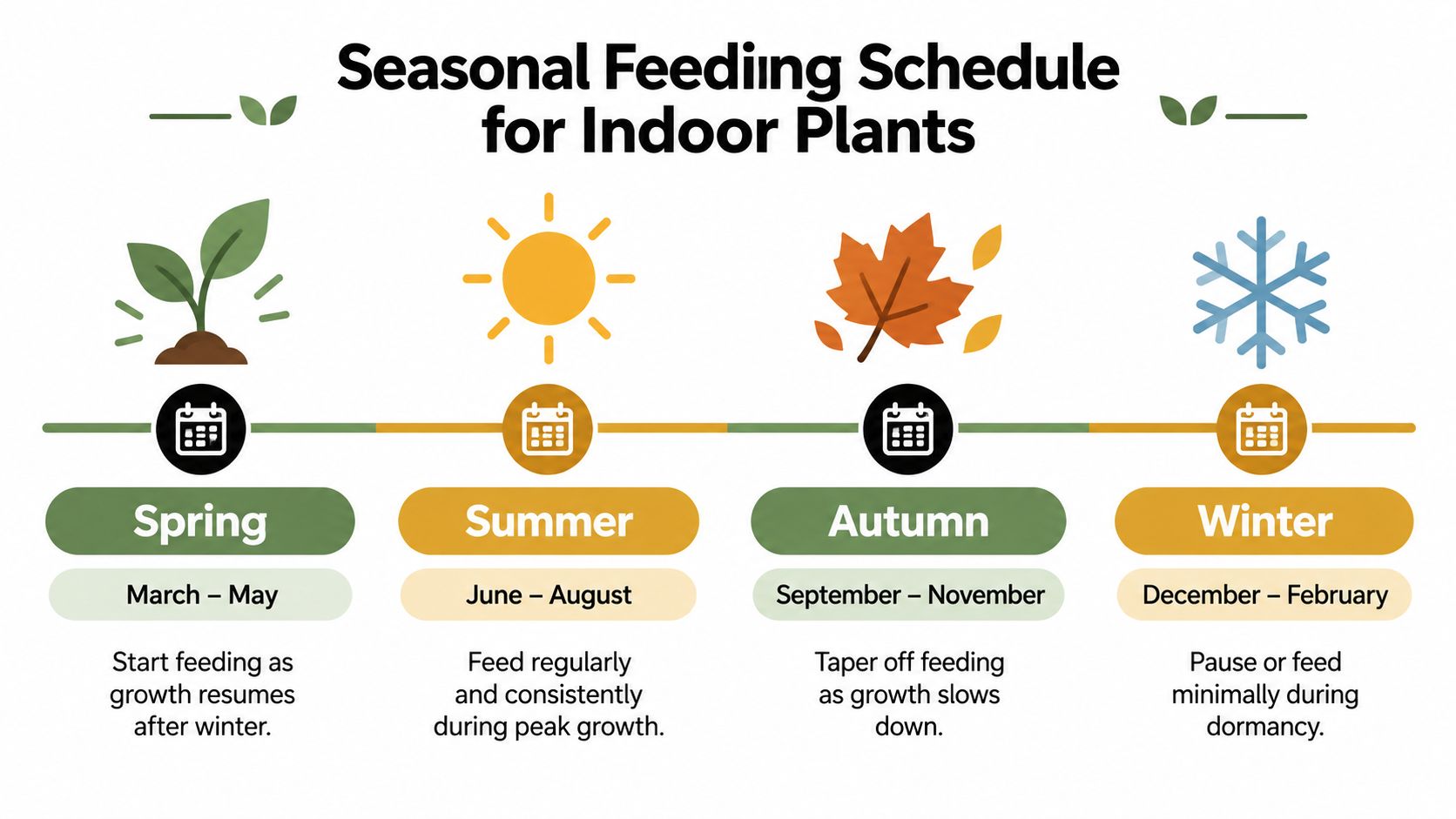
Summer, June through August, is often the strongest feeding window for foliage plants such as pothos, monstera, and fiddle leaf fig. Keep the solution weak and consistent when growth continues. If heat causes wilting or slows the plant, don't compensate with more fertilizer. Check root moisture, airflow, and light exposure instead.
Autumn, September through November, calls for a gradual taper as light drops and growth slows. Move from frequent feeding to every 2 to 3 weeks, then stop when the plant no longer produces meaningful growth.
Winter, December through February, is a rest period for many indoor plants. Skip fertilizer entirely for dormant plants, or use a single half-strength dose monthly only for a true tropical that continues growing under suitable grow lights. University of Maryland Extension supports monthly diluted feeding in summer for most plants, while Virginia Tech advises reducing both the amount and frequency by about half for slow-growing plants in its indoor-plant fertilizer guidance.
This March-to-September window is the practical baseline for most houseplants. Growth, not habit, decides whether feeding continues.
Tailoring Feed to Bonsai, Fiddle Leaf Figs, Succulents, and Orchids
A mixed collection shouldn't receive one identical routine. Container size, root structure, foliage, and growth season all change how forgiving a plant is.
Bonsai
Bonsai grow in shallow containers with limited room for roots and potting media. That makes precise, modest feeding more useful than occasional heavy applications. A balanced fertilizer at one-quarter strength every 2 weeks during growth is a cautious working rhythm for many bonsai, provided the tree is healthy and actively growing.
Late in the growing season, avoid pushing soft, overly lush growth. Some growers shift toward a lower-nitrogen formula as growth tapers, but the plant's species and local conditions still matter. Set the routine at one-quarter strength every 2 weeks, then pause when the tree becomes dormant.
Fiddle leaf figs
Fiddle leaf figs can use more nutrition than slow-growing succulents when they receive bright, stable light. A balanced formula at one-half strength every 1 to 2 weeks from spring through early fall can suit an actively growing specimen, but only if watering and drainage are reliable.
Their large leaves make problems easy to notice. Crispy lower leaves or brown margins aren't a signal to increase fertilizer automatically. Check light, root moisture, pests, and airflow before changing the feed. Use one-half strength every 1 to 2 weeks during active growth, then stop during the low-light winter period.
Succulents and cacti
Succulents and cacti generally need a lighter touch. A low-nitrogen formula at one-quarter strength, only 2 to 3 times during the growing season, avoids turning a slow-growing plant into a soft, stretched one. Never fertilize a dormant specimen just because the soil is dry.
Set the dose at one-quarter strength and use it only when the plant is actively growing and has already received appropriate water.
Orchids
Orchids growing in bark or moss require careful attention to salt buildup around sensitive roots. A urea-free, low-salt formula at one-quarter strength every 2 weeks can be used during active growth, followed by a monthly plain-water flush to move residual salts through the medium.
Avoid feeding a dehydrated orchid or one with damaged roots. The working setting is one-quarter strength every 2 weeks, with plain water used regularly to keep the root zone from accumulating residue.
| Plant Type | Dilution | Frequency | Seasonal Focus | Watch Out For |
|---|---|---|---|---|
| Bonsai | One-quarter strength | Every 2 weeks during growth | Feed while active, taper before dormancy | Limited root space and salt buildup |
| Fiddle leaf fig | One-half strength | Every 1 to 2 weeks while active | Spring through early fall | Overfeeding in low light |
| Succulents and cacti | One-quarter strength, low nitrogen | 2 to 3 times per growing season | Feed only during active growth | Feeding dormancy or encouraging soft growth |
| Orchids | One-quarter strength, low salt, urea-free | Every 2 weeks while active | Flush with plain water regularly | Sensitive roots and residue in bark or moss |
Troubleshooting Overfeeding and Underfeeding Recovery
Overfeeding and underfeeding can look surprisingly similar. Yellow leaves, weak growth, and poor color don't identify fertilizer as the cause by themselves. Start with the root zone, light, and watering pattern before reaching for another dose.
| Symptom | Likely Cause | Fix |
|---|---|---|
| Brown or crispy leaf tips | Excess salts, dry roots, or concentrated fertilizer | Stop feeding, check moisture, and flush if salt buildup is suspected |
| White crust on the soil | Soluble-salt accumulation | Remove visible crust and flush the root zone thoroughly |
| Pale new growth | Weak light, root trouble, or insufficient nutrition | Improve the environment before increasing fertilizer |
| Slow leaf development | Low light, seasonal slowdown, or restricted roots | Check light and roots, then feed only during active growth |
| Yellowing lower leaves with soft stems | Watering or root damage, sometimes compounded by overfeeding | Correct moisture and drainage; don't add fertilizer |
| No flowers on a mature bloomer | Light, season, root condition, or nutrition | Improve growing conditions before using a bloom formula |
The recovery protocol
If you've applied full-strength concentrate by mistake, stop feeding immediately. Water the pot thoroughly with plain water, allowing it to drain freely, then empty the saucer. For a serious buildup, flush the root zone with 3 to 4 pot volumes of plain water, provided the container has an open drainage path.
After flushing, withhold fertilizer for 4 to 6 weeks while the plant recovers. Keep light, moisture, and temperature steady, and remove badly damaged leaves only when they're clearly declining. A moisture meter can help you monitor the root zone, although it won't replace checking the soil and drainage directly.
When new growth resumes and the plant looks stable, restart at half the previous dilution. Don't immediately return to the old schedule because the leaves appear greener. Give the roots time to show that they can handle feeding again.
Underfeeding requires a different response. If the plant has adequate light, stable watering, healthy roots, and ongoing growth but remains pale and small, begin with a reduced liquid dose rather than a corrective blast. Record the date, concentration, and plant response. The safest long-term prevention is a calendar, accurate measuring tools, and a dilute rhythm that leaves room for observation.
Leaves & Soul offers liquid plant foods, targeted formulas, slow-release nutrients, and plant-specific supplies for bonsai, fiddle leaf figs, succulents, cacti, orchids, and other houseplants. Visit Leaves & Soul to choose a feeding option that matches your plant's growing medium and care routine, then start with a diluted application only when active growth gives you a reason to feed.