


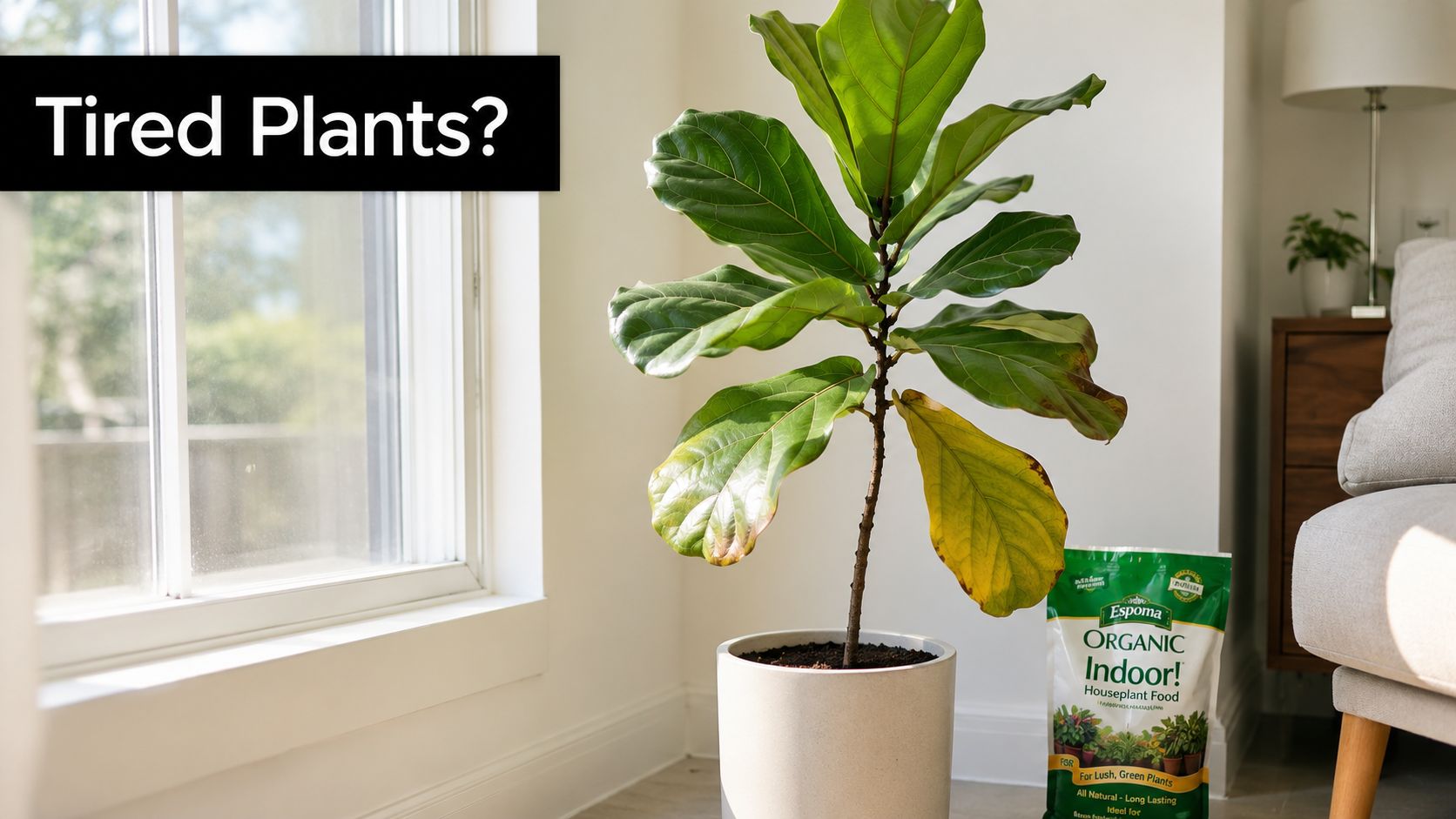
You water carefully, feed on schedule, and still your fiddle leaf fig looks tired. Maybe the leaves remain pale, or your bonsai dries out unevenly even though you've been watching its moisture closely. Before adding more fertilizer, look at the soil itself. Roots can only use nutrients effectively when the growing medium holds water, air, minerals, and microbial life in a workable balance.
A humic acid soil amendment can help with that missing link. It isn't a miracle tonic and it isn't a complete fertilizer. It's a soil conditioner that can improve the environment around roots, making an existing nutrient program more effective when the soil has a real structural or chemical limitation.
Why Your Plants Might Need Humic Acid
A fiddle leaf fig may receive regular fertilizer and still struggle if its potting mix has become compacted, drains poorly, or no longer holds moisture evenly. The same problem appears in bonsai, where a shallow pot can dry quickly at the surface while retaining wet pockets lower down. In both cases, the plant may have access to nutrients on paper, but the roots don't experience those nutrients in a stable, usable environment.
Start with the actual problem
Humic acid makes the most sense when your soil needs help with nutrient retention, structure, water management, or biological activity. Research describes humic substances as supporting soil structure, texture, water-holding capacity, microbial activity, and micronutrient availability. A review in Frontiers in Agronomy also describes their ability to chelate and co-transport micronutrients to plants.
That doesn't mean every unhappy plant needs humic acid. Yellow leaves can result from low light, overwatering, root damage, pests, temperature stress, or an incorrect fertilizer program. A humic product won't correct a dark corner or rescue roots that are constantly sitting in water.
Practical rule: Diagnose light, watering, roots, and fertilizer first. Use humic acid when the soil itself is part of the problem.
The commercial scale of humic acid reflects this broader role. One industry estimate places the market around USD 800 million in 2025 and projects about USD 1.56 billion by 2032, with agriculture and soil amendment applications representing roughly 63% of demand in that model. The Research and Markets industry overview shows that humic acid is used far beyond hobby gardening, particularly in programs focused on soil management and nutrient efficiency.
For a home gardener, the useful takeaway is simple. Humic acid is closer to improving the “workshop” where roots operate than to supplying the tools themselves. If the workshop is already well built, the amendment may add little. If the mix is tired, compacted, or poor at holding nutrients, it may support a more reliable fertilizer routine.
What Humic Acid Actually Is and Where It Comes From
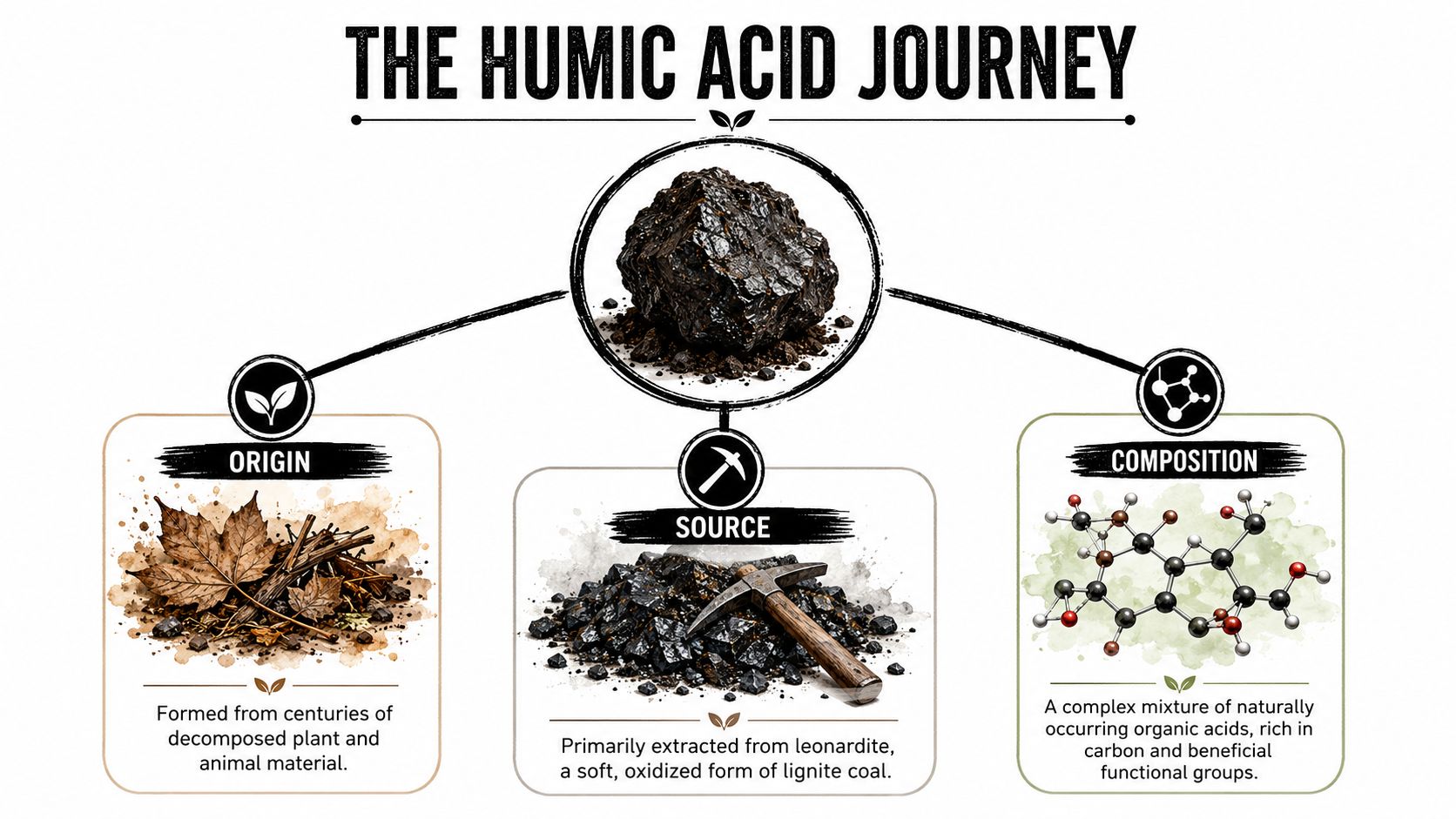
Humic acid comes from decomposed plant and animal material that has changed over long periods through biological and chemical processes. Commercial products are commonly associated with leonardite, a soft, oxidized, coal-like mineral formed from ancient organic deposits. Peat and other organic materials can also contain humic substances.
Think of it as a molecular sponge
The phrase “humic acid” describes a complex group of organic molecules rather than one simple ingredient. Many of these molecules contain functional groups that can interact with minerals and charged particles in soil. A useful gardening analogy is a molecular sponge. It can hold onto certain nutrients and help keep them in the root zone instead of allowing them to move away immediately with drainage.
Another analogy is a nutrient taxi. Humic molecules can bind with micronutrients and help transport them through the soil toward roots. This process is called chelation, but you don't need advanced chemistry to understand the practical point. A mineral that is chemically tied up may be difficult for a plant to access, while a humic-associated mineral can remain more available under suitable conditions.
Humic substances are commonly discussed as a family:
- Humic acid consists of larger organic molecules that are more active in the soil environment. They're associated with aggregation, nutrient retention, and improved physical conditions.
- Fulvic acid consists of smaller, more soluble molecules. Products may include both materials, but their behavior in soil and water differs.
- Humin is the fraction that remains insoluble across the usual extraction conditions. It contributes to persistent organic matter rather than acting like a readily dissolved liquid input.
These categories overlap in natural soils, and product labels don't always use them consistently. Look beyond a prominent word on the front of the package and check the guaranteed analysis, source material, dilution instructions, and whether the product is intended for soil drenching, mixing, or another use.
The agricultural importance of humic acid follows from its chemistry. It can influence several soil functions at once, including how particles bind, how water moves, and how nutrients interact with roots. That broad influence explains why growers use it as a foundation-supporting amendment rather than treating it only as a short-lived plant stimulant.
How Humic Acid Improves Soil and Plant Health
Humic acid earns its place in a growing program when it addresses a soil limitation. Its main contribution isn't direct nutrition. Instead, it changes the conditions that determine whether roots can reach, retain, and use nutrients.
Better structure creates a better root zone
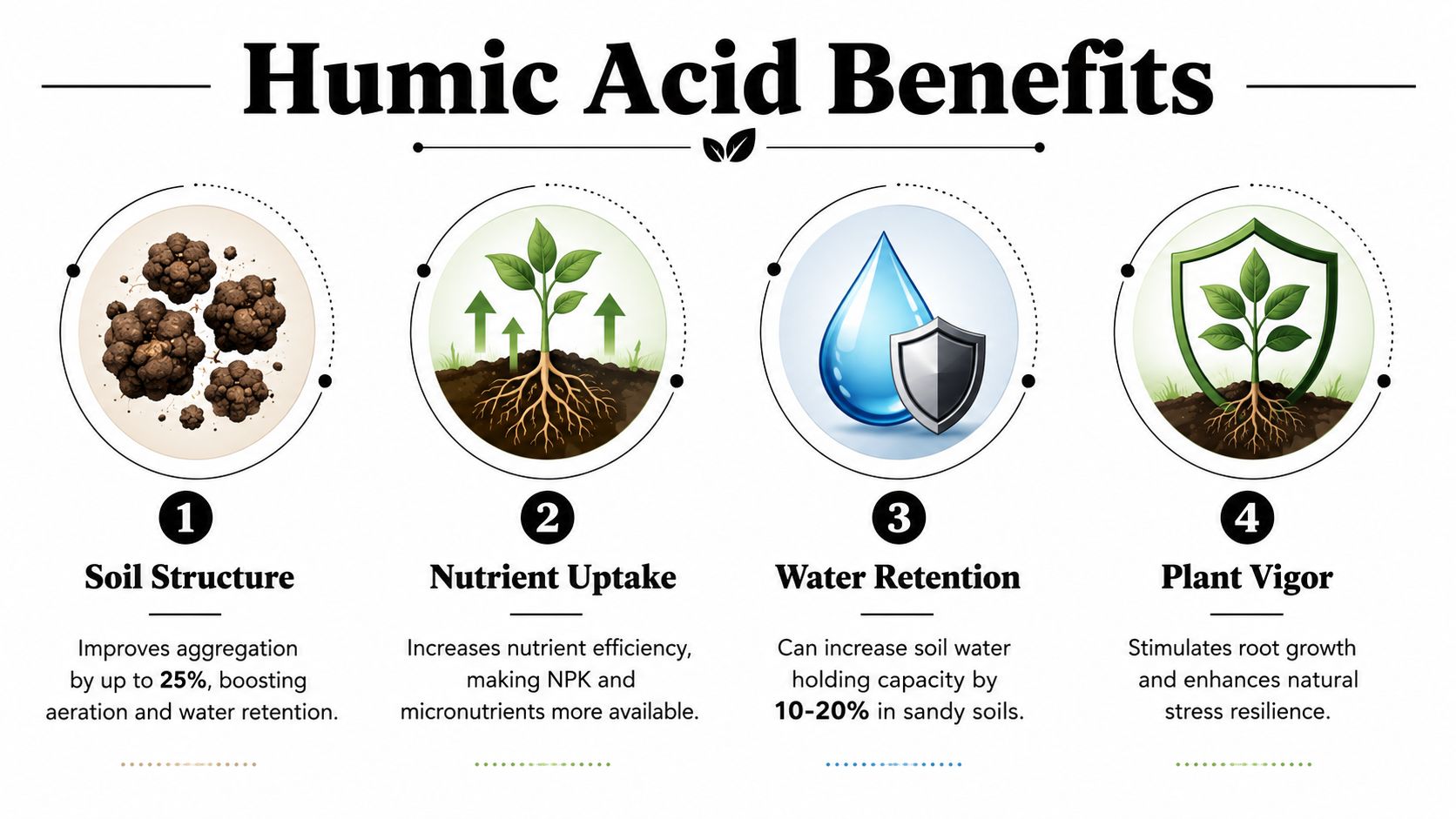
Soil particles can form aggregates, or small clusters, that leave a mixture of air spaces and water-holding spaces. Humic substances are associated with improved aggregation and soil structure. In a sandy mix, that may help the medium hold moisture and nutrients for longer. In a heavy clay soil, stronger aggregation can support drainage and aeration by preventing the particles from behaving like a dense, sealed mass.
That distinction matters for container plants. A mix that drains instantly may leave roots thirsty and nutrients moving out of the pot quickly. A mix that stays saturated may deprive roots of oxygen. Humic acid won't replace the need for correctly sized bark, perlite, pumice, or other structural ingredients, but it can support the chemistry and biology of a well-designed mix.
Nutrients stay available more effectively
Humic substances can bind with micronutrients and assist their movement toward roots. This is especially relevant for minerals that become less available under challenging soil conditions. The result isn't that humic acid supplies a complete meal. It helps the meal remain usable.
A dataset summarized in FAO AGRIS reported that humic acid fertilizer amendment increased crop yield by 12% on average, nitrogen use efficiency by 27%, and nitrogen uptake by 17%. Those figures come from agricultural research and shouldn't be treated as a guaranteed result for a houseplant in a small pot. They do, however, support the idea that humic acid can act as a nutrient-efficiency enhancer when paired with an appropriate fertilizer program.
Soil biology has more room to work
Humic materials can support microbial activity and nutrient cycling. Beneficial microbes need suitable moisture, oxygen, carbon sources, and root access. Humic acid alone won't create a complete soil food web, especially in a sterile or poorly managed pot, but it can contribute to a more biologically active root environment.
For a deeper look at the living organisms involved, explore the role of microbes in healthy soil. The practical lesson is to treat humic acid as one part of soil management, alongside appropriate organic matter, drainage, irrigation, and plant nutrition.
Application Rates and Formats for Different Plants
The correct application depends on the product concentration, the growing medium, and the plant's tolerance for changes in moisture and salinity. Because commercial formulas vary, the label should take priority over a generic internet recipe. If the label gives a dilution range, begin at the conservative end and observe the plant before increasing use.
Choose the format that fits the container
Liquid concentrates are convenient for soil drenches and can be distributed evenly through a pot when properly diluted. They're useful for established houseplants and mixed collections, but concentrated liquid can be misapplied if you estimate rather than measure.
Granular or powdered humates are practical for garden beds and for mixing into fresh potting media. They're less convenient for a plant already in a small pot because uneven distribution can create localized pockets of amendment.
Pre-mixed amendments simplify application, particularly during repotting. Their limitation is that you have less control over the amount of humic material and may not know how much of the blend is responsible for the result.
A conservative plant-by-plant guide
Use this table as a starting framework, not as a substitute for the product label. The supplied research supports soil application as the more reliable route compared with foliar spraying or seed treatment, so direct the amendment into the root zone unless the manufacturer specifies another method.
| Plant Type | Best Format | Application Rate | Frequency |
|---|---|---|---|
| Houseplants in containers | Diluted liquid soil drench | Use the label's lowest soil-drench dilution and apply only until the root ball is evenly moistened | Apply during active growth according to the label, not at every watering |
| Bonsai in shallow pots | Carefully measured liquid drench | Use a conservative label dilution, keeping the volume consistent with the pot's shallow root zone | Use occasionally during active growth and pause when the tree is dormant |
| Succulents and cacti | Very dilute liquid or a small amount mixed into fresh media | Start below the label's general container rate because fast drainage and low organic matter limit contact time | Use sparingly and only when the medium has a clear nutrient-retention or structure issue |
| Orchids in bark-based media | Diluted liquid applied to the root zone | Follow the label's lowest compatible dilution and flush the medium with plain water as part of normal care | Apply infrequently during active root or leaf growth, avoiding routine use during stress or dormancy |
For a new application, first water a dry root ball lightly with plain water. Then apply the diluted humic solution evenly around the medium rather than pouring it into one spot. Keep the plant in its normal light and watering conditions, and record changes in leaf color, new growth, moisture behavior, and root health.
Avoid foliar spraying unless the product is specifically labeled for it. The research summarized in the supplied materials indicates that soil application is consistently more effective than foliar spraying or seed treatment. Roots are the main target when your goal is to improve soil structure and nutrient availability.
Compatibility with Fertilizers and Specific Plant Types
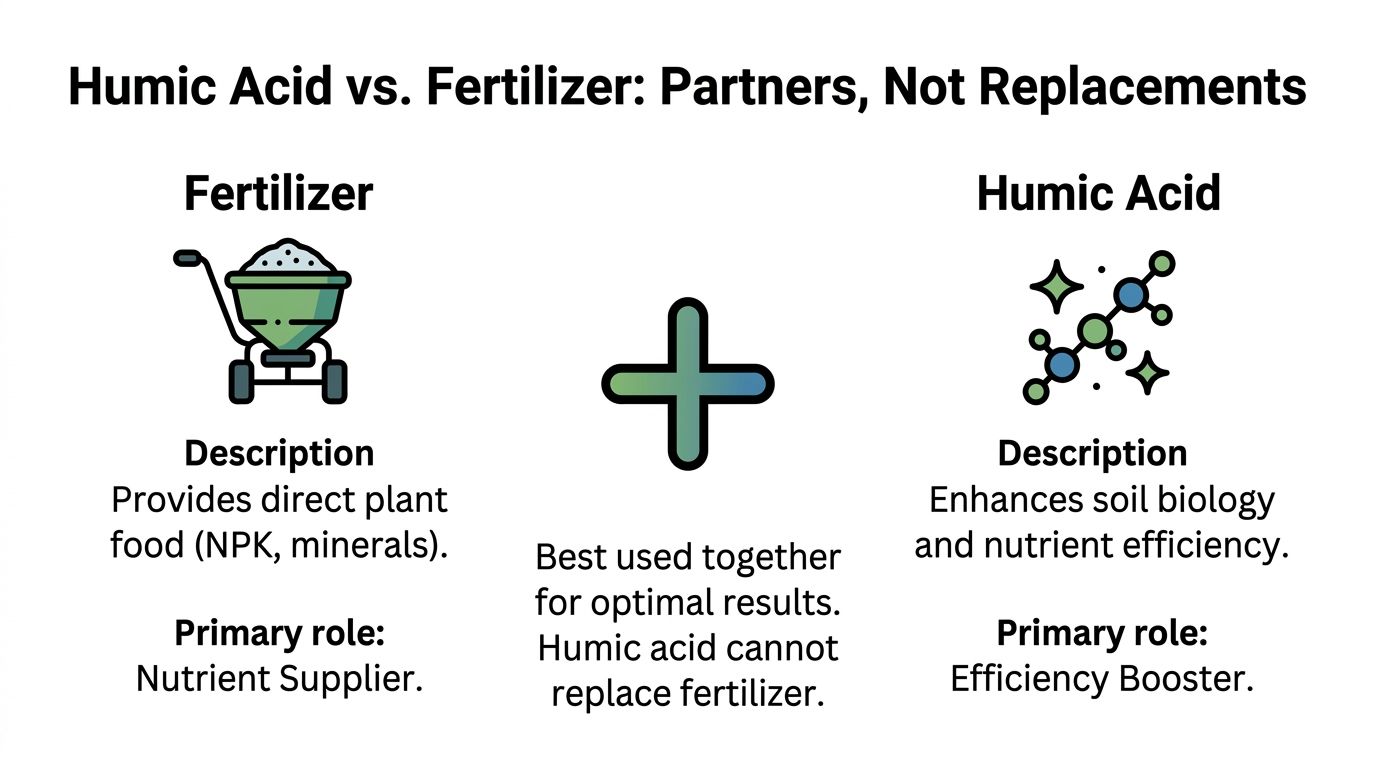
Humic acid and fertilizer perform different jobs. Fertilizer supplies plant nutrients such as nitrogen, phosphorus, and potassium. Humic acid helps the soil retain and present certain nutrients more effectively. The most useful pairing is therefore not “fertilizer or humic acid,” but a properly measured fertilizer program supported by an amendment when the soil needs it.
Use the pairing without doubling the dose
Humic acid can generally fit alongside slow-release pellets, liquid feeds, compost, and other organic amendments, but compatibility depends on the product chemistry. Avoid mixing concentrates in the same bottle unless both labels permit it. Some combinations can precipitate, clog applicators, or make it difficult to know how much nutrition you're giving.
For houseplants such as fiddle leaf figs, humic acid may be reasonable when the potting mix has become compacted or nutrients wash through quickly. It won't compensate for weak light or chronically wet roots. Keep the plant's fertilizer schedule stable while testing the amendment, so you can identify what changed.
Bonsai require more restraint. Their shallow pots and deliberate watering routines mean that adding an unfamiliar amendment can alter how quickly the mix wets and dries. Apply a measured soil drench to one tree first rather than changing the entire collection.
Plant type determines the likely payoff
Succulents and cacti often grow in mixes designed to drain rapidly and hold limited organic matter. That's useful for preventing rot, but it can also reduce the contact time between a liquid amendment and the root zone. If the plant already has healthy roots and an appropriate gritty mix, humic acid may offer little practical benefit.
Orchids present another special case. Bark-based media changes as it decomposes, and roots need both moisture and air. A dilute soil application may be more suitable than a foliar spray, but the amendment won't replace orchid fertilizer or correct decomposed, waterlogged bark.
Humic acid also isn't a universal pH fixer. It may influence soil chemistry and nutrient availability, but it shouldn't be chosen because you want to acidify an alkaline medium. Test the growing medium and read how soil pH affects nutrient availability before trying to solve a pH problem with a general amendment.
Common Mistakes and When Humic Acid Will Not Help
The most common mistake is treating humic acid as a universal plant booster. A healthy plant in a fresh, well-structured potting mix may show little visible response because its roots already have suitable access to air, water, and nutrients.
More product can create more confusion
Higher application rates aren't automatically better. Recent literature suggests that cost-effectiveness may peak at moderate rates, rather than increasing indefinitely with heavier applications. The 2026 saline-alkaline wheat study reported that 7.5 Mg ha−1 improved soil quality through the 0–40 cm layer and produced benefits comparable to higher rates with better cost-effectiveness. That agricultural result doesn't translate directly to a bonsai pot, but it reinforces the principle that excess isn't a sound strategy.
Overapplication can also make container care harder to interpret. If the medium begins holding moisture differently, you may continue watering on the old schedule and create wet roots. Apply a conservative amount, then watch how quickly the pot dries before making another change.
Don't use it for the wrong diagnosis
Humic acid won't fix:
- Poor light: Move the plant or improve supplemental lighting.
- Overwatering: Correct the watering interval and inspect the roots.
- Root rot: Remove damaged roots and replace contaminated or collapsed media.
- Pests: Identify and treat the pest directly.
- Severe nutrient deficiency: Use a suitable fertilizer after confirming the likely deficiency.
- Bad drainage: Repot with a structurally appropriate medium.
It also may not be worth buying for containers you repot frequently. A fresh, high-quality mix can already provide the physical properties your plant needs, while a small pot gives the amendment limited time to influence the wider root zone. Humic acid works gradually as part of soil management, not as an emergency treatment for a plant that is declining today.
Making Your Decision and Getting Started
Use this quick checklist before purchasing a humic acid soil amendment:
- Identify the limitation: Is the soil compacted, excessively leaky, poor at retaining nutrients, saline, or low in organic matter?
- Check the plant's medium: Bonsai, orchids, succulents, and houseplants need different moisture and aeration conditions.
- Read the label: Look for the source material, guaranteed analysis, dilution instructions, and directions for soil use.
- Start conservatively: Apply a measured, diluted soil drench to one plant or a small area first.
- Track the response: Watch moisture behavior, new growth, leaf color, and root condition over the following weeks.
Choose a product with clear labeling and avoid formulas that hide the active ingredients behind vague promises. Humic acid should support a broader plan that includes good light, correct watering, suitable fertilizer, healthy roots, and an appropriate growing medium.
If you're rebuilding a tired container mix, you can also compare humic acid with biochar as a soil amendment. The right choice depends on the specific limitation you're trying to correct, not on which product sounds more powerful.
Leaves & Soul offers purpose-built soils, fertilizers, bonsai accessories, and plant-focused nutrient options for bonsai, fiddle leaf figs, houseplants, succulents, cacti, and orchids. Visit Leaves & Soul to compare tools that can support a complete soil and feeding routine, rather than relying on humic acid alone.