


The most popular advice about liquid kelp plant food is also the most misleading. You're often told to splash it on every plant, every week, at one strength, and watch everything surge. That advice skips the question that matters most. How much, for which plant, and when should you stop?
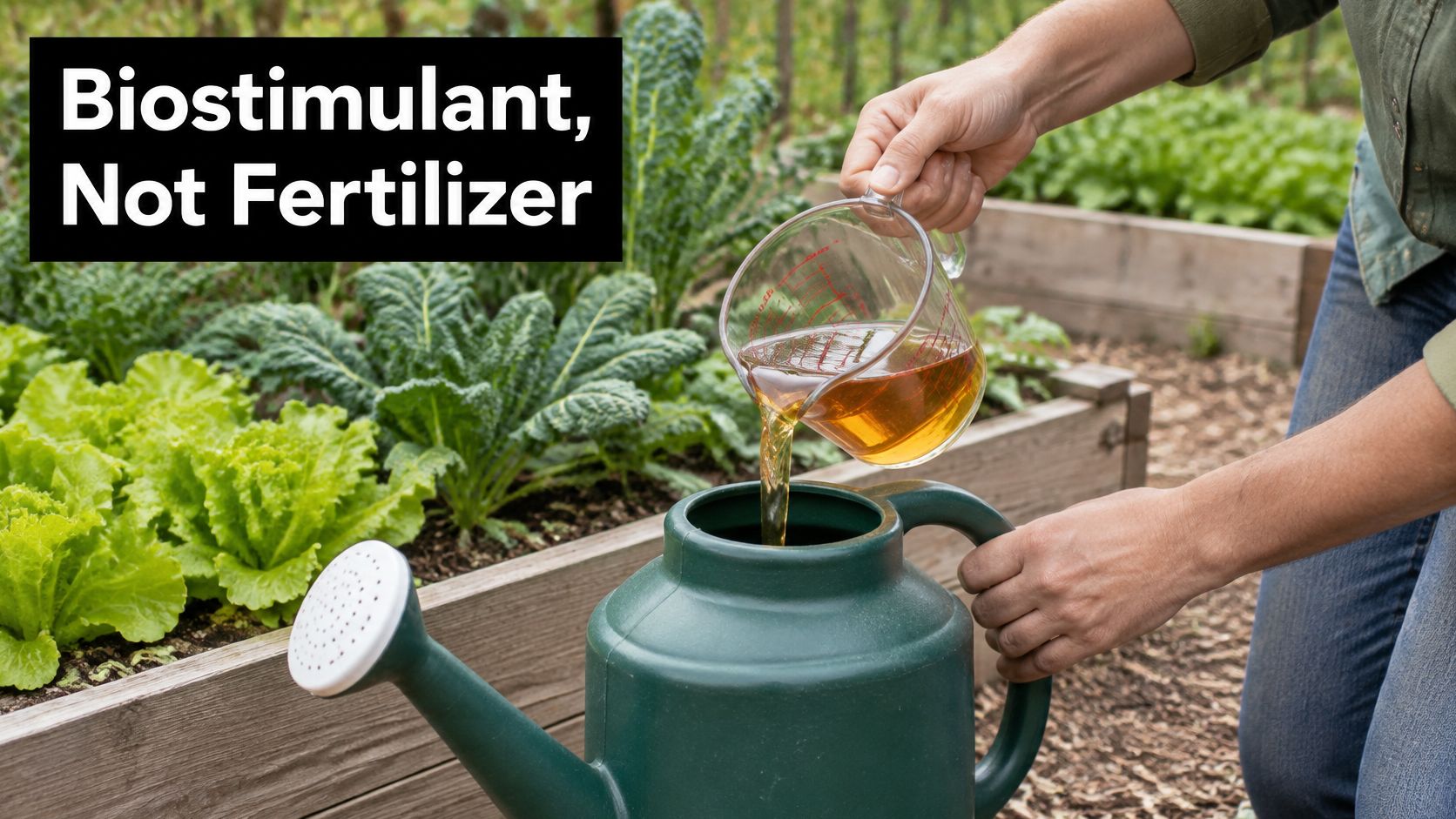
Kelp isn't a magic tonic, and it isn't a complete feed. It's a biostimulant, a supplement that can help roots and leaves work better when the basics, especially light, water, and balanced fertilizer, are already right. Used thoughtfully, it's most plausible for cuttings, transplants, and plants recovering from stress. Used carelessly, stronger mixes can do less than weaker ones.
This guide gives you a plant by plant starting point, clear stop signals, and a simple two week test. You'll learn when kelp belongs in your routine, and when your plant is better off without it.
What Liquid Kelp Plant Food Is and How It Works
Liquid kelp plant food is a water soluble extract made from brown seaweed. It works like a vitamin supplement next to a meal. A balanced fertilizer supplies the meal, mainly nitrogen, phosphorus, and potassium. Kelp helps the plant use what's already available and supports processes like root initiation.
That distinction prevents the commonest disappointment. A fiddle leaf fig short on nitrogen won't green up on kelp alone, because the extract carries too little of it to correct pale, weak growth. A freshly repotted bonsai that needs new roots is a better candidate, since root initiation is where kelp's role is most plausible.
What's Inside the Bottle
Kelp extracts contain alginates and other polysaccharides, amino acids, soluble sugars, minerals, antioxidants, and hormone like compounds tied to root initiation, cell division, and stress signaling. In one kelp waste analysis reported by a review of kelp extracts and their plant compounds, nitrogen was the dominant measured mineral, followed by calcium, with approximately 15.6% alginic acid and 20.6% amino acids in the analyzed material.
One analysis describes one material, not every bottle on a shelf.
Species and extraction method change the composition, so two products both labeled kelp can behave differently in the same pot. That variability is also why the evidence for kelp reads as promising rather than settled, and why your bottle's label outranks any generic recipe.
Practical rule: If you can't name the complete fertilizer feeding your plant, fix that first. Kelp comes second.
How Kelp Compares With Other Feeds
| Product | What It Supplies | Speed of Effect | Best Role |
|---|---|---|---|
| Liquid kelp plant food | Biostimulant compounds, trace minerals and small amounts of N-P-K | Fast, through roots or leaves | Supplement during transplant, propagation or stress |
| Kelp meal (dried powder) | Organic matter, potassium and trace elements | Slow, breaks down over months | Soil amendment mixed in at planting |
| Complete balanced fertilizer | Measured N-P-K plus micronutrients | Predictable and label-controlled | Primary feeding for all plants |
Professional growers apply the same budgeting logic at larger scale, where evaluating plant health care ROI comes down to one question: does an added treatment earn its place beside basic nutrition? The same test works at home. Kelp supplements a feeding plan. It doesn't replace it.
Dilution Rates and Schedules for Each Plant Type
Start with one rule. The product label wins. If your label rate conflicts with the table below, use the label and treat the table as a guide to frequency, route, and warning signs. For a quick conversion, 1 mL per litre is about 4 mL per US gallon, roughly three quarters of a teaspoon.
Dose isn't universal, and the Frontiers review of seaweed extract use on ornamental cuttings evaluated approximately 0.2% foliar sprays, cited 1 to 2 mL/L solutions at roughly two week intervals, and found drenches sometimes produced stronger rooting responses than sprays. A basil trial in that body of work found the strongest response at 2.0 mL/L, with higher concentrations not necessarily superior.
Starting Rates and Schedules by Plant Type
| Plant Type | Starting Rate (Soil Drench) | Foliar Spray | Frequency in Growing Season | Stop Signal |
|---|---|---|---|---|
| Bonsai (established) | 0.5-1 mL/L | Avoid unless the label allows | Every 4 weeks | Yellowing tips or white crust on soil |
| Fiddle leaf fig (established) | 1 mL/L | Light mist at about 0.1-0.2%, in shade | Every 4 weeks | Brown leaf edges or drooping after feeding |
| Other houseplants | 1 mL/L | Light mist at about 0.1-0.2% | Every 2-4 weeks | Pale or curling new leaves |
| Orchids | 0.5 mL/L | Avoid crown and blooms | Every 4 weeks in active growth | Limp roots or leaf spotting |
| Succulents and cacti | 0.5 mL/L | Avoid the body, soil only | Monthly while actively growing, none in winter | Soft base or soggy soil |
| Cuttings, seedlings and repotted plants | 1-2 mL/L | Light mist at about 0.2% | Every 2 weeks for 4 to 6 weeks | Wilting or stalled growth; stop once roots establish |
Reading the Rows That Match Your Plants
Bonsai and fiddle leaf figs are established plants in confined or slow changing root zones, so they get a moderate soil drench only every four weeks. A bonsai in a shallow pot concentrates salts quickly. A fiddle leaf fig shows feeding stress in its leaf edges, so watch those edges after each application.
Orchids get the lowest soil rate. Don't spray the crown, where water sits and invites rot, and keep spray off blooms. If roots that were firm and silvery green go limp, stop and flush with plain water at the next watering.
Succulents and cacti are soil only. Their bodies and tight rosettes trap moisture, and they grow slowly, so monthly feeding in active growth is plenty. Pause completely in winter rest.
Cuttings, seedlings, and repotted plants are the exception that justifies the higher rate and shorter interval, because making roots is the whole job right now. Once you see new root tips or resistance when you gently tug a cutting, drop back to that plant's normal row.
If you're unsure how these supplements fit beside base feeding amounts, check the guide to fertilizer application rates for houseplants and bonsai before you mix anything.
A stop signal doesn't mean kelp failed forever. It means drop to the next lower rate, flush once with plain water, and wait at least one normal watering cycle before you decide.
Judge the result over several weeks, not days. Look for new root production, steadier leaf color, normal internode growth, and general vigor. One fast flush after a warm week isn't proof the kelp worked.
How to Mix and Apply Liquid Kelp Step by Step
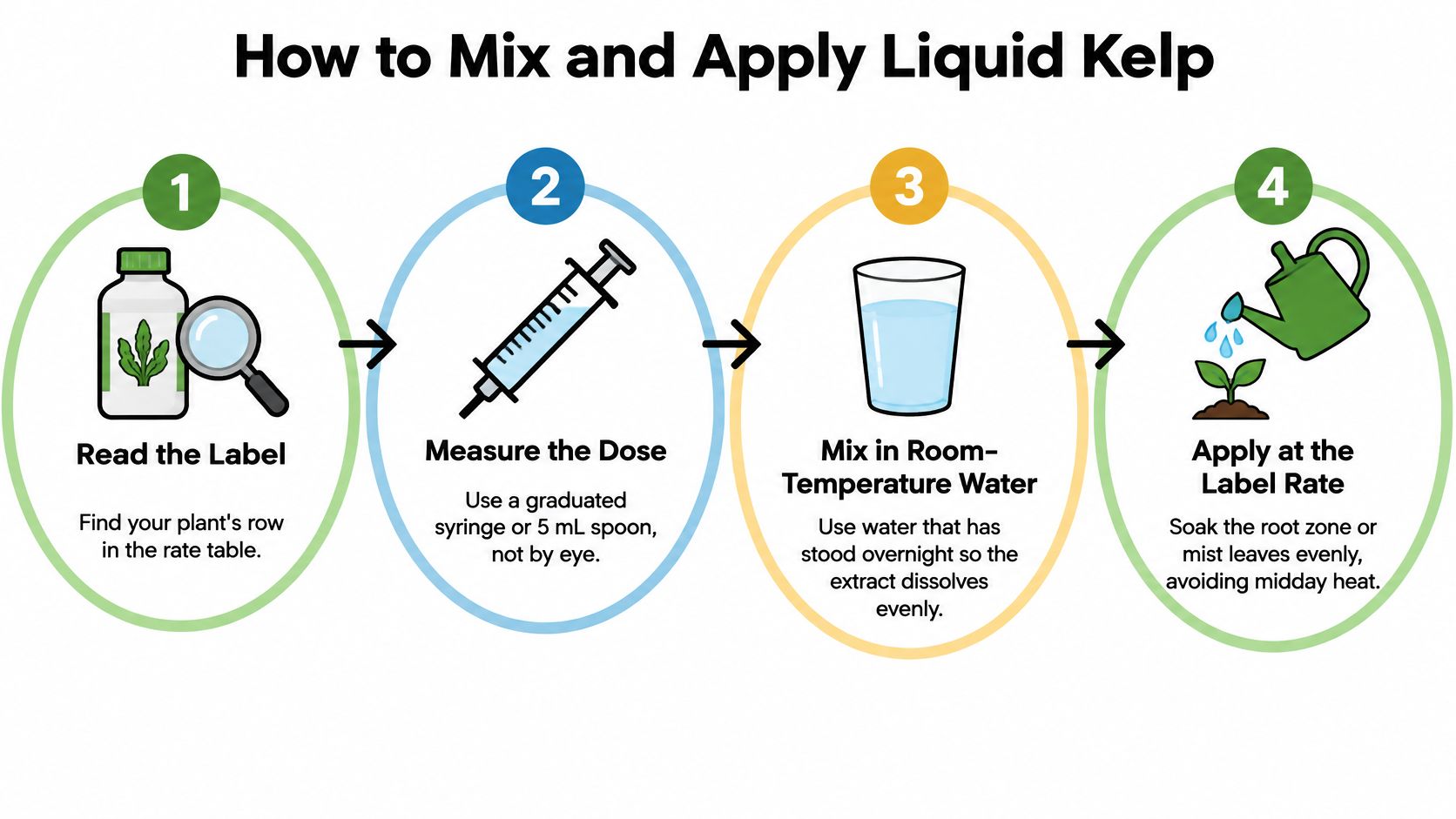
Good application is mostly measuring and timing. The visual summary below shows the core sequence before the detailed steps.
Concentration changes the outcome, sometimes sharply. In the Scotland study of Laminaria digitata kelp solutions, a 0.05% solution increased germination of Plantago lanceolata, Trifolium repens, and Avena strigosa, while a 0.5% solution increased total root weight in cuttings. Visible vigor of Plantago lanceolata declined significantly at both 0.5% and 5.0%, so stronger did not automatically mean better.
The Eight Steps
- Read the label first. Find your plant's row in the rate table, then check whether the label allows soil use, foliar use, or both. If the label is vague, choose the lower rate and the soil route.
- Measure with a tool. Use a graduated syringe or a 5 mL spoon. A casual pour can easily double a 0.5 mL orchid dose.
- Use room temperature water. Water that has stood overnight lets chlorine dissipate and avoids shocking roots with cold water. Mix until the color looks even.
- Mix only what you'll use within 24 hours. Diluted organic liquids sour as microbes multiply. Fresh mix also keeps your dose honest, since stored leftovers invite guessing.
- Check the soil before you drench. Apply to moist soil, never to bone dry or drought stressed roots. If the pot is dry, water plainly first and feed at the next watering.
- Drench slowly. Pour evenly over the root zone until a little drains from the pot. Empty the saucer after a few minutes so roots don't sit in salty runoff.
- Mist only in mild conditions. For foliar use, spray in morning or evening shade and coat leaves lightly. Skip foliar spraying when temperatures pass about 30°C, and never spray heat stressed foliage.
- Test before you treat everything. Apply to two or three plants, note the date and rate, and wait two weeks. Treat the rest only if those test plants show no stop signals.
The short demonstration below shows the mixing and watering motion at normal speed, which is useful if you've never measured a concentrate this small.
Say you're feeding six similar houseplants. Test two at 1 mL/L, leave four untreated, and compare new leaves after three weeks in the same light. That simple control tells you more than treating all six and crediting kelp for spring itself.
Timing and Pairing Kelp With Other Fertilizers
Kelp fits best in three windows. Use it during the active growing season, in the first weeks after repotting once new roots are moving, and shortly before a predictable stress such as a heat wave or a move indoors. In each case the plant is building or protecting roots, which matches what kelp plausibly supports.
Pause when growth pauses. A leafless deciduous bonsai in winter dormancy and a resting cactus aren't taking up much of anything. Feeding them adds salts to soil that stays wet longer, which is the opposite of help.
Kelp Pairings and How to Space Them
| Pairing | Compatible? | How to Space It |
|---|---|---|
| Bonsai pellets (18-6-8 slow release) | Yes, as the base feed | Drench kelp between pellet top-ups, never in place of them |
| Balanced water-soluble liquid feed | Yes | Alternate weeks, or use kelp at the starting rate on different days |
| Fruit and vegetable liquid feed (high P or K) | Yes, with caution | Apply on different days and keep kelp at the lower row rate |
| Fungicide, insecticidal soap or neem | Only if the label allows | Spray kelp on separate days; avoid tank mixing |
| Freshly repotted plant in new soil | Yes, after roots move | Wait about 2-3 weeks, then start the drench schedule |
| Dormant bonsai or resting cactus | Pause | No kelp until active growth resumes |
For a concrete base, Leaves & Soul sells 18-6-8 Bonsai Fertilizer Pellets and 16-5-11 Fiddle Leaf Fig and House Plant Pellets as slow release primary feeds for those plant types. With pellets handling baseline nutrition, space a kelp drench between pellet top ups rather than on the same day, so you can tell which input caused any change.
With liquid feeds, alternate instead of stacking. You might give a balanced liquid one week and kelp at the table rate the next, or apply them on different days in the same week. The overview of the do's and don'ts of mixing fertilizers covers the same caution for concentrates generally.
Don't tank mix kelp with fungicides, insecticidal soap, or neem unless every label involved explicitly allows the combination. Pest and disease sprays need their own coverage and drying time. Applying products on separate days also makes leaf spotting easier to trace to one cause.
Safety, Organic Status and Mistakes to Avoid
Liquid kelp is forgiving, but it is not foolproof. Concentration varies widely from one bottle to the next. The SABRAO review of seaweed extract dose and formulation summarizes foliar applications around 0.1% to 0.5% and soil drenches around 0.5 to 2 g/L, while a lettuce experiment found positive responses at 4 mL/L using a specific green algae formulation. Alkaline hydrolysis, aqueous extraction, and species choice produce different products, so treat the table rate as a starting point and let the product label take priority when the two disagree.
Mistakes That Cause the Most Harm
- Overdosing for faster results: Doubling the rate doesn't double root growth. It raises salinity and can produce the leaf edge burn you're trying to avoid.
- Feeding a stressed plant at full strength: A drought-stressed plant needs plain water first and a reduced rate once it recovers. A recently repotted plant can take the table's starting rate once new roots are moving.
- Treating kelp as medicine: Kelp won't cure root rot or correct a true nutrient deficiency. Rot needs trimming, dry time, and fresh medium. Deficiency needs the missing nutrient.
- Ignoring salt buildup: Leach pots with plain water every few waterings until runoff flows freely. White crust on soil or pot rims means you've waited too long.
Odor is a useful quality check. A mild seaweed smell is normal. A sour or rotten smell in the diluted mix means discard it and mix fresh, and don't seal leftover solution hoping it stays fine until next week.
Residue matters on some plants. Waxy fiddle leaf fig leaves can show dried spotting, succulent rosettes trap liquid, and orchid crowns hold moisture where rot starts. Skip foliar spray on those surfaces and use a soil drench instead.
Seaweed based products are widely accepted in organic growing. Acceptance in practice and certification for a specific program are two different things, so if you need certified inputs, look for an OMRI listing on the exact product you hold. That same label-checking discipline appears in guidance for organic landscaping in the Twin Cities, where product claims still have to match site requirements. The comparison of synthetic vs organic fertilizer explains why the source of a nutrient alone doesn't determine how a plant responds to it.
Store concentrate sealed, cool, and out of reach of children and pets. Label every spray bottle with the product, dilution, and date. An unlabeled brown liquid on a shelf is how double dosing happens.
Realistic Results and Whether Kelp Belongs in Your Routine
Start with honest expectations. The 2024 PLOS ONE meta analysis of seaweed fertilizer field studies found seaweed fertilizer increased crop yield by an average of 15.17%, with root and tuber crops showing the largest response at 21.19%. The wider body of seaweed research points in the same direction, with liquid and powdered products producing similar average effects.
Those are field crop averages. A windowsill orchid is a different setting. The numbers support a modest, real effect under many conditions, and they tell you nothing about transforming a single houseplant in a week.

Where Kelp Is Most Plausible, and Where It Isn't
- Cuttings rooting now: Extra support during root initiation is kelp's clearest home use case.
- Recovery after repotting: Once new roots move, a low rate drench fits the rebuilding phase.
- Predictable stress ahead: Heat, cold nights, or relocation to a new room are reasonable times for one measured application.
- True nutrient deficiency: Yellowing from missing nitrogen or phosphorus calls for a fertilizer that supplies those nutrients. Kelp alone won't.
- Low light, pests, root rot, or pot bound roots: Fix the light, treat the pest, trim the rot, or repot. Kelp can't stand in for any of those.
Skip kelp when the plant is healthy and already well fed, when it's dormant, when roots are rotting, or when you can't yet confirm the label rate. A thriving fiddle leaf fig on a steady pellet routine may show no visible change at all. That's a legitimate result, and it usually means the base feeding already covers the plant.
Judge your trial over three to six weeks. Photograph the plant, then check new root tips where visible, leaf color, spacing between new nodes, and overall vigor. Tight, normal internodes suggest steady growth. Long, pale spacing usually means the plant needs more light.
Your First Action
Pick one bonsai, fiddle leaf fig, or orchid. Keep its complete fertilizer exactly as it is, add kelp once at that plant's table rate, and write down the row, rate, date, and starting condition. Wait two weeks, note any change or stop signal, then decide to continue, lower the rate, or stop.
Kelp earns its place as an adjunct you tested, one measured dose at a time.
That verdict favors evidence over assumption, and it will save you money and a few burned leaf edges. If your test plant roots faster or settles after repotting more smoothly, you've found a use that fits your conditions. If nothing changes, you've learned your current feeding already covers the plant's needs.
Keep your base feeding simple and plant specific with slow release pellets, liquid foods, and soils for bonsai, fiddle leaf figs, orchids, succulents, and houseplants, then add supplements like kelp only when your test shows they help. Visit Leaves & Soul to compare the feeds mentioned here and choose the starting point that matches your plant.