


You water faithfully, inspect the leaves, and still find yesterday's flower buds on the soil or blooms that fade before they have had a chance to shine. The problem may not be neglect. Flowering plants often need nutrients available at the right moment, but liquid plant food can help or harm depending on its strength, timing, and the amount of moisture moving through the root zone.
The useful way to think about liquid plant food for flowers is as a precision tool, not a stronger version of ordinary fertilizer. It can deliver soluble nutrients quickly during active growth, yet those same nutrients can move out of pots and beds with excess water. The healthiest routine matches the feed to the flower, the season, and the growing medium.
Why Flowering Plants Need Liquid Nutrition
A rose can have plenty of water and still struggle to produce strong flowers. Water carries nutrients through the root zone, but it doesn't create those nutrients. During active growth, a flowering plant must support new leaves, stems, roots, buds, and open flowers at the same time. If the soil or potting mix contains too little of a required element, regular watering won't correct the shortage.
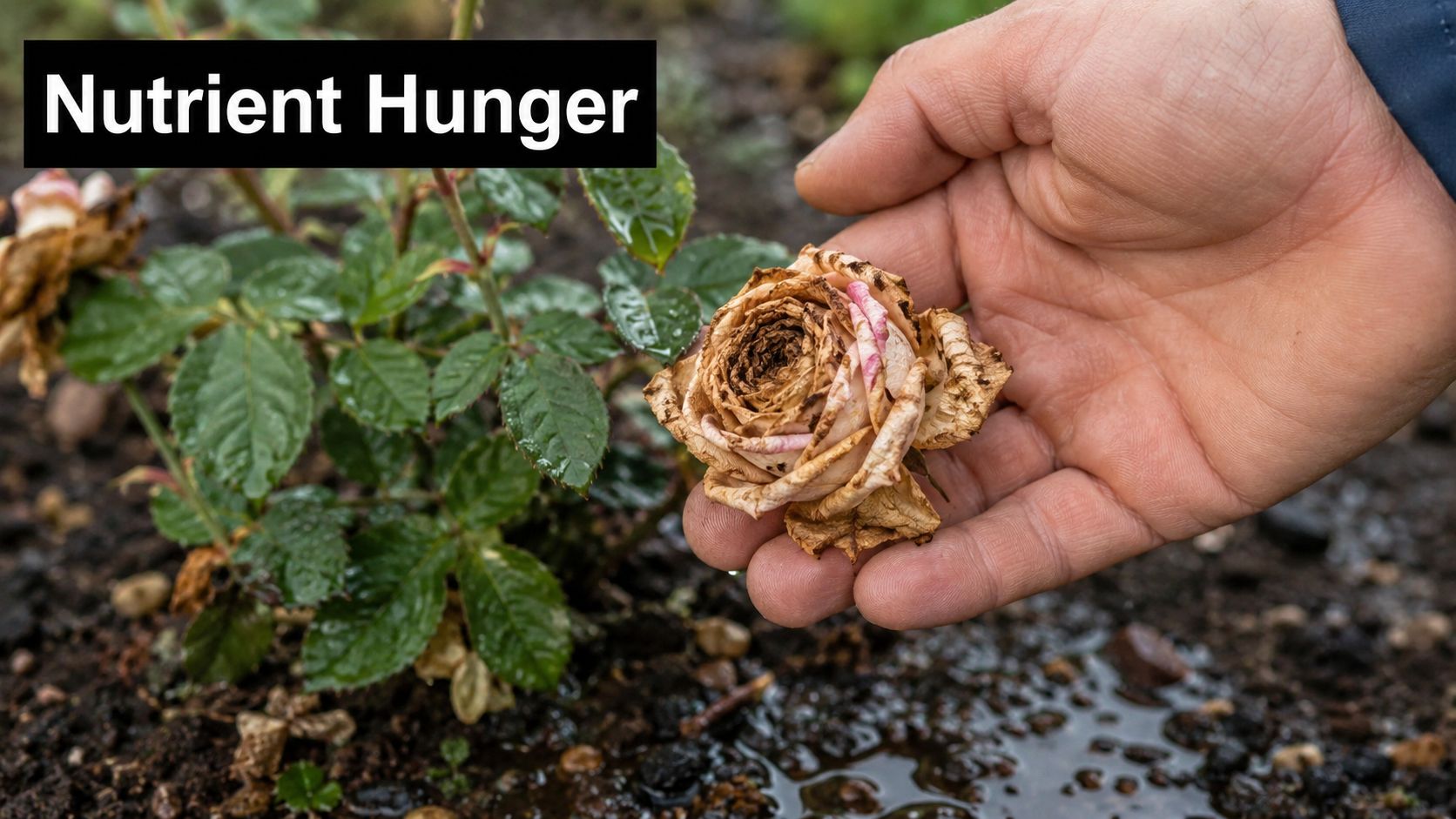
Why liquid feed acts quickly
Liquid fertilizer dissolves in water, placing nutrients in a form roots can access when moisture reaches them. University of Massachusetts guidance describes liquid fertilizer as useful for a quick boost, with water-soluble products commonly sold ready to use or as concentrates mixed with water. Because the nutrients remain soluble, they can also leach through soil, so these products generally need more frequent applications than granular or controlled-release fertilizers. University of Massachusetts guidance on fertilizing flower gardens
That combination creates the central trade-off. A liquid feed can help a plant respond during an active bloom period or a short-term nutrient shortage, but it doesn't provide the same lasting reserve as a slow-release product. A container plant with fresh potting mix may not need liquid nutrition immediately, while a heavily flowering plant in a small pot may use available nutrients quickly.
Practical rule: Use liquid plant food when the plant needs accessible nutrition now, not simply because the calendar says it is feeding day.
When it makes sense
Liquid feeding is most useful when flowers are actively growing, a plant is recovering from a mild nutrient shortage, or a container has limited nutrient reserves. It can also suit gardeners who want to adjust feeding strength rather than commit to a long-lasting fertilizer already mixed into the medium.
It isn't the right response to every weak bloom. Poor light, damaged roots, waterlogged soil, pests, temperature stress, and inconsistent watering can all reduce flowering. Adding fertilizer to a plant with unhealthy roots may increase stress instead of solving the underlying problem.
Start by checking moisture, drainage, light, and the condition of the leaves. Once those basics look reasonable, liquid plant food becomes a measured way to support the plant's current demand.
Understanding N-P-K Ratios and Micronutrients for Blooms
A flowering plant can show pale leaves, slow growth, or fewer buds after a gardener follows the fertilizer label exactly. The three numbers on that label describe the relative analysis of nitrogen, phosphorus, and potassium, or N-P-K, but they do not determine the dose a particular plant can use. Dilution strength, growth stage, root medium, and watering frequency all affect what reaches the roots.
Read each nutrient as a job
Nitrogen builds leaves, stems, and other green tissue. Too little may leave foliage pale and growth weak. Too much can produce soft, leafy growth while flowering becomes less balanced.
Phosphorus supports energy transfer and reproductive development, including flower and seed formation. It does not act as a universal bloom switch. Extra phosphorus cannot correct poor light or damaged roots, and a moderate-phosphorus formula may suit a plant whose growing medium already contains enough.
Potassium helps regulate water movement and supports general plant function during flowering and fruiting. Bloom formulas often emphasize potassium more than feeds intended mainly for leafy growth.
Micronutrients work in smaller amounts but still affect plant performance. Iron supports healthy green growth, magnesium is involved in chlorophyll formation, and zinc contributes to normal development. Deficiencies can alter color, growth, or flower formation. A balanced formula is often more useful than chasing the largest number on the bottle.
Use benchmarks as a reference, not a universal recipe
Independent nursery-crop research found that woody species generally performed adequately at about 50 mg N/L, 20 mg P/L, and 50 mg K/L. Many herbaceous flowering species needed roughly 100 to 150 mg N/L, 20 mg P/L, and 120 to 150 mg K/L. Nursery-crop research on liquid-feed concentrations
| Plant Type | Nitrogen (mg N/L) | Phosphorus (mg P/L) | Potassium (mg K/L) |
|---|---|---|---|
| Woody species | 50 | 20 | 50 |
| Many herbaceous flowering species | 100 to 150 | 20 | 120 to 150 |
The same research found that several herbaceous crops reached acceptable yields with approximately 50 mg N/L, 10 to 15 mg P/L, and 60 mg K/L. A stronger solution is therefore not automatically better.
Fast-acting liquid food also carries a hidden trade-off. Nutrients become available quickly, but unused material can leave the root zone with the next thorough watering, especially in a small pot or porous medium. Match the dose to the flower's current demand and the season. A vigorous plant in active bloom may use more than a recently repotted plant or one entering dormancy.
For another way to read product labels and compare feeding approaches, see this guide to liquid plant food. Use benchmarks as starting points, then adjust carefully according to plant response and the product directions.
Organic Versus Synthetic Liquid Formulations
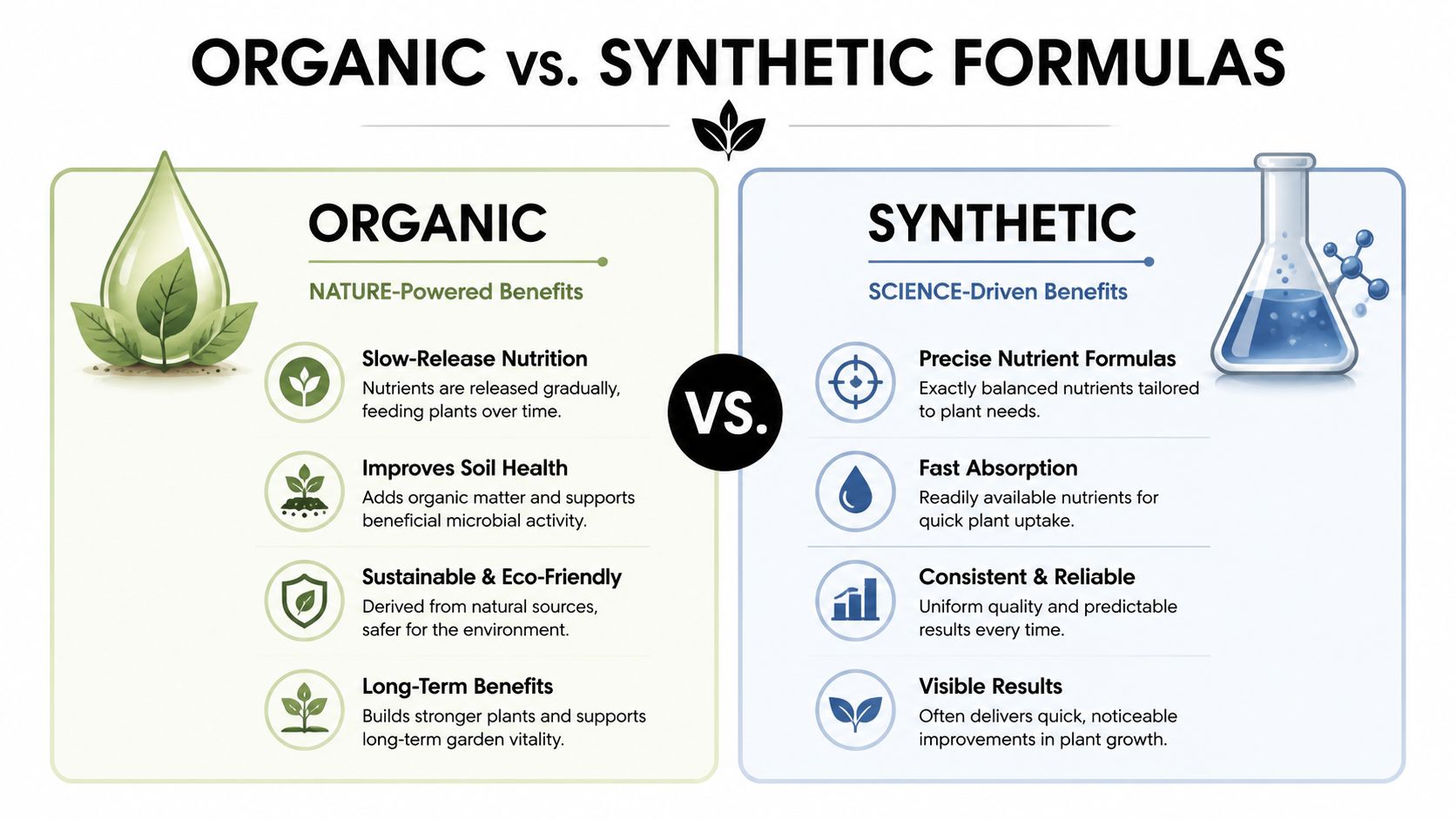
Organic and synthetic liquid feeds can both support flowers, but they work through different practical routes. A synthetic fertilizer usually provides a clearly defined nutrient analysis in a readily soluble form. That makes it useful when you want predictable nutrient delivery or need to respond to a suspected deficiency during active growth.
Organic liquid products vary more in their nutrient composition and may depend on microbial activity and decomposition before some nutrients become available. They can fit a soil-building approach, particularly in beds with active organic matter, but they may be less convenient when a container plant needs a precisely measured correction.
Compare the decision in practical terms
| Consideration | Organic liquid formulation | Synthetic liquid formulation |
|---|---|---|
| Nutrient availability | May depend more on biological activity and the product's ingredients | Usually more direct and predictable |
| Precision | Product analyses can vary, so label reading matters | Defined analysis makes dose planning simpler |
| Soil relationship | Can complement a soil-health program | Focuses mainly on supplying measured nutrients |
| Best fit | Ongoing stewardship and general support | Targeted feeding during active growth or correction |
The choice also depends on how you garden. A rose border with compost-rich soil may suit an organic program supplemented by a liquid feed when needed. A collection of flowering houseplants may be easier to manage with a clean, measured synthetic concentrate because each pot has a small root zone and limited nutrient storage.
Recent research reports that organic liquid fertilizer combined with microorganisms improved plant growth and soil properties in 2025, while a 2025 review identified growing interest in enhanced-efficiency fertilizers and nutrient optimization rather than relying only on conventional soluble feeding. Research on organic liquid fertilizer, microorganisms, and enhanced-efficiency fertilizers
Choose the product around the growing system. A feed that suits a living garden soil may not be the simplest option for a small indoor pot.
If you're comparing soil-building options, this resource on how to choose organic fertilizer for plants offers useful background before you settle on a routine. For a more focused comparison of organic liquid products, see this guide to organic liquid plant food.
How to Dilute and Apply Liquid Plant Food Correctly
A flowering plant can look thirsty, yet feeding it immediately may waste nutrients or stress its roots. Liquid plant food acts quickly because dissolved nutrients are ready to move with water. That speed is useful, but it also means excess solution can leach from a pot or run beyond the active root zone. Accurate dosing and suitable timing matter more than using a stronger mix.
Follow a repeatable mixing process
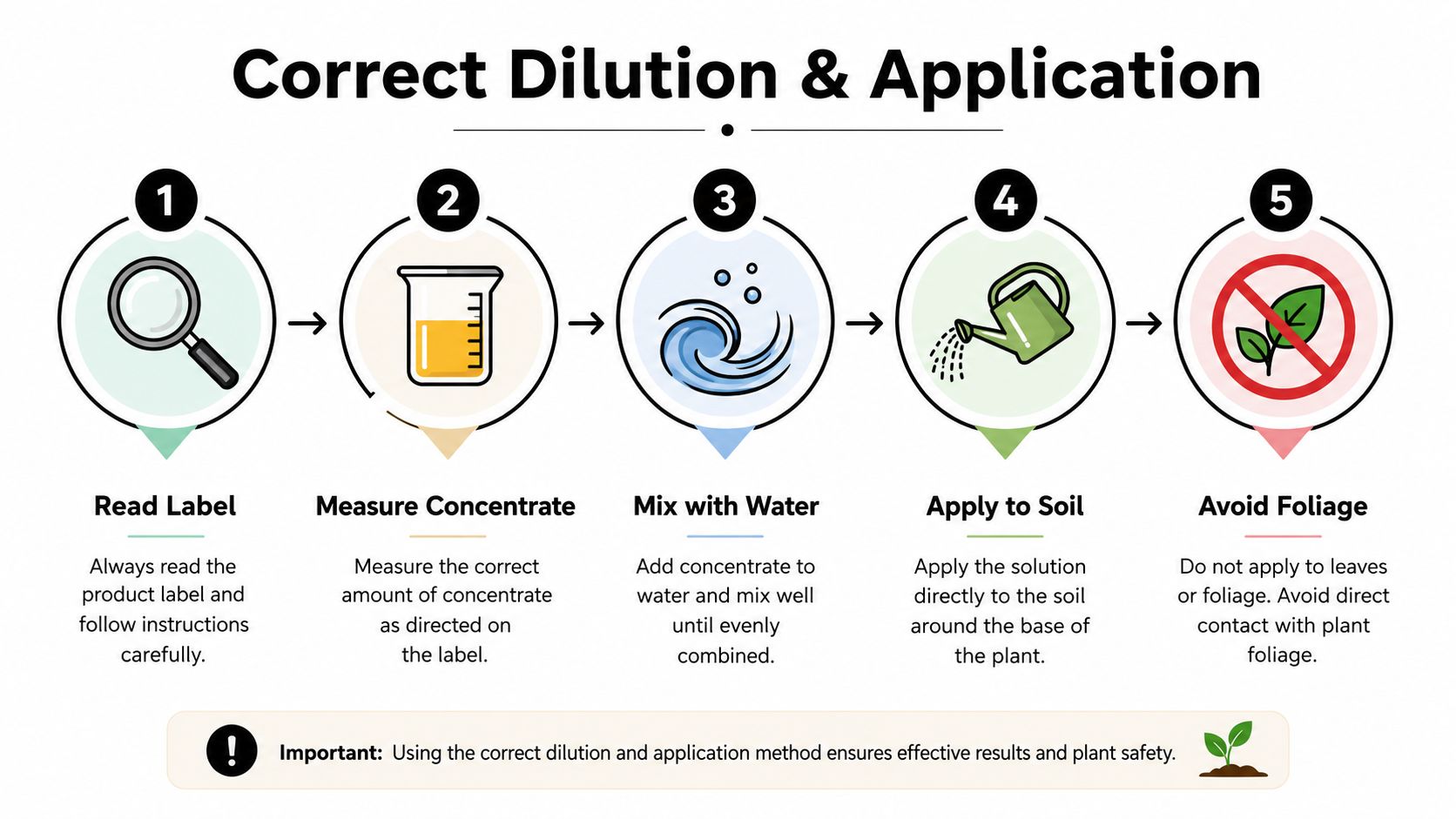
- Read the label first. Confirm whether the product is ready to use or concentrated, then follow the directions for flowers or the relevant plant group.
- Measure with a marked tool. A syringe, graduated dosing cup, or small measuring jug is more dependable than estimating from a bottle cap.
- Add the measured amount to water. Stir or mix thoroughly so nutrients are distributed evenly through the watering can.
- Check the root zone. If the potting mix is very dry, moisten it with plain water first. Dry roots meet a concentrated solution abruptly, increasing stress.
- Apply to the soil. Pour around the root zone instead of repeatedly wetting petals or foliage.
- Record the application. Note the date, product, dilution, and plant response. These notes reveal whether a seasonal adjustment is needed.
The label rate is a ceiling to follow, not an invitation to add more. Research on liquid-feed concentration found that some herbaceous flowering crops produced acceptable yields at lower nutrient concentrations than a higher benchmark range, supporting a cautious starting point when a plant's needs are uncertain. Liquid-feed concentration research
Match feeding to moisture and season
Water controls how dissolved nutrients reach roots and how easily they leave the container. In a 2025 sunflower field study, liquid fertilizer increased yield, biomass, and uptake of N, P, K, Zn, Fe, and Cu with sufficient rainfall, while showing no significant yield or biomass advantage under irrigated conditions. The 2025 sunflower liquid-fertilizer study
The finding does not mean rain is required. It shows that a soluble feed may offer little extra growth when moisture is already adequate. In a container, repeated watering can also carry unused nutrients through drainage, so a smaller, measured application may serve the plant better than a strong dose followed by leaching.
Use the plant's growth and the season as guides:
- Spring: Begin only after active growth starts, with adequate light and moisture.
- Summer: Feed actively flowering plants when they are using nutrients, especially in containers, while watching for runoff after heavy watering.
- Autumn: Reduce or stop feeding as growth and flowering slow. Indoor plants that remain actively growing may follow a lighter routine.
A visual demonstration can help you check the order of operations:
Troubleshooting Feeding Problems and Bloom Issues
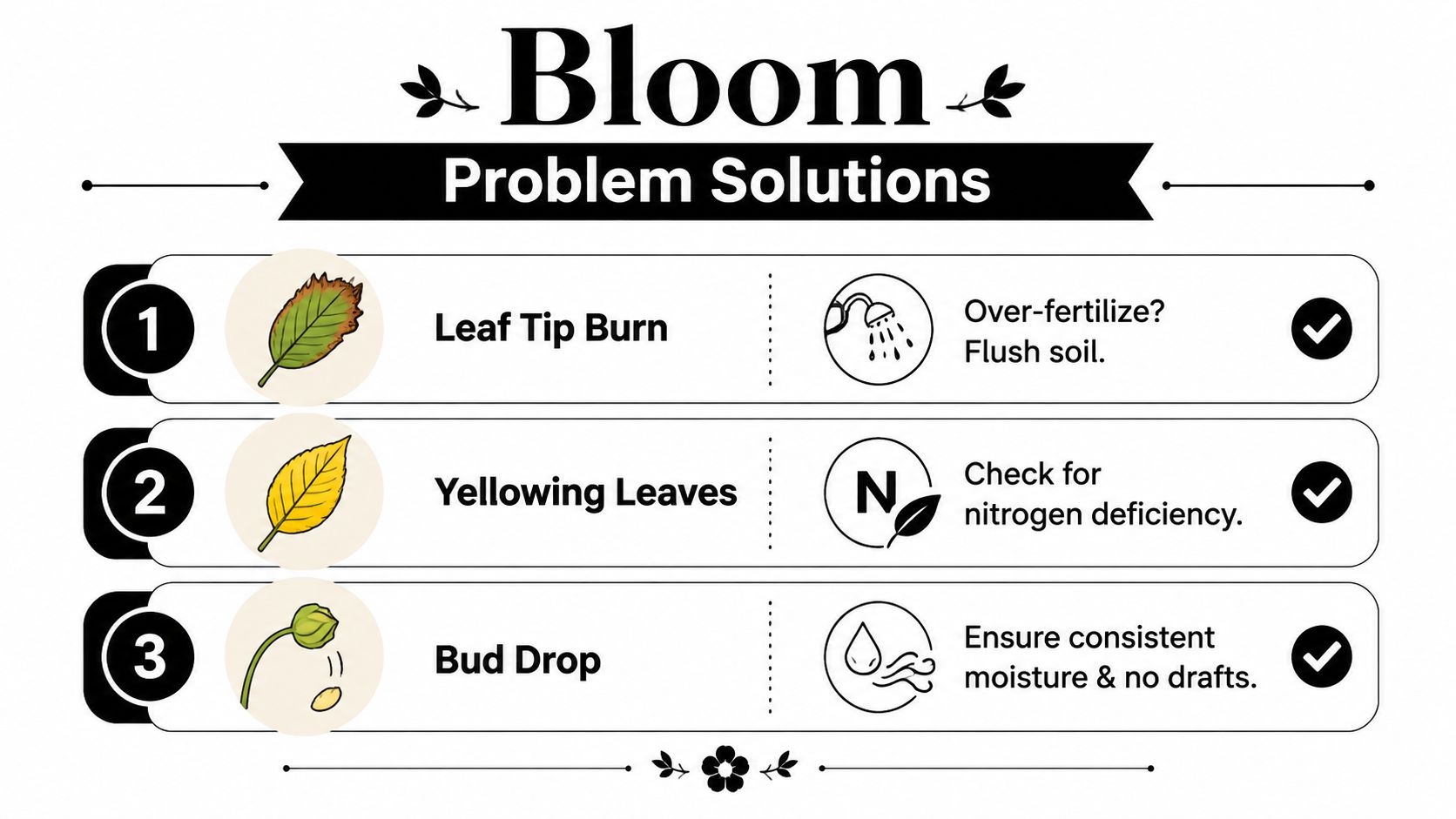
A plant's symptoms rarely identify one nutrient with complete certainty. Leaf tip burn, pale foliage, and dropped buds can come from feeding, moisture, roots, light, temperature, or pests. Diagnose the growing conditions before reaching for a stronger bottle.
Leaf tip burn
Brown or scorched tips often point to excess salts around the roots, especially after repeated strong applications or heavy evaporation from a container. Stop feeding, check drainage, and water thoroughly with plain water if the plant tolerates that treatment. Don't immediately resume at the old strength.
A damaged leaf won't become green again. Judge the correction by new growth, root-zone moisture, and whether the browning stops spreading.
Yellow leaves and weak growth
Pale leaves may indicate insufficient nitrogen, but they can also signal poor roots, low light, or waterlogged media. Examine older and newer leaves, inspect the root zone where possible, and look for insects before selecting a fertilizer.
If the plant is underfed, use a properly diluted balanced feed rather than jumping straight to a highly concentrated bloom formula. Flower production depends on a functioning whole plant, not just on phosphorus or potassium.
Bud drop
Buds can fall when moisture swings sharply, temperatures change, roots stay wet, or the plant experiences drafts and other stress. A fertilizer increase won't repair an unstable environment. Keep watering consistent, improve drainage, and place indoor flowers away from abrupt temperature changes.
Cut flowers need even greater dosing accuracy. Floral-industry guidance reports vase life of 8.8 days at the recommended rate, falling to 7.5 days at double strength and 6.5 days at half-rate. The guidance recommends calibrating dosing units to the product label. Floralife guidance on correct flower-food dosing
For cut flowers, both errors matter. Too much solution can shorten vase life, while too little can interfere with the treatment's intended function.
Plant-Specific Feeding Tips for Popular Flowers
A label can tell you how to dilute a product, but it can't tell you whether the plant wants frequent liquid feeding, a weak solution, or a different approach altogether. Species, pot size, root condition, and growth stage all matter.
Flowering houseplants
Orchids have exposed or semi-exposed roots and are especially vulnerable to salt accumulation. Use only the label dilution intended for orchids, apply it when the roots and medium are able to take up moisture, and allow excess water to drain fully. A weak, consistent routine is safer than occasional heavy feeding.
African violets prefer careful handling. Keep fertilizer water at a suitable indoor temperature, avoid wetting the leaves, and apply around the edge of the pot or from below if that suits your setup. Leaf wetness can leave marks, while cold water can stress the plant.
Peace lilies appreciate steady moisture but don't want a constantly saturated root zone. Feed only when the plant is actively growing, and check whether low light or root trouble is limiting flowers before increasing nutrition.
For a broader product-selection reference, explore this guide to the best fertilizer for flowering plants.
Garden flowers
Roses benefit from a feeding plan that supports new growth and flowering without keeping the soil constantly saturated. Apply liquid feed to moist soil, keep it off the flowers where possible, and consider a longer-lasting base fertilizer if the bed dries and rehydrates unevenly.
Petunias and other heavy-flowering container plants can use nutrients steadily because they produce flowers over an extended period. Liquid feed can be useful during active blooming, but containers also need careful watering and drainage to reduce nutrient loss.
Hydrangeas require a separate distinction. Nutrition supports growth and flowering, while soil pH can influence bloom color in some hydrangeas. More fertilizer isn't a substitute for understanding the plant's pH conditions or cultivar.
Build the routine around the plant
Keep a small card beside each group of flowers with its name, pot size, last feeding, and response. That simple record helps you avoid giving an orchid the same treatment as a petunia or treating a newly planted rose like a hungry hanging basket.
When Liquid Fertilizer Is Not the Best Choice
Fast availability becomes a weakness when the root zone can't retain soluble nutrients. Water-soluble fertilizer can move through potting media with irrigation, which means a container may lose nutrients before the plant uses them. University guidance describes liquid fertilizer as a quick-boost product that requires more frequent reapplication, while nursery and greenhouse research indicates that soluble fertilizer can leach more nitrogen than controlled-release products. One cited study found more nitrogen leached at 30 and 60 days after planting from water-soluble fertilizer than from controlled-release fertilizer. University guidance on fertilizer and nutrient leaching
Choose a slower option when retention matters
Controlled-release pellets or granular fertilizers may suit containers that are watered frequently, gardeners who prefer a lower-maintenance routine, and plants that need a steadier nutrient supply. They won't provide the same immediate correction as a liquid feed, but they can reduce the need for repeated mixing and limit the rush of nutrients through the medium.
A combined approach can work well. Use a controlled-release base for ongoing nutrition, then reserve a diluted liquid feed for a clearly active flowering period or a confirmed short-term need. Avoid stacking products without checking their total nutrient contribution, especially in small pots.
The right question isn't, “Which fertilizer is strongest?” It's which delivery method keeps the plant supplied without sending unnecessary nutrients out of the root zone. Once you start matching dosage precision and seasonal timing to the flower, liquid plant food becomes more efficient, more predictable, and much less wasteful.
Leaves & Soul offers liquid plant foods, spray formulas, slow-release pellets, and targeted soil amendments for indoor and outdoor growers, including options for flowering plants and cut flowers. Visit Leaves & Soul to compare delivery methods and choose a feeding product that fits your flowers, containers, and growing routine.