


Your fiddle leaf fig is dropping leaves, your orchid has stopped producing fresh growth, and the potting mix looks perfectly ordinary. Before reaching for more water, consider nutrition. Indoor plants live in containers with a limited root zone, so nutrients are gradually removed, washed through, or used as new leaves and roots develop.
Organic liquid fertilizer for indoor plants can help, but it isn't a magic recovery treatment. It supplies nutrients through a biologically active potting mix, where microbes help make some organic compounds available to roots. The product's ingredients, concentration, moisture level, light, and plant type all affect the result.
This guide will take you from the basic biology of organic liquid feeds to label reading, dilution, application timing, and plant-specific selection. By the end, you'll know how to feed gently, interpret an N-P-K label without relying on it alone, and build a routine that supports your plants without overwhelming their containers.
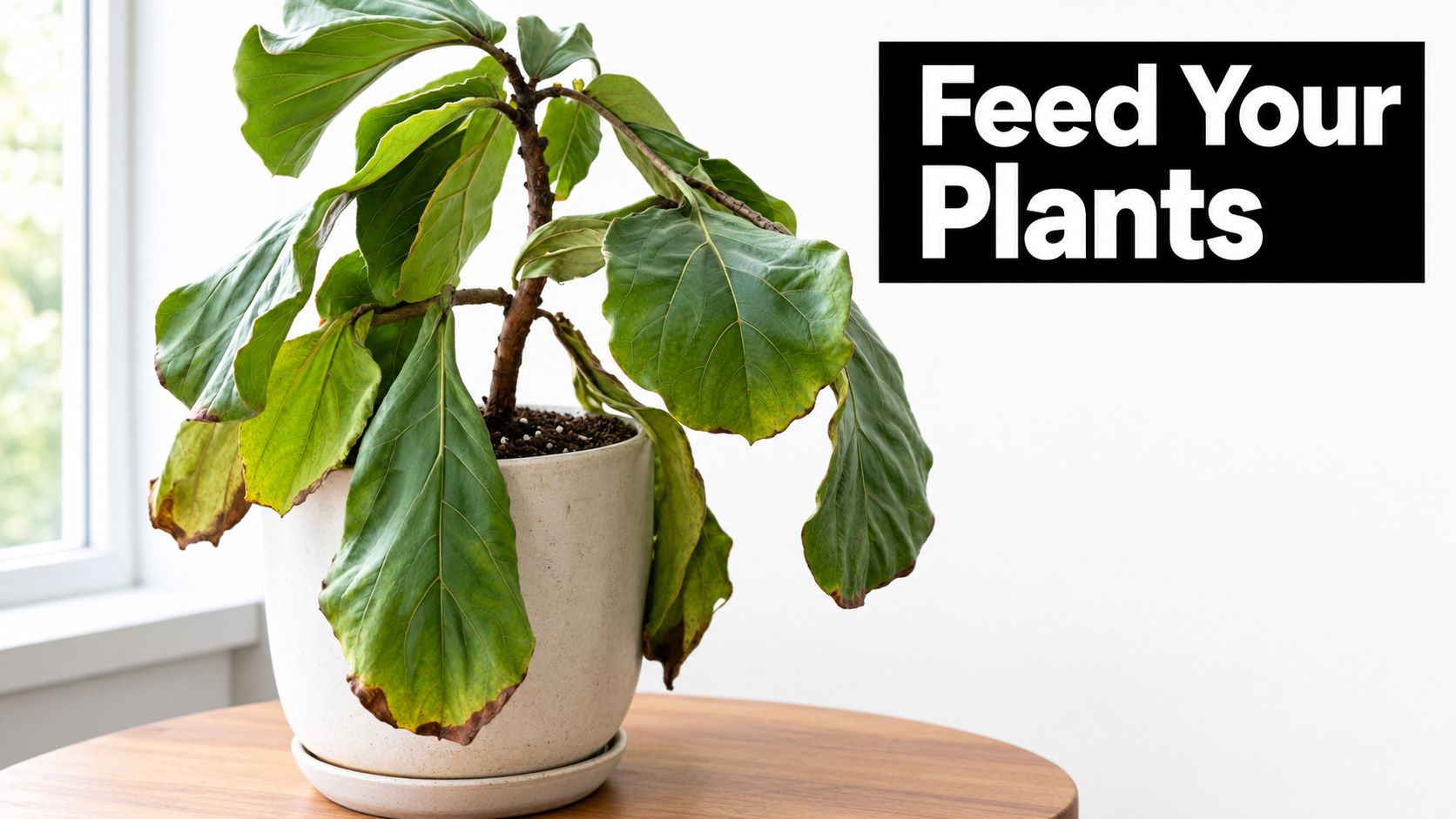
Introduction to Organic Liquid Fertilizer for Indoor Plants
A houseplant with pale leaves can tempt you to fertilize immediately. First check the basics: soggy mix, weak light, damaged roots, or poor drainage can create similar symptoms. Feeding is more appropriate when the plant is actively growing and its root environment is reasonably healthy.
Organic liquid fertilizer for indoor plants is a concentrated feed made from biologically sourced materials. Ingredients may include plant residues, fish by-products, seaweed, manure, digestates, and other agricultural by-products. Unlike a dry amendment left in the potting mix, the liquid is diluted with water and applied during watering.
The label matters, but the N-P-K numbers do not explain everything. Organic describes the source of ingredients, not an automatic promise of mildness, completeness, or full-strength safety. Formulas can differ in nutrient concentration and pH, and some depend on microbial activity in the potting mix before roots can use their nutrients.
That makes indoor feeding a substrate-based practice rather than a simple hydroponic delivery system. The potting mix is part of the process. Its moisture, air space, organic matter, and microbial community influence how a diluted feed behaves around the roots. Dilution is therefore a control point, not merely a label instruction.
Indoor containers also offer less growing media, receive little natural flushing from rain, and can dry slowly in dim rooms. A gentle application gives the plant and its potting mix more room to respond. University extension guidance recommends water-soluble fertilizers for houseplants at weekly, biweekly, or monthly intervals, with general-purpose products diluted to half or quarter strength because many are made for faster-growing outdoor plants. UConn Extension's houseplant fertilization guidance explains the reasoning and gives a practical conversion example.
A useful starting point: Fertilizer supports a healthy indoor plant. It cannot replace suitable light, drainage, watering, or a functioning root system.
How Organic Liquid Fertilizer Works Indoors
A houseplant can receive a diluted organic feed and still show no immediate response. The reason is that application and availability are separate steps. You add the product to the potting mix, microbes process suitable organic compounds, and roots absorb the mineral forms that become available.
Synthetic water-soluble fertilizer usually supplies nutrients roots can take up quickly. An organic liquid may contain more complex materials, so bacteria and fungi in the growing media help break them down through mineralization. Moisture, temperature, oxygen, microbial activity, and the formula itself affect how quickly and completely this happens.
The difference resembles a sports drink and a prepared meal. A sports drink delivers simple ingredients immediately, while a meal must be digested first. Organic liquid fertilizer is closer to the meal. Its label describes the contents, but not the speed at which a particular potting mix can make those nutrients available.
Why potting mix changes the equation
Houseplants commonly grow in mixes containing peat, coir, bark, perlite, or composted materials. This is substrate-based cultivation, not true hydroponics. Roots move through a solid medium that holds water, air, organic compounds, and microbes, so the condition of that medium becomes part of the feeding process.
A 2026 systematic review of liquid organic fertilizers in soilless cultivation reported wide variation among products: 0.74 to 11,000 mg/L for nitrogen, 0.22 to 4,000 mg/L for phosphorus, and 4.5 to 53,000 mg/L for potassium. It also found pH values from 4.6 to 8.1. Two products can therefore share the organic label while requiring different handling. The Frontiers review of liquid organic fertilizers found that yields in substrate-based systems were generally comparable to synthetic fertilizer, while nutrient delivery in NFT and DWC systems could reduce yields by 15% to 65%.
That distinction matters indoors. A potted fiddle leaf fig or orchid grows in container substrate, not NFT or DWC. An organic liquid can work well when its concentration, the mix's moisture, and root conditions are managed carefully.
Organic feeding is biology-dependent nutrition. The label matters, but the potting mix determines how much of that nutrition becomes available to the plant.
A short visual explanation connects the process from bottle to root.
Common Ingredients and Nutrient Profiles Explained
A bottle labeled organic can contain very different materials. One formula may rely on a single input, while another combines several sources. Those choices shape its nutrient profile, odor, color, pH, storage behavior, and release rate. For indoor plants, the ingredient list matters because the potting mix must process much of the nutrition before roots can use it.
What common inputs contribute
Fish by-products commonly provide nitrogen and amino-acid-containing compounds, which may support foliage plants producing new leaves. Their actual strength depends on processing and formulation. Fish-based products can also smell noticeable, especially in a warm living room.
Corn steep liquor, plant extracts, and fermented residues may supply organic nitrogen and other nutrients. A horticulture study found that fertilizers made from corn steep liquor, fish by-products, and anaerobically digested food waste produced lettuce and tomato seedlings with growth comparable to conventional fertilization when nutrient release matched crop demand. The Horticulture Science study on organic fertilizer sources supports the viability of these materials, not identical performance across every product.
Seaweed and plant extracts can contribute trace elements and biologically active compounds. Their value depends on the source and concentration. They are ingredients within a formula, not proof that the product supplies every nutrient a houseplant requires.
Manure, digestates, and agro-industrial by-products may offer broader nutrition, along with more variable organic material. Processing and quality control therefore matter. Follow the label rather than treating a familiar ingredient as safe to apply undiluted.
Reading the N-P-K label
N-P-K numbers provide a starting comparison for nitrogen, phosphorus, and potassium. They do not show microbial activity, trace elements, organic carbon, pH, or how much nutrition becomes available at a particular dilution.
For indoor plants, the numbers work like the headline on a recipe. The dilution instructions explain the serving size, while the potting mix determines how the ingredients are handled. A concentrated product may require only a small amount in irrigation water, whereas a weaker one may be intended for more frequent use.
Check the recommended dilution, application interval, storage instructions, and listed nutrient sources. For a clearer explanation of fertilizer numbers, read this guide to plant fertilizer numbers. Treat the label as instructions for managing a living root zone, not merely as a promise of strength.
Benefits and Limitations for Indoor Plants
A houseplant can look hungry, yet adding more fertilizer may not solve the problem. In an indoor pot, nutrition moves through a small, living root zone rather than an open field or hydroponic reservoir. Organic liquid fertilizer works best when its release matches the potting mix, moisture, oxygen, and the plant's ability to use nutrients.
Liquid feeding offers practical control. You can dilute it, apply it with regular watering, and stop if the plant reacts poorly. That makes it easier to make a small adjustment than to mix a large amount of dry material into a limited container.
The strongest case for organic liquids is not that they always outperform synthetic fertilizers. They can suit substrate-based containers when their nutrients become available at a useful pace and the mix can process the organic compounds. Research is encouraging, but the results need context. Short-term chrysanthemum pot experiments reported root growth improvements ranging from 10.2% to 77.8% and shoot growth improvements ranging from 10.7% to 33.3% compared with chemical fertilizer. A citrus study also associated organic liquid feeding with greater biomass, more fibrous-root development, and less excessive nitrate accumulation. The MDPI study on organic liquid fertilizer and plant responses provides that context.
Where organic liquids can help
- Gentle, adjustable feeding: Dilution changes the root-zone concentration gradually, which is useful in a small indoor container.
- Biological activity: Organic compounds may interact with microbes in the potting mix. The effect depends on the mix's biology, moisture, aeration, and temperature.
- Root and shoot development: Controlled studies indicate that some formulas can support growth below and above the substrate.
- Easier observation: A liquid routine helps you connect a feeding event with later changes in leaf color, new growth, and root-zone behavior.
Where expectations need restraint
Light sets the plant's energy budget. A plant in a dim room may not use added nutrients efficiently, while waterlogged soil can reduce oxygen and injure roots. A very dry or biologically inactive mix may also mineralize organic ingredients slowly.
Evidence for ordinary houseplant media remains limited. Recent research often examines soilless cultivation, container production, or crops other than long-lived indoor ornamentals. Questions about ideal frequency, odor, mold risk, and compatibility with peat- or coir-based mixes therefore remain less settled.
A fiddle leaf fig, orchid, and bonsai have different roots, watering patterns, light levels, and substrate preferences. Organic liquid fertilizer is one tool within that care system, not a universal remedy.
Indoor reality: Nutrient-rich fertilizer cannot correct a dark room, compacted mix, or roots that stay wet too long.
How to Use Organic Liquid Fertilizer Safely
A plant can look thirsty even when its roots are sitting in overly strong fertilizer. Indoor pots hold a small root-zone volume, so there is less room for nutrients to spread or wash away. Safe feeding therefore starts with the product label and the potting mix, not the plant's size.
For general-purpose liquid fertilizers, houseplant guidance often recommends half or quarter strength. A useful example is a label rate of 1 teaspoon per quart monthly. Quarter strength could mean 1/4 teaspoon per quart weekly or 1/2 teaspoon per quart every other week, as shown in the earlier houseplant dilution guidance. The amount in the water and the spacing between applications work together. Changing one without considering the other can still leave the root zone too concentrated.
A practical dilution table
| Label Rate | Indoor Safe Dilution | Frequency |
|---|---|---|
| 1 capful per gallon | Use the label dilution conservatively for indoor containers | Every 2 weeks during active growth |
| 1/2 cap per quart | Use as a gentle indoor starting point | Every 2 weeks during active growth |
| 1 teaspoon per quart monthly | 1/4 teaspoon per quart | Weekly |
| 1 teaspoon per quart monthly | 1/2 teaspoon per quart | Every other week |
Indoor-plant feeding guides commonly describe liquid formulas at about 1 capful per gallon or 1/2 cap per quart, often applied every 2 weeks during active growth. Liquid nutrients generally move through the potting mix faster than granules, so reapplication may fall within 1 to 4 weeks, depending on the label, plant, light, and watering routine. This indoor-plant feeding guide summarizes this approach.
The application routine
- Check the plant first. Do not feed roots affected by rot, severe drought stress, or pest damage. Delay after repotting unless the product label or professional advice supports feeding.
- Pre-water a very dry mix. Water applied to bone-dry media can travel unevenly, carrying fertilizer toward some roots more heavily than others. Moisten the mix with plain water, then apply the diluted solution.
- Pour onto the potting mix. Keep the liquid off leaves, particularly under strong grow lights, and empty any solution that collects in the saucer.
- Begin gently. Observe new growth, leaf color, root-zone odor, and the mix's surface before increasing the dose. These signs provide better feedback than a single yellow leaf.
- Adjust for light and season. Dim conditions and dormant periods usually mean slower nutrient use. Continuing a summer schedule through a low-light winter can leave unused organic material in the pot.
Organic ingredients also behave differently from clean mineral salts. Microbes in the substrate help break down some materials, while a cold, dry, compacted, or poorly aerated mix may process them slowly. For household-derived options and their limitations, see this guide to natural fertilizers you may already have at home.
Dilute concentrated products before every use, unless the label specifically states otherwise. Store the bottle as directed, close it firmly, and keep it away from children and pets.
Choosing the Right Formula for Your Houseplants
A plant label can suggest a formula, but the potting mix determines how that feed behaves. A leafy fiddle leaf fig may suit steady foliage support during active growth, while an orchid needs nutrition that fits its airy, bark-based environment and watering cycle.
For indoor containers, organic liquid fertilizer is substrate-based nutrition, not hydroponic feeding. The diluted product enters the mix, where moisture, aeration, and microbial activity affect how nutrients become available. That is why a higher N-P-K number does not automatically make a formula better. A balanced general-purpose liquid can work for many plants at conservative dilution, provided the label and growing conditions support that choice. As noted earlier, products intended for outdoor use may require more dilution indoors.
Match the feed to the plant
Fiddle leaf figs and other foliage plants generally need support for leaf and root development without forced growth in low light. Choose a clearly labeled indoor formula, and do not increase its strength because one older leaf has turned yellow.
Orchids commonly grow in open, fast-draining media. Their fertilizer should fit the watering routine. A clean, purpose-built orchid feed may be easier to manage than a heavy liquid that leaves a persistent odor in the mix.
Succulents and cacti often grow slowly in porous media, so their nutrient demand is modest compared with vigorous foliage plants. Lower light or cooler conditions can reduce that demand further.
Bonsai need more deliberate choices because shallow containers restrict the root system. Liquid fertilizer allows flexible feeding, while slow-release pellets create a different maintenance routine. Either option still depends on good drainage and a suitable bonsai substrate.
Leaves & Soul offers Professional Liquid Indoor Plant Fertilizer, a 3-1-2 liquid concentrate mixed with water, as well as liquid plant foods, spray formulas, slow-release pellets, and targeted soil amendments. Its range includes options for fiddle leaf figs, orchids, succulents and cacti, and bonsai. Compare the product form with the plant's light, container, and potting mix. For a broader comparison of ingredients and formats, read this guide to organic fertilizer choices for plants.
Simple Habits for Healthy Indoor Feeding All Year
Healthy indoor feeding comes from repeatable checks, not a rigid calendar. Before adding fertilizer, check whether the plant is actively growing and whether its root zone is working well.
Use the gentlest effective dilution, record the date and amount, and judge the plant by fresh growth. One yellowing older leaf does not automatically mean the plant needs more nutrients.
Light sets the plant's ability to use what you provide. A plant in bright light can generally process nutrients more effectively than one in a dim corner. Moisture matters just as much. Organic liquid fertilizer supports a living potting mix, where microbes and roots interact, rather than acting like a quick repair for overwatering, underwatering, pests, or poor drainage.
Keep the concentrate, measuring tool, and notes in one place. This reduces accidental double-feeding and helps connect changes to nutrition, repotting, watering, or seasonal conditions. If the mix develops a lasting unpleasant odor, surface growth, or visible buildup, pause feeding and inspect the container, drainage, and moisture level.
Start with a small application and wait for useful feedback before adjusting. For soil-to-leaf care, explore the indoor soils, fertilizers, plant-specific blends, and bonsai supplies from Leaves & Soul. Select a product form that suits the plant, potting mix, light, and your care routine.
Follow the label's dilution directions, then make each application part of a consistent root-to-leaf routine.