


You're standing beside a houseplant with yellowing leaf edges, wondering whether it needs more fertilizer. Or perhaps your bonsai is growing slowly, your succulent looks weak despite plenty of light, or your orchid has produced leaves but no satisfying blooms. A potassium-heavy product may seem like the obvious answer, but adding more nutrients isn't always the right first move.
Plant fertilizer with potassium works best when you treat potassium as a placement and timing decision, not as the last number in an N-P-K label. The right product depends on the plant, the growing medium, the condition of the roots, and whether potassium is missing. A container can also change the result because its small root zone dries, leaches, and accumulates salts differently from a garden bed.
This guide will help you understand what potassium does, recognize deficiency without confusing it with drought or root trouble, compare liquid and granular forms, and choose a practical approach for houseplants, bonsai, succulents, and orchids. If N-P-K labels still feel confusing, start with this explanation of plant fertilizer numbers.
Introduction to Potassium and Why Your Plants Need It
A fiddle leaf fig can look vigorous while struggling at the leaf margins. Older leaves may develop pale edges, then dry brown patches, even though the pot receives regular watering and the newest leaf looks healthy. The same pattern can appear in a bonsai after a demanding growth flush, or in a flowering plant that produces foliage but lacks the sturdy structure needed for attractive blooms.
Potassium helps plants manage water, maintain internal pressure, move nutrients, and tolerate stressful conditions. It isn't a building block in the same way nitrogen contributes to leafy growth, but it acts more like a control system that helps the plant use water and operate efficiently. That role matters indoors, where a small pot can move quickly from adequately moist to dry, and outdoors, where heat, wind, and irregular watering put pressure on roots.
The world uses potassium fertilizer extensively. The FAO-based market overview reports that global potassium use rose 62% from 2002 to 2023, reaching 38 million tonnes in 2023. Application per hectare also increased from 15 kg/ha to 23 kg/ha of cropland during that period. Those figures describe broad agricultural use, not a recommended rate for a houseplant, but they show why potassium has become an important part of balanced plant nutrition.
The question isn't always “Which potassium fertilizer?”
The more useful questions are:
- Does the plant have a potassium problem?
- Can the roots reach the nutrient?
- Will the growing medium hold it long enough to be useful?
- Should the fertilizer release quickly or gradually?
- Could extra potassium create a salt or nutrient-balance problem?
A healthy plant doesn't automatically need a potassium-heavy feed. Soil, potting mix, compost, previous fertilizer applications, and water quality may already provide enough. Good care begins with observation and, where practical, soil or growing-medium testing. Fertilizer should correct a need, not become a reflex every time a leaf changes color.
How Potassium Supports Plant Health and Resilience
Potassium functions as part of a plant's water-management system. Tiny openings called stomata control the exchange of gases and water across the leaves. Potassium helps regulate their opening and closing, so the plant can limit water loss while continuing photosynthesis when conditions allow.
This role becomes easier to understand in containers with uneven moisture. A bonsai in a shallow pot may dry rapidly, while a succulent may alternate between drought and heavy irrigation. An orchid growing in bark has a different moisture pattern from a fiddle leaf fig in a moisture-retentive mix. Potassium supports the plant's internal response, but it cannot replace appropriate watering.
Practical rule: Potassium supports resilience, but it cannot correct compacted roots, poor drainage, or a pot that remains wet.
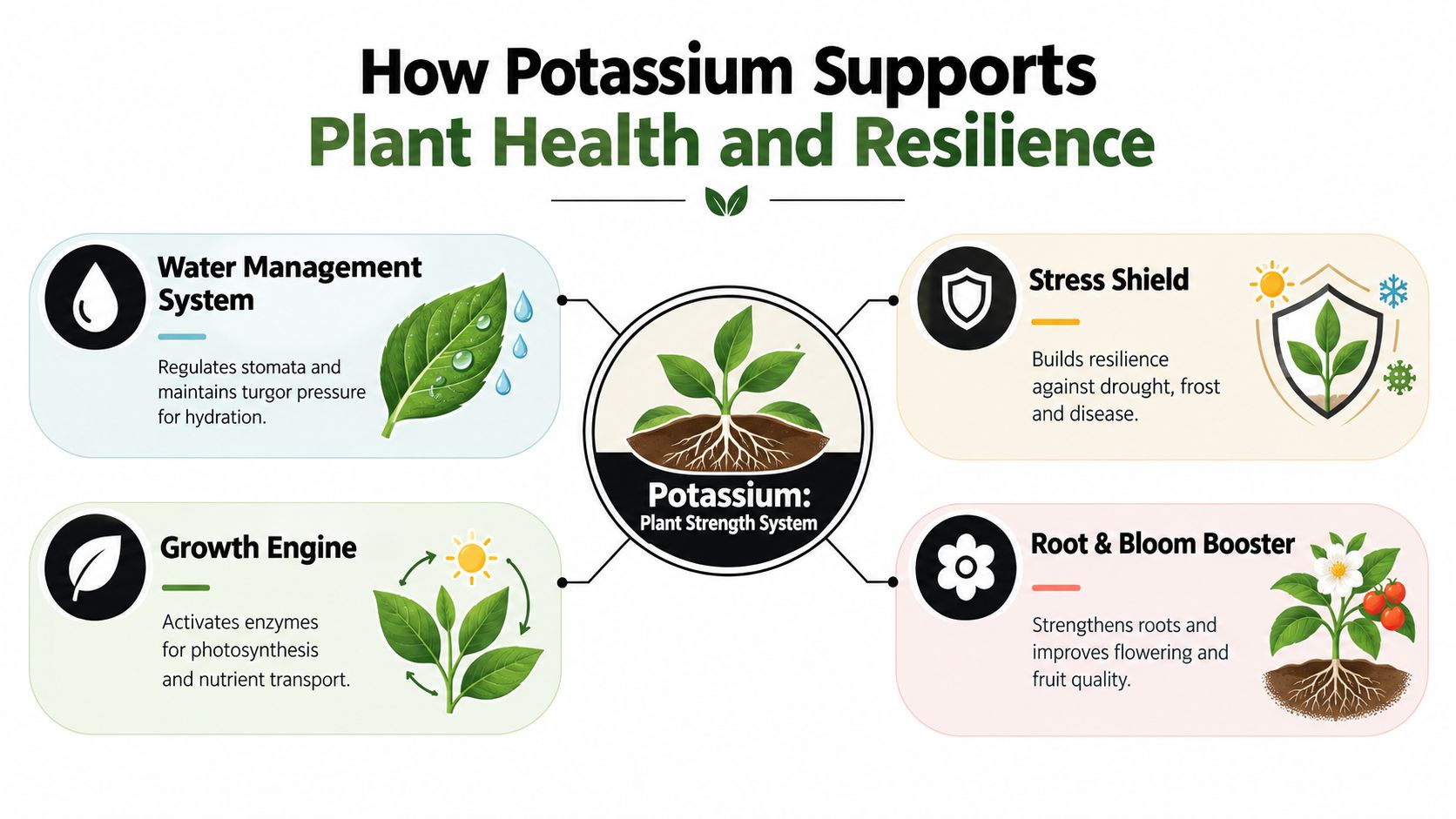
Four jobs potassium performs
Water regulation helps maintain turgor, the internal pressure that keeps leaves and stems firm. If this balance falters, foliage may droop, curl, or lose its normal posture even when the root ball is not completely dry.
Enzyme activation gives potassium a wider role than moisture control. Plants use enzymes to coordinate photosynthesis, nutrient transport, and other chemical processes. Potassium helps these systems function, so inadequate supply can leave a plant generally weak rather than producing one isolated symptom.
Stress resistance connects potassium with a plant's ability to handle drought, temperature stress, and disease pressure. Adequate supply can support stronger physiological function under pressure. It does not make a plant immune or cure an infection.
Root, flower, and fruit performance depend on balanced nutrition. A plant receiving enough nitrogen but too little potassium may produce soft, vigorous growth without comparable structural strength or quality. Potassium uptake often ranks second only to nitrogen, and can exceed nitrogen uptake in crops such as potatoes and sugar beets. Annual removal can range from 50 to 500 lb K2O per acre, depending on crop and yield, according to Montana State University Extension guidance.
Why placement changes everything
Potassium must reach the root surface before roots can absorb it. In soil and potting media, it moves toward roots largely through diffusion. The active uptake zone is therefore close to the roots, rather than spread evenly throughout the entire container.
Dry or compacted media can interrupt that movement. Moisture helps potassium travel toward roots, while compaction limits air exchange and healthy root exploration. A plant may show stress even without an extreme total shortage if the nutrient remains out of reach.
Container size changes the delivery decision. In a small bonsai pot, a modest amount of a soluble fertilizer can move through the root zone quickly, so careful timing and dilution matter. Pellets may suit a larger houseplant that needs gradual release, while an orchid in coarse bark may need nutrients delivered with irrigation. A succulent often needs less frequent feeding because its growth and watering pattern differ.
Good potassium care combines adequate moisture, healthy roots, and nearby placement. The N-P-K ratio matters, but it does not decide the treatment by itself. Choose a format and timing that put potassium near active roots only when the plant and growing medium indicate a need.
Recognizing Potassium Deficiency and Excess in Your Plants
Potassium deficiency usually follows a recognizable pattern. Because potassium is mobile inside the plant, the plant can move it from older tissue toward newer growth. As a result, the oldest leaves often show symptoms first, especially along their margins.
Look for marginal chlorosis, meaning yellowing around the leaf edges. As the problem continues, those margins may become brown and necrotic while the midrib remains noticeably greener. In a houseplant, you might see this on lower leaves. In a bonsai, the pattern may appear on older foliage after an active growth period. Affected plants can also show weak stems, drooping or curling leaves, reduced flowering, or smaller fruit.
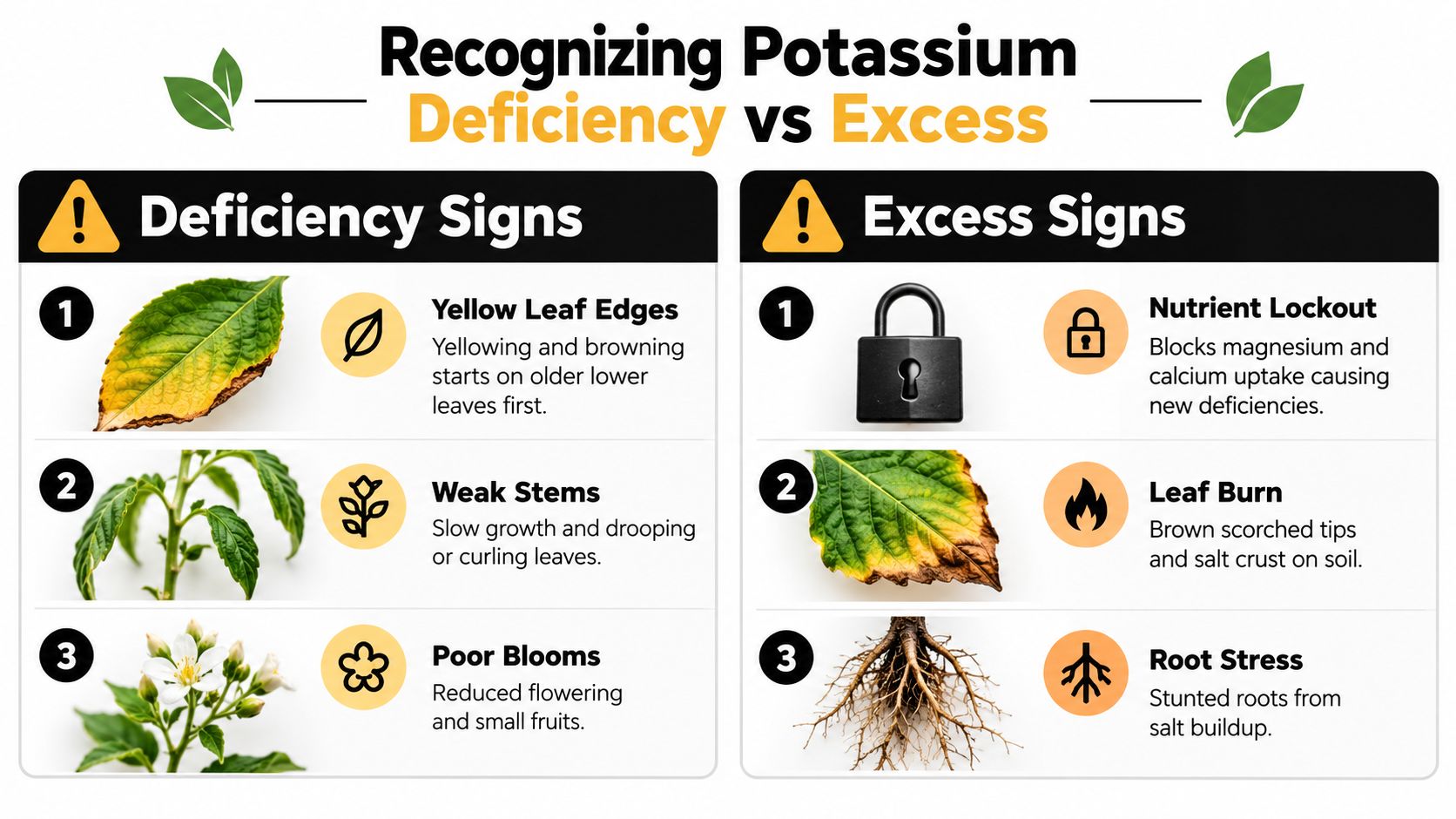
Read the symptom pattern before fertilizing
Drought and compacted conditions can produce symptoms that resemble potassium deficiency. Check the roots, moisture level, drainage, and soil texture before reaching for a concentrated product. If the pot is bone dry, water may be the immediate issue. If it stays wet for too long, damaged roots may be preventing uptake.
Corn deficiency often becomes visible around 4–6 weeks after planting near the V6 stage, according to Iowa State University Extension's nutrient deficiency guide. Houseplants don't follow that crop-specific calendar, but the underlying lesson applies: symptoms often appear during periods of active demand, not necessarily immediately after the deficiency begins.
Use this quick diagnostic sequence:
- Start with leaf age. Older leaves with yellowing and browning edges point more toward potassium stress than a problem limited to fresh growth.
- Inspect the margin. Potassium deficiency commonly begins at the edges while the central vein stays greener.
- Check the root zone. Look for compacted mix, persistent wetness, dry pockets, or roots circling tightly around the pot.
- Review recent feeding. A plant that has received repeated fertilizer may have excess salts rather than a shortage.
- Consider testing. Soil testing is more reliable than diagnosing from a single leaf, particularly in outdoor containers and bonsai benches.
Excess potassium has its own warning signs
More potassium isn't automatically better. Excess fertilizer can increase salt concentration around roots and interfere with the uptake of other nutrients, including magnesium and calcium. Brown tips, scorched margins, a crust on the growing medium, stunted roots, or new deficiency-like symptoms after feeding should make you pause.
If you suspect over-application, don't add another nutrient to counteract it. First, follow the product label and assess whether the container can be flushed safely with clean water. Make sure the pot drains freely, and avoid flushing a plant that already has severe root rot without addressing the underlying root damage.
Visible deficiency is a warning that the plant has already been under stress. Preventive, well-placed feeding is usually more useful than a late, heavy rescue dose.
For a broader symptom checklist, compare what you see with this guide to plant nutrient deficiency symptoms. Diagnose the pattern, not just the color.
Comparing Common Potassium Fertilizer Forms and Sources
The potassium source determines more than the nutrient label. It affects how quickly potassium dissolves, whether the product adds another nutrient, and how carefully you need to manage salt buildup.
Muriate of potash, or potassium chloride, is a concentrated mineral fertilizer that dissolves readily. It can be useful in suitable garden soils, but chloride and salt sensitivity make it a less comfortable choice for many containers, orchids, and delicate plants.
Sulfate of potash, or potassium sulfate, supplies potassium alongside sulfur. It's often chosen when a grower wants to avoid adding chloride. Potassium nitrate supplies potassium with nitrate nitrogen, so it can be helpful when both nutrients are needed, but it isn't appropriate when the plant already receives abundant nitrogen.
Organic sources such as kelp-based products, compost-derived materials, and mineral amendments generally release nutrients differently from soluble synthetic fertilizers. Their nutrient content can vary, and they may not correct a confirmed potassium shortage as predictably or quickly. The label and the growing medium should guide the decision.
Potassium fertilizer forms compared
| Fertilizer Form | Solubility and Release | Best Use Case | Considerations |
|---|---|---|---|
| Muriate of potash | Fast and soluble | Suitable outdoor beds with a confirmed need | Adds chloride and requires careful application around salt-sensitive plants |
| Sulfate of potash | Soluble, generally quick to available | Plants needing potassium without extra nitrogen | Still concentrated, so avoid piling it into a small root zone |
| Potassium nitrate | Fast and soluble | Situations needing potassium and nitrate nitrogen | Can push unwanted leafy growth if nitrogen is already sufficient |
| Liquid potassium fertilizer | Rapidly available after dilution | Houseplants, active growth, and controlled feeding | Application must be even, and over-concentration can injure roots |
| Granular fertilizer | Breaks down as moisture reaches granules | Garden beds and top-dressing | Slower than a liquid and must stay near an active root zone |
| Slow-release pellets | Gradual release over time | Bonsai and routine container care | Easier to overfeed a small pot if the product or amount doesn't match the plant |
| Organic amendment | Variable, often gradual release | Soil-building and gentle maintenance | Nutrient availability depends on decomposition and product composition |
Potassium and phosphorus have limited mobility in soil, so the fertilizer form should match your ability to place it near roots. In a container, a small amount of soluble fertilizer may offer more control than a broad amendment mixed into a large volume of media.
Growing media also influence the outcome. If you're rebuilding a container mix or reducing reliance on peat, this guide to best peat moss alternatives 2026 offers useful context on choosing a suitable base before you decide how potassium should be delivered.
When and How to Apply Potassium for Best Results
Potassium works most reliably as a preventive input. Apply it while the plant is actively growing and before the period when demand peaks, such as vigorous vegetative growth or flower and fruit development. Waiting until the lower leaves are already scorched turns a nutrition program into an emergency response, and late correction may not restore damaged tissue.
Start with the product label, then adjust your thinking around the root zone rather than applying fertilizer to the visible canopy. Potassium needs to reach active roots, and dry soil slows its movement. Watering practices therefore matter as much as the fertilizer itself.
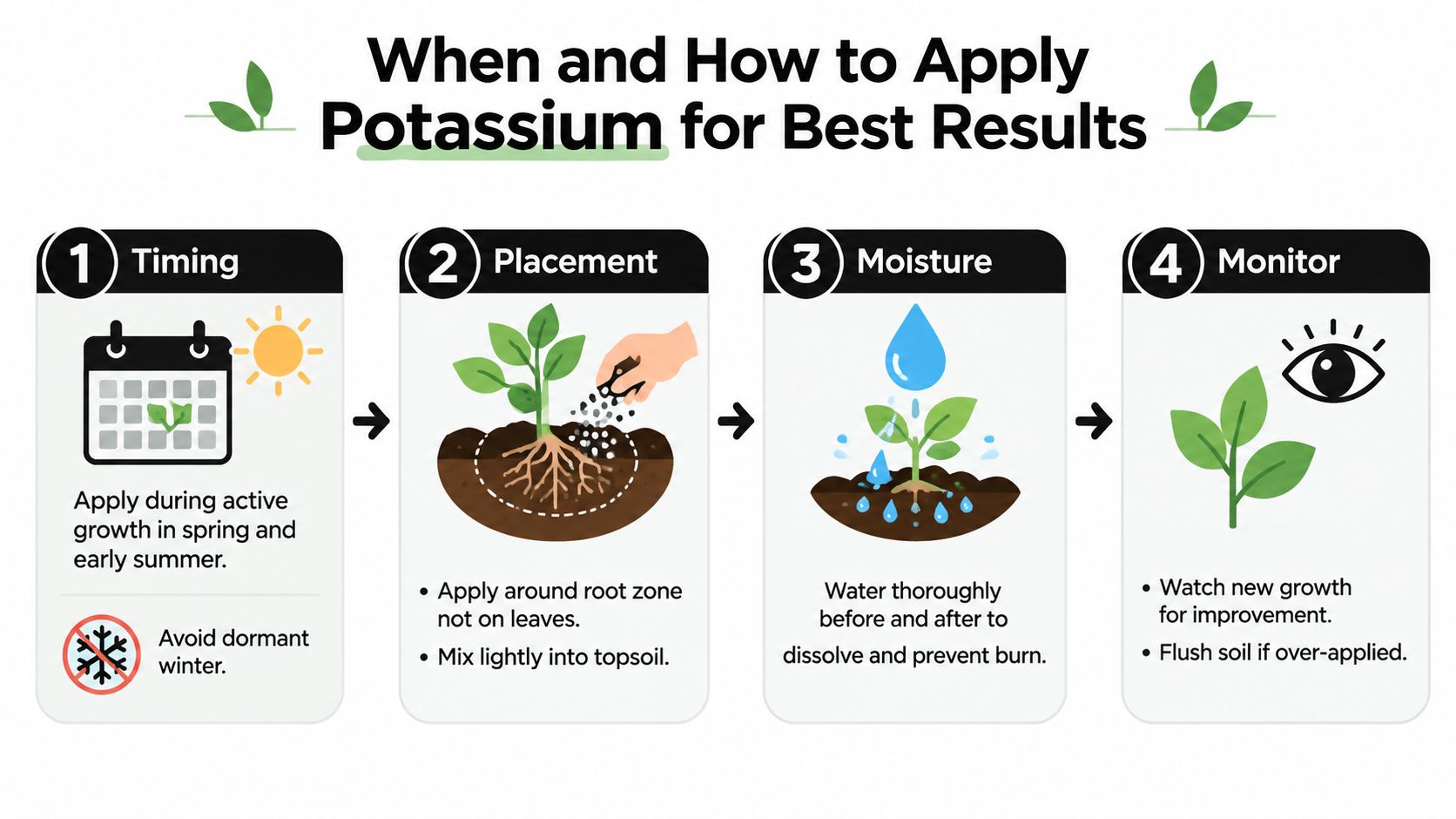
A practical application sequence
First, inspect before feeding. Confirm that the plant is growing, the pot drains properly, and the medium isn't saturated or severely dry. Don't fertilize a plant with damaged roots as though it can absorb nutrients normally.
Next, choose the delivery method. A diluted liquid soil drench gives you control and places the nutrient in the root zone. Granules or pellets can work for established plants when you distribute them evenly across the surface and keep them away from the trunk, crown, or exposed roots.
Then, manage moisture. Apply fertilizer to an already hydrated plant rather than a severely wilted one. Water thoroughly according to the product instructions so soluble nutrients dissolve and reach the roots without forming a highly concentrated pocket.
Finally, observe new growth. Old damaged leaves won't turn green again. Improvement should appear in later growth, stronger posture, or more consistent flowering rather than in repaired tissue.
Split applications can improve control
A single application isn't always the best strategy, especially in containers or under irrigation stress. The 2026 study summarized in the Frontiers in Plant Science research reports improved results from split potassium applications under irrigation stress, with the strongest treatment using a 2:3:5 timing strategy rather than one dose. That finding doesn't create a universal schedule for houseplants, but it supports a useful principle: dividing applications can keep potassium available as demand changes.
For a bonsai, that might mean using a controlled-release product during active growth instead of repeatedly applying strong liquid feeds. For an orchid, it may mean a carefully diluted feed during growth, followed by less frequent feeding when the plant is resting. For a succulent, restraint is often more important than frequency.
Foliar feeding can reach leaves quickly, but it shouldn't replace root-zone nutrition. Spray only when the label specifically supports foliar use, avoid strong sunlight or heat during application, and test on a small area first. If you've over-applied a soluble product, stop feeding and consider a careful flush only when drainage and plant condition make it safe.
Choosing the Right Potassium Fertilizer for Houseplants Bonsai Succulents and Orchids
A fertilizer that suits a vigorous fiddle leaf fig may be excessive for a cactus. The same potassium source can behave differently in a bark-based orchid mix, a bonsai substrate, and a peat-free houseplant blend. Match release speed and concentration to root volume, not to the appearance of the label alone.
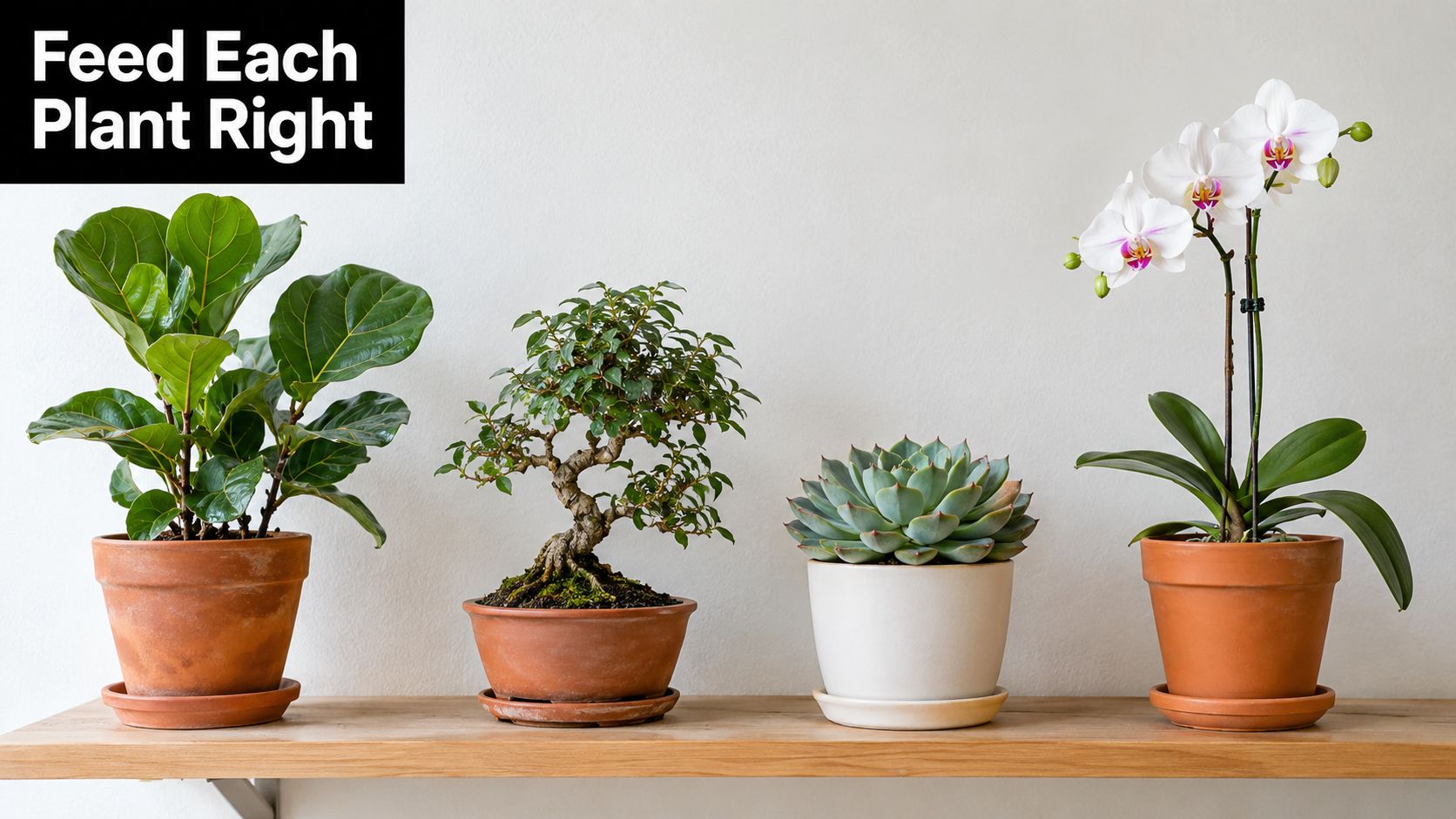
Use the plant's routine as your decision guide
| Plant type | Practical priority | Suitable format to consider | Main caution |
|---|---|---|---|
| Tropical houseplants | Steady growth with manageable feeding | Diluted liquid or measured slow-release pellets | Don't add potassium automatically when yellowing comes from watering or light problems |
| Bonsai | Consistent nutrition in a small, highly managed root zone | Controlled-release pellets or carefully diluted liquid | Avoid piling pellets against the trunk or feeding dry roots |
| Succulents and cacti | Low-demand nutrition with excellent drainage | Weak liquid feed during active growth | Concentrated salts can stress sparse roots and dry media |
| Orchids | Gentle feeding through airy, bark-based media | Diluted orchid feed or suitable slow-release product | Bark mixes can dry and leach quickly, while exposed roots are sensitive to concentrated fertilizer |
A tropical houseplant such as a fiddle leaf fig may benefit from a balanced fertilizer that includes potassium when it's actively producing leaves. A product like 16-5-11 Fiddle Leaf Fig and House Plant Pellets is a slow-release option, while liquid feeding offers more control when the plant is recovering or the pot is small.
Bonsai have limited root volume, but they also receive close observation and regular watering. 18-6-8 slow-release Bonsai Fertilizer Pellets can fit a routine where gradual release is preferable to frequent mixing, provided you follow the label and account for the tree's season and condition.
Succulents and cacti usually need a lighter touch. Their fleshy tissues store water, and their roots can be damaged by repeated concentrated feeding. A weak, well-diluted liquid fertilizer during active growth is easier to adjust than a heavy pellet application.
Orchids add another complication. Bark-based media have large air spaces and may not retain soluble nutrients like a dense potting mix. A gentle orchid-specific product, such as 13-11-11 slow-release orchid pellets, may be more practical for some collections, while liquid feeding allows closer control for plants with sensitive roots.
For general indoor feeding technique, use this guide to fertilize indoor plants. The essential test is whether the format lets you control placement, moisture, and frequency.
Building a Confident Potassium Care Routine at Home
A reliable potassium routine doesn't begin with the strongest fertilizer on the shelf. It begins with the plant's growth stage, the condition of its roots, the texture of its medium, and evidence that additional potassium is needed.
For outdoor soil, testing provides a stronger basis than guessing. One recent crop-nutrition analysis identifies fields below about 100 ppm soil-test K as the clearest candidates for added potassium, describes 100–130 ppm as uncertain, and considers fields above 160 ppm unlikely to benefit, as summarized in the Gardeners' fertilizer guidance. These thresholds aren't a universal prescription for every potting mix, but they reinforce the central lesson: potassium should respond to conditions, not habit.
Use this simple home routine:
- Observe: Check older leaves, margins, growth rate, and flower production.
- Inspect: Confirm that roots have air, moisture is reaching the pot evenly, and drainage works.
- Select: Choose liquid, granular, pellet, or amendment form according to plant type and pot size.
- Place: Keep potassium near active roots without concentrating it against stems or crowns.
- Monitor: Judge the next flush of growth, not damaged leaves, and stop feeding if salt buildup or burn appears.
Start with one plant category and one clearly labeled product. Once you understand how your fiddle leaf fig, bonsai, succulent, or orchid responds, you can adjust the timing and format with confidence. Potassium is most useful when it supports a complete care system, not when it distracts from light, watering, drainage, and root health.
Leaves & Soul offers professional-grade soils, liquid plant foods, slow-release pellets, and targeted amendments for houseplants, bonsai, succulents, and orchids. Visit Leaves & Soul to choose a potassium-containing fertilizer and growing medium that match your plant's root zone and care routine.