


Excessive phosphorus doesn't guarantee stronger roots. In controlled trials, root growth improved around 90 kg/ha phosphorus but declined at the tested 120 kg/ha rate, while nitrogen showed its strongest response around 120 kg/ha and inhibited roots at 180 kg/ha (controlled fertilizer study).
That finding cuts against the most popular root-development fertilizer advice. A high middle number on a bottle can look persuasive, especially when a plant has weak growth, but a phosphorus-heavy product won't repair waterlogged media, compacted soil, cold roots, salt injury, or damaged roots. The first decision isn't which ratio to buy. It's whether phosphorus is limiting.
For indoor plants, bonsai, orchids, succulents, and container-grown vegetables, the safest strategy is measured nutrition matched to the root zone. Test the growing medium when possible, improve moisture and aeration first, then choose a balanced fertilizer or targeted amendment only when the diagnosis supports it.
Why Your Root Development Fertilizer Strategy Needs a Reality Check
The quickest way to waste money on a root fertilizer is to assume the middle number does the heavy lifting. Phosphorus has been tied to root and crop development for roughly 200 years, and Way's 1850 soil-science work helped show what happens when phosphorus is added to soil (FAO soil science reference). That history matters, but it also fed a stubborn shortcut. Growers still jump from “phosphorus is involved in rooting” to “more phosphorus means more roots,” and those are not the same claim.
Plants take up phosphorus mainly as the orthophosphate ions H₂PO₄⁻ and HPO₄²⁻. In soil, it moves toward roots mostly by diffusion, which makes it far less mobile than nitrogen. That changes the whole conversation. A root has to physically reach a patch of available phosphorus, and whether it can do that depends on placement, moisture, pH, and concentration, not just the ratio printed on the bag. If you want a better handle on root-zone access and chemistry, this guide to what your plants wish you knew about soil pH is worth reading.
Practical rule: Use a high-phosphorus fertilizer for a confirmed need, not as a default rooting tonic.
The label can point you in the wrong direction
A fertilizer labeled 12-24-12 contains 12% N, 24% P₂O₅, and 12% K₂O by weight, not equal amounts of elemental nutrients (Mississippi State University fertilizer guidance). So the middle number is a reporting convention. It is not proof that the product will build a bigger root system in every situation.
Extension guidance pushes back on another common habit, loading transplants with extra phosphate just because they are transplants. Washington State University notes that the link between phosphate and root growth is often assumed more than clearly demonstrated, and that adequate nitrogen may be enough in many cases (Washington State University phosphate guidance). That lines up with what indoor growers see all the time. A plant with poor roots often has a root-zone problem first, and a fertilizer problem second.
Containers make that mistake costlier. In a garden bed, nutrients spread through a larger volume. In a bonsai pot, nursery can, or houseplant container, the same instinct can create a hot zone around already stressed roots. You may get greener top growth for a while and still end up with a weaker root system, more imbalance, or more runoff from excess salts and unused phosphorus.
Diagnose the root problem before feeding
Check the medium and recent care history before you change the fertilizer.
- Waterlogging: Saturated media cuts oxygen and damages fine roots.
- Compaction: Dense mixes limit root extension and reduce contact with water and nutrients.
- Cold media: Root activity slows, and phosphorus movement slows with it.
- Soluble salts: Repeated feeding can make the root zone too concentrated.
- Root damage: Repotting, drought, pests, or disease can reduce uptake no matter what ratio you apply.
- Actual deficiency: A soil or media test can show whether N, P, or K is limiting.
The useful question is simple. What is stopping this plant from making and using healthy roots right now? Once you answer that, the fertilizer choice usually gets much clearer.
Choosing the Right Root Development Fertilizer for Your Plants
Picking a root fertilizer by the middle number alone is how growers end up with stalled plants in expensive pots. Choose the product from the actual situation. Plant type, container size, watering habits, media texture, and test results matter more than any blanket high-phosphorus rule. If you do not have a confirmed deficiency, a balanced formula is usually the safer starting point.
Controlled research supports moderation: the 2021 rate trial summarized above found root growth improved up to moderate levels and was inhibited at the highest tested rates, which is why a balanced formula is the sensible default.
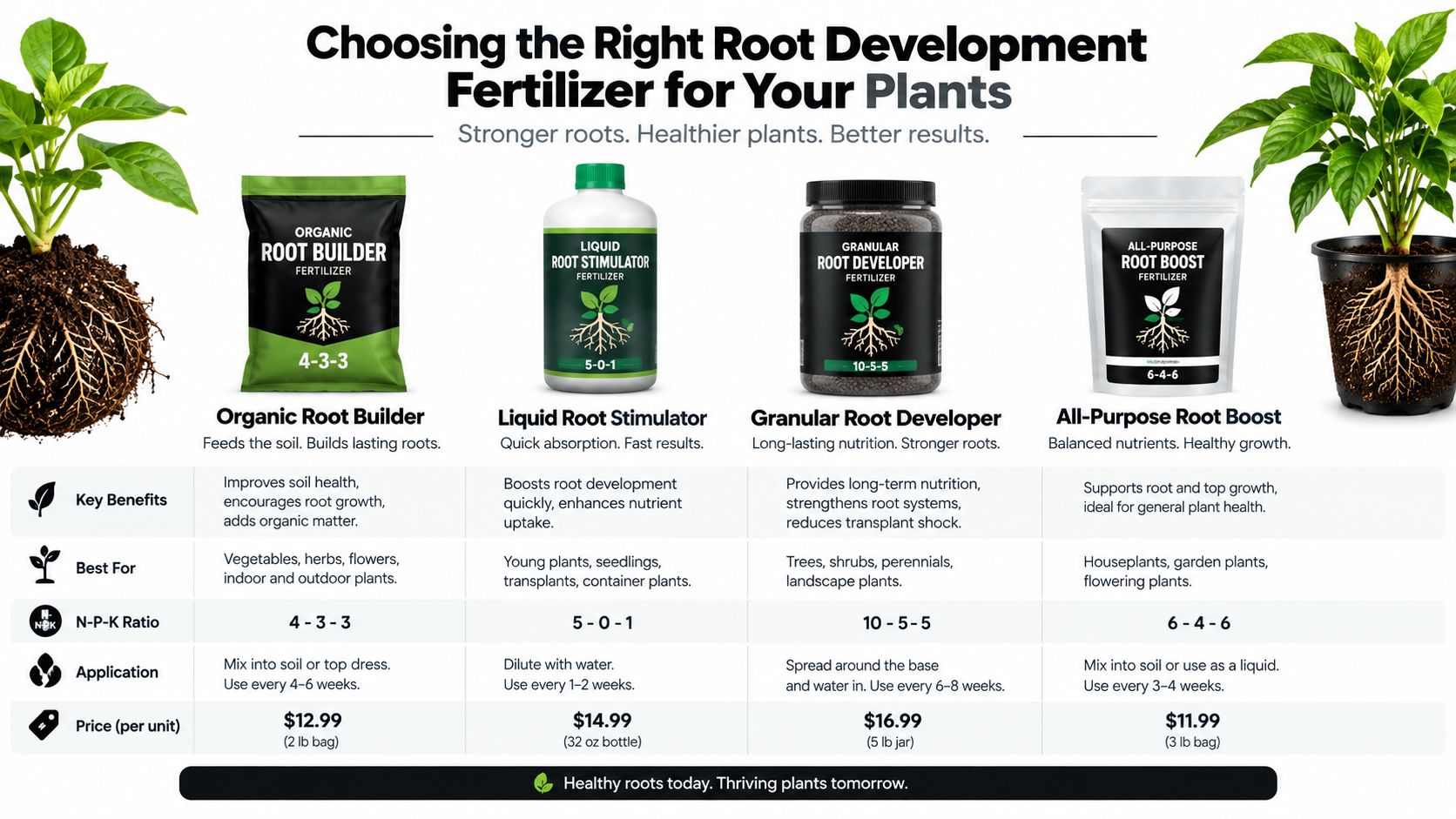
Match the product to the growing situation
Balanced liquid fertilizers fit actively growing houseplants when you can dilute accurately and watch the response week to week. They move through the root zone evenly and let you reduce feed fast if the plant slows, the weather changes, or the mix stays wet too long. That control is the main advantage. The trade-off is simple. In a small pot, a heavy hand can raise soluble salts fast.
Slow-release pellets suit growers who water on a fairly regular schedule and want less day-to-day mixing. They feed gradually, but once they are in the pot, you have fewer ways to correct an over-application quickly. Spread pellets through the media surface instead of piling them against the trunk, crown, or a tight root ball. In very small containers, caution matters more than convenience.
Targeted phosphorus products have a place, but it is narrower than the label often suggests. Use them when a media test points to low available phosphorus, when starter nutrition is justified, or when the crop and stage genuinely call for it. Slow growth, small leaves, or weak roots do not automatically mean phosphorus is the limiting factor. In practice, poor aeration, cold media, root damage, and salt buildup are at least as common.
Organic amendments can help, but they are not automatically mild or predictable. Bone-based inputs, composted materials, frass, and similar products release nutrients according to their composition and the conditions in the potting mix. In containers, that can make timing hard to judge. Keep rates measured, and do not stack several amendments at once unless you know what each one is contributing.
Plant type still matters. Bonsai, orchids, succulents, and cacti usually respond better to low-dose feeding and sharp drainage than to an aggressive ratio. A vigorous fiddle leaf fig or another leafy houseplant usually does better on a balanced program during active growth than on a phosphorus spike.
A good filter is control. If you cannot say what problem the fertilizer is solving, wait.
Effective Application Methods for Deeper Root Systems
Application method determines whether roots can reach the nutrient or encounter a damaging concentration. Start with a soil or growing-media test, sample the active root zone, and use the result to identify whether nitrogen, phosphorus, or potassium is limiting. For surface-rooted plants, the sampled zone is typically 0–6 inches (Utah State University application guidance).
Use the root zone, not the plant label, as your map
Phosphorus and potassium move slowly through soil. Before planting, incorporate them into the root zone or position them close enough to developing roots for contact. Nitrogen is comparatively mobile, so time it near active uptake rather than applying a large amount long before roots can use it.
For a banded application, place fertilizer beside and slightly below the seed or transplant zone. Never put concentrated fertilizer directly against roots. Cover the band and irrigate so moisture can move nutrients into the surrounding medium without creating a harsh pocket.
In containers, translate that principle into even distribution. Don't bury a concentrated line of pellets beside a small root ball, and don't pour a strong liquid feed onto dry media. Dry roots can be injured when a concentrated solution reaches them suddenly.
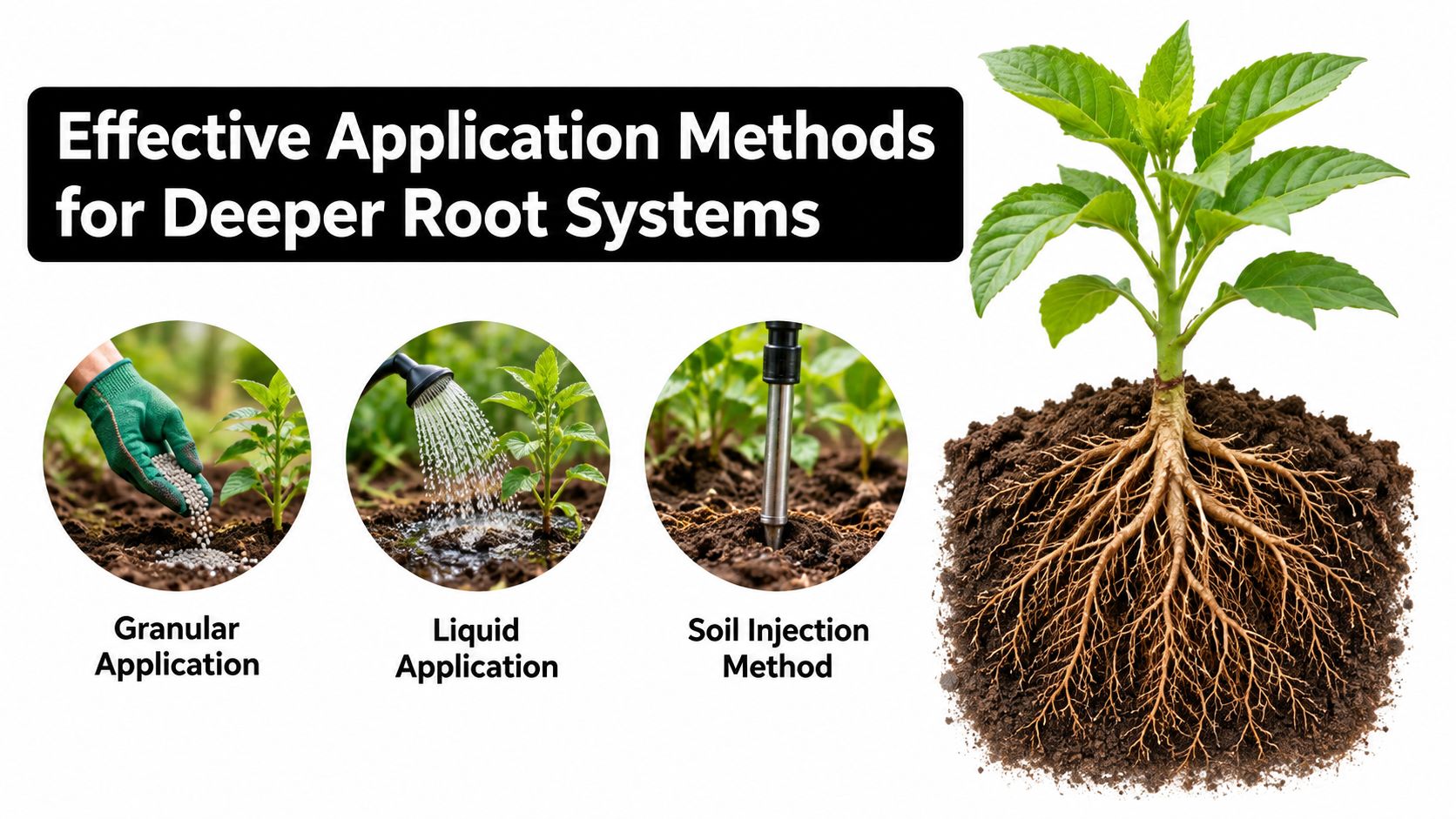
Apply each format with control
Liquid feeding: Water the plant normally if the medium is dry, then apply the correctly diluted fertilizer solution across the root zone. Keep the solution off leaves when the product is intended for soil use, and don't increase concentration to compensate for a missed feeding.
Slow-release granules: Measure according to the label and distribute them across the surface or mix them through fresh media when the product permits. Keep granules away from stems, exposed roots, and the drainage outlet. Their slow release doesn't remove the risk of salt accumulation.
Soil drenches: Use a measured solution and enough water to wet the root zone without leaving the pot anaerobic. A drench can correct a diagnosed issue, but it isn't a shortcut around testing or dilution.
Preplant incorporation: Mix immobile nutrients into the active root zone before sowing or transplanting. This gives new roots a reasonable chance of encountering phosphorus and potassium instead of forcing them to search through nutrient-poor soil.
Active growth is the appropriate feeding window for most indoor plants. Pause after repotting, drought, or root damage, and wait until new roots resume. A plant with inactive or injured roots can't make good use of additional fertilizer.
For practical instructions on choosing between drenching, top-dressing, and other approaches, use this guide to fertilizer application methods. It reinforces the central point: dose, placement, moisture, and timing work together.
Beyond NPK: Using Biostimulants and Mycorrhizae
Root products get oversold fast. A stronger phosphorus number, a seaweed tonic, or a scoop of inoculant will not build roots in a potting mix that stays soggy, starves roots of oxygen, or swings between bone dry and saturated. Root growth responds to the whole root zone, not a single label claim.
That is why I treat biostimulants and biologicals as support tools, not root-making shortcuts. Mycorrhizal fungi, seaweed extracts, humic substances, microbial inoculants, and organic amendments can all change conditions around the roots, but they still depend on workable moisture control, air in the medium, and a feeding program that matches the plant.
Mycorrhizae can help roots access parts of the medium they do not physically occupy, but only if the product contains compatible organisms and the roots are healthy enough to form that relationship. Medium choice matters. Watering habits matter. A biological input will not rescue roots sitting in stagnant media.
Seaweed extracts get attention for good reason. They contain compounds such as auxins, cytokinins, and betaines that are associated with root development and stress tolerance. A 2025 Frontiers editorial describes these compounds as part of a larger interaction with nutrient uptake and beneficial microbes, not as isolated fertilizer ingredients (Frontiers perspective on biostimulants).
More stimulation can backfire
Dose matters more than marketing suggests. A 2025 greenhouse study in the same research program found that one experimental biostimulant improved root length, surface area, and volume at some concentrations, while a higher humic-extract treatment inhibited root growth.
That trade-off is the practical point. If you want to test a biological product, change one variable at a time and watch what happens to new root emergence, root color, root density, and post-stress recovery. Piling on seaweed, humics, microbes, frass, and a strong mineral feed in the same week turns diagnosis into guesswork.
For insect-based amendments, this guide on using frass safely is worth reading. Frass can fit a root-zone program, but it is still an amendment with nutrient value and handling limits, not evidence that every slow plant needs more phosphorus.
The same realism applies to mycorrhizae. They can complement a sound root program, but they do not replace testing, irrigation control, or a substrate that drains and re-wets properly. This guide to mycorrhizae for indoor plants is useful for deciding whether an inoculant fits your setup instead of treating it as a cure-all.
Troubleshooting Common Root Fertilization Problems
Root problems get blamed on phosphorus far too often. In practice, the fertilizer is usually only part of the story. Pale leaves, stalled growth, brown tips, weak new roots, or a sudden slump can all show up when the root zone is too wet, too dry, too compacted, poorly aerated, salt-loaded, or cold. Treat those symptoms as clues, not as proof that the plant needs a high-middle-number formula.
Start with the basics. Check the medium, the watering pattern, the last few feeds, and the condition of the roots themselves. If roots are struggling, adding more product often makes diagnosis worse.
When fertilizer causes the damage
Fertilizer burn usually comes from repetition, concentration, or bad timing. I see it after growers stack feedings too closely, mix too strong, or fertilize a plant whose roots are already dry, damaged, or stressed from repotting. Salts build up around the roots, and the plant has a harder time taking in water even though the pot still looks moist. Small containers are less forgiving because there is not much substrate to buffer mistakes.
If your medium can be flushed, run clean water through it thoroughly and let it drain completely. Never flush into a cachepot full of runoff. Do not go straight back to the old feeding rate either. Give the plant time, restore aeration, stabilize moisture, and wait for signs of fresh root activity before resuming a lighter program.
Recovery rule: Stop trying to correct a stressed root system with more inputs. Restore oxygen, moisture balance, and time first.
Phosphorus can also be present and still unavailable. That is one reason the old "more phosphorus equals more roots" advice fails so often. Phosphorus moves slowly, and root access depends on conditions in the medium. If a test or recent feeding history suggests phosphorus is already present, look harder at pH, compaction, excess water, cold media, and physical root damage before you add more.
Test one change at a time
A simple home trial beats guesswork. Compare an unfertilized control against one changed variable, such as a balanced feed, a root-zone phosphorus treatment, or a lower-nitrogen approach. Keep light, irrigation, temperature, substrate, pot size, and plant maturity as even as possible so you can see clearly what the fertilizer changed.
Measure roots, not just top growth.
- Root mass: Compare starting and ending mass when destructive sampling is realistic.
- Root length: Record the longest root and whether new fine roots are appearing.
- Lateral roots: Count branching instead of assuming a larger canopy means a stronger root system.
- Root-to-shoot ratio: Check whether top growth is outrunning what the roots can support.
- Root condition: Note color, firmness, odor, and any sign of salt injury.
- Consistency: Use 5–10 comparable plants per treatment and repeat across two watering cycles or growing periods when the setup allows it (Mississippi State University trial guidance).
Label reading matters. As covered earlier, the middle number describes phosphorus oxide rather than elemental phosphorus, so compare products by nutrient content and by how much you apply. The ratio on the front of the package creates a lot of false confidence.
Correct timing and placement errors
Placement mistakes are common and expensive. Nitrogen applied before roots can actively absorb it is easier to lose. Phosphorus and potassium placed too far from developing roots are less useful than growers expect because they do not move freely through the medium. Fertilizer placed directly against a transplant, fresh cutting, or exposed root creates the highest concentration exactly where the plant is least able to handle it.
Timing matters just as much. During dormancy or long low-light stretches, cut feeding back or stop it instead of sticking to an active-growth schedule. After repotting, drought stress, or root pruning, let the plant recover first. Bonsai and succulents need extra care here. Sparse irrigation and small root zones make concentrated applications risky, so even distribution and conservative dilution beat chasing a phosphorus-heavy label.
If the symptoms are still muddy, use a visual guide to fix nutrient deficiencies and separate likely nutrient issues from plain environmental stress. Symptom charts are useful for narrowing options. They are a poor excuse to apply several corrective products at once.
A root fertilizer program is working when roots stay firm, branch well, and fill a well-aerated medium at a steady pace. Greener leaves alone do not prove much. If roots are sparse, dark, soft, sour-smelling, or stalled, correct the environment first and reconsider the feeding program second.
Leaves & Soul offers soils, liquid fertilizers, slow-release pellets, and targeted amendments for bonsai, houseplants, succulents, cacti, and orchids. Visit Leaves & Soul to match your plant and container setup with a measured root-focused nutrition approach instead of relying on a high-phosphorus label alone.