


You add fertilizer to your bonsai because the new shoots look weak, then a few weeks later those shoots stretch too far and the tree seems harder to manage. Or you carefully follow a liquid-feeding routine until a busy week interrupts it, leaving the tree underfed in a small pot that drains quickly. Slow release bonsai fertilizer offers a calmer alternative, but it isn't a “set and forget” solution.
The important question isn't only which pellets you buy. It's whether their release behavior matches your pot size, climate, watering pattern, and current growth stage. A shallow bonsai pot on a hot balcony can use nutrients very differently from a tree in a cool greenhouse, and pellets alone won't always give you enough control for refinement or recovery.
Why Bonsai Need a Different Feeding Approach
A beginner often starts with a reasonable idea: feed the bonsai more because it's growing. The trouble begins when a general-purpose fertilizer is applied heavily to a small pot. The tree responds with long, soft shoots, internodes become difficult to refine, and the grower later has to prune away growth that never fit the design. After repotting, those same concentrated nutrients can be especially unwelcome around freshly disturbed roots.
Bonsai don't live in garden soil. They grow in shallow containers with restricted root space, often in free-draining mixes that include akadama, pumice, lava, or similar materials. A tree grown in the ground can send roots outward to search for nutrients and moisture. A bonsai can't. Its roots repeatedly encounter the same limited volume, and every watering event can move soluble nutrients through that small root zone.
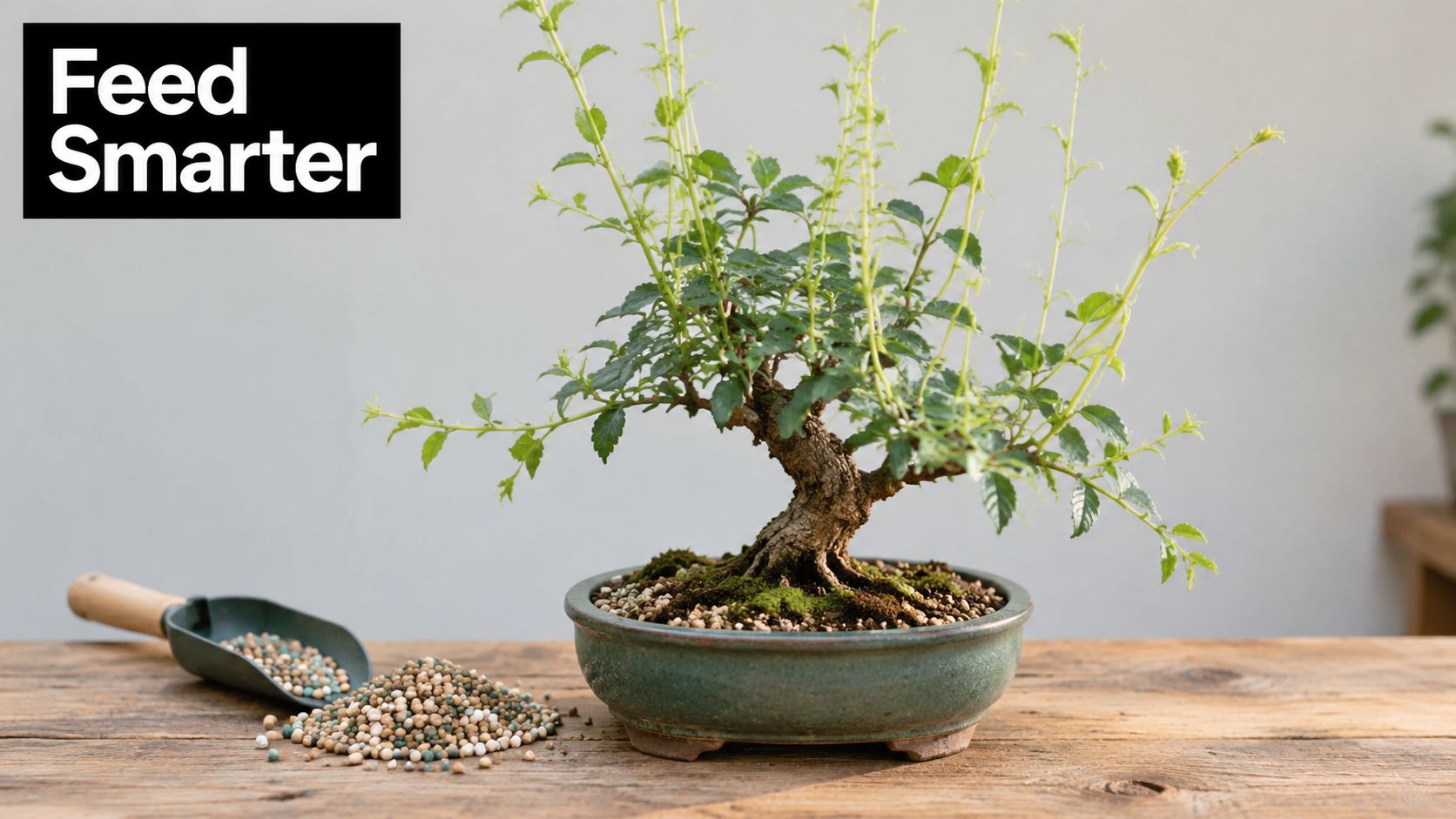
The small-pot problem
Frequent watering keeps bonsai healthy, but it also changes the feeding picture. Nutrients can leach from the mix, while a missed feeding leaves the tree with little reserve. Adding a large amount all at once creates the opposite problem, a sudden concentration around roots that have nowhere else to go.
That's why bonsai benefit from a steady and predictable nutrient supply rather than repeated bursts. Controlled-release products used for bonsai meter nutrients gradually through coatings that respond to moisture and temperature. Documented release windows range from a few months to as long as 16 months, depending on the product and conditions. One professional formulation is specified to release over 12 to 14 months at about 21°C, or 15 to 17 months at 16°C, while another line is offered in 3, 6, 9, 12, and 16-month versions (Bonsai Europe's controlled-release fertilizer information).
Practical rule: In a bonsai pot, aim for a gentle supply that follows active growth. Don't try to compensate for a small root zone with a large fertilizer dose.
Slow-release feeding has long been treated as a practical bonsai option, not a specialist novelty. Earlier bonsai guidance described controlled-release pellets as common in container plants, while later references listed products with release periods ranging from short cycles of 2 to 3 months through longer schedules of 7 to 8 months (historical and practical bonsai fertilizer guidance). The useful lesson is simple: pellet feeding has evolved, but the reason it suits bonsai remains the same. It smooths out the nutrient supply inside a very small growing environment.
How Slow Release Fertilizer Actually Works
Think of a pellet as a tiny sugar cube wearing a rain jacket. The nutrient core is inside, and the outer skin doesn't let everything dissolve the moment water touches it. Moisture enters gradually, the nutrients dissolve inside, and the solution seeps outward into the root zone.
That simple image describes the basic mechanism of a coated fertilizer granule. Manufacturers coat soluble fertilizer prills with water-insoluble or semipermeable materials. Water penetrates the coating, dissolves the fertilizer salt, and the dissolved nutrients diffuse outward over time. This process is designed to reduce sharp nutrient spikes and better synchronize supply with plant uptake, which is valuable in confined bonsai containers (review of controlled-release fertilizer mechanisms).
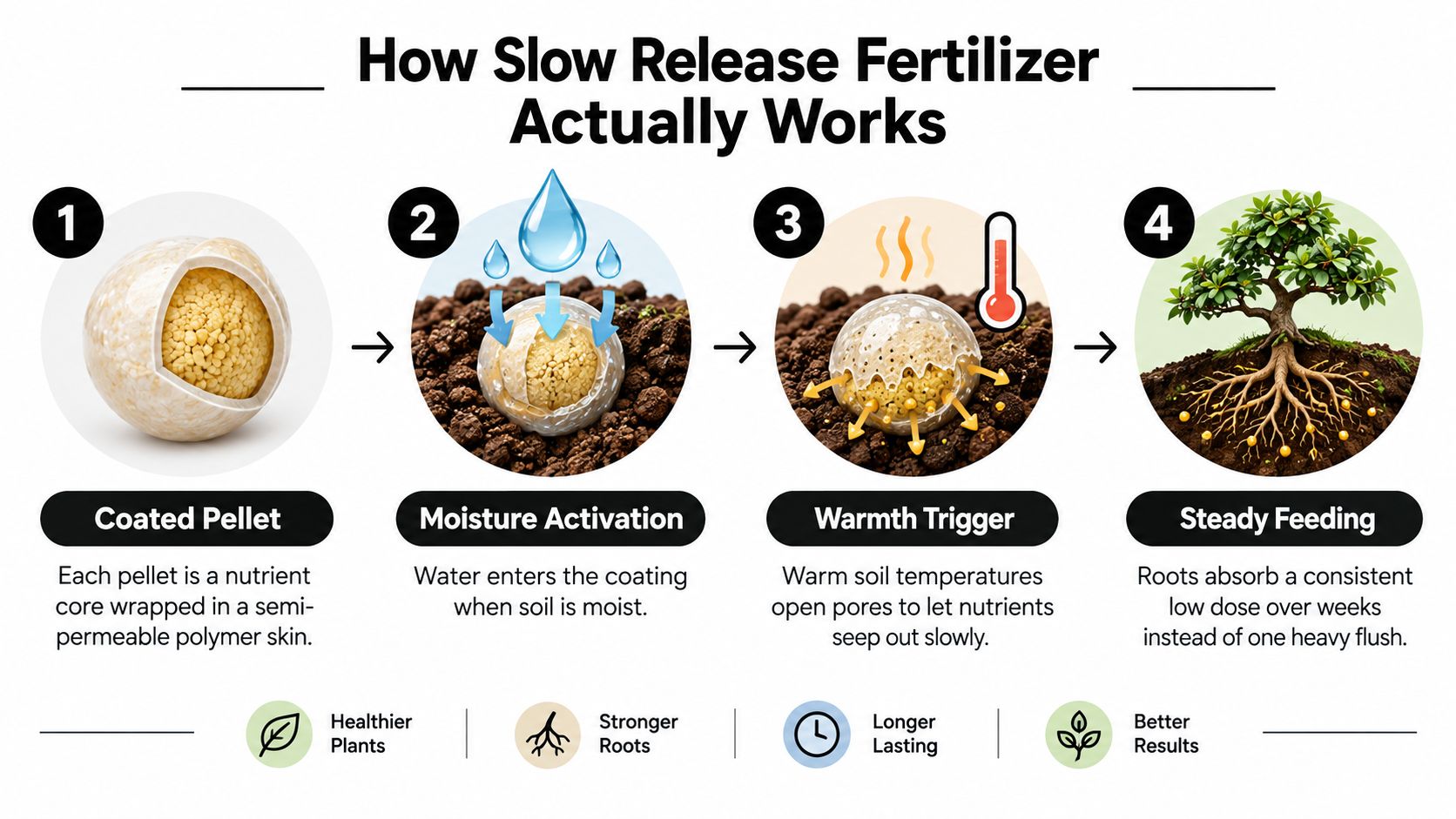
Four parts of the release process
- The coated pellet stores the nutrients. A resin-coated granule contains a nutrient core surrounded by a semipermeable shell.
- Moisture activates the process. Water enters the coating when the surrounding mix becomes moist.
- Temperature changes the pace. Warmth generally increases movement through the coating, while cooler conditions slow it.
- Roots receive smaller doses. Instead of one heavy application, nutrients reach the root zone gradually as the tree is watered and grows.
The phrase “slow release” causes confusion because it can describe more than one technology. Some products depend on organic materials breaking down through microbial activity. Controlled-release fertilizer usually refers to an engineered coating and diffusion process. Bonsai growers often use “pellets” for both categories, but they don't behave identically.
A true controlled-release product is therefore not a clock that releases the same amount every day. It behaves more like a small reservoir whose flow changes with its surroundings. A warm, moist pot can move through the feeding cycle faster than a cool pot, and the label duration should be treated as a guide tied to stated conditions.
For a visual explanation of the wider category, see this overview of what slow-release fertilizer means. The practical takeaway is that the coating changes the timing, but your climate and watering habits still help determine the actual result.
Here's a short visual explanation of the mechanism in action:
Slow Release vs Liquid vs Organic Bonsai Fertilizers
The difference becomes clearer when you look at what happens inside the pot. Pellets provide a background supply with fewer applications. Liquid fertilizer reaches the roots quickly and gives you much finer control, but it can move through a free-draining bonsai mix rapidly. Organic options, such as fertilizer cakes or fish-based feeds, release through biological activity and can vary with the condition of the soil and the weather.
| Factor | Slow Release Pellets | Liquid Feed | Organic, cake, fish, and similar |
|---|---|---|---|
| Application effort | Lower maintenance after placement | Requires repeated measuring and mixing | Usually simple, but replacement and odor can be concerns |
| Speed | Gradual and condition-dependent | Fast response | Gradual and dependent on breakdown |
| Control | Good baseline, limited short-term adjustment | Precise control over strength and timing | Less predictable |
| Overfeeding risk | Lower than immediately soluble products when used correctly | Higher if mixed too strongly or applied too often | Varies by product and decomposition |
| Best use | Healthy trees needing steady support | Recovery, correction, or vigor adjustment | Growers who prefer organic inputs and accept variability |
| Bonsai soil fit | Works well when distributed across akadama, pumice, or lava | Useful when the mix drains quickly and adjustment is needed | Can suit organic-focused systems, but residues and smell need consideration |
Independent bonsai guidance commonly places slow-release or organic feeding on a less frequent rhythm than liquid feeding, with slow-release types often applied around every 4 to 6 weeks, compared with many chemical liquid fertilizers applied every 10 to 14 days (bonsai fertilizing guidance from Bonsai Winnipeg). Those intervals aren't universal instructions. They show the practical difference between a background feed and a quick, repeatable dose.
What each method feels like
Pellets are convenient because you make fewer feeding decisions. They're useful for a healthy tree that is growing steadily and doesn't need weekly changes in vigor. The trade-off is that you can't instantly turn the nutrient supply up or down.
Liquid feed is more work, but it gives you a dial. You can use a weaker mix for a cautious tree, pause it when growth becomes too strong, or make a measured correction when the tree needs faster support. It also washes through quickly, which can be useful in a carefully managed bonsai mix but demands consistent application.
Organic products feed the broader root-zone environment as well as the tree. They can be a good fit for growers who want a slower, biologically active approach, but their strength and timing can vary. For readers comparing feeding principles across different container-grown crops, this guide to feeding cannabis plants offers useful general context, though bonsai still require species-specific restraint.
For a deeper discussion of the trade-offs between fertilizer categories, use this comparison of synthetic and organic fertilizer. In short, choose pellets for convenience and continuity, liquid for control, and organic inputs for a slower system where variability is acceptable.
When and How Much Slow Release to Apply
Feed the tree's growth curve, not the calendar alone. A bonsai entering active spring growth has a different demand from one slowing down in autumn, and a refined tree shouldn't receive the same encouragement as a young tree being developed.
In early spring, apply a modest baseline when buds are swelling or new growth is beginning, provided the tree is healthy and the product suits the conditions. Before summer heat arrives, check whether the pellets have softened or broken down and whether the tree is still growing strongly. Mid-summer is often a maintenance period, while late summer can be a useful window for supporting ramification in trees that are still actively extending. Autumn feeding depends heavily on species and climate. Deciduous trees may still be storing energy, while trees approaching dormancy shouldn't be pushed indiscriminately.
Start with pot surface area
Exact product rates belong to the product label, and pellet strength differs. For a beginner, the safer principle is surface area controls quantity. A small display pot shouldn't receive the same handful as a medium training container because both hold bonsai.
| Pot Size | Early Spring | Pre-Summer | Mid-Summer | Late Summer | Autumn |
|---|---|---|---|---|---|
| Shallow training pot | Light, even application as growth begins | Inspect and refresh only if pellets have broken down | Maintain cautiously during active growth | Use a modest refresh for trees still extending | Reduce or stop as growth slows |
| Small display pot | Very light application, spread widely | Check for concentration and runoff | Avoid automatic topping up | Feed only if the tree remains actively growing | Usually taper toward dormancy |
| Medium landscape pot | Establish a measured baseline | Reassess according to growth and pellet condition | Continue only while roots and shoots are active | Support development if vigor is needed | Adjust for species and local autumn growth |
Treat the table as a decision framework, not a substitute for the label. If you're using a strong product, choose less. If the tree is newly repotted, stressed, or weak-rooted, delay rather than forcing a feeding schedule.
Place pellets where water can reach them
Distribute pellets in an even ring around the pot, leaving space around the trunk. Don't pile them beside exposed surface roots or in one corner. A light covering of soil, akadama fines, or moss can help keep them from washing away, but don't bury them so that you can't inspect their condition.
Refresh by visible breakdown and tree activity, not by habit. A pellet that remains firm may still have a working coating, while a collapsed or empty shell may no longer contribute much. Heavier-feeding trees such as many junipers and pines can often use more support during active growth. Refined deciduous bonsai, including maples, generally benefit from more restraint because excessive vigor can lengthen internodes and undo fine branch structure.
Climate Pot Size and Real Release Behavior
A label duration isn't a promise that applies equally to every bonsai bench. Controlled-release fertilizer responds to temperature and moisture, so the same product can behave differently on a hot balcony in summer and in a cool greenhouse during early spring.
The distinction between slow release and controlled release matters here. A simple slow-release material may depend on breakdown and provide a broad, variable feeding pattern. A controlled-release pellet uses a coating designed to regulate diffusion, but that regulation still changes with environmental conditions. One documented controlled-release formulation lasts 15 to 17 months at 16°C, but 12 to 14 months at about 21°C (Bonsai Europe's product specifications). That difference demonstrates why the printed duration should be read alongside temperature.
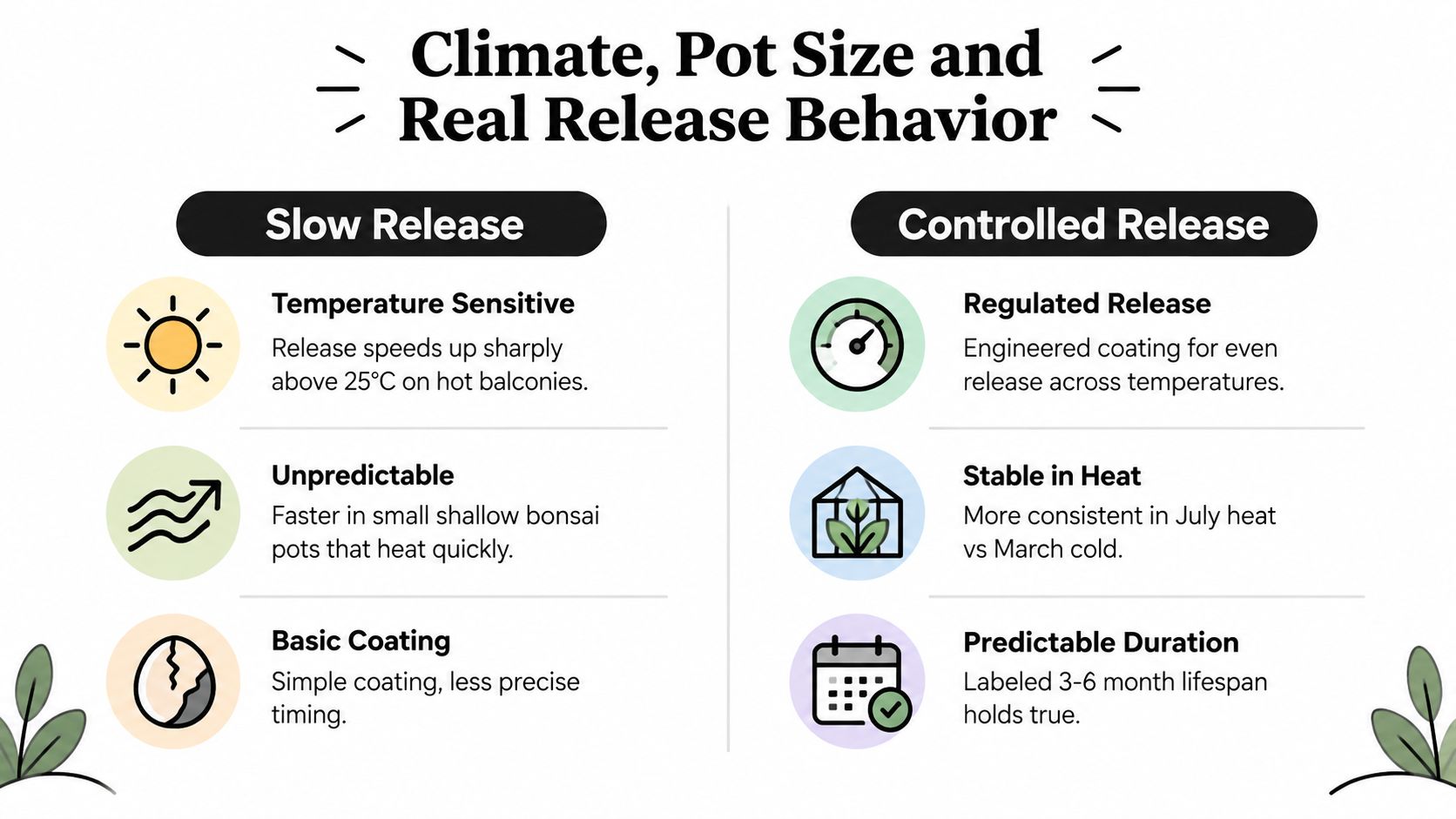
Heat and moisture change the curve
A shallow bonsai pot warms quickly because it contains little insulating soil. A dark plastic container in full sun can become much warmer than a deeper nursery container or a shaded ceramic pot. Repeated wetting keeps the coating active, while long dry periods interrupt the release process. Rapid wet-dry swings can therefore produce a different pattern from a pot that stays evenly moist.
You don't need to calculate diffusion rates to manage this. Watch the tree and the pellets together. If growth accelerates during hot weather, the product may be releasing faster. If pellets stay hard through cool conditions, don't automatically add more because the label date has arrived.
Test the product on your own bench
For a useful field check, place a small, representative sample of pellets in a mesh container or shallow tray exposed to the same watering and temperature conditions as the bonsai. Weigh the sample at the start and again after two weeks, keeping the sample dry during each weighing. Also inspect whether the surface has softened, cracked, crusted, or developed an empty shell.
The result won't give you a laboratory release curve, but it will show whether your conditions are moving the product quickly or slowly. For pot selection and root-volume context, this guide to choosing the right pot size can help you think beyond the tree's canopy. A shallow root zone deserves a smaller, more carefully observed nutrient load.
When Slow Release Is Not Enough on Its Own
Pellets are excellent at providing a baseline. They're less capable when the grower needs to change that baseline quickly. A tree recovering from stress, a branch being strengthened selectively, or a refined canopy being pushed toward shorter growth may need more precise control than a coated granule can offer.
A weak tree may respond better to a carefully diluted liquid feed applied at a measured interval, assuming the roots are healthy and the underlying problem has been addressed. Liquid feeding also gives you a way to support one phase of development without committing the whole pot to a longer release cycle. That matters when one branch is weak but the rest of the tree is already vigorous.
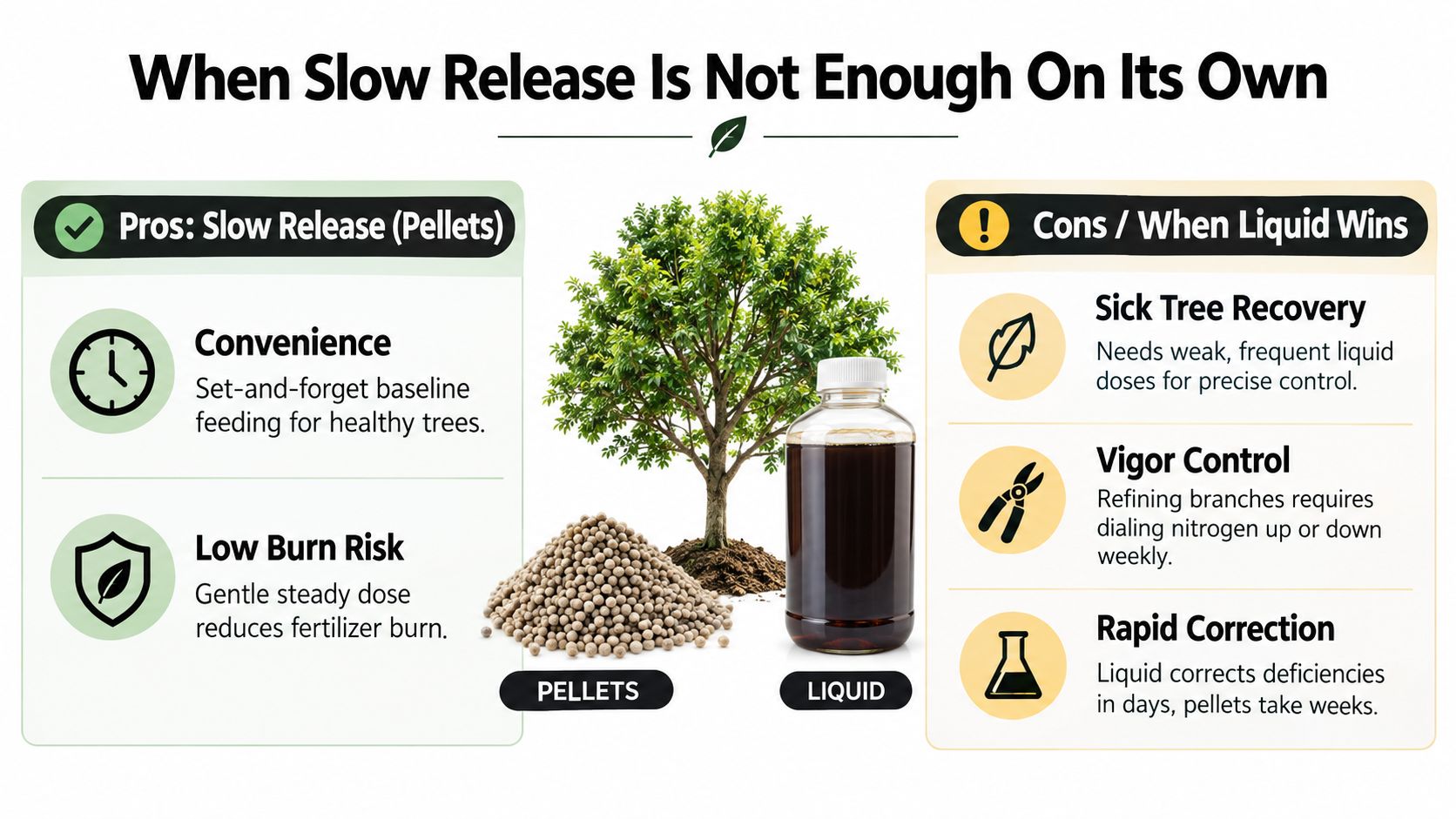
Four situations where liquid feed has an advantage
- Recovery: A stressed tree may need a cautious, adjustable approach rather than a long-lasting pellet load.
- Selective vigor: Liquid feed lets you change the strength or frequency while you monitor new growth.
- Refinement: During ramification work, the ability to reduce nitrogen promptly can matter more than convenience.
- After root work: Freshly disturbed roots can be vulnerable to concentrated fertilizer, so feeding should wait until recovery is underway.
Don't stack both systems at full strength. If pellets are already present, use a weaker liquid program and monitor growth, or pause the pellets before beginning a liquid-heavy period. After repotting, many growers choose to wait 4 to 6 weeks before resuming fertilizer, allowing the tree to rebuild functioning roots (bonsai fertilizer timing guidance).
Decision rule: Use pellets as the base load for a healthy tree. Reach for liquid fertilizer when recovery, growth control, or refinement demands a faster adjustment.
This doesn't make pellets a poor choice. It makes them one tool in a feeding system. Convenience is valuable, but bonsai design often depends on controlling vigor rather than maximizing it.
Choosing a Safe Bonsai Slow Release Product
Read the label before you read the marketing name. A reliable product should tell you its N-P-K analysis, release type, expected duration, and application instructions. The analysis describes the nutrient ratio, but it doesn't tell you how aggressively the product will release in your particular pot.
Use this buyer checklist
- Check the coating description. Resin-coated or polymer-coated granules usually signal an engineered controlled-release product. Look for information about temperature or moisture response.
- Match duration to the container. A shorter-cycle product can be easier to manage in a shallow bonsai pot than a very long-duration formulation, because you can reassess the tree during the season instead of committing nutrients far ahead.
- Avoid unexplained strength. Extremely high nitrogen can push coarse growth, especially in refined deciduous trees. A strong formula isn't automatically a better formula.
- Inspect compatibility. Pellets should sit securely on an open bonsai mix and tolerate repeated watering without instantly dissolving or washing from the surface.
- Choose for species and stage. Conifers often suit leaner feeding during refinement, while deciduous and fruiting trees may need a somewhat different balance during active growth.
A product promising a fixed duration without explaining the conditions behind that duration deserves caution. Controlled-release products are temperature-sensitive, so the label should help you understand how climate changes performance. The mechanism itself is well established, water enters the coating, dissolves the nutrient core, and nutrients diffuse outward gradually (controlled-release fertilizer review).
Three useful product types
- A moderate-duration resin-coated pellet for a healthy tree in a shallow training pot.
- A longer-duration controlled-release product for a stable tree where fewer applications matter more than seasonal adjustment.
- A mild organic pellet or cake for growers who prefer gradual biological feeding and accept less precise timing.
A fertilizer marketed only as “slow release” isn't automatically bad, but you need to know whether it relies on coating, decomposition, or both. For indoor or tropical bonsai, avoid products that leave strong-smelling organic residues if the pot stays warm and wet, especially where pests or unpleasant odors would be difficult to manage.
Leaves & Soul offers Bonsai Fertilizer Pellets, 18-6-8 Slow Release, as one product option for growers looking for a pellet-based bonsai feed. Compare its label with other products, then choose according to species, pot volume, and the growth control you need.
A Simple Slow Release Routine You Can Follow
A dependable routine starts with the pot, not the fertilizer bag. Measure the container's surface area or estimate its growing volume, then classify it as a shallow training pot, a small display pot, or a larger development container. That single step prevents the most common mistake, applying the same handful everywhere.
Four steps for the same weekend
- Measure the growing space. Note the pot size, mix type, drainage speed, and whether the roots fill the container.
- Choose the pellet grade. Select a product whose release window fits the climate and the tree's growth stage. Read the temperature conditions behind the label duration.
- Place pellets evenly. Set them in a ring away from the trunk and exposed roots. A light top dressing can help hold them in place, but leave enough access for inspection.
- Record the application. Write down the date, product, approximate amount, and current condition of the tree. Take a photograph of new growth so you can compare vigor later.
Use broad seasonal cues. Apply or refresh during the spring growth push, reassess before the hottest part of summer, and taper as autumn growth slows. In a warm climate, active growth may continue longer. In a cool greenhouse, the same pellets may remain intact for longer. Let the tree's growth and the pellets' condition guide the decision rather than automatically feeding because a month has passed.
Pair every application with one observation habit. Photograph new shoots, inspect runoff for unusual crusting, or check whether pellets are softening. If the tree looks pale and growth remains weak while pellets are intact, investigate light, roots, watering, and release conditions before adding more. If leaf edges brown, salt crust appears, or growth becomes coarse, stop feeding and review the dose.
Bench rule: Underfed trees need investigation before more fertilizer. Overfed trees need a pause, clean water, and time.
A calmer feeding system comes from matching release behavior to pot size, temperature, moisture, and seasonal purpose. Start with measured pellets, keep records, and use liquid feed only when you need control that a pellet cannot provide.
Leaves & Soul offers bonsai fertilizer pellets, liquid plant foods, purpose-built soils, and bonsai accessories for growers managing small root zones and changing seasonal needs. Visit Leaves & Soul to compare feeding options and build a more measured routine for your trees.