


You're standing in a garden center with a bag of small colored pellets in one hand and a pale Phalaenopsis on the windowsill in mind. The label promises months of feeding, but your orchid's bark is drying at a different pace, the room gets warmer near the glass, and the roots don't resemble the neat examples shown on the packaging.
That uncertainty is normal. Slow release fertilizer for orchids isn't difficult because you're careless. It's difficult because the label describes the product in general terms, while your orchid lives in a particular pot, substrate, temperature, light level, and watering routine. The practical question isn't just which pellets to buy. It's how quickly those pellets will release nutrients in your setup, where they should sit, and how you'll know whether the plant needs more, less, or none.
Why Orchid Feeding Feels Harder Than It Should
Orchid fertilizer advice often sounds simpler than orchid culture really is. “Apply every few months” seems clear until you remember that one plant may be in coarse bark, another in diatomite, and a third mounted on a slab. A bright, warm windowsill can also produce a very different release pattern from a cool room with infrequent watering.
The first mistake is treating the printed duration as a promise. A label might describe how long a product can release nutrients under specified conditions, but the pellet responds to its surroundings. Watering frequency, temperature, pot size, and substrate particle size all influence nutrient delivery. A small pot that dries rapidly may not behave like a larger pot that stays moist.
Start with the plant, not the bag
Before adding fertilizer, inspect the orchid's current condition. Healthy new roots, firm leaves, and active growth suggest that the plant can use nutrients. A recently repotted orchid with damaged roots needs stability first, not an automatic dose. A plant in cool dormancy may also need less feeding than one producing roots, leaves, canes, or flower spikes.
The substrate matters just as much. Bark gradually changes as it ages, and decomposing material can hold moisture and salts differently from fresh, open bark. Diatomite and other mineral media can also alter how fertilizer sits around the roots. The same pellet count can therefore create different results in two pots.
Practical rule: Treat the duration on the package as a starting point, then adjust it to the conditions around your orchid.
A useful routine begins with three observations: measure the pot, identify the medium, and note how quickly it dries after watering. Once you know those details, the pellet becomes part of a feeding system rather than a guess. You'll be able to choose a nutrient formula, place it safely, and check whether the plant is responding before you reapply.
What Slow Release Fertilizer Actually Is
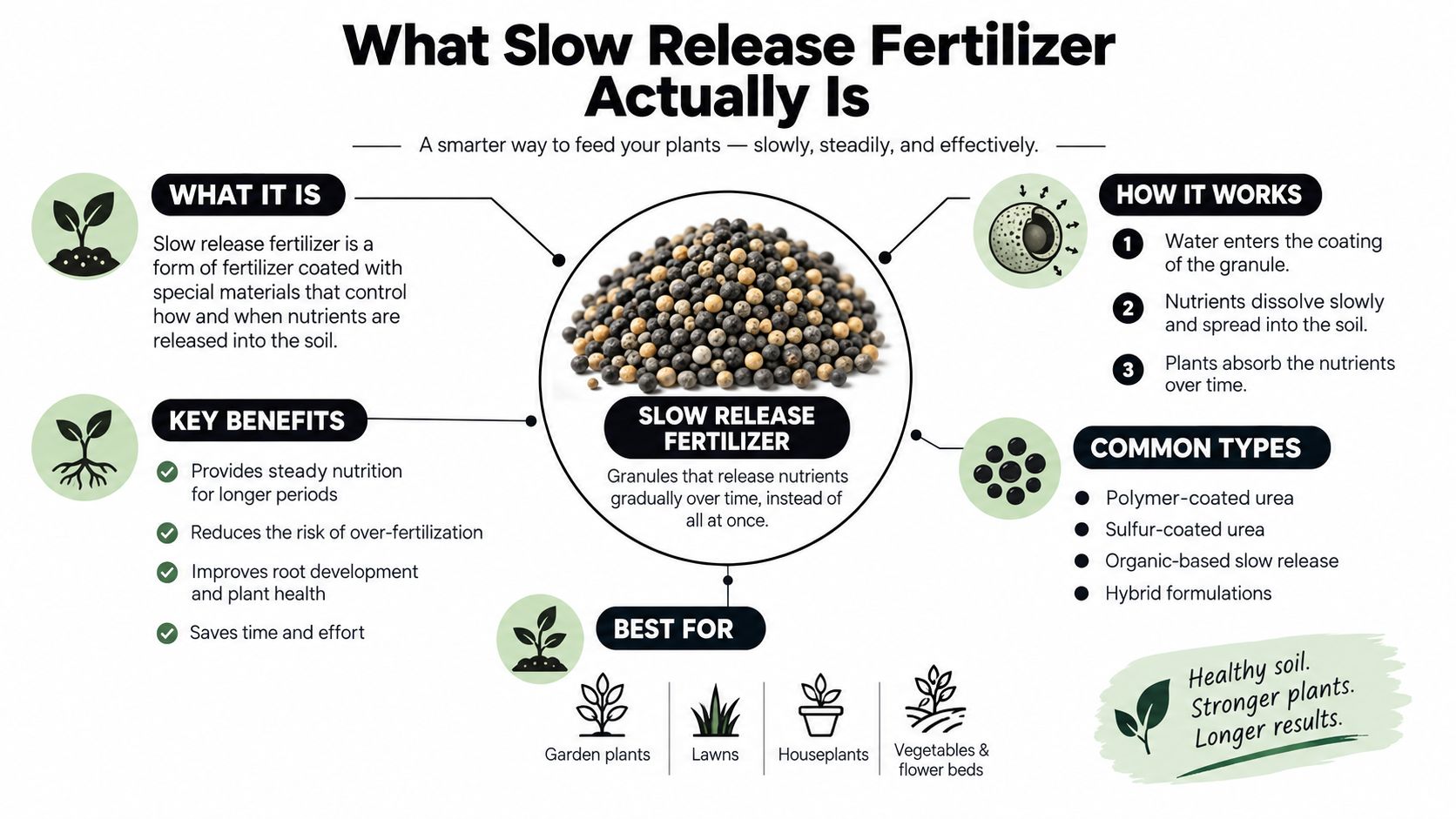
Slow-release fertilizer is a delivery system, not a nutrient formula. A coated granule contains nutrients that are released gradually as water enters the coating and dissolved nutrients move out. Polymer-coated products, including Osmocote-style pellets, are commonly designed to provide a controlled supply over an extended period.
Liquid fertilizer works differently. The nutrients are already dissolved, so they become available when you apply the solution. Slow-release pellets separate the question of what nutrients are present from how quickly those nutrients become available.
Read the two parts of the label
The N-P-K numbers describe the fertilizer's nutrient analysis. Nitrogen supports leafy and vegetative growth, phosphorus participates in several plant processes, and potassium supports overall plant function. The numbers don't tell you whether the product will last for a particular number of weeks in your orchid's pot.
The duration describes the intended release rate under the manufacturer's conditions. Warm temperatures and repeated watering can accelerate release, while cooler or drier conditions can slow it. Organic slow-release products use a different mechanism. Materials such as bone meal or feather meal depend more heavily on microbial breakdown, so their performance can vary with moisture, temperature, and biological activity in the medium.
For a general introduction to the delivery system, see this explanation of what slow-release fertilizer means. The important distinction is simple: the granule controls timing, while the analysis controls nutrient content.
Why orchid growers need a cautious approach
Orchids often grow in airy, low-volume media, and their roots can be sensitive to concentrated salts. A pellet pressed against a root or rhizome can create a local hotspot even when the total amount in the pot seems modest. That's why the best product on paper can still be the wrong choice if it's placed carelessly or used at a rate suited to a different container.
Slow Release vs Liquid Feeding for Orchids
Slow-release pellets and liquid fertilizer solve different problems. Pellets create a background supply that can help growers who forget regular feeding. Liquid fertilizer gives you immediate control, which helps when an orchid is entering active growth, recovering from stress, or approaching a period when you want to pause feeding.
Neither method removes the need to observe the roots. Pellets can release faster in warm, frequently watered conditions, while liquid fertilizer can accumulate in bark if the grower feeds repeatedly without enough plain water. A careful grower chooses the method that matches both the plant and their own habits.
| Factor | Slow Release Pellets | Liquid Fertilizer |
|---|---|---|
| Nutrient timing | Gradual delivery over an extended period | Immediate availability after application |
| Control | Less flexible once applied | Easy to dilute, pause, or adjust |
| Routine | Fewer applications | Requires a consistent feeding schedule |
| Salt management | Can create concentrated spots if misplaced | Can accumulate when applied repeatedly without flushing |
| Dormancy | Cannot be removed as easily when conditions change | Can be stopped immediately |
| Best fit | Growers who want a steady baseline | Growers who want precise seasonal control |
The trade-off in daily care
Pellets trade flexibility for consistency. Once placed in the pot, they continue releasing according to their design and environment. That can be helpful for a stable, actively growing orchid, but it's less convenient if the plant suddenly loses roots, enters cool rest, or needs a dry period.
Liquid fertilizer trades convenience for control. You can apply a diluted feed during active growth, skip it during dormancy, and use plain water when you want to leach excess salts. The method demands attention, though. If you regularly forget feeding, the plant may experience long gaps followed by an overly strong correction.
A combined approach can work well. Some growers use pellets as a baseline and add occasional diluted liquid feed from spring onward, especially for seedlings or larger plants. The key is to avoid treating both products as full doses at the same time. If you combine methods, reduce the intensity of each and watch the newest roots and leaves.
For a closer look at the more adjustable method, read this guide to liquid fertilizer for orchids.
Choosing the Right N-P-K and Pellet Type
The fertilizer analysis should match the orchid's growth pattern, not just the promise on the front of the bag. A mixed collection often benefits from a balanced formula, while a plant with a distinct seasonal cycle may need a more targeted approach. N-P-K is a starting framework, not a substitute for observing growth.
A balanced formula can suit many orchids because it avoids pushing one nutrient too aggressively. High-nitrogen products may encourage leaves and canes, but excessive vegetative growth can become unhelpful when the plant should be preparing for flowering. A bloom-oriented formula may have a place near spike initiation, but it isn't a permanent replacement for balanced nutrition.
Look beyond the three numbers
Orchids also use calcium, magnesium, and trace elements. Bark-based media may not provide a dependable supply of every nutrient, especially as the mix ages or watering removes dissolved minerals. Check the full analysis rather than choosing by N-P-K alone.
Controlled-release fertilizer has been tested in orchid production. A 2025 study of Cymbidium ensifolium ‘Dongfang Honghe’ used Osmocote No. 601, with an analysis of 10%-11%-18%, plus 2% MgO and trace elements, and applied it every 150–180 days. The treatment using 20 grains significantly improved seedling height, leaf number, root parameters, total leaf nitrogen, and total phosphorus compared with the other treatments, as reported in the Cymbidium ensifolium study.
That result supports a multi-month feeding cycle, but it doesn't mean every orchid pot should receive the same number of grains. The study used a specific orchid, product, substrate system, and treatment design. Your Phalaenopsis in bark may need a gentler application than a vigorously growing Cymbidium in a larger container.
Choose duration with real conditions in mind
A regional orchid-society guide reports that slow-release products may last only 50%–60% of their label duration in its conditions and recommends 9-month formulations for orchids. It also describes an 8–9 month product applied in spring as supplying nutrients for roughly the following 5 months, depending on the growing setup. The guidance includes a level teaspoon for orchids in 7–15 mm diatomite in 100 mm pots, while a 200 mm pot with larger diatomite may require a heaped tablespoon. These benchmarks appear in the orchid fertilizer guidance document.
| Orchid and stage | Recommended N-P-K | Pellet longevity | Notes |
|---|---|---|---|
| Phalaenopsis, active leaf and root growth | Balanced or moderately balanced | Choose a longer-duration product cautiously | Use small amounts in airy bark and keep pellets away from roots |
| Cattleya, developing new leads | Balanced formula | Moderate duration can suit active growth | Coarse bark may dry quickly, so inspect before reapplying |
| Dendrobium nobile, firming canes | Lower nitrogen emphasis | Longer duration may reduce repeated feeding | Avoid encouraging soft, late leafy growth |
| Cymbidium, active seasonal growth | Balanced formula with magnesium and trace elements | Multi-month cycles are supported by controlled-release research | Match dose to pot volume and substrate |
Watch this orchid fertilizer application video for a visual demonstration of placement and handling.
How to Apply Slow Release Fertilizer Step by Step
Application should begin with the root system, not the measuring spoon. A large pot with a small root mass doesn't automatically need a large dose. Conversely, a vigorous orchid filling a larger container may require a different distribution pattern because the pellets occupy a greater volume of media.
1. Identify the active root zone
Look for firm roots and fresh tips. Place fertilizer where moisture reaches the active root zone, but don't press granules against the crown, rhizome, or emerging roots. Surface placement is often safer because you can see the pellets, remove them if conditions change, and avoid burying a concentrated pocket deep in the pot.
Some growers lightly bury pellets about 1–2 cm into the medium, but the safest depth depends on the pot and substrate. In a small bark mix, surface placement may be more practical. In a larger mineral medium, shallow distribution can prevent one dense cluster from sitting beside a root.
2. Measure conservatively
The study on Cymbidium used 20 grains of its selected product and found significant growth improvements under its tested conditions. That's useful evidence, but it shouldn't be copied blindly into every orchid collection. Product size, nutrient analysis, pot volume, and root mass all change the meaning of a “grain.”
Use the product's orchid or container-plant directions as the upper boundary, then start below that boundary when the plant is new to slow-release feeding. Spread pellets across the surface rather than forming a pile. Don't mix different pellet types in the same pot, and don't add a new batch just because the old pellets look less colorful. If you can't tell whether the previous dose remains active, wait and observe rather than stacking applications.
For practical handling guidance, see how to use slow-release plant food.
3. Match application to the season
Spring root and leaf growth is usually the easiest time to begin, provided the orchid is actively growing. Summer applications may release faster in warm conditions, so inspect the pot before adding anything. In autumn, avoid using nitrogen-heavy products if the plant is moving toward a natural rest or spike-development period.
During cool dormancy, pause feeding when the plant isn't producing roots or new growth. Pellets already in the pot can't be switched off as easily as liquid fertilizer, which is another reason to use modest amounts and avoid automatic redosing.
Water after placement, but don't drench the pot repeatedly just to activate the coating. Resume the orchid's normal watering pattern and check for salt residue, root-tip changes, or leaf damage during the following weeks.
Reading the Signs of Overfeeding or Underfeeding
The calendar can mislead you. A pellet may still be releasing nutrients when the label date says you should reapply, or it may have released much faster than expected in a hot, frequently watered setup. The orchid itself provides better evidence than a rigid schedule.
Signs that point toward excess
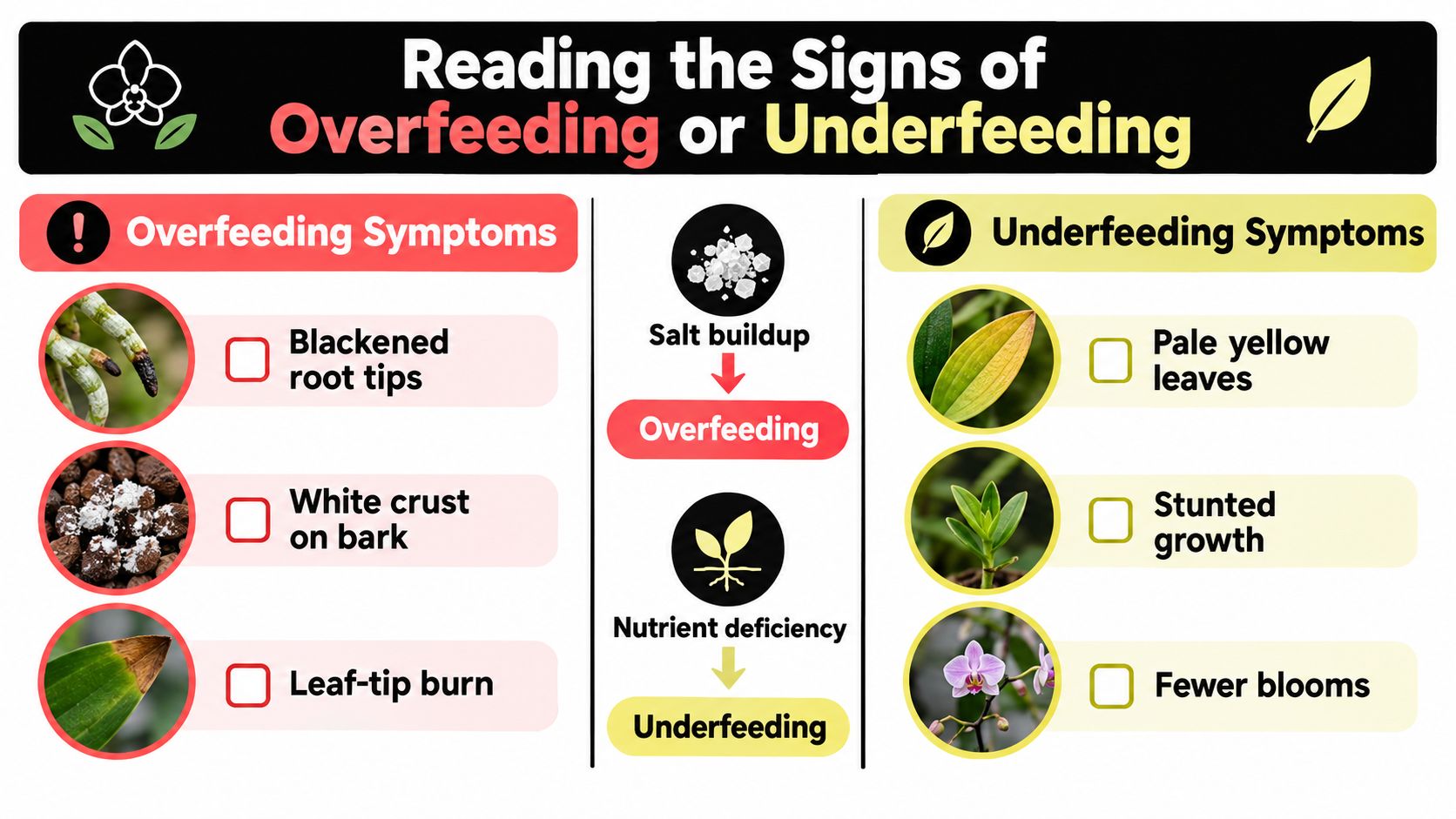
Blackened root tips, a white crust on bark, and brown leaf tips can indicate salt buildup or root stress. A pellet sitting against a root can create a localized concentration even when the overall dose seems small. If the growing area becomes hot, some growers worry that Osmocote-type pellets can release too quickly above roughly 85°F, a concern discussed in this orchid fertilizer safety discussion.
When you see these signs, don't add a corrective fertilizer. Remove visible pellets if practical, inspect the roots, and flush the medium thoroughly with plain water. If the potting mix is old, compacted, or smells sour, repotting may matter more than changing brands.
Pale leaves don't automatically mean more nitrogen
Underfeeding can show up as pale leaves, stalled new growth, fewer blooms, or weak spikes. But pale foliage may also reflect low light, damaged roots, or stale media that no longer manages water well. Adding nitrogen before checking those conditions can worsen the problem.
Use a short diagnostic routine:
- Lift the pot: A sudden change in weight tells you more about watering rhythm than the calendar does.
- Smell the medium: Sour or stagnant odors suggest poor aeration or decomposition.
- Inspect new roots: Firm, active tips are more encouraging than old, damaged roots.
- Check the light: A plant that lacks adequate light may not use added fertilizer effectively.
- Look for residue: White deposits on bark support a salt-management problem rather than a simple nutrient shortage.
Before you feed: Ask whether the orchid is growing, whether the roots can use the nutrients, and whether the medium can drain them safely.
Best Picks by Orchid Variety
A Phalaenopsis in a small bark pot can dry differently from a Cattleya in coarse media. Dendrobium nobile types also change needs after their canes mature, while Cymbidiums may sustain a longer growth cycle. These differences affect more than the N-P-K label. Pot size, substrate, drainage, and root health all influence how quickly pellets release nutrients and how long those nutrients remain around the roots.
Use the table as a starting guide, not a fixed schedule. Match the product's analysis and granule size to the recommendation, then adjust when the plant, pot, or medium changes.
| Orchid type | Recommended N-P-K | Dose per pot | Replacement interval |
|---|---|---|---|
| Phalaenopsis in bark | 13-11-11 | Quarter teaspoon per pot | Refresh every 4 months during active growth |
| Cattleya in coarse bark | 14-14-14 | Half teaspoon per pot | Replace every 3 months while new leads mature |
| Dendrobium nobile types | 7-14-14 | Quarter teaspoon per pot | Use after canes firm, then reassess with seasonal growth |
| Cymbidium in larger pots | 15-15-15 | One teaspoon per pot | Top up every 5 months through summer |
Make the choice fit the medium
Phalaenopsis often needs restraint because a small indoor pot offers little room for uneven nutrient distribution. A pellet that seems mild in a large, airy container can create a concentrated area beside roots in a compact pot. Bark that dries quickly may shorten the practical release period, but rapid drainage does not make a heavy dose safe.
Cattleya's coarse bark can move water and nutrients through the pot quickly, so observe new leads and root activity rather than treating the replacement interval as automatic. For Dendrobium nobile types, the shift from cane growth to rest matters. Continued high nitrogen after the canes firm may encourage growth when the plant is entering a quieter phase, making the lower-nitrogen formula more suitable for the stated timing.
Cymbidiums require a separate approach. Controlled-release research on Cymbidium ensifolium supports nutrient delivery over a multi-month cycle when the product, dose, substrate, and growing conditions are coordinated. That finding does not make one formula right for every Cymbidium. It does show why pot volume and medium must be considered alongside the label.
Leaves & Soul offers 13-11-11 slow-release orchid fertilizer pellets for growers considering the Phalaenopsis-style analysis above. Compare the analysis with the orchid's pot size, substrate, and current growth before applying any product. A label interval describes expected release conditions, not a guarantee for every orchid collection.
Your Orchid Feeding Routine Going Forward
A dependable routine begins with the whole growing system. Inspect each pot monthly, record whether the orchid is producing roots or new growth, and examine the pellets before replacing them. Note the product, application date, pot size, substrate, and visible changes in leaves or roots. These details connect the label's expected release period with what happens in your collection. A small pot or fast-drying medium can make the practical duration different from the printed interval.
Flush with plain water every third watering, while considering drainage and the orchid's condition. This helps carry away salts when release speeds up or residue gathers in the substrate. Treat the interval as a guide, not a rule for a stressed plant. Flush more thoroughly if you see residue or damaged root tips, and pause fertilizer while you investigate.
Take one photograph of new growth each season. Comparing images makes changes in root activity, leaf color, and spike development easier to judge. It can also separate a naturally slow orchid from one that has stopped progressing.
Choose one orchid today. Identify its variety, measure the pot diameter, check the substrate, and match those details to the table. Set a phone reminder for the first inspection and possible replacement date, rather than only for feeding. The plant's response should determine the next decision.
Leaves & Soul carries orchid nutrients, including slow-release pellets, along with soils and amendments for indoor and outdoor plants. Visit Leaves & Soul to compare the orchid formula with your pot size, substrate, and routine before the next application.