


If you're tired of keeping a mental note of the last time you fertilized, you're not alone. A lot of plant owners start with liquid feed, miss a week, overcorrect the next, and then wonder why one pothos is racing ahead while the bonsai beside it looks stalled.
That's why so many growers turn to slow release fertilizer pellets. They simplify feeding. You add them to the pot, water as usual, and let the fertilizer release gradually instead of arriving all at once. For busy households, that can feel like a huge relief.
But there's a catch that indoor gardeners run into all the time. A pellet in a garden bed and a pellet in a tiny ceramic bonsai pot are not living the same life. A warm windowsill, a black nursery pot, a shelf under grow lights, or a balcony that heats up by noon can all change how those pellets behave. So yes, pellets can reduce the work. They just work best when you understand the little climate inside your pot.
The Simple Solution to Constant Fertilizing
You water the plants on Saturday morning. The pothos on the bookshelf looks fine. The bonsai on the warm windowsill looks thirsty again. The peperomia under the grow light is putting on new leaves faster than anything else in the room. If all three rely on your memory for liquid feeding, it is easy for one to get too little, another to get too much, and none to get a very consistent routine.
Slow release fertilizer pellets make that rhythm easier to manage because they turn feeding from a weekly task into a slower, steadier background process. You add them to the potting mix or soil surface, water as usual, and the plant gets access to nutrients over time instead of in one quick splash. If you want a clearer beginner overview of what slow release fertilizer is, that foundation helps before you start choosing formulas.
The advantage indoors is predictability, but only if you judge the pellet by the conditions in the pot, not the promise on the label. A package may say it feeds for several weeks. In a cool room, that estimate may feel accurate. In a shallow bonsai pot on a bright windowsill, the same pellets can act like they are on a faster clock because the root zone warms up and dries out more often.
That is why pellets feel simpler than liquid feed without being completely hands-off. They reduce the number of decisions you have to make, and they smooth out the feast-or-famine cycle that happens when fertilizing depends on memory alone.
Why pellets feel easier
Here's the practical appeal:
- Fewer repeat tasks because you are not mixing fertilizer every week
- More even feeding because roots meet nutrients gradually
- Better consistency between waterings because the pot has a baseline nutrient supply
For hobby growers, that often means fewer dramatic swings in growth. A plant in a container has limited soil to draw from, so steadier access usually works better than alternating between “nothing for two weeks” and “extra to catch up.”
One simple rule helps: treat pellets as a baseline feeding system, then adjust for the pot's microclimate.
That matters a lot indoors. A terracotta herb pot near afternoon sun may run warmer and release faster than a plastic pot in the same room. A shelf under grow lights can stay warm for long stretches, which can shorten the release window compared with a cooler north-facing corner. An orchid in chunky bark and a tropical foliage plant in dense potting mix also hold moisture differently, so the pellets are not operating in the same environment even if the label is identical.
So the simple solution is not just using pellets. It is using pellets with an eye on where the pot lives, how quickly it dries, and whether that setup is likely to make the release behave slower, faster, or close to plan.
How Slow Release Pellets Actually Feed Your Plants
Each slow-release pellet holds water-soluble nutrients inside a semi-permeable coating. Once you water the pot, moisture moves into the pellet, dissolves those nutrients, and lets them pass back out in small amounts over time.
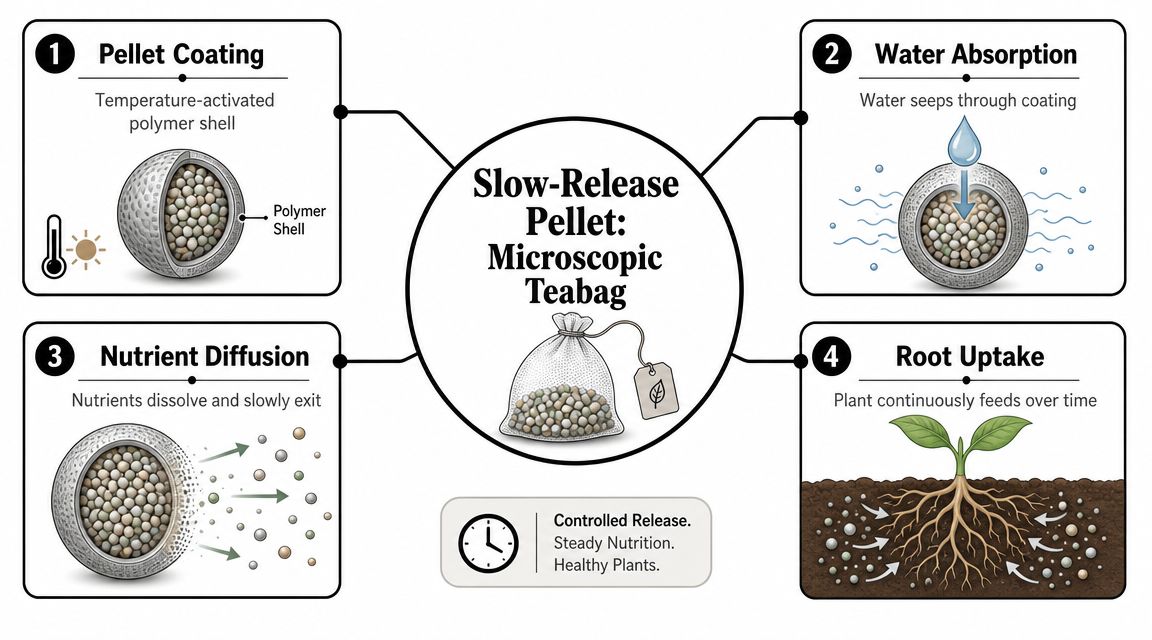
The key idea is simple. Release is shaped by the conditions around the pellet, not just by the label on the bag.
If you are new to the category, Leaves & Soul has a clear primer on what slow-release fertilizer is.
What happens inside the pellet
Water enters first. The nutrients inside dissolve into a concentrated solution. Then that solution diffuses outward through the coating and into the surrounding potting mix, where roots can absorb it.
That process sounds tidy on paper, but indoor containers rarely behave like a laboratory. A bonsai pot on a bright windowsill may heat up by midday and cool off again at night. A nursery pot tucked under grow lights may stay warm for long stretches. A cachepot with dense mix may hold moisture longer than a shallow terracotta pot, even if both sit in the same room.
So while people often hear a generic warning about temperature, the more useful question is this: what kind of little climate does your specific pot create?
Why indoor pots can change the release rate
In the ground, soil conditions shift slowly. In containers, especially small ones, the root zone can swing fast. That is why pellets often feel more predictable outdoors than they do in indoor hobby setups.
A few common examples show why:
- Shallow bonsai pots heat and dry quickly, so pellets may cycle through warm, moist conditions and release faster than expected.
- Sunny windowsills can warm the potting mix much more than the room temperature suggests.
- Grow light shelves often keep both leaves and containers warmer for longer parts of the day.
- Plastic pots inside decorative covers may stay moist longer, which changes how long the pellet stays active after watering.
This is the part many guides skip. Two growers can use the same pellet at the same dose and still get different results because the pellets are responding to different microclimates.
What the roots notice
Your plant only responds to the nutrients that reach the root zone in that pot, under those conditions.
If the container stays cool and dries at a moderate pace, the release often feels steady and easy to live with. If the container runs warm and stays wet, the same pellet can move through its supply much sooner than the package timing led you to expect.
For hobby growers, that is useful news, not bad news. It means you can improve predictability by watching the setup, not by guessing. Check how warm the pot gets by afternoon. Notice whether the mix stays damp for days or dries quickly. Keep in mind that a jade under LEDs, a fern in a bathroom, and a bonsai in a shallow ceramic pot are not giving pellets the same working conditions.
That is how slow-release feeding becomes easier to manage indoors. You stop treating the pellets as a fixed timer and start treating them as a controlled drip that speeds up or slows down with the pot's own small climate.
Decoding Pellet Formulas and NPK Ratios
The front of a fertilizer label can look more mysterious than it really is. Once you understand the three big numbers, the bag starts speaking plain English.
NPK stands for nitrogen, phosphorus, and potassium. Those are the primary macronutrients plants use in the largest amounts.
What the numbers actually mean
Think of them this way:
- Nitrogen supports leafy, green growth.
- Phosphorus supports roots and helps with flowering and energy transfer.
- Potassium supports overall vigor and stress handling.
If you're feeding a foliage-focused plant, a formula with stronger nitrogen often makes sense. If you're caring for a broad mix of houseplants, a more balanced formula can be easier to live with.
Leaves & Soul, for example, carries an 18-6-8 slow-release bonsai pellet and a 16-5-11 pellet for fiddle leaf figs and general houseplants. Those numbers tell you the bonsai formula leans harder into nitrogen for active vegetative growth, while the houseplant formula stays broader and more general. If fertilizer numbers still feel cryptic, their article on plant fertilizer numbers is a useful companion.
The number many shoppers miss
Most home gardeners stop at NPK. That's understandable, but with slow release products there's another quality clue worth knowing. You want to know how much of the nitrogen is in slow- or controlled-release form.
According to industry guidance on slow-release nitrogen percentage, slow- or controlled-release nitrogen should make up more than 40% of total nitrogen in a blend to deliver the intended longevity benefit. Guidance in that same source says 40–50% or more is preferable when the goal is extended nutrition.
That's important because two products can have similar NPK numbers but behave differently over time. One may feed steadily. Another may include only a small amount of slow-release nitrogen and run out of momentum sooner.
A practical way to read the label
When you compare pellet products, use this sequence:
- Start with plant goal. Are you feeding foliage, roots, flowers, or general maintenance?
- Read the NPK. Make sure the ratio fits that goal.
- Check release quality. Look for evidence that a meaningful share of the nitrogen is slow or controlled release.
- Match it to the pot environment. A strong formula in a hot, wet setup may act stronger than expected.
A good pellet formula isn't just about what nutrients are inside. It's also about how much of that nutrition is built to arrive gradually.
That mindset helps you choose more intelligently than just grabbing the highest first number on the package.
Pellets Versus Liquid Feeds A Gardener's Choice
You fertilize on Sunday, the plant looks happy by Wednesday, and two weeks later you are trying to remember whether that windowsill pothos got fed at all. Indoor growing often works like that. Each pot lives in its own little climate, and that is why the pellet-versus-liquid choice is less about preference and more about predictability.
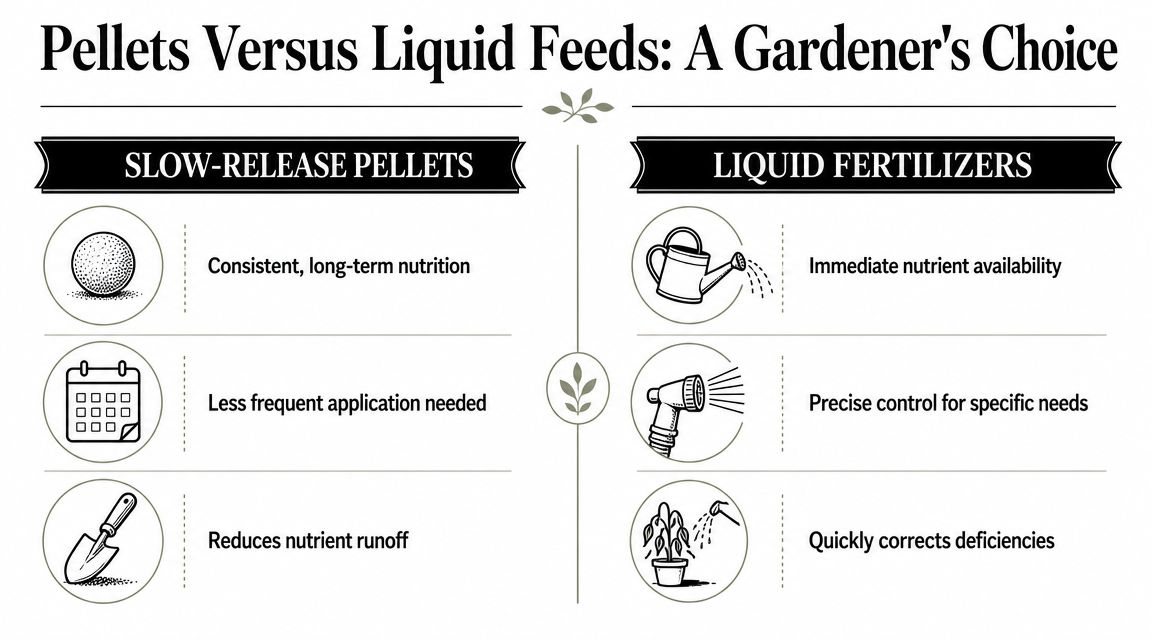
Pellets are useful when you want a steady baseline. Liquids are useful when you want to steer more actively. A good gardener often uses both, but for different jobs.
Where pellets make indoor care easier
Slow release pellets work like a timed pantry in the pot. With each watering cycle, the plant gets small portions instead of one big meal. In indoor containers, that matters because hobbyists are usually not dealing with a uniform garden bed. They are dealing with a bonsai pot that dries by noon, a ceramic cachepot that stays damp longer, or a shelf under grow lights that stays warmer than the rest of the room.
That steady pattern makes pellets a strong fit for:
- Established houseplants that need regular background feeding
- Busy routines where weekly mixing is easy to skip
- Plant collections where keeping every pot on a liquid schedule gets tiring
- Containers with predictable care habits, especially if watering is fairly consistent
Pellets are often easier to manage in indoor setups because you can match them to the pot's rhythm. A warm bonsai tray under lights may release faster than the same pellets in a cool bedroom pot, but once you learn that pattern, feeding becomes more repeatable. For many growers, that is the main advantage.
If you want that kind of low-maintenance baseline for common houseplants, houseplant fertilizer pellets for fiddle leaf figs and indoor pots can make the schedule easier to keep.
Where liquid feeds still earn their place
Liquid fertilizer gives you more immediate control. You mix a dose, apply it, and adjust again the next time if the plant, season, or watering pattern changes.
That makes liquids helpful when:
- A plant needs a quick response
- You prefer small, frequent adjustments
- The root zone is tiny or sensitive, as with some orchids and recently rooted cuttings
- Your indoor conditions swing a lot, such as a windowsill that runs cool one week and hot the next
A liquid feed is a bit like turning a faucet. You can open it a little, pause it, or change the timing fast. Pellets are closer to setting a drip line. Less work day to day, but less flexibility once they are in the pot.
A side by side view
| Feeding style | Best use | Tradeoff |
|---|---|---|
| Slow release pellets | Ongoing, lower-maintenance nutrition | Less control after application |
| Liquid fertilizer | Quick adjustments and flexible scheduling | Requires regular attention |
For indoor gardeners, the practical question is usually this: do you want to manage feeding every week, or do you want to manage the pot environment so feeding stays more predictable?
That is why many hobbyists settle on a simple split approach. Pellets handle the routine feeding for stable container plants. Liquid fertilizer stays available for course corrections, seasonal shifts, or a plant that is growing in a very changeable spot. In a house full of microclimates, that combination gives you both consistency and control.
Your Plant Specific Application Guide
Using pellets gets easier once you stop asking, “How much fertilizer does a plant need?” and start asking, “What kind of pot, root system, and watering pattern am I working with?” A bonsai in a shallow tray won't be managed the same way as a fiddle leaf fig in a living room floor pot.
Start with placement, not just amount
Before looking at plant type, get the placement right:
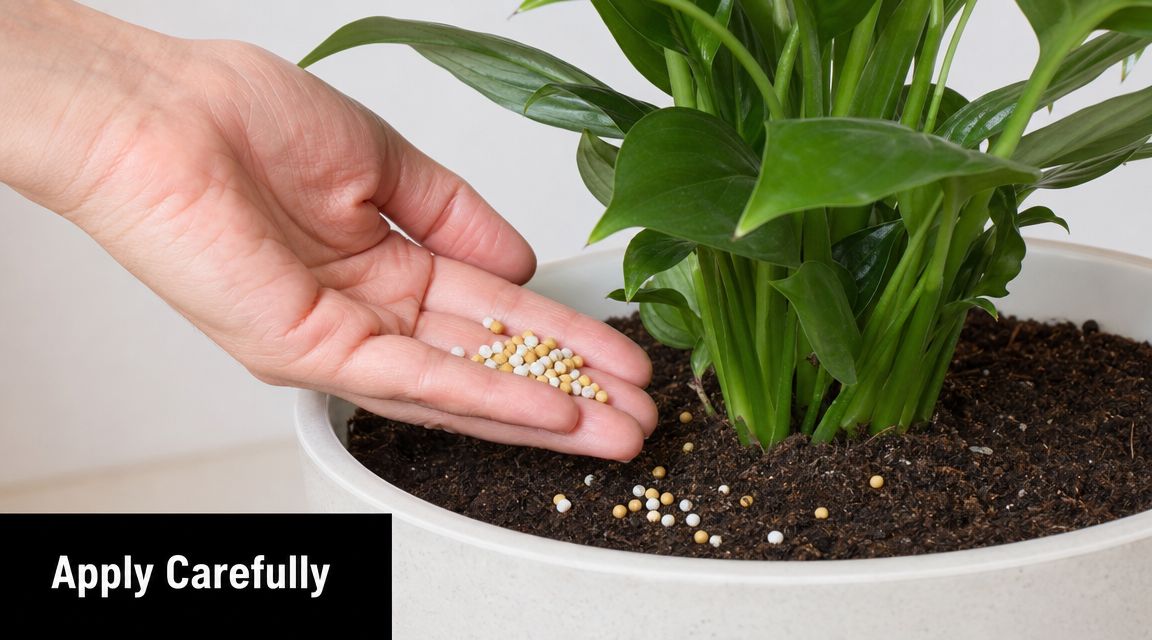
- Top-dress the soil surface when you want easier monitoring and removal.
- Keep pellets away from the stem or trunk so nutrients aren't concentrated right at the crown.
- Water normally after application so the pellets can begin working.
- Avoid burying pellets deep in tiny pots unless the product directions specifically call for mixing in.
For many indoor growers, surface application is the friendliest method because you can see what's happening and adjust if needed.
Here's a quick-reference table you can bookmark.
Slow-Release Pellet Application Rates
| Plant Type | Application Rate (per 6-inch pot) | Frequency | Notes |
|---|---|---|---|
| Bonsai | Follow product label directions | Reapply based on label and growing conditions | Small pots heat up quickly, so monitor closely |
| Houseplants | Follow product label directions | Reapply during active growth as directed | Good fit for steady maintenance feeding |
| Succulents and cacti | Use a lighter hand and follow product directions | Feed conservatively during active growth | Fast-draining mixes and bright heat can change release behavior |
| Orchids | Follow orchid-specific product directions if using pellets | Reapply cautiously | Bark-based setups dry unevenly, so watch performance rather than assuming uniform release |
Bonsai
Bonsai growers benefit from pellets because shallow containers leave little margin for forgotten feedings. The root zone is compact, watering is frequent, and growth can stall quickly if nutrition disappears.
With bonsai, I'd prioritize observation over routine. If the pot sits outdoors or on a hot balcony, pellets may move faster than expected. Keep them spaced across the soil surface rather than clustered in one spot. The classic mistake is assuming a tiny pot needs no monitoring because the fertilizer is “slow.”
Houseplants including fiddle leaf figs
For foliage plants, pellets are a practical maintenance tool. They're especially helpful when you want your feeding routine to be more consistent from month to month.
If you're shopping for a houseplant-specific option, Leaves & Soul's Fiddle Leaf Fig and House Plant Fertilizer Pellets are one example of a pellet product designed for that category. Use the package directions, then let the plant's environment guide your follow-up. A cooler room may stretch the feeding window. A bright, warm window may shorten it.
A short demonstration can help if you've never top-dressed pellets before:
Succulents and cacti
These plants confuse people because they're often described as light feeders, and that's broadly true. But “light feeder” doesn't mean “never feed.” It means go gently and respect the plant's slower rhythm.
Use fewer pellets than you would for a thirsty tropical of the same pot size, and avoid piling them into one hot corner of a terra-cotta pot that sits in direct sun. Succulent mixes drain quickly, and bright conditions can make release less even than people expect.
Orchids
Orchids deserve caution, not fear. Their potting media often behaves differently from standard soil, and water doesn't always move through bark mixes in a uniform way. That means pellets can work, but the setup needs more attention.
Place pellets where you can inspect them. Watch root color, leaf firmness, and overall growth. If you prefer highly adjustable feeding, you may decide liquid feed suits orchids better. If you use pellets, think of them as a modest baseline rather than a heavy feeding program.
Watch the pot, not just the plant label. Pot size, material, sun exposure, and watering style often matter as much as the plant category.
Troubleshooting When Pellets Go Wrong
You top-dress a plant on Saturday, water as usual all week, and by the next weekend the leaves look worse, not better. That can feel confusing because pellets are supposed to be the low-maintenance option. Indoors, though, a pellet does not live in a generic “room temperature” setting. It lives in one very specific little climate. A shallow bonsai pot on a sunny sill behaves differently from a plastic nursery pot under grow lights, even if both are in the same home.
That small-scale predictability is what matters. Pellets respond to the conditions around the root zone, so the pot setup often explains problems more clearly than the label on the package.
A useful reference point comes from this IFAS publication on controlled-release performance in containers, which explains that heat and moisture can speed nutrient release in container growing. For indoor growers, the practical lesson is simple. Warm roots plus frequent watering usually speed things up. Cool media plus lighter watering usually slow things down.
When release runs too fast
Fast release often shows up in compact indoor setups that heat up more than you expect. A dark pot in a bright window, a plant close to a radiator, or a container sitting under strong grow lights can create a warmer root zone than the room itself suggests. Add frequent watering, and the pellets may empty their nutrient supply sooner than planned.
Common clues include:
- Brown leaf edges or tips soon after feeding
- Stress that looks like watering trouble, even when your routine has not changed
- White crust on the soil surface or pot rim
- A plant that fades quickly during warm, bright conditions
If that sounds familiar, pause before adding more fertilizer. Remove any visible pellets from the surface. If the plant and potting mix tolerate flushing, run plain water through the pot to wash out some accumulated salts. Then look at the setup like a gardener and a detective. Is the pot black or very small? Is one side of the container heating up every afternoon? Is the plant under lights for long hours? Those details often matter more than people expect.
Bonsai growers run into this often because bonsai containers are shallow and exposed. The root zone can warm and dry fast, then get watered again, which creates a quicker feed cycle than the pellet label may suggest.
When release seems too slow
Slow release can be just as frustrating. You apply pellets, wait, and see almost no change. In many indoor spaces, this happens during cooler months, in dim corners, or in pots that stay on the dry side.
Check the basics before you blame the fertilizer:
- Is the plant actively growing right now?
- Is the light level strong enough to support new growth?
- Are the roots healthy enough to take up nutrients?
- Are the pellets sitting in a cool, fairly dry mix?
A pellet in a cool windowsill pot behaves a bit like a teabag in lukewarm water. The contents do not move out at the same pace. Under grow lights, the opposite can happen. The leaves may sit in an air-conditioned room while the top of the pot warms under the fixture, which changes release speed in a way the room thermostat does not reveal.
How to inspect a pellet
A quick hands-on check can save a lot of guessing. Pick one pellet from the soil surface and press it gently.
- Mushy or hollow pellets often mean much of the nutrient charge has already been released.
- Firm pellets may still contain fertilizer, or they may have had only limited exposure to the heat and moisture needed for faster release.
- Pellets that vanish much sooner than expected usually point to a warmer, wetter pot environment.
Pellets do not fail on their own. Usually, the pot's environment reveals the true cause of the problem.
That is good news for indoor gardeners. It means you can adjust the conditions instead of treating the product like a mystery. Use fewer pellets in hot windows, spread them more evenly across the soil surface, shorten grow-light intensity if the pot is overheating, or switch to a pot material that stays cooler. In small containers, especially bonsai pots and crowded windowsill planters, those changes can make feeding much more predictable.
Your Leaves and Soul Fertilizer Questions Answered
Are pellets safe around pets and children
Store any fertilizer where pets and children can't reach it. Pellets may look harmless, but they're still garden inputs and shouldn't be treated like décor. If you top-dress the soil, avoid leaving loose pellets scattered around the potting area.
Can I use bonsai pellets on other houseplants
Sometimes yes, but that doesn't mean it's always the right match. A bonsai-focused formula may be useful for another foliage plant, yet the plant's growth habits, pot size, and environment still matter. Check the NPK, consider the plant's needs, and use the product directions as your baseline.
What's the best way to store an open bag
Keep pellets sealed, dry, and out of direct heat. A cool cupboard, closed bin, or shelf away from moisture is usually a sensible choice. The main goal is to prevent humidity from affecting the product before you use it.
Do pellets expire
Fertilizer products can lose practicality if they absorb moisture, clump, or degrade in storage, so don't treat an opened package as immortal. If pellets have changed texture, smell unusual, or no longer resemble the original product, be cautious. The package directions are the best guide for storage life.
Can I add liquid fertilizer on top of pellets
You can, but do it deliberately. Pellets already provide background nutrition, so piling on liquid feed without a reason can create more stress than benefit. If you combine methods, use liquid fertilizer for a clear purpose such as a temporary adjustment, not as a reflex.
Why didn't my plant respond after I added pellets
A fertilizer can only support growth that the plant is ready to make. If light is weak, roots are unhealthy, the plant is dormant, or watering is off, you may not see much change. Feeding works best when the rest of the care setup supports growth too.
If you want a simpler feeding routine for bonsai, houseplants, succulents, or orchids, take a look at Leaves & Soul. The shop carries purpose-built soils, fertilizers, and accessories for indoor and outdoor growers who want clearer choices and fewer care mistakes.