


In a University of California evaluation summarized in Purdue University's organic-fertilizer guide, a surface-applied organic fertilizer released 31.5% of its nitrogen over 48 days, while incorporating the same product into soil increased release to 86.0%. The fertilizer hadn't changed. Its placement had.
That's the central challenge with slow release organic fertilizer for vegetables: supplying enough nitrogen isn't just a matter of choosing a bag with the right analysis. You also have to arrange for that nitrogen to become available while your crop can use it. A fertilizer can contain plenty of nitrogen and still leave a rapidly growing vegetable short.
How Much Nitrogen Reaches Vegetables and When
Organic fertilizers generally contain nutrients in larger, less-soluble compounds rather than supplying everything in immediately available form. That makes them useful for a planned feeding program, but it doesn't make every organic granule a predictable, season-long nutrient source.
The University of California evaluation illustrates how much formulation and placement can change release. The following figures are shares of each product's total nitrogen, not percentages of the fertilizer's weight.
Nitrogen released by placement in a University of California evaluation
| Product and placement | Released in first week | Released over 48 days |
|---|---|---|
| 4-4-2 organic fertilizer, surface | 24.1% | 36.1% |
| 4-4-2 organic fertilizer, incorporated | 30.3% | 54.0% |
| 12-0-0 product, surface | 12.8% | 31.5% |
| 12-0-0 product, incorporated | 30.7% | 86.0% |
Read across each row to compare early release with release over the longer evaluation period. Then compare the surface and incorporated treatments for the same product. Incorporation improved nitrogen release in both products, but the size of the response differed.
Don't read these figures as a promise for another brand or another garden. They describe the evaluated materials under the evaluation's conditions. They demonstrate why a label analysis alone can't predict how quickly a vegetable will receive nitrogen.
Release isn't the same as crop supply
Even when a fertilizer releases nitrogen, the amount may not match what a crop needs at that moment. A small transplant and a vigorously growing vegetable have different demands, while the fertilizer follows a release pattern governed by its ingredients and surroundings.
Nor should you assume that gradual release means an even daily supply. Organic products can provide a relatively brisk initial release followed by a slower period. A long-season crop may therefore need a supplemental feeding even when granules remain visible in the bed.
Practical rule: Treat preplant organic fertilizer as the beginning of a nutrient program, not proof that the entire season is covered.
For an unplanted bed, spread the calculated amount evenly and incorporate it into the intended rooting area when the product directions permit. Don't leave a concentrated pile where a transplant's roots will sit. In an established planting, move mulch aside and use a shallow side-dressing rather than digging through roots.
The useful question isn't whether the fertilizer has disappeared. It's whether available nitrogen and crop demand coincide. Plan a crop check during vigorous growth, with a supplemental application available if testing indicates a shortfall.
What Controls How Fast Organic Nutrients Release
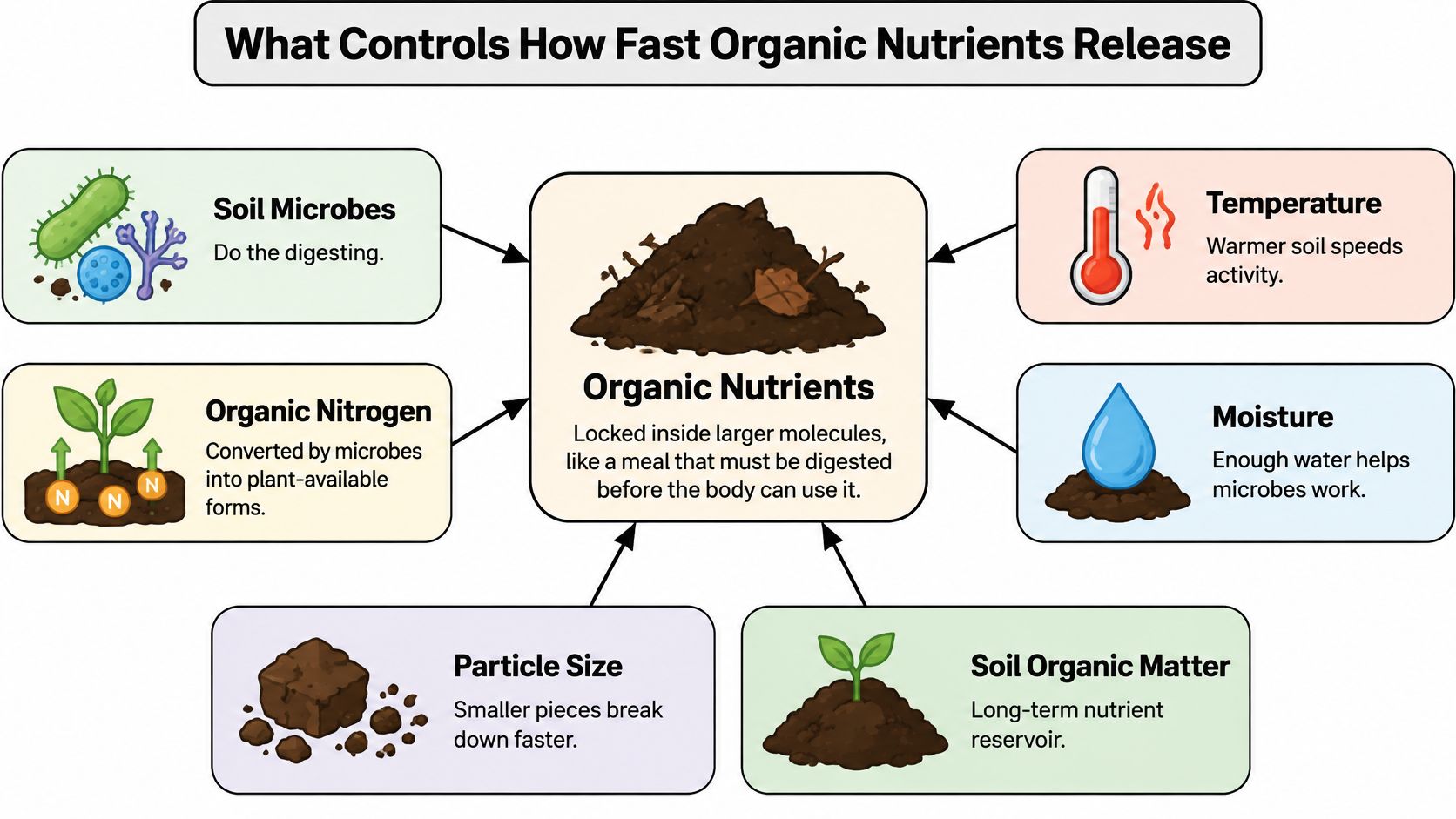
Organic nitrogen needs biological processing before vegetables can use it. Soil microorganisms carry out mineralization, which converts organic nitrogen into plant-available forms such as ammonium and nitrate.
That conversion runs faster in warm, adequately moist soil and slows sharply in cold soil. Washington State University Extension's plant-nutrition handbook describes that moisture and temperature dependence, and its guidance also presents Colorado State University's benchmark that compost and composted manure commonly release only 5–25% of their nitrogen in the first year. A fertilizer with a high total nitrogen analysis can therefore deliver a small first-season supply, which leaves fast-growing vegetables short during peak demand.
Material choice changes the starting point
Blood meal, seed meals, and composted manure all qualify as organic materials, but gardeners should not treat them as interchangeable. Meals generally release more slowly than soluble products, while composted manures release slower still.
Release class of common organic materials
| Material | Release class |
|---|---|
| Blood meal | Medium-rapid |
| Soybean meal | Slow-medium |
| Cottonseed meal | Slow-to-medium |
| Composted cow manure | Slow |
A release class is a relative description. It is not a calendar date or a percentage for a fertilizer calculation. Medium-rapid blood meal still needs microbial conversion before uptake. Slow composted manure may build soil fertility over time without correcting an immediate nitrogen shortage, so heavy feeders can miss their window while nitrogen is still becoming available.
For background on the organisms behind that delay, see the guide to microbial activity in soil. In practice, give those organisms workable conditions with even moisture. Avoid applying fertilizer to a bed that remains saturated, since excess water restricts the air exchange microbes need.
Diagnose the conditions before adding more
If plants are not responding, inspect the soil before repeating an application. Check below the surface with a trowel. A damp-looking crust can conceal dry soil, and a dry-looking surface can cover a saturated root zone.
Adding another slow material will not necessarily fix a slow-conversion problem. It can accumulate nitrogen that becomes available later, after conditions improve and after crop demand has passed. Match long-lasting amendments to soil improvement, and calculate a separate nutrient source when the crop needs feeding sooner.
Setting Rates from Soil Tests and Organic Matter
The N-P-K analysis describes nutrient content, not the application rate your garden needs. Before buying fertilizer, establish what the soil can already supply and which nutrients are deficient.
The University of Maryland Extension guide to fertilizing vegetable gardens estimates approximately 0.4 pounds of available nitrogen per 1,000 square feet for each 1% of soil organic matter, which gives the calculated estimates below. These are planning estimates, not guarantees of nitrogen delivery during a particular week.
Available nitrogen supplied by soil organic matter
| Soil organic matter | Estimated available nitrogen per 1,000 sq ft |
|---|---|
| 1% | 0.4 lb |
| 2% | 0.8 lb |
| 3% | 1.2 lb |
| 5% | 2.0 lb |
An established, compost-enriched bed may need much less additional fertilizer than a newly prepared bed. Repeatedly applying a balanced product without checking soil history can also add phosphorus or potassium that the garden doesn't need.
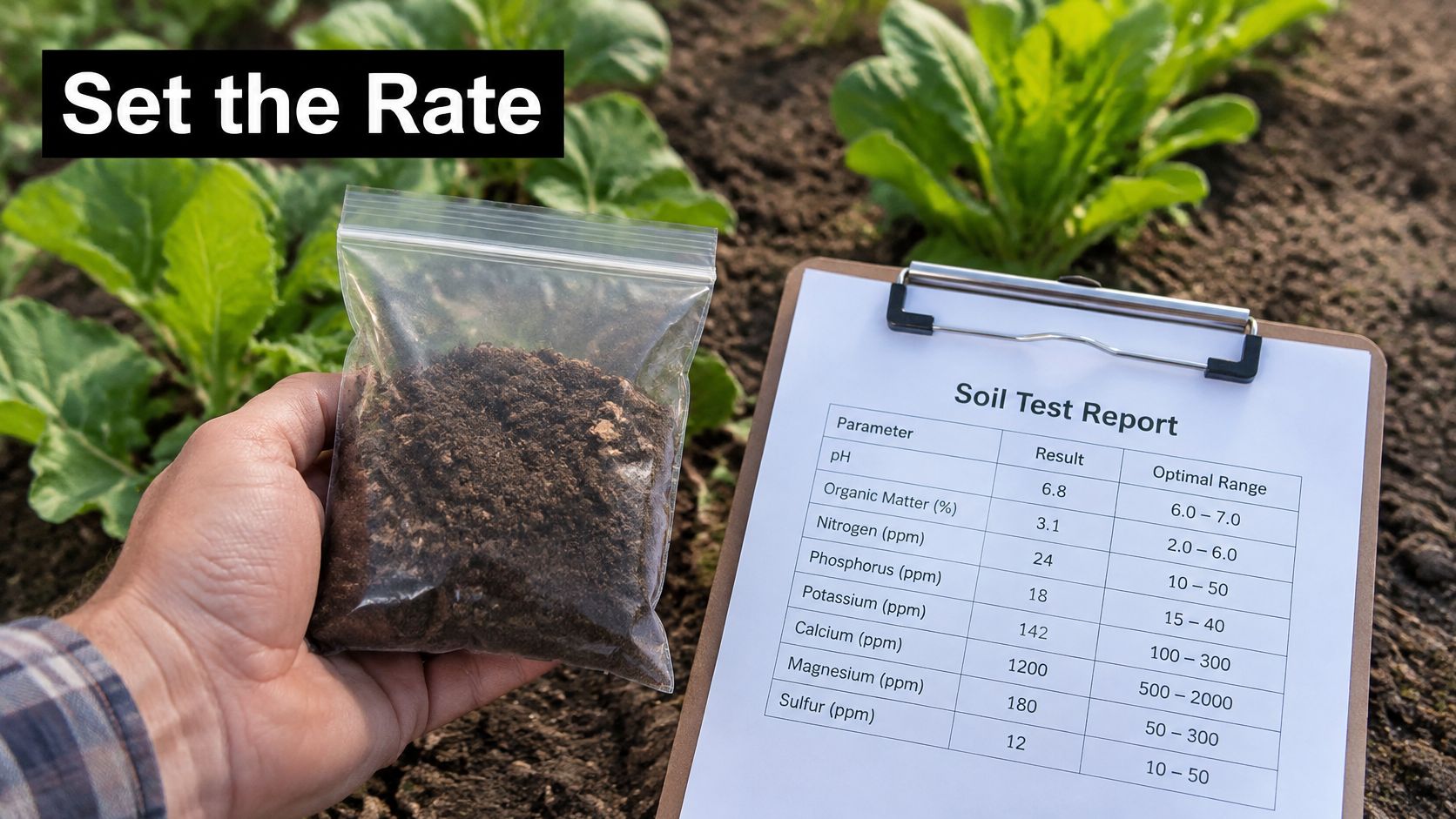
Keep the soil report beside your fertilizer labels when planning an application.
Calculate the remaining requirement
- Request the right soil information. Ask the laboratory for organic matter, phosphorus, potassium, pH, and vegetable-garden recommendations. Tell it about recent compost, manure, and fertilizer applications.
- Estimate the soil contribution. Use locally appropriate guidance to estimate nitrogen from existing organic matter. A general estimate is a starting point, especially when soil temperature and crop timing differ from typical conditions.
- Account for earlier amendments. Record what you applied and when. Estimate the remaining contribution from compost or manure without counting the same nitrogen both as a separate amendment credit and as part of another soil-supply estimate.
- Estimate available nitrogen from the chosen product. Use product-specific release information or extension guidance where available. A release class helps select an ingredient, but it doesn't supply an exact availability fraction.
- Allocate the remaining need across applications. Reserve an adjustable portion for side-dressing, particularly for demanding crops. Don't commit the entire budget before you know how the planting is developing.
The underlying calculation is:
Estimated available nitrogen = product weight × nitrogen fraction × estimated availability fraction.
Then subtract credible soil and amendment contributions from the crop recommendation before determining how much additional product to apply. If the availability fraction is unknown, acknowledge that uncertainty rather than treating all labeled nitrogen as immediately usable.
Avoid solving the wrong deficiency
A sufficient phosphorus or potassium result is a reason to avoid unnecessary additions, not a reason to seek a more balanced bag. Choose a nitrogen source that fits the remaining requirement.
Also consider soil pH and nutrient availability before interpreting pale growth as proof of inadequate fertilizer. Adding nutrients won't reliably correct a root-zone condition that prevents the plant from using them.
Timing Applications Around Vegetable Demand
A vegetable's nitrogen demand changes as it develops. Your application calendar should follow that change rather than a fixed instruction to fertilize once in spring.
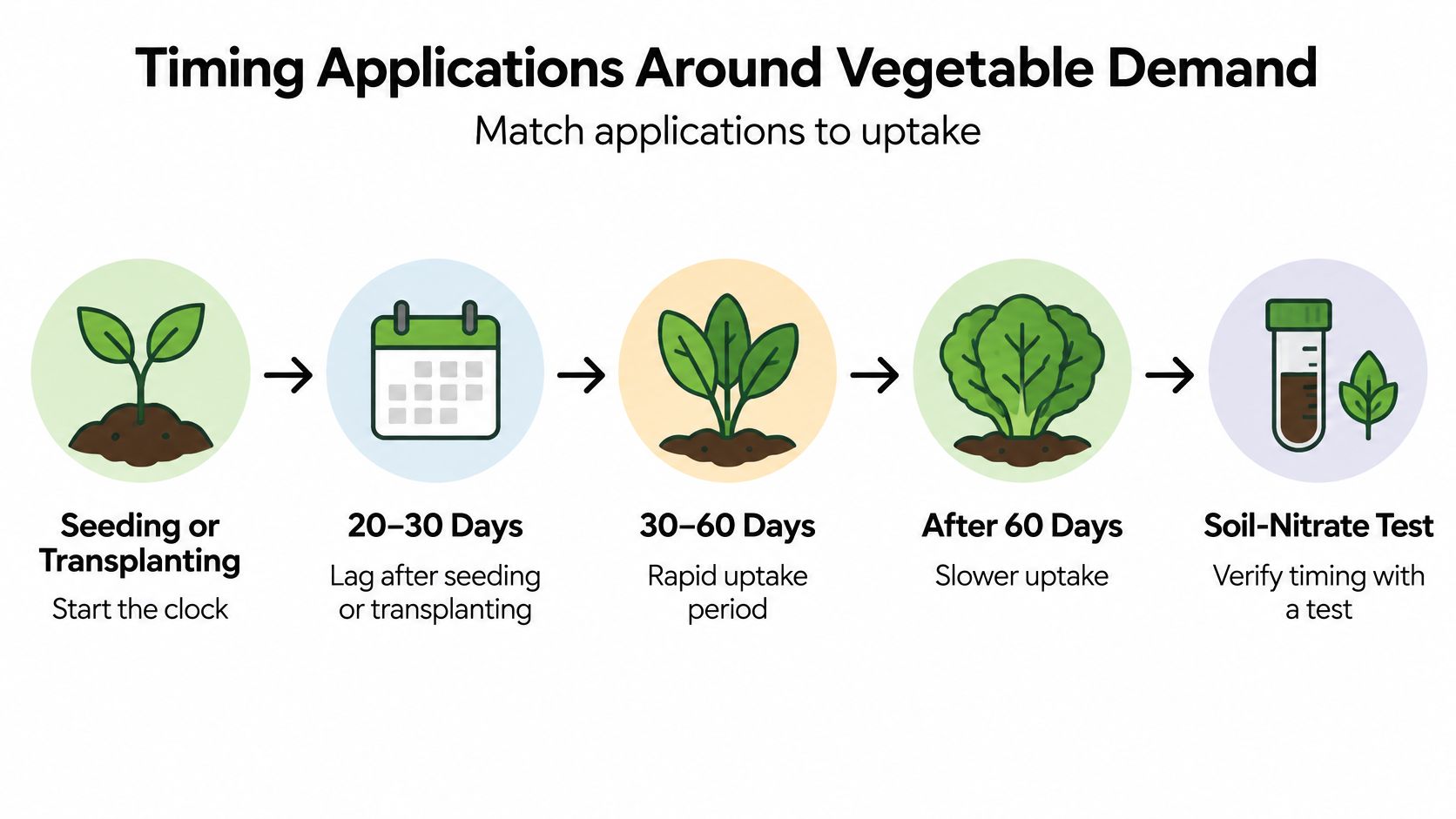
Oregon State University Extension's vegetable nutrient-management guide describes a typical 20–30-day lag after seeding or transplanting, followed by rapid uptake for roughly 30–60 days, and reports that nitrogen mineralization approximately doubles as soil temperature rises from 50°F to 70°F. Those patterns explain why the same material can require different management in a cool spring planting and a warm summer succession.
Use the timeline as a sequence of stages, not a universal harvest calendar.
Build a calendar around a tomato transplant
Say you're transplanting tomatoes in early May. Write the transplant date on your garden calendar, then add a preplant application window and a reminder to assess the crop as vigorous growth begins.
- Before transplanting, incorporate the calculated base application early enough for conversion to begin under workable soil conditions. Don't choose a long lead time solely because the fertilizer is organic.
- At planting, place the roots in an evenly prepared bed. Keep concentrated fertilizer away from direct stem contact.
- During establishment, check moisture beneath the mulch and correct irrigation problems before assuming the crop needs more feed.
- As growth accelerates, use an in-season soil-nitrate test to decide whether to apply, reduce, or omit the reserved side-dressing.
- Near the end of production, avoid automatic nitrogen additions that encourage foliage when you're trying to finish the crop.
A side-dress date is a decision point, not an obligation to empty another scoop into the bed.
A side-dressing belongs beside the growing plants, where you can incorporate it shallowly without cutting substantial roots. Restore mulch afterward and water appropriately for the product and soil conditions.
Keep a contingency rather than a rescue habit
In cold or short-season conditions, consider whether the first feeding needs a faster-release organic source. If testing identifies an in-season gap, compare suitable options using the guide to liquid fertilizer for vegetables, while checking the actual product's analysis and permitted uses.
A video companion can help you think through the application process.
Don't use leaf color alone to set the dose. Combine crop appearance with soil moisture, root condition, fertilizer history, and the test result before changing the plan.
Heavy and Light Feeders in Beds and Containers
Suppose you apply the same organic pellets to a sheltered lettuce bed and a tomato bed exposed to cold spring weather. The lettuce looks acceptable, while the tomatoes stall and pale. That comparison doesn't prove that the fertilizer works for lettuce and fails for tomatoes.
The crops have different demands, and their root zones aren't necessarily operating under comparable conditions. A pale plant can also have problems unrelated to nitrogen supply, so increasing the dose immediately would be a guess.
Utah State University Extension's guide to selecting and using organic fertilizers provides a useful basis for choosing materials by nutrient content and release behavior. For tomatoes, corn, squash, and brassicas, plan how you'll assess and meet supplemental needs rather than assuming a slow amendment will cover every growth stage.
Respond to the limiting condition
- Cold spring soil: Check whether the crop is appropriately timed for local conditions. Where feeding is justified, choose a source suited to the early requirement rather than increasing a slow base application.
- Drought: Restore suitable root-zone moisture before interpreting poor growth as fertilizer failure. Don't spread a large additional dose onto a dry bed and expect an immediate response.
- Heavy rain: Let saturated soil drain, inspect the planting, and reassess available nutrients. Avoid replacing the entire original application by guesswork.
Less-demanding crops don't automatically need the same program as a heavy feeder growing nearby. Keep separate bed records so that a vigorous tomato planting doesn't become the justification for fertilizing every vegetable.
Containers need their own plan
Limited rooting volume and frequent watering make nutrient timing especially important in containers. Check whether the potting mix already contains fertilizer before adding an organic product, and don't transfer a field-soil organic-matter calculation directly to a manufactured growing medium.
For a container tomato, plan smaller, adjustable applications instead of depositing the entire anticipated seasonal requirement at once. Measure each addition, distribute it over the available surface as directed, and keep it away from the stem.
Raised beds also deserve individual assessment. A bed filled largely with imported compost and growing mix isn't necessarily equivalent to the natural soil beneath it.
A very slow amendment may be useful for long-term soil improvement yet insufficient for a hungry crop in a short growing season. Choose by crop, rooting environment, and season, not by the assumption that slower is always better.
Building a Homemade Slow Release Blend
A homemade blend is useful only when you know what each ingredient contributes. Mixing several organic materials together doesn't automatically create a balanced fertilizer, and a scoop-based recipe can hide large differences in ingredient weight.
Start with the soil recommendation and select ingredients to meet the remaining need. You'll need a scale, a mixing tub, a scoop, ingredient labels, and a batch record.
Choose ingredients by purpose
Use mature compost for the soil-conditioning part of the program. Don't assume it supplies the concentrated nitrogen contribution of a meal-based fertilizer, and don't add a thick layer to make a blend look substantial.
Soybean meal or cottonseed meal can provide the slower nitrogen component. Blood meal belongs only where the planned program calls for a faster contribution. If phosphorus and potassium are already sufficient, don't add extra ingredients merely to create a more impressive ingredient list.
Batch discipline: A reproducible blend begins with weighed ingredients and written calculations, not matching scoops.
Make and apply a traceable batch
- Write the ingredient list before mixing. Record each material's name, labeled analysis, intended purpose, and any available release information. Leave out ingredients that don't address an identified need.
- Weigh each ingredient separately. Keep the measurements in consistent units so you can reconstruct the blend rather than guessing what went into it.
- Calculate the nutrient contribution. Add the labeled nitrogen contributions from the weighed ingredients, then estimate availability using defensible ingredient-specific information. Don't label the homemade mixture with a guaranteed analysis you haven't established.
- Mix thoroughly in a clean tub, breaking apart clumps so that concentrated meals don't remain in pockets. Wear suitable protection against dust and follow each ingredient's handling directions.
- Measure the application area. Allocate the intended amount to that bed, spread it evenly, and incorporate it into the topsoil where appropriate. Don't bury a concentrated band beneath transplant roots.
- Label the remaining batch with its ingredients, mixing date, and intended use. Record what went onto the bed, not just the amount you planned to apply.
Keep raw or fresh manure out of this blend. Finished compost and raw manure aren't interchangeable materials, particularly in a food garden.
If the crop later needs supplemental nitrogen, adjust with a measured source suited to that need. Another bulky compost application may add unwanted nutrients without supplying nitrogen on the required schedule.
Confirm Organic Compliance Before Planting
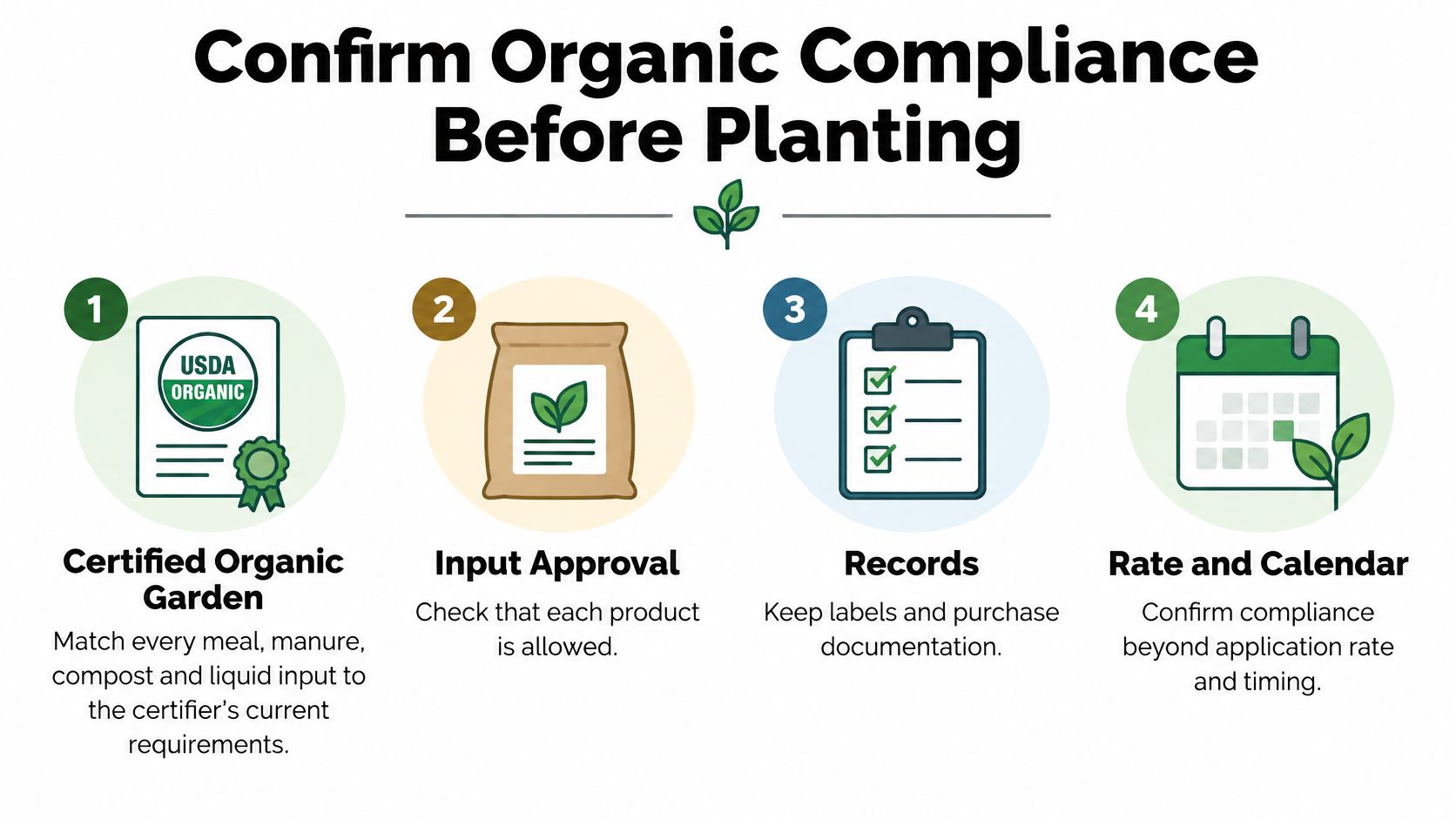
Organic origin and approval for certified organic production aren't the same check. If your garden or operation is certified, confirm each input with your certifier's current requirements before purchasing or mixing it.
Check the complete product, not just its headline ingredient. Keep the label and documentation for meals, composts, manures, and liquid fertilizers, including anything you intend to use as a supplemental feed.
Use this checklist before committing your materials to the bed.
Keep safety and records alongside the calendar
- Verify input approval. Confirm that the exact product and intended use meet the requirements that apply to your operation. Don't infer approval from natural-sounding packaging.
- Confirm compost condition. Use mature material rather than an unfinished pile. Keep raw manure separate and follow current food-safety guidance for any manure-to-harvest interval.
- Retain application records. Write down the bed, product or homemade batch, amount applied, estimated available nitrogen, and application date.
- Set the follow-up decision. Record when you'll assess the crop and obtain an in-season nitrate test, then change the planned side-dressing if the result warrants it.
Crop color remains useful as an observation, but it isn't a substitute for the application history and a suitable test. Keep those records together so you can distinguish an unmet nutrient requirement from a watering or root problem.
Before planting, have the soil recommendation, input approval, preplant date, and side-dress assessment date written down. That turns an uncertain bag of slow-release nutrients into a manageable feeding plan.
At Leaves & Soul, we offer soils, soil amendments, fertilizers, and liquid fruit and vegetable fertilizers for home gardeners. Visit Leaves & Soul to compare options against your soil report and feeding calendar, and check each product's analysis and organic suitability before choosing it for your vegetable garden.