


Bonsai soil is a granular, fast-draining substrate engineered to keep roughly 50% solids, 25% air, and 25% water in the root zone, not the moisture-holding garden soil most beginners reach for. It gives roots something closer to a breathable sponge than a block of mud.
The popular advice to “just use well-draining soil” sounds sensible, but it leaves out the decision that determines whether a bonsai thrives: what does well-draining mean for this tree, this climate, and this pot? A pine in a rainy garden, a ficus beside a warm window, and a tiny tree in a shallow tray shouldn't all receive the same substrate.
Bonsai soil is best understood as a root-zone engineering system. The ingredients matter, but their particle size, durability, pore spaces, and balance matter more than the name on the bag.
Why Bonsai Soil Is Not Just Small Dirt
Bonsai soil isn't ordinary dirt crushed into smaller pieces. Garden soil and generic potting mix are designed for beds or deeper containers, where excess water can move downward and where the surrounding soil provides some structural stability. A shallow bonsai pot offers much less vertical space, so fine material can remain saturated around the roots for too long.
Think of ordinary soil as a sponge with very small holes. It may hold plenty of water, but once those holes fill, air struggles to enter. Bonsai roots need water, yet they also need oxygen for healthy function. The roots act a little like lungs, exchanging gases through the spaces between particles. If those spaces collapse, watering can turn from support into stress.
A purpose-built bonsai substrate uses separate particles rather than a continuous mass of fine material. A commonly cited target is about 50% solids, 25% air, and 25% water, a structure described in bonsai soil guidance from the American Bonsai Society. The water remains available after irrigation, while the air-filled spaces help prevent the root zone from becoming stagnant.
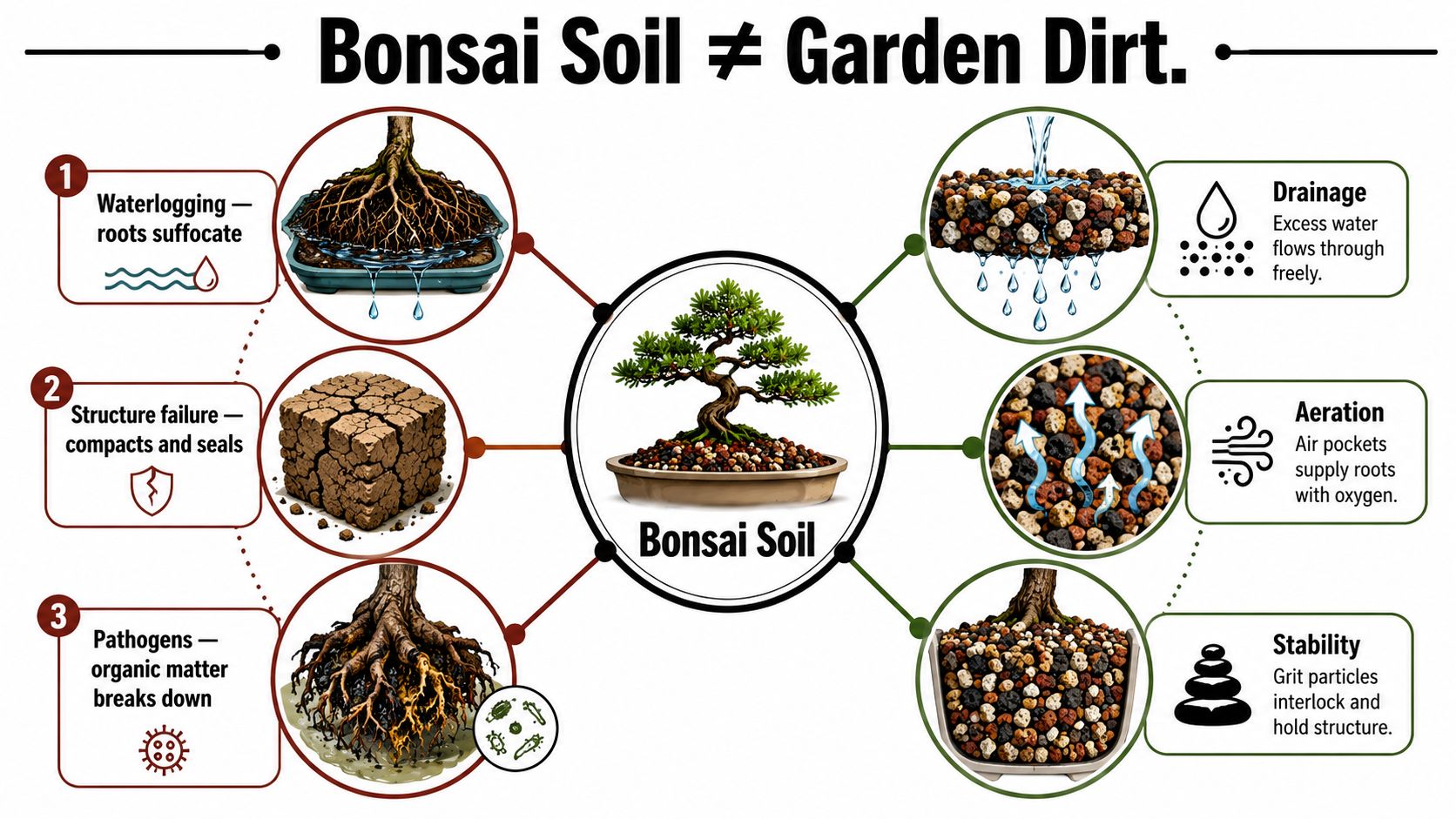
The sponge and lung test
A useful beginner test is to stop asking whether a mix “holds water” and ask two questions instead:
- Does it hold enough moisture for the roots to use?
- Does it leave enough open space for air to return after watering?
A mix that drains instantly but dries before the tree can use it is unhelpful. A mix that stays wet and airless is equally unsuitable. Good bonsai soil balances the two conditions.
Many bonsai mixes combine a dense or inert fraction, an absorptive fraction, and an organic fraction in broadly comparable proportions. The exact blend changes with the tree and growing conditions, but the purpose stays consistent: preserve pore space while giving fine roots access to moisture and nutrients.
Particle size completes the picture. A bonsai society guide states that better than 90% of bonsai soils can be made from particles between 1/4 inch and 1/16 inch, with finer screening used for very small shohin and mame trees. Those ranges explain why bonsai soil is engineered rather than improvised. Next, the ingredients can be understood by the job each performs inside the pot.
The Four Core Components and What Each One Does
A bonsai mix is a working system, not a random collection of grit. Each component changes four conditions around the roots: drainage, water storage, air space, and structural stability. The right choice depends on the tree, climate, watering routine, and pot, so a useful mix follows decisions rather than a fixed recipe.
Akadama
Akadama is a granular clay medium associated with Japanese bonsai practice. Its pores retain moisture after watering, while the spaces between its particles allow more air than ordinary garden clay. That buffering gives roots access to moisture when watering cannot happen immediately after the surface begins to dry.
Akadama gradually softens and breaks down. Its documented material profile includes a pH of 6.9 and conductivity of 0.052 ms/cm, as recorded in the akadama reference. These properties help explain its use in containers, where the substrate strongly affects the root environment. Choose it when moderate moisture retention matters, and monitor the mix as the particles age.
Pumice
Pumice is a lightweight volcanic stone with internal pores. Those pores hold some water without turning the medium into a dense paste, while its rough surfaces give new roots places to grip. Pumice suits a mix that needs more drainage and aeration without adding much weight.
Lava rock
Lava rock provides durable structure. Its irregular particles leave channels for water and air, and the material resists the collapse associated with decomposing organic matter. It also adds weight, which can steady a tree in a light or shallow container. Use more of it when physical stability and lasting structure matter more than water storage.
Organic matter
Composted bark, peat, coco-based materials, and other organic amendments retain moisture and store nutrients. They can support tropical trees or plants kept in hot, dry interiors, where a mineral-heavy mix may dry too quickly. Their particles decompose, however, and shrinking material can remove the air spaces it created.
Traditional mixes often rely mainly on inorganic material. One bonsai reference describes a common traditional mix as 75 to 80% inorganic and 25 to 30% organic, while some tropical mixes use 65 to 75% organic material and 25 to 35% inorganic aggregate. Treat these as starting points, not universal instructions. A humid climate, frequent rainfall, or a shallow pot may call for a different balance than a hot room or a thirsty species.
| Component | Drainage | Water Retention | Structure | pH Effect |
|---|---|---|---|---|
| Akadama | Moderate | Moderate to high | Gradually declines as particles soften | Mildly influential |
| Pumice | Fast | Moderate inside pores | Stable and lightweight | Generally low |
| Lava rock | Fast | Low to moderate | Very stable and supportive | Generally low |
| Organic matter | Slow to moderate | High | Declines as it decomposes | Depends on material |
These materials perform different jobs. Akadama moderates moisture, pumice opens the mix while storing some water, lava rock preserves structure, and organic matter increases retention. Combine them according to the result you need: more air and stability for wet conditions, or more moisture storage for heat, dry air, or a tree that uses water quickly.
Particle Size and the Drainage Equation
Bigger particles usually drain faster. Smaller particles retain more water, but they can close the air spaces that roots need. That is the central drainage equation, and it matters more than memorizing a famous recipe.
Many specialists screen bonsai media to roughly 2 to 6 mm for standard trees, with finer 2 to 4 mm particles used for shohin or younger material and coarser 4 to 8 mm fractions used for larger or more drought-demanding trees, according to Bonsai Tonight's soil guidance.
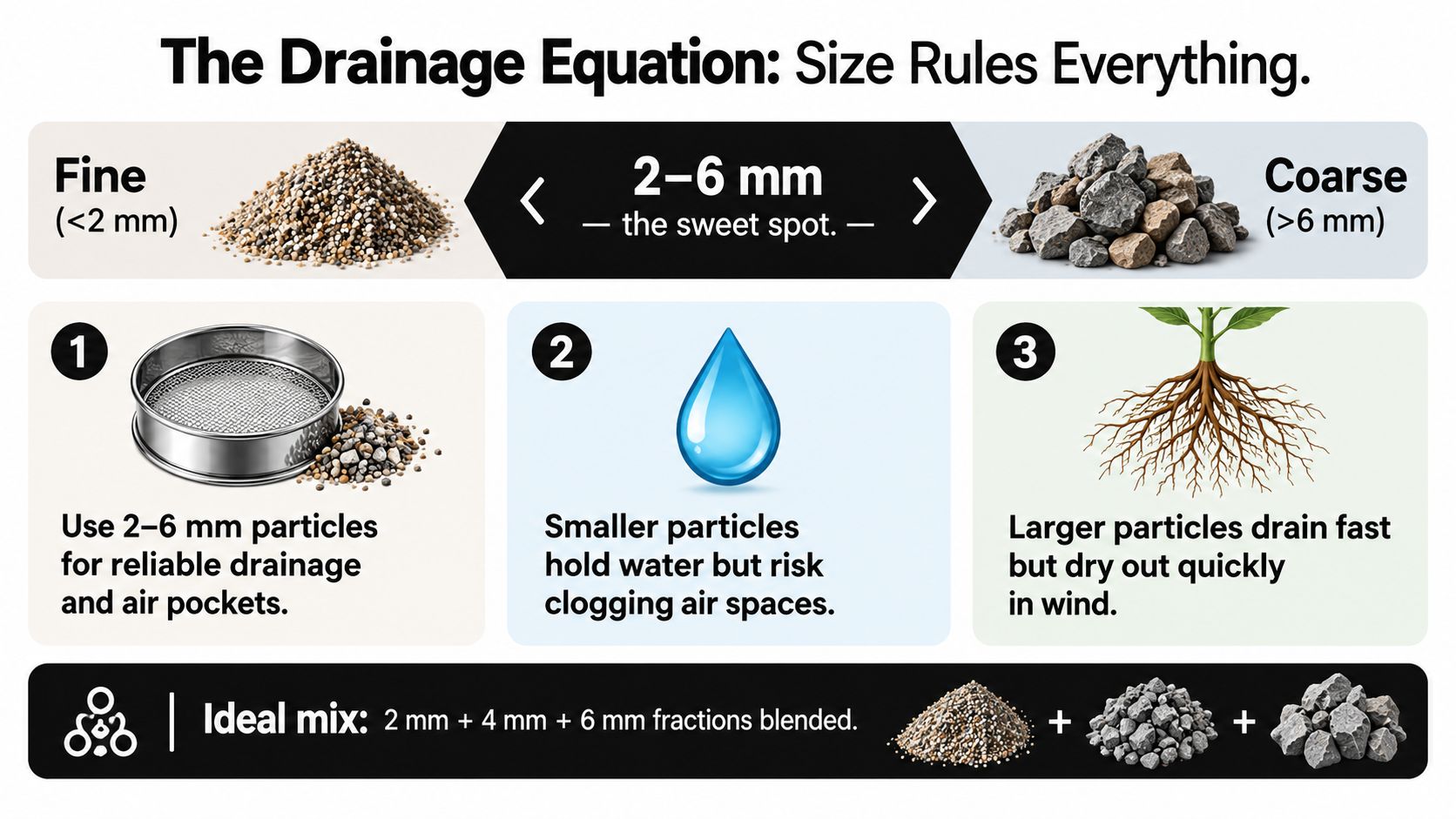
Why uniform particles matter
Imagine filling a jar with stones of similar size. Open channels remain between them. Add dust and tiny fragments, and those gaps fill from the bottom upward. Water may still enter from the surface, but it moves more slowly and air returns less effectively.
That's why screening isn't cosmetic. Removing dust prevents fines from migrating downward and forming a compact layer near the drainage holes. A small tree in a shallow pot may need a finer grade because its roots and container are small, but “finer” shouldn't mean powdery.
Use the pot and the tree as your starting rule:
- Shallow containers: Choose a consistent small-to-medium grade that fits the root system without producing dust.
- Large or deep training pots: Use a coarser fraction when rapid drainage and root aeration are priorities.
- Windy, dry positions: Avoid a mix so coarse that the root ball dries before the tree can use its stored moisture.
Particle rule: If water lingers at the surface, remove fines or increase the coarse fraction. If the root ball dries too quickly, add a smaller, more absorptive fraction.
The relationship between particle size and drainage is also explained in this guide to how soil particle size affects drainage.
A short visual demonstration can make the difference easier to see:
Benchmark Mixes That Actually Work
Recipes should follow the rules, not replace them. A classic blend can give you a reliable starting point, but the correct question is always whether the mix keeps the roots supplied with both moisture and air in your growing conditions.
The following examples translate the substrate logic into practical templates. Their ratios are starting points, not universal prescriptions.
Mix A, the classic inorganic trio
Use equal parts akadama, pumice, and lava rock, screened to 2 to 5 mm. This arrangement balances moisture buffering, porosity, and structural stability, making it a useful starting point for many temperate deciduous trees and conifers.
Mix B, the tropical organic-leaning blend
A tropical blend can use 50% akadama, 25% pumice, 15% lava rock, and 10% pine bark or coco coir, as described in the supplied benchmark. The organic portion adds a modest moisture reserve, while the mineral ingredients stop the container from behaving like a pot of ordinary compost.
Mix C, the conifer fast-drain blend
For pines and junipers in wet conditions, try 50% pumice, 30% lava rock, and 20% akadama, screened to 3 to 6 mm. The lower akadama share and coarser grade favor rapid drainage and a durable air-filled structure.
| Mix | Components (ratio) | Particle Size | Best For |
|---|---|---|---|
| Classic inorganic trio | 1/3 akadama, 1/3 pumice, 1/3 lava rock | 2 to 5 mm | Temperate conifers and deciduous trees |
| Tropical organic-leaning | 50% akadama, 25% pumice, 15% lava rock, 10% bark or coco coir | Fine to medium | Ficus, jade, and other tropicals |
| Conifer fast-drain | 50% pumice, 30% lava rock, 20% akadama | 3 to 6 mm | Pines and junipers in wet climates |
Before potting, sieve dry materials and rinse away dust. Pre-soaking akadama helps the granules accept water evenly instead of drawing moisture away from newly settled roots. For more practical mixing guidance, see this bonsai soil mix recipe guide.
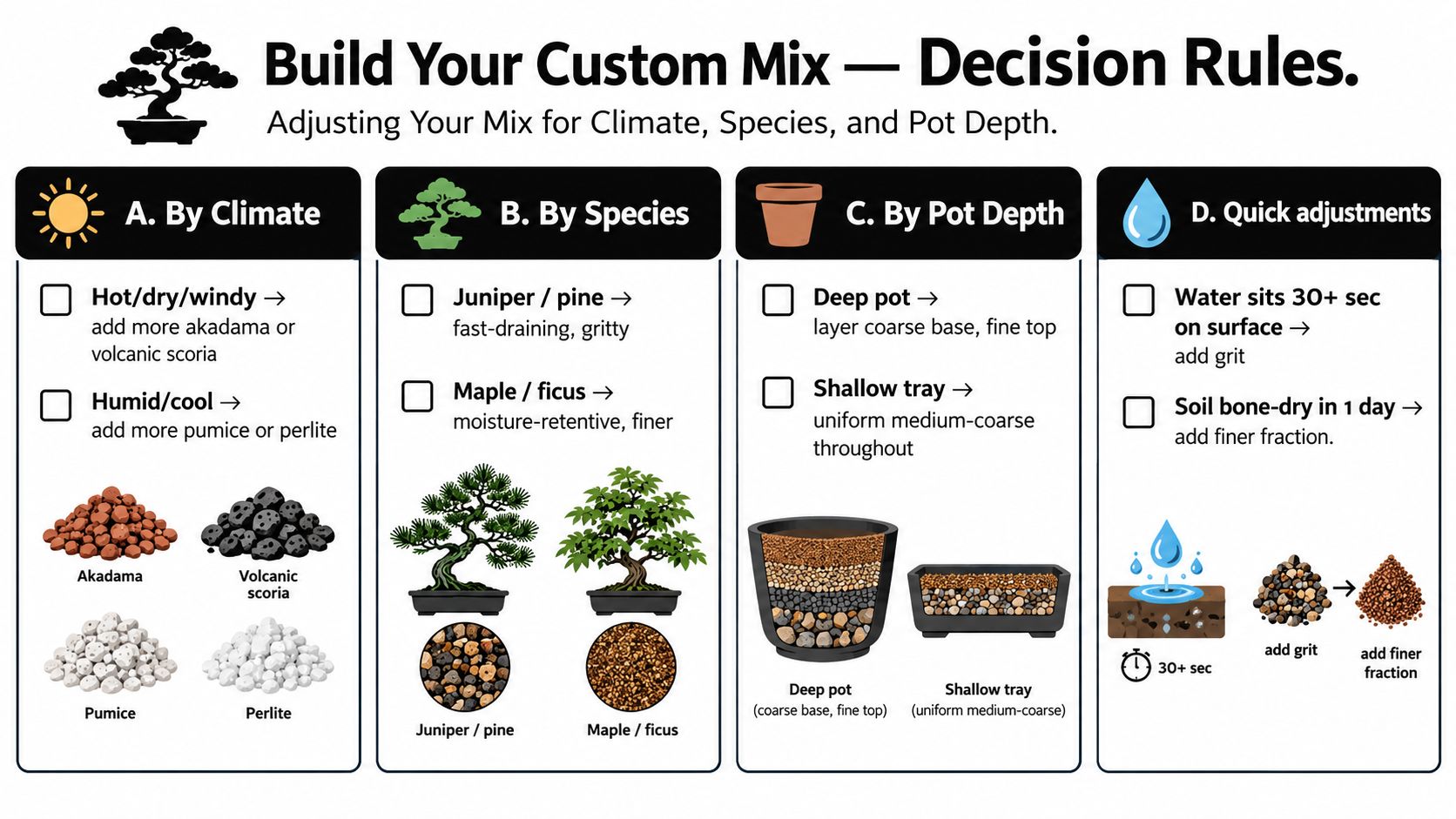
Adjusting Your Mix for Climate, Species, and Pot Depth
A universal bonsai recipe fails because evaporation isn't universal. The same container can dry rapidly on a hot, windy balcony and remain wet for much longer in a cool, humid garden.
Start with the climate
In hot, dry, or windy conditions, increase the mix's moisture buffer with a greater share of akadama or a restrained amount of organic material. Do not just add garden soil. Preserve the granular structure and adjust the materials that hold usable moisture.
Cool, rainy, or humid conditions call for the opposite direction. Increase durable, open components such as pumice and lava rock, and keep organics limited. The aim is to shorten the period of saturation without making the tree impossible to water.
Match the species
Deciduous trees often tolerate a slightly more moisture-retentive and somewhat finer mix than drought-sensitive conifers. Pines and junipers generally benefit from a gritty, fast-draining structure. Tropical species such as ficus and jade can sit between those extremes, with a small organic fraction useful when indoor air is warm and dry.
Pot depth changes the equation again. A shallow mame or shohin container has little vertical moisture reserve, so a stable, well-screened medium grade can help prevent compaction and uneven wet spots. A deeper training pot gives water more room to move, allowing you to choose a grade that better suits the root system and local drying rate.
Fertilizer doesn't solve a drainage problem. Coarser media may release nutrients more readily with frequent watering, so feeding should respond to the tree's growth and watering pattern rather than being used to compensate for a collapsed substrate.
Use this checklist before changing a recipe:
- Climate: Does the tree dry too quickly, or does the surface remain wet?
- Species: Does it prefer an airy conifer mix, a balanced deciduous mix, or extra tropical moisture?
- Container: Is the pot shallow enough to require careful moisture buffering?
- Particles: Are dust and fines blocking channels?
- Watering: Does the mix need more retention, or does it need faster release?
For indoor growing, this guide to choosing soil for indoor bonsai offers another way to frame those decisions.
Common Mistakes and Misconceptions to Skip
Potting mix and garden soil are close enough
They aren't. Fine organic media can collapse around roots in a shallow container, reducing the air-filled spaces that make frequent watering safe. A bonsai substrate needs particles that hold their shape and allow water to leave without stripping the root zone of all usable moisture.
Every akadama behaves the same
Akadama quality varies. Harder material can preserve its granular structure for years, while softer material may break down much sooner. Once the granules turn into fine clay, the mix no longer provides the pore pattern you selected.
More fertilizer fixes weak soil
Fertilizer supplies nutrients. It doesn't create oxygen, reopen clogged channels, or restore broken particles. If the root zone stays saturated, adding more fertilizer can increase stress rather than repair the underlying problem.
A fourth mistake is skipping the sieve. Dust settles into lower layers, fills drainage channels, and creates a dense zone that can stay wet even when the surface appears dry.
Structural reminder: Fertilizer feeds the tree, but particle structure keeps the roots alive.
Once you understand that distinction, secret recipes become less persuasive. Ask what each ingredient contributes, how long it will remain stable, and whether its particle size fits the tree and container.
Your First Bonsai Soil Setup and a Simple Performance Test
Start with the classic equal-part blend of akadama, pumice, and lava rock. It gives beginners a clear baseline because each material has a distinct role, and you can adjust the result after observing how the planted tree behaves.
Prepare the substrate
- Sieve the dry components. Separate dust and unsuitable fines from the usable particles.
- Blend equal parts. Combine akadama, pumice, and lava rock in a clean container.
- Remove remaining dust. A second pass helps keep fine material from settling into the lower root zone.
- Pre-moisten the mix. Spray it until the particles are evenly damp, not muddy.
- Pot the tree carefully. Work the mix around the roots so no large voids remain, while preserving the open structure.
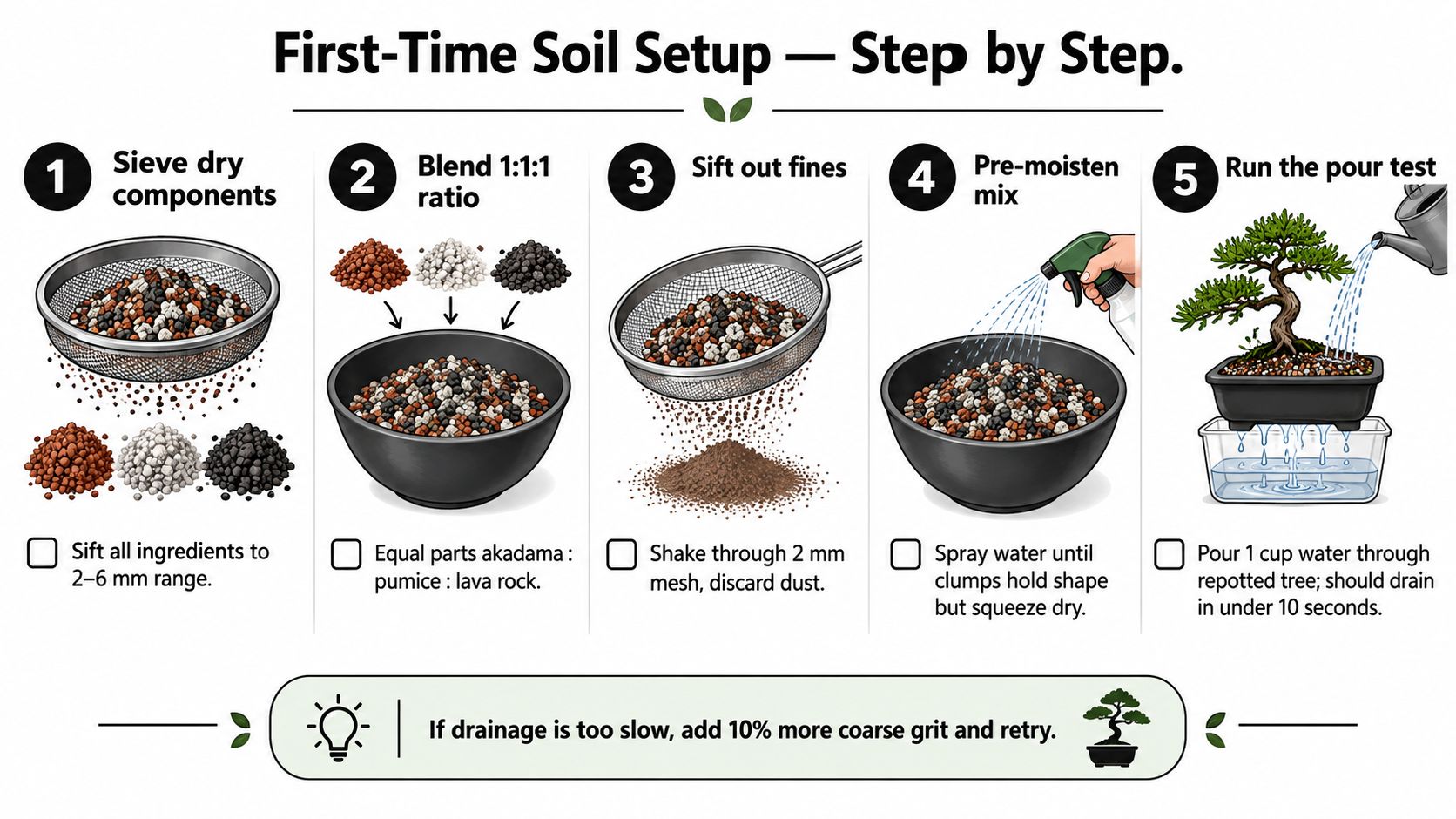
Run two simple checks
First, water the freshly potted tree thoroughly and watch the drainage holes. Water should leave steadily rather than pooling on the surface or moving reluctantly through the pot. This isn't a contest for the fastest possible flow. You're checking that the substrate accepts water and releases excess water without sealing.
Next, inspect the structure after normal watering. Look at the surface for crusting, probe gently with a chopstick, and check whether the particles still feel distinct rather than collapsing into mud. If the mix dries unusually fast, add a finer or more absorptive fraction at the next repot. If it stays wet, remove fines or increase the open mineral fraction.
Top-dress when the surface erodes, and use a chopstick to check moisture below the top layer rather than relying only on appearance. Refreshing a bonsai mix is a periodic maintenance decision based on particle breakdown, root growth, and drainage performance, not a reason to replace a healthy substrate on a fixed schedule.
Leaves & Soul offers purpose-built bonsai soil, fertilizers, pots, and repotting accessories for growers who want a ready-made starting point rather than sourcing each component separately. Visit Leaves & Soul to compare bonsai soil options and choose the tools that fit your tree, container, and growing conditions.