


Plant fertilizer usually supplies the three main nutrients plants use most, and the numbers on the label show the percentage of N, P2O5, and K2O in the mix. A label like 10-20-10 has a 1:2:1 ratio, which tells you that fertilizer isn't a plant's meal. It's a nutrient supplement that supports how the plant grows.
If you're standing over a new pothos, fiddle leaf fig, orchid, or bonsai wondering, “Do I feed this thing or leave it alone?”, you're not confused because gardening is hard. You're confused because a lot of plant advice mixes up plant food and plant fertilizer as if they mean the same thing.
They don't.
Plants make their own food through photosynthesis. Fertilizer gives them nutrients they need to build leaves, roots, flowers, stems, and healthy new growth. That's why I like to explain fertilizer as a vitamin supplement, not a meal. Once you see it that way, fertilizer labels get less mysterious, and it becomes much easier to avoid two common mistakes: using the wrong formula and using too much.
Fertilizer Is a Vitamin Supplement Not a Meal
A new plant owner often asks a very reasonable question: “Should I give my plant some food?” The word sounds harmless. It even sounds caring. But it points you in the wrong direction.
Horticultural guidance on the plant fertilizer vs. plant food debate makes a useful distinction. Fertilizers supply nutrients, while plants make their own food through photosynthesis. That means fertilizer is not an energy source. It's a nutrient supplement, and that distinction should shape how you choose products and how often you use them, as explained in this discussion of plant food vs. plant fertilizer.
Think of it this way. A person eats a meal for energy. A vitamin doesn't replace lunch, but it can support healthy body functions. Plants work in a similar way. Sunlight, water, and air let them make sugars through photosynthesis. Fertilizer helps by supplying nutrients that may be missing or limited in potting mix or soil.
Why this distinction matters
If you think fertilizer is food, you're more likely to overapply it. Many beginners assume more feeding means faster growth. In practice, plants don't “eat” fertilizer like a pet empties a bowl.
Practical rule: If your plant is getting poor light, more fertilizer won't solve the real problem.
That's an important confidence boost for new gardeners. You don't need to constantly pour products into a pot to prove you're taking care of your plant. Good plant care is usually about balance: enough light, proper watering, suitable soil, and the right nutrients in the right amount.
What fertilizer actually does
Fertilizer helps plants access the building blocks they need for specific jobs inside the plant.
- Leaf support: Nutrients help plants produce and maintain leafy growth.
- Root development: Some nutrients support stronger root systems.
- Flowering and fruiting: Certain formulas lean toward bloom and root support.
- Overall resilience: Nutrients also help with internal processes tied to water movement and general vigor.
This is why two fertilizers can both be “for plants” and still behave very differently. One might favor lush foliage. Another might be better suited for roots, flowers, or sturdy growth.
Once you stop asking, “What food should I give my plant?” the better question appears: What nutrients does this plant need right now?
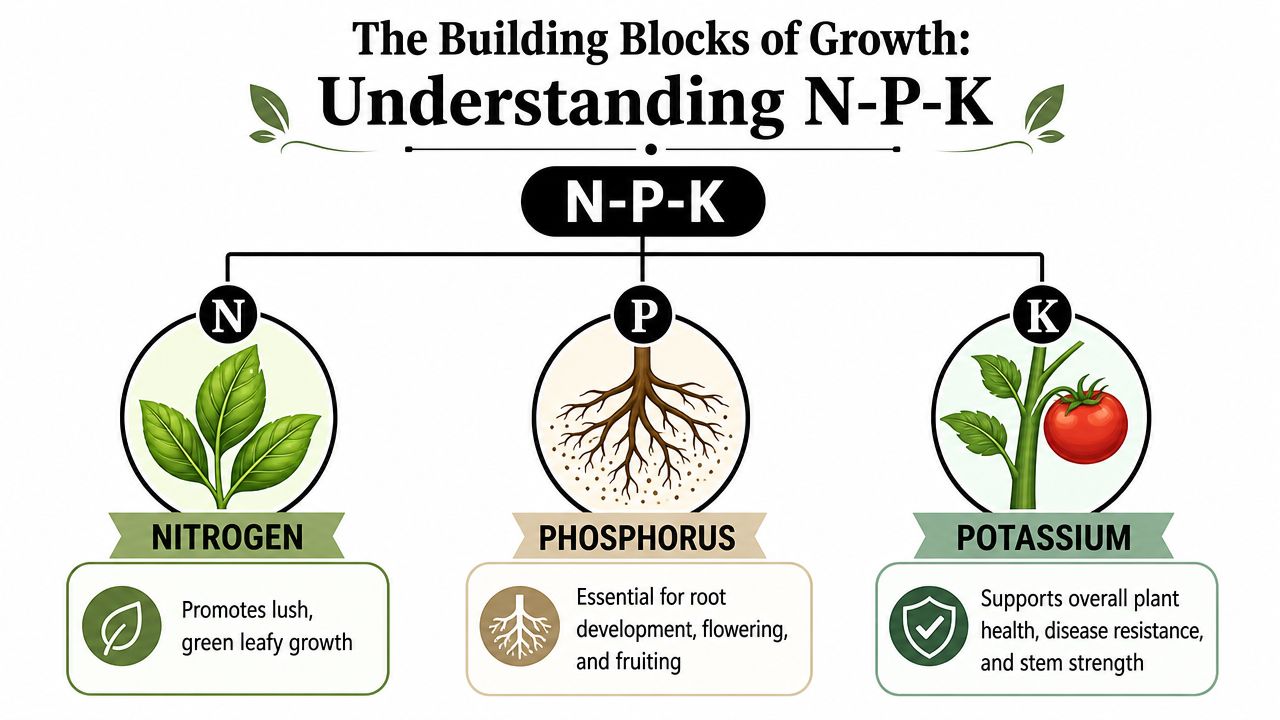
The Building Blocks of Growth Understanding N-P-K
Walk down the fertilizer aisle and you'll see strings of numbers on every bag, bottle, and box. Those numbers aren't random. They're the basic language of plant nutrition.
Commercial fertilizer labels use an N-P-K analysis, which represents the percentage of Nitrogen (N), Phosphate (P2O5), and Potash (K2O) in the product. A 10-20-10 fertilizer has a 1:2:1 ratio, which points more strongly toward root and flower support than leafy growth, as outlined in the University of Minnesota Extension's quick guide to fertilizing plants.
What each letter means in plain English
You don't need to memorize chemistry to read a fertilizer label. A simple mental shortcut helps.
- Nitrogen (N) supports leafy, green growth. If a plant is mainly being grown for foliage, nitrogen matters a lot.
- Phosphorus (P) is associated with roots, flowering, and fruiting.
- Potassium (K) supports overall plant health, including functions tied to stress tolerance and water regulation.
I often tell beginners to think of them like this:
- N is for green
- P is for power
- K is for keeping the plant steady
It's not a scientific formula. It's just a handy way to remember the job each nutrient tends to do.
How to read the numbers
A label with three numbers tells you the fertilizer's nutrient balance. It does not tell you whether that product is automatically right for every plant.
Here's a simple reading guide:
| Label example | What it suggests |
|---|---|
| Higher first number | More emphasis on leafy growth |
| Higher middle number | More emphasis on roots and blooms |
| Higher last number | More emphasis on general hardiness and plant function |
| Balanced-looking formula | More even support across several needs |
That's why it helps to choose a fertilizer based on the plant's stage and your goal. A leafy indoor plant has different needs from a blooming orchid or a compact bonsai in training.
A fertilizer label is less like a grade and more like a recipe.
If you want a deeper walk-through of how these labels work in everyday gardening, this guide to understanding plant fertilizer numbers is a useful next read.
Nutrient labels can also help you understand products outside typical houseplant care. For example, potassium-based materials show up in other gardening tasks too, including guides on using potassium nitrate for tree stumps. That's a different job entirely, but it's a good reminder that the nutrient itself and the intended use both matter.
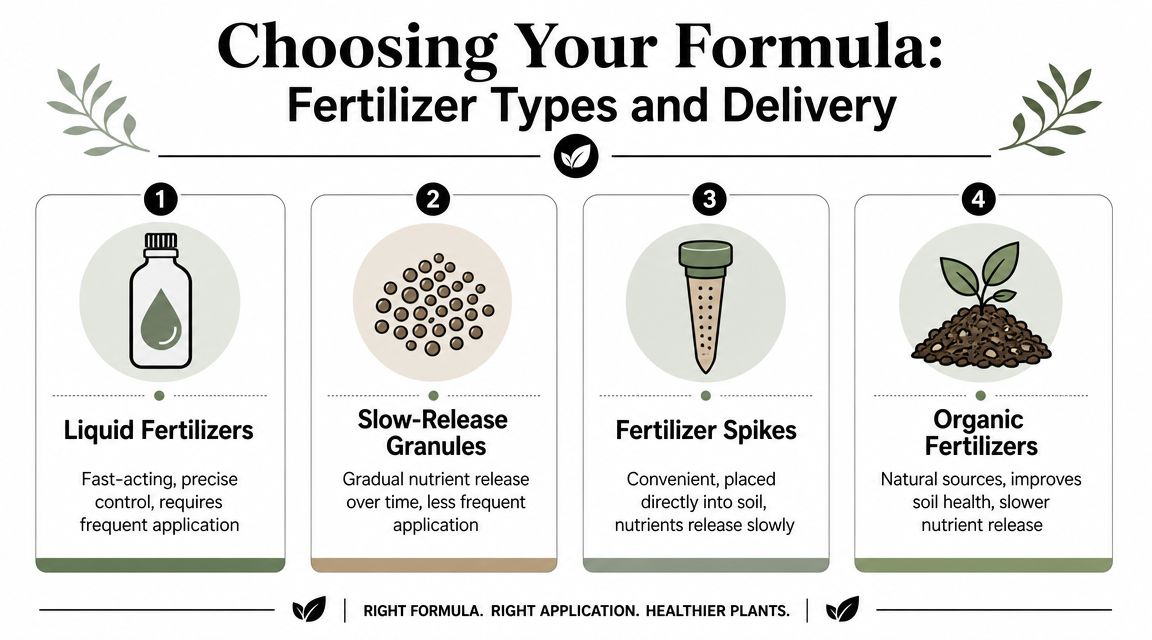
Choosing Your Formula Fertilizer Types and Delivery
Once you understand N-P-K, the next question is practical: what form should you buy? The answer depends as much on your habits as on your plants.
Some gardeners love the routine of mixing a liquid feed. Others want something they can apply and mostly forget for a while. Neither approach is automatically better. The useful question is which delivery method fits your plant, your potting setup, and your own consistency.
The common forms most home gardeners use
Here's how the main options compare in real life.
| Type | How it works | What it's good for | What to watch for |
|---|---|---|---|
| Liquid fertilizer | Mixed with water and applied during watering | Fast response and easy dose adjustment | Easy to overdo if mixed too strong or used too often |
| Slow-release granules or pellets | Nutrients release gradually over time | Steady feeding with less frequent application | You still need to follow directions and avoid piling on more |
| Spikes | Inserted into the soil near the root zone | Convenient and tidy | Nutrients may be concentrated in one area |
| Organic materials | Nutrients become available as they break down | Gentle feeding and soil-building benefits | Release can be slower and less immediate |
Organic and synthetic mean source, not morality
This part gets emotional fast, but it doesn't need to.
Organic fertilizers come from natural materials such as plant, animal, or mineral sources. Synthetic fertilizers are manufactured to provide nutrients in a more direct form. For a home gardener, the day-to-day difference often comes down to how quickly nutrients become available and how predictable the feeding pattern is.
That means your choice can be practical rather than ideological.
- Choose liquid if you want fast control.
- Choose slow-release pellets if you prefer a steadier, lower-maintenance routine.
- Choose organic options if you want nutrient input that also supports the growing medium over time.
- Choose spikes carefully if convenience matters and you're working with suitable containers.
If you're weighing those trade-offs in more depth, this comparison of organic vs. chemical fertilizers can help you sort out the difference in plain language.
Match the fertilizer to the growing setup
The same plant can behave differently depending on where and how it grows. A pothos in a roomy potting mix, a bonsai in a shallow container, and an aquarium plant rooted in substrate don't access nutrients the same way.
That's one reason substrate and delivery matter so much in planted tanks. For aquariums, nutrient-rich substrate can be essential for thriving aquascapes, because the root zone works differently from a standard houseplant pot.
The best fertilizer is the one you can apply correctly and consistently.
A perfectly chosen formula won't help much if you never remember to use it. On the other hand, a simple slow-release product can work beautifully for a busy plant owner who tends to forget weekly care.
How to Fertilize Common Houseplants
Most common houseplants don't need a complicated feeding program. They need a simple routine that matches how they grow.
For indoor plants, fertilizing usually makes the most sense when the plant is actively growing. If your plant is pushing new leaves, extending stems, or generally looking busy, that's when nutrients are most useful.
A simple houseplant routine
You don't need a spreadsheet. Start with these basic habits:
- Feed during active growth: Most houseplants use nutrients more readily when they're making new growth.
- Use less rather than more: Underfeeding is easier to correct than fertilizer burn.
- Water appropriately first: Very dry soil and concentrated fertilizer are a rough combination.
- Watch the plant, not just the calendar: Healthy new growth is your feedback system.
A general leafy houseplant usually does well with a balanced fertilizer or one that leans a bit toward nitrogen. That supports foliage, which is the main reason many people grow indoor plants in the first place.
A Fiddle Leaf Fig example
A fiddle leaf fig is grown for its large leaves and upright structure. That means foliage support matters more than bloom support. In that case, a formula with stronger nitrogen makes practical sense.
One option sold by Leaves & Soul is 16-5-11 Fiddle Leaf Fig and House Plant Pellets, a slow-release pellet fertilizer designed for leafy houseplants. It's a good example of how a formula can be formulated for the way a specific plant is usually grown.
If you want a no-fuss rhythm to follow, this article on a simple fertilizer schedule for any houseplant lays out an easy framework.
Signs your plant may want nutrients
Houseplants can't tell you they're hungry, but they do give clues.
- Paler new growth: This can suggest the plant isn't getting what it needs.
- Slower growth than expected: If light and watering are good, nutrients may be part of the picture.
- Smaller leaves: A plant may keep growing, but with weaker new growth.
- General lack of vigor: The plant just looks stalled.
Before blaming fertilizer, check light and watering first. A plant in a dim corner won't become lush because you fed it.
This short video gives a visual feel for the basics of feeding houseplants well.
Specialized Feeding for Bonsai Orchids and Succulents
Some plants don't respond well to generic advice. Bonsai, orchids, and succulents each ask for a different kind of restraint.
That's why a beginner can do everything “right” for a pothos and still struggle with these plants. The issue usually isn't effort. It's that their growth habits, root systems, and containers change how fertilizer should be used.
Bonsai need control more than speed
Bonsai growers aren't chasing wild, fast growth. They're trying to support health while keeping the plant compact and in proportion. A shallow bonsai container also holds limited growing medium, so nutrients don't hang around forever.
Slow, measured feeding often fits bonsai care better than heavy doses of fast liquid fertilizer.
A practical bonsai approach often looks like this:
- Use steady feeding: Slow-release pellets can provide a more even nutrient supply.
- Adjust to the tree's activity: Feed more when the tree is actively growing, less when it isn't.
- Avoid forcing lush growth: Extra fertilizer can create oversized leaves or coarse growth that works against bonsai goals.
That's why a bonsai-specific formula such as an 18-6-8 pellet product makes sense in context. The point isn't that bonsai need magic fertilizer. The point is that bonsai care values controlled development.
In bonsai, “healthy” and “fast” are not the same thing.
Orchids prefer gentleness
Orchids make many new growers nervous because they look delicate. In truth, the biggest fertilizer mistake with orchids is often giving too much too confidently.
Orchids are commonly grown in airy media rather than dense potting soil. That changes how water and nutrients move around the roots. A gentle liquid fertilizer, applied lightly and consistently, often suits them better than a strong dose meant for a heavy-feeding houseplant.
A good working mindset for orchids:
- Use dilute feeding: Weak solutions are usually safer than strong mixes.
- Pair feeding with active growth: When roots or leaves are actively developing, the plant can use nutrients more effectively.
- Keep the medium in mind: Bark-based mixes don't behave like regular potting mix.
Many orchid hobbyists summarize this as feeding lightly on a regular basis. The phrase matters less than the principle: orchids reward moderation.
Succulents need less than people think
Succulents are where overenthusiasm causes trouble. They grow in a way that encourages conservation. They store water, often grow slowly, and don't usually need the same feeding intensity as a leafy tropical houseplant.
That doesn't mean they need no fertilizer. It means they need less.
Here's where new growers go wrong:
- They assume “plant food” should be frequent.
- They use a rich houseplant formula at full strength.
- They fertilize a plant that isn't actively growing.
A succulent usually responds better to light, occasional feeding than to rich, frequent applications. If the plant is compact, colorful, and steady, don't feel pressured to push it harder.
The real lesson with specialty plants
Bonsai, orchids, and succulents all teach the same mature gardening lesson. Fertilizer should match the plant's natural pace.
A bonsai needs measured support. An orchid needs a soft touch. A succulent needs restraint. Once you stop treating fertilizer like a universal “boost,” plant care gets much more intuitive.
The Dangers of Too Much Love Overfertilization Explained
Most fertilizer mistakes come from kindness. Someone sees a struggling plant, assumes it needs more nutrients, and adds another dose. Then the plant looks worse.
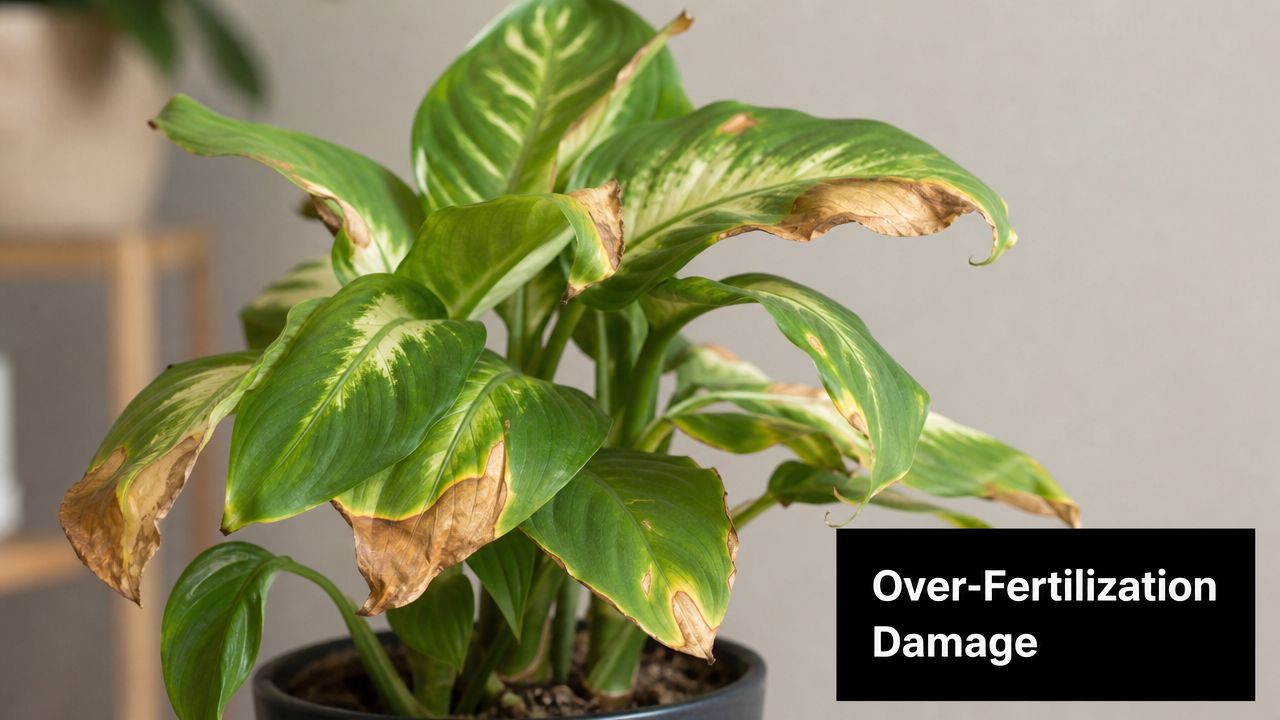
What's happening is often called fertilizer burn. In simple terms, excess fertilizer can leave a buildup of mineral salts in the growing medium. That creates stress around the roots and can make it harder for the plant to take up water properly.
What it looks like
Watch for a cluster of symptoms rather than one single clue.
- Brown, crispy leaf tips: Often the first thing people notice
- Scorched leaf edges: Leaves can look dry even when the soil is moist
- White crust on the soil or pot rim: A visible sign of salt buildup
- Sudden droop after feeding: The roots may be under stress
If a plant declines right after fertilizing, stop feeding before you do anything else.
What to do next
The simplest fix is usually to flush the soil. That means watering thoroughly so excess salts can wash down and out of the pot's drainage holes. You may need to repeat this carefully, depending on how severe the buildup is.
After that, let the plant recover. Don't stack on more fertilizer to compensate. And when you restart, use a lighter hand.
A plant rarely dies because you skipped one feeding. Plants get into trouble much faster when you keep “helping” after they've already had too much.
Beyond Your Windowsill Fertilizer and the Environment
Fertilizer matters far beyond houseplants and backyard beds. Modern agriculture depends heavily on it. Synthetic fertilizer use increased by 800% between 1961 and 2019, a sign of how central it became during the high-yield farming era described in the history of fertilizer.
That scale helps explain both sides of the story. Fertilizers support plant growth and crop production, but overapplication can also lead to nutrients moving into waterways, where they create environmental problems. Our World in Data notes that just under half of people alive today are dependent on synthetic fertilizers, which shows both their importance and the responsibility tied to using them well in any setting, from farms to home gardens, in its overview of fertilizers and global food production.
For a home gardener, the takeaway isn't guilt. It's precision.
What responsible use looks like
- Follow label directions: More isn't better.
- Choose the right formula: Match the product to the plant and the goal.
- Prefer steady feeding when appropriate: Slow-release options can help reduce the urge to overapply.
- Keep excess out of runoff: Apply carefully and avoid washing unused fertilizer away.
Small choices count. A thoughtful gardener uses less guesswork, wastes fewer nutrients, and gets better results at the same time.
When you understand what plant fertilizer is, you stop treating it like a magic potion. You start using it like a tool.
If you want help picking a fertilizer that matches your plant type and your care style, browse Leaves & Soul. The shop focuses on purpose-built fertilizers, soils, and accessories for houseplants, bonsai, orchids, and succulents, which makes it easier to choose with confidence instead of guessing from a crowded garden shelf.