


You water your echeveria, expecting plump leaves the next morning. Instead, the rosette softens, the stem turns dark, and the soil still feels wet days later. Across the room, a jade plant in a coarse, pebble-filled mix keeps growing under the same conditions. The difference often isn't the plant or the climate. It's the space around the roots.
The Quick Answer for Curious Growers
Succulent soil is a fast-draining, mineral-forward growing medium designed to move excess water away from roots while leaving enough moisture and nutrients for steady growth. It isn't defined by a label on a bag. A product called “cactus mix” may still be too fine or too water-retentive for your particular pot, light level, and watering habits.
A useful working test is simple. After a thorough watering, the mix should drain freely, then move from soaked to barely damp within three to seven days in warm indoor conditions, according to independent succulent drainage guidance. That window isn't a rigid rule for every species or season, but it gives you a practical target. A pot that stays wet for weeks behaves more like a houseplant container than an arid root zone.
Four decisions determine whether the mix works:
- Particle size: Coarse particles leave air channels open. Dust and fine peat fill those spaces.
- Mineral-to-organic ratio: Pumice, perlite, grit, and lava rock provide structure, while a smaller organic fraction supplies limited moisture and nutrients.
- Pot porosity: An unglazed terracotta pot can release moisture through its sides, while a glazed container or plastic pot holds it longer.
- Watering cadence: The right schedule follows the mix's dry-down, not a calendar reminder.
Recipes can be adjusted for leafy succulents, desert cacti, humid rooms, and overwatering habits. Troubleshooting also becomes easier once you stop asking, “Which brand is best?” and start asking, “What is this mix doing to water and air?”
Carry this definition to the garden center: succulent soil is a coarse, airy medium that drains quickly, resists compaction, and lets the root zone dry between waterings.
What Succulent Soil Actually Does
A succulent can sit in a bright window yet struggle after each watering if its pot stays heavy and wet. The soil's job is to move excess water away, keep air around the roots, and dry within a predictable window. A suitable mix is fast-draining, airy, and mostly mineral or inorganic material, rather than garden soil or a compost-heavy blend, as described in this extension reference.
Air pockets are part of the root system
Macroporosity describes the larger spaces between coarse particles. Water drains from these spaces by gravity, and air then takes its place. Roots need that exchange because saturated soil leaves little oxygen around them.
A peat-heavy houseplant mix holds water in many small pores. Fine particles can also settle together, forming a dense layer that keeps the root zone damp. That structure may suit a tropical foliage plant, while succulents generally benefit from open channels made by pumice, perlite, coarse sand, or lava rock. These materials work like gaps between stones in a gravel path, giving water a route downward and air a route back in.
Use the dry-down window as your test
A practical mix should lose most freely draining water during the first several days and become dry or nearly dry through the root zone within roughly three to seven days in warm indoor conditions. That window is a working target, not a fixed rule for every species, season, room, or pot. A mix that remains wet for weeks creates a longer period of low oxygen and greater root-rot pressure.
Test the setup without special equipment:
- Water until excess exits the drainage hole.
- Note the pot's weight immediately afterward.
- Check its weight and the mix at root-zone depth over the next several days.
- If it remains heavy and wet beyond the intended window, adjust the particle mix, pot, light, or watering interval.
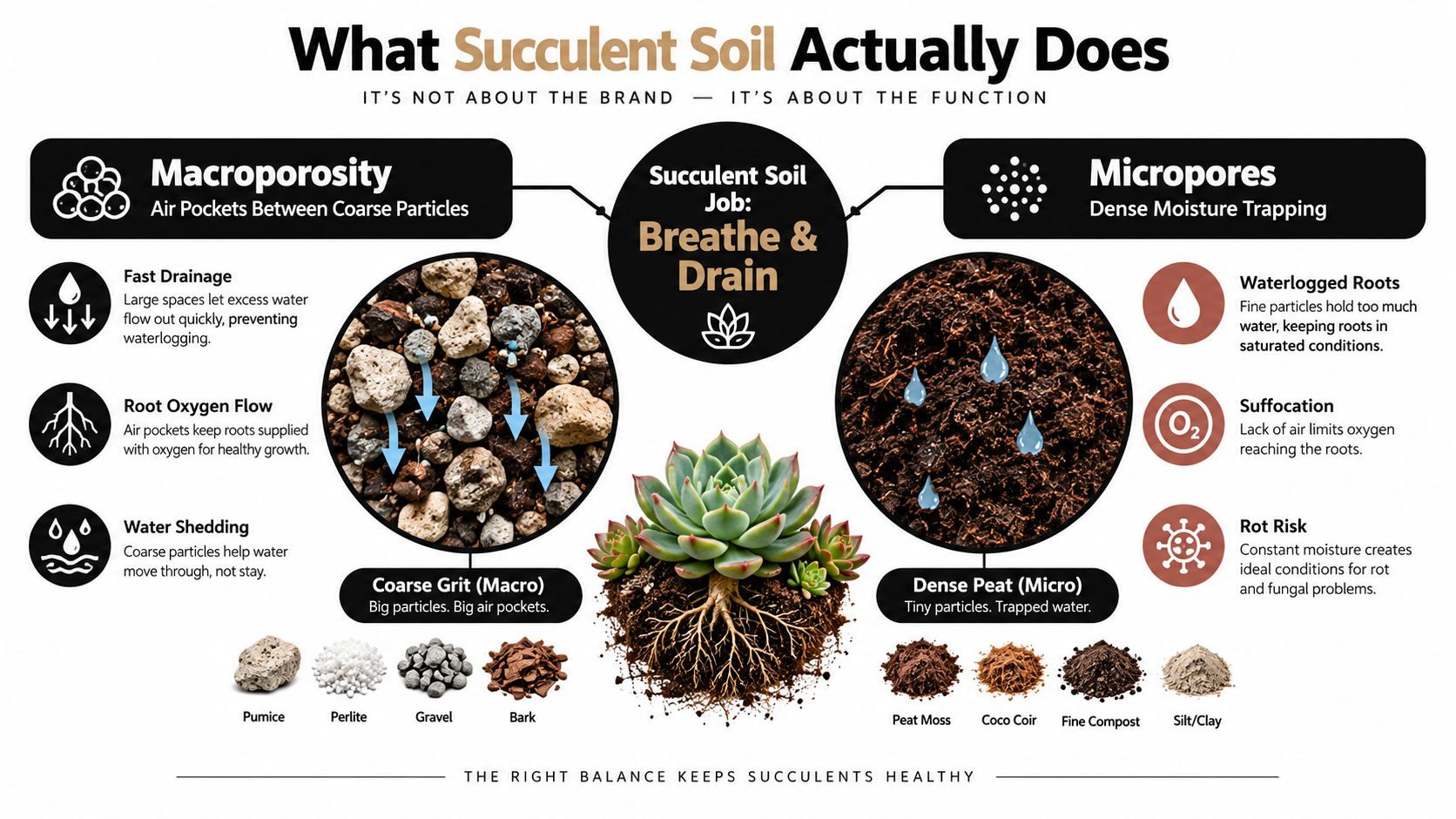
Minerals create the framework
Mineral ingredients keep their shape better than some organic materials. They preserve open space, resist compaction, and control how long water remains near the roots. The organic portion still provides a modest moisture and nutrient buffer, but too much can turn the container into a reservoir.
A useful decision framework connects three choices. Larger mineral particles and a higher mineral-to-organic ratio usually shorten dry-down. A porous terracotta pot can shorten it further, while plastic or glazed containers may hold moisture longer. Choose the combination that brings the root zone toward the three-to-seven-day window. The aim is a repeating rhythm of thorough watering, drainage, air exposure, and controlled drying, not a completely dry container at all times.
The Ingredients That Make Up a Great Mix
A succulent mix works like a carefully spaced framework. Each ingredient affects water movement, air left after watering, and the plant's stability in its pot. The percentages below are starting ranges, not fixed recipes. Published guidance commonly includes mineral amendments, coarse grit, and a relatively low-organic growing medium, while the right balance depends on particle size, room humidity, watering habits, and container choice.
| Ingredient | Drainage | Moisture Retention | Typical % |
|---|---|---|---|
| Pumice | High, with stable pore space | Low to moderate | 30–40% |
| Perlite | High and highly aerating | Low to moderate | 30–40% |
| Coarse sand or horticultural grit | High when genuinely coarse | Low | 20–30% |
| Lava rock | High and durable | Low to moderate | 20–30% |
| Pine bark fines | Moderate, depending on particle size | Moderate | 30–40% organic fraction |
| Coco coir | Moderate, with more moisture buffering | Moderate to high | 30–40% organic fraction |
Pumice and perlite
Pumice is lightweight volcanic stone filled with internal pores. Those pores retain a small amount of water without collapsing into a dense mass, giving roots a limited hydration reserve while preserving open air spaces.
Perlite is a porous volcanic glass sold as bright, lightweight particles. It increases aeration and helps water pass through, but watering can carry it toward the surface. Because it is light, it may also leave a tall or top-heavy plant less stable. Combine it with heavier grit when the pot needs more weight.
Coarse sand, grit, and lava rock
Coarse sand or horticultural grit adds weight and creates larger pathways for water to leave the root zone. Fine play sand can settle between larger particles, closing those pathways and producing the compact texture you meant to avoid. For regional soil-related materials, growers can browse Shopifarm's soil-rich Middlebury listing as a starting point.
Lava rock is rough, durable, and resistant to breakdown. Its irregular pieces form channels around roots and help anchor taller specimens. Clean, angular poultry grit or another additive-free mineral grit can sometimes provide a similar structural function.
Pine bark fines form the organic portion of the mix. They hold some moisture, give roots something to grip, and break down gradually. Use pieces small enough to distribute evenly, but avoid material so fine that it acts like compost.
Coco coir can replace peat when you need an organic ingredient that re-wets readily. It helps a highly mineral mix absorb water more evenly, yet it holds more moisture than grit. Use a smaller share in humid rooms or where watering is frequent.
Particle size and mineral ratio should guide the pot choice. Coarser particles and more mineral material generally shorten dry-down, while terracotta can release moisture faster than plastic or glazed ceramic. Aim for the root zone to approach a three-to-seven-day dry-down window, then adjust the mix, container, light, or watering interval if it stays wet longer. The goal is a repeatable cycle of thorough watering, drainage, air exposure, and controlled drying.
DIY Recipes You Can Mix Today
Treat a homemade mix like a grocery list measured by volume. A scoop, cup, or small container works as long as you use the same measure for every ingredient. The formulas below are practical starting points, while published succulent guidance also describes mineral-heavy combinations such as 50% pumice, 30% grit, and 20% loam or compost, plus blends close to one-third organic and two-thirds mineral in this succulent soil guide.
Recipe one for a general gritty mix
Use this for many leafy succulents, including echeveria, haworthia, and jade:
- 50% pine bark fines: The organic base gives roots some moisture and nutrient-holding capacity.
- 25% pumice or perlite: The porous mineral portion opens the mix and improves aeration.
- 25% coarse builder's sand: The heavy, angular fraction supports drainage and keeps the plant anchored.
If pumice isn't available, perlite is a workable substitute. Choose horticultural or builder's sand that feels gritty rather than silky. Fine sand can pack between bark pieces and defeat the purpose of the recipe.
Recipe two for an extra-fast-draining cactus mix
Use a more mineral-forward blend for desert cacti, humid rooms, or collections that frequently suffer from overwatering:
- 40% pumice: Provides stable pore space and moderate internal moisture.
- 30% lava rock: Adds weight, durability, and open channels.
- 20% pine bark fines: Supplies a limited organic buffer.
- 10% coarse sand: Improves anchorage and helps water move through the column.
Clean poultry grit can replace lava rock if its particles are angular and free from additives. For a broader walkthrough of ingredient handling and mixing, see this guide to making succulent soil.
| Ingredient | Recipe 1: Standard Gritty Mix | Recipe 2: Extra-Fast-Draining Cactus Mix |
|---|---|---|
| Pine bark fines | 50% | 20% |
| Pumice or perlite | 25% | 40% pumice |
| Lava rock | Not included | 30% |
| Coarse sand | 25% | 10% |
Before planting, sieve out dust and particles below 1 mm, lightly moisten dry bark so it doesn't repel the first watering, and label the batch with its recipe. If water races through but the plant wrinkles repeatedly, add a little more organic material next time. If the pot remains heavy and damp, increase the mineral fraction.
Repotting the Right Way
Repotting works best when the plant and the new mix are both relatively dry. Stop watering about five to seven days before repotting, then prepare the container, tools, and fresh medium while the root ball loses excess moisture.
Choose a pot with a drainage hole. Unglazed terracotta usually supports faster moisture release than glazed ceramic, while plastic tends to extend the drying period. Match the container to the root mass rather than the spread of the leaves, and choose a pot no more than one inch wider than the root ball. A large empty volume of soil can stay damp around a small root system.
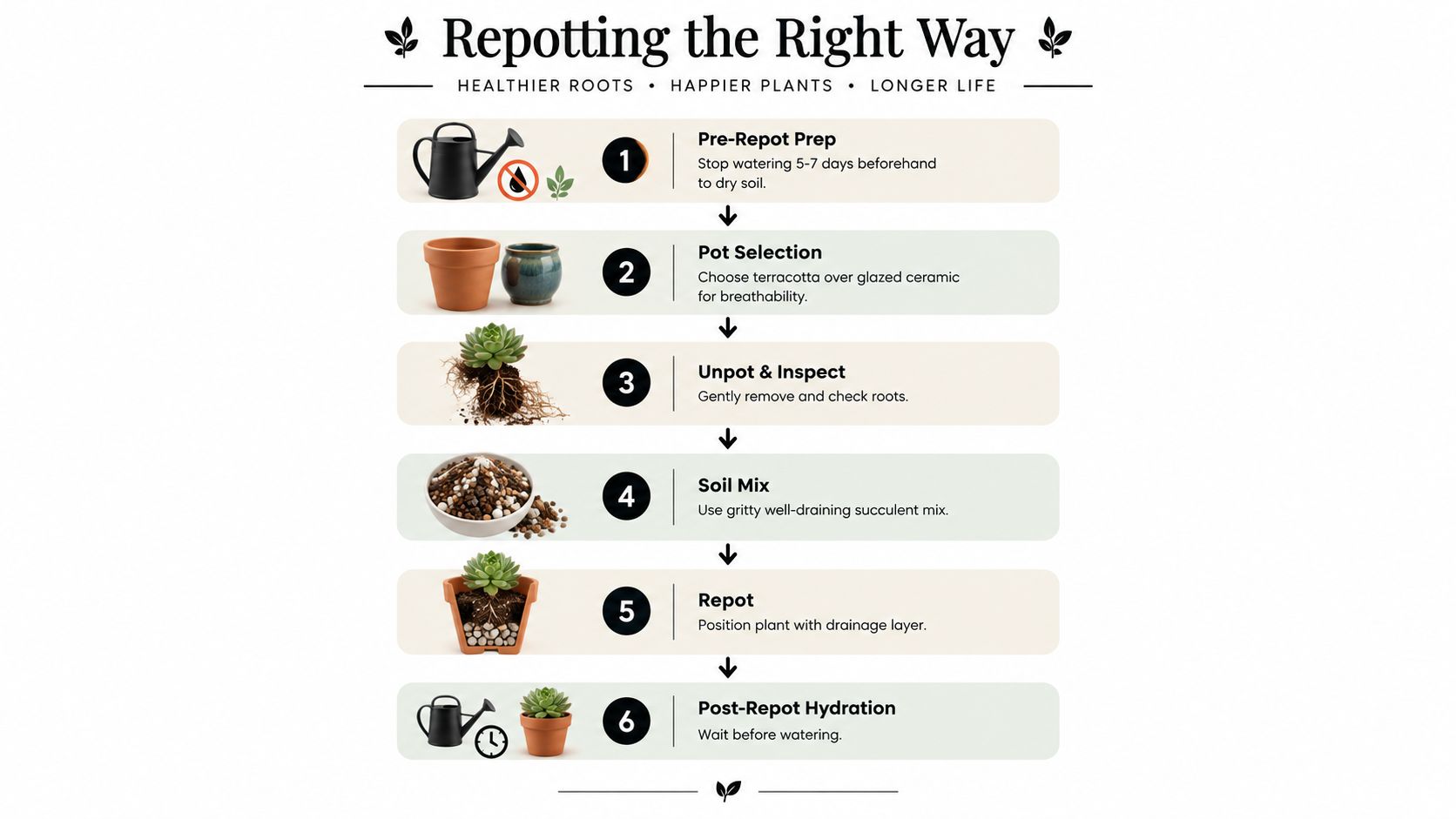
A calm, clean sequence
- Prepare the work area. Set out dry mix, gloves, a clean tool, and the new pot.
- Remove the plant gently. Support the foliage close to the soil line and loosen the root ball without pulling hard.
- Inspect the roots. Healthy roots should feel firm. Remove soft, dark, or foul-smelling material with a clean blade.
- Cover the drainage opening. A small mesh piece or broken pot shard can keep loose mix from escaping. It shouldn't block the hole.
- Add a base of dry mix. Set the root system at the same height it occupied before.
- Spread and fill. Center the roots, add mix around them, and stop at the crown. Don't bury a succulent stem that was previously above the soil.
A video demonstration can help you visualize the hand movements:
For a written companion, follow this succulent repotting guide. After repotting, wait five to seven days before the first watering. This pause lets damaged roots and disturbed tissues dry rather than sealing fresh wounds in wet soil. During the first month, water only after the mix has dried through the root zone, then observe how quickly the new pot becomes light again.
Buying a Mix Versus Making Your Own
A bagged cactus mix offers convenience and a reasonably consistent starting texture. A DIY blend gives you control over particle size, mineral content, and the amount of organic material. Neither option automatically works because the plant, pot, light, and watering routine determine how quickly the medium dries.
Read the ingredient list before buying. The first few ingredients generally make up most of the product, so a label led by peat, coco coir, or generic potting soil may need extra pumice or grit. A bag that feels dusty, clumps when moist, or contains little visible mineral material may drain more slowly than its name suggests.
| Factor | Store-Bought Cactus Mix | DIY Blend |
|---|---|---|
| Cost per quart | Simple to purchase, but varies by product and packaging | Components may be economical when purchased in bulk |
| Consistency | Usually more uniform from bag to bag | Depends on measuring, screening, and mixing |
| Particle size | Can range from coarse to dust-fine | You choose and sieve the texture |
| Organic content | Set by the manufacturer | Adjustable for species, climate, and habits |
| Beginner-friendliness | Fastest route to planting | Requires materials and a little testing |
Match the method to your habits
A beginner who waters often may benefit from a known gritty product or a bagged mix amended with additional pumice. A grower with a large collection can buy mineral components in bulk and tune the blend for different pots. In either case, the dry-down test matters more than the marketing language.
Use a bulk-soil supplier's measurements as a separate planning reference, not as a succulent recipe. For example, this guide to ordering topsoil from Value Tools can help explain volume purchasing, but ordinary topsoil remains a poor default for potted succulents because it can be dense and moisture-retentive.
For indoor conditions, this guide to the best soil for indoor succulents provides another way to think about potting medium selection. If you choose a commercial product, open the bag and inspect it. If it feels like ordinary houseplant soil, alter the texture before planting rather than waiting for rot to reveal the mistake.
Troubleshooting Common Soil Problems
Soil symptoms often look like watering problems, but the container and particle structure may be the underlying cause. Diagnose the chain rather than treating the visible leaf or stem in isolation.
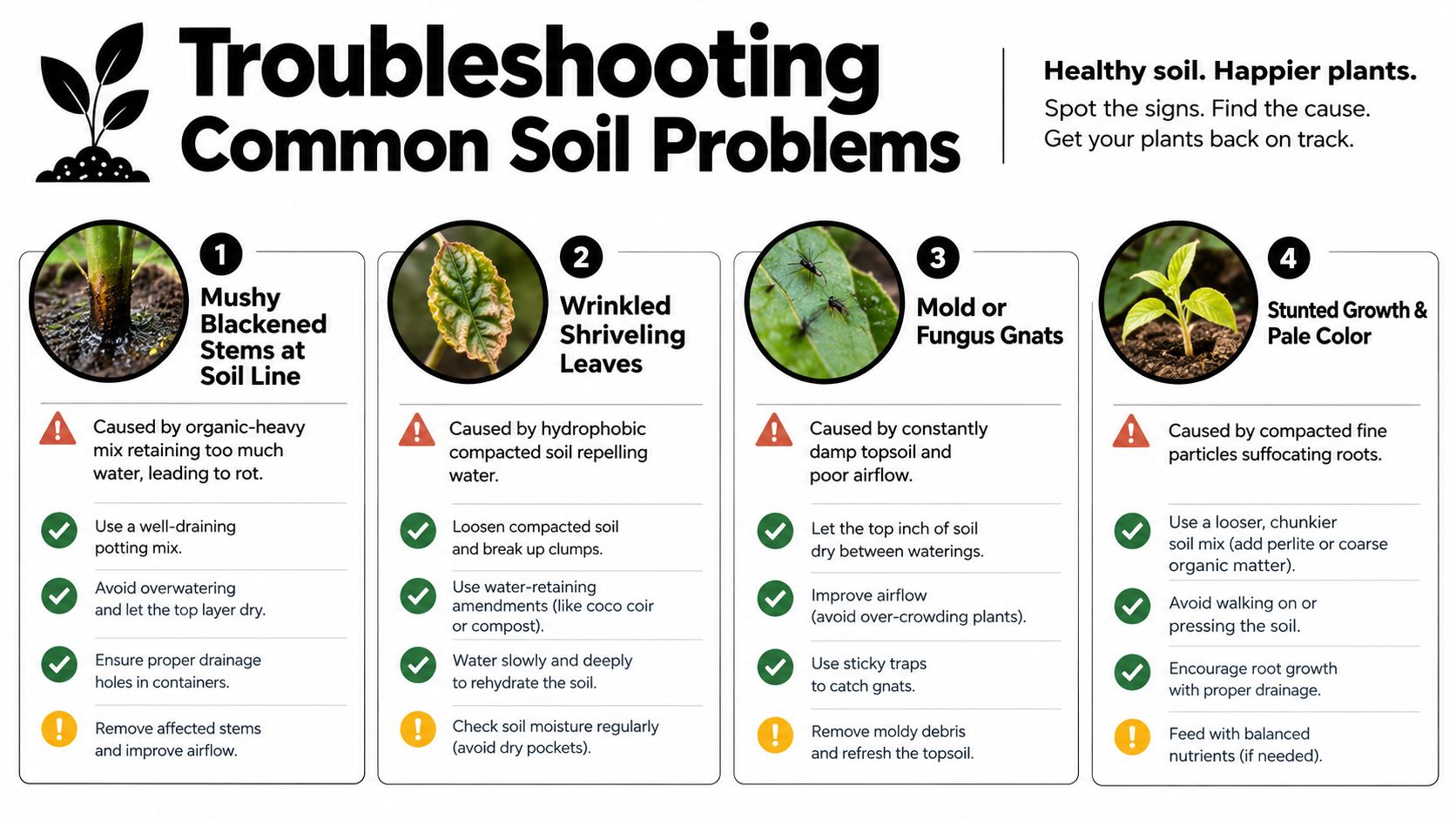
Mushy, blackened stems
A dark, soft stem at the soil line usually signals prolonged moisture around vulnerable tissue. An organic-heavy mix, a container without effective drainage, and a cold or dim windowsill can keep the root zone wet well past the intended dry-down period. Low oxygen then creates conditions that favor decay.
Remove the plant, inspect the roots, and cut away soft tissue with a clean blade. Repot into a dry, coarse medium and a container with an open drainage hole. This week, don't water by habit. Weigh the pot and check the root-zone moisture before each irrigation.
Wrinkled leaves and water-repelling soil
Not every thirsty-looking succulent needs more water immediately. Peat or coir that has dried too far can become hydrophobic, causing water to run down the sides while the center remains dry. The plant wrinkles because the root ball isn't receiving a consistent drink.
Re-wet the medium slowly, using several small applications or a brief soak followed by complete drainage. If the mix repeatedly repels water, replace it with a more mineral-forward blend rather than relying on repeated surface watering.
White crust on the surface
A pale crust may come from minerals left behind by tap water or fertilizer solution. Rainwater generally contributes a different mineral load, but the visible residue alone doesn't tell you whether salts have accumulated dangerously around roots.
A coarse top dressing can hide the crust, but it won't remove the buildup. Flush the medium thoroughly when the plant and pot can drain freely, then review fertilizer strength and water quality. If the crust returns quickly or roots show damage, repot into fresh substrate.
A pot that never dries
An oversized container, dense particles, weak light, and poor airflow can all lengthen the wet period. The plant may look healthy at first while its roots remain in a persistently damp pocket.
Move the plant to a better-lit, better-ventilated position and compare the container size with the root mass. If the medium remains wet, repot into a smaller pot with coarser material. Correct the structure before watering less, because a dense mix can stay wet even when the surface appears dry.
Putting It All Together for Healthier Succulents
Use one decision rule to make the rest of succulent care easier: the pot should reach the intended dry-down window of roughly three to seven days in warm indoor conditions. If it doesn't, change the variable that causes the delay. Increase mineral material, choose a smaller or more breathable pot, improve light and airflow, or lengthen the interval between thorough waterings.
Each ingredient has a primary assignment:
- Pumice and perlite: Create air space and preserve open channels.
- Coarse sand and lava rock: Improve drainage, add weight, and support roots and stems.
- Pine bark fines and coco coir: Provide a modest moisture buffer and organic root support.
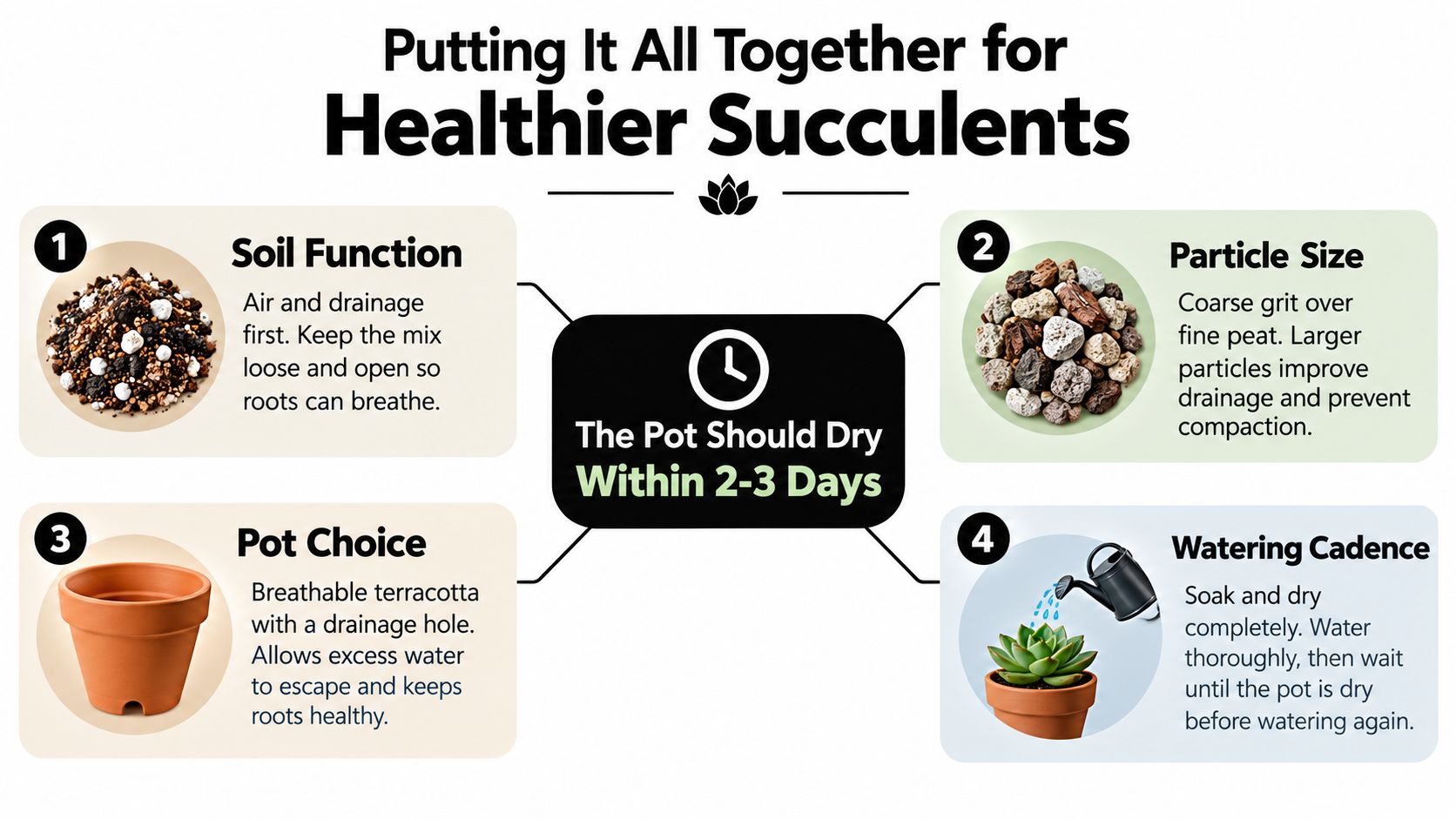
Container choice changes the same equation. Unglazed terracotta can amplify a fast-draining mix by releasing moisture through its walls. Plastic and glazed ceramic usually retain moisture longer, so they may require a more mineral-heavy substrate or a longer interval between waterings. Seasonal conditions matter too. A plant that dries quickly in bright summer growth may need a slower watering rhythm during a darker winter period.
Keep this short checklist near your potting station:
- Check the hole: Never plant in a container without effective drainage.
- Check the texture: Choose coarse, crumbly material instead of fine, clumping soil.
- Check the size: Match the pot to the root mass.
- Check the dry-down: Track how many days the root zone takes to dry.
- Check the season: Reassess after changes in light, temperature, or airflow.
For a broader look at designing low-water plant spaces, you can explore this xeriscaping guide from Task Masters Inc.. The same practical principle applies indoors: give roots the physical conditions that match the plant's water-storing nature.
Leaves & Soul offers ready-to-use succulent soil blends alongside fertilizers and other plant-care supplies, giving you a straightforward option when you want a consistent starting medium for cacti and succulents. Visit Leaves & Soul to choose a purpose-built soil, repot your plant with the dry-down framework above, and build a healthier routine from the roots up.