


You notice one yellow leaf and try to stay calm. Then you spot another on the bottom branch, then one with a brown patch near the middle, and suddenly your fiddle leaf fig feels like a full-blown emergency.
Most of the time, it isn't random. A yellow leaves fiddle leaf fig is giving you a readable signal. The trick is not to treat every yellow leaf the same. A plant that's too wet needs a different fix than one that's hungry, sitting in dim light, or dealing with pests. If you diagnose too fast, you can make the problem worse by watering more when the roots are already stressed, or fertilizing a plant that really needs fresh soil and better drainage.
I've found that the fastest way to save a struggling fiddle leaf fig is to work like a grower, not a guesser. Start with four checkpoints: water, light, nutrition, and pests. Then look closely at the pattern. Is the yellowing mostly on older bottom leaves? Is it spreading through the whole canopy? Are there brown spots too? Are the leaves soft, or dry and crisp?
Why Are My Fiddle Leaf Fig Leaves Turning Yellow?
That sinking feeling is real, especially when the plant looked fine a week ago. But yellow leaves are a symptom, not a verdict.
The two most common drivers are overwatering and soil acidity, with soil pH between 6.5–7.0 being the sweet spot and readings below 6.0 linked to yellowing foliage. When pH drops to 5.5, severe yellowing across the canopy has been documented in reported cases, as explained in this guide on why fiddle leaf figs develop yellow leaves.
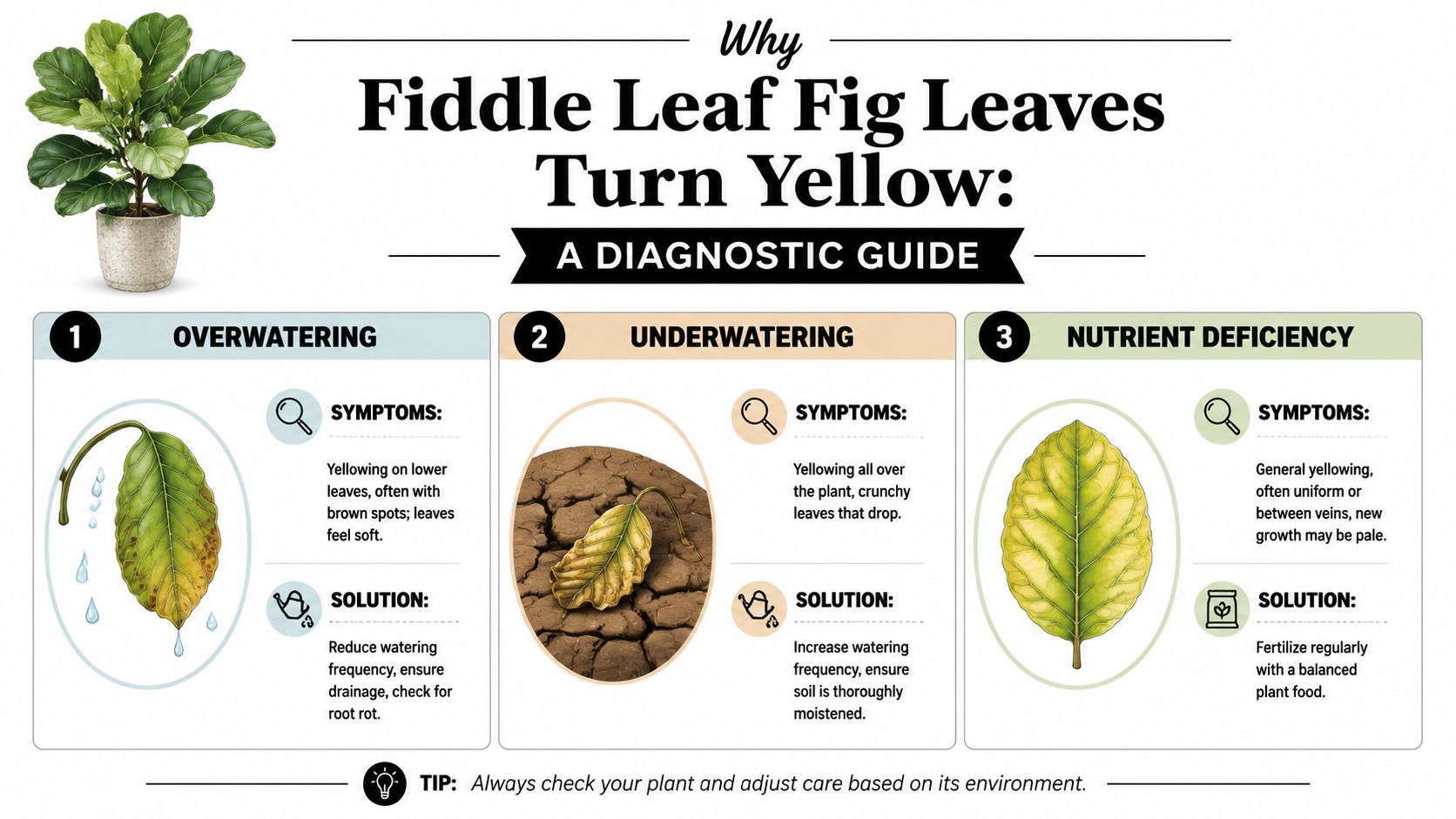
Read the pattern before you react
The plant usually tells you where to look first.
| Symptom | Probable Cause | First Step |
|---|---|---|
| Lower leaves turning yellow first | Overwatering or aging lower foliage | Check soil moisture before doing anything else |
| Yellowing across much of the plant | Water stress or nutrient depletion | Review watering pattern and feeding history |
| Yellow leaves with brown spots | Root stress, often from excess moisture | Inspect drainage and consider root health |
| Pale, washed-out yellowing | Nutrient deficiency or pH issue | Test pH and review fertilizer routine |
| New yellowing after a location change | Light or environmental stress | Move plant back to a stable bright spot |
If you want a useful regional care perspective, this fiddle leaf fig nz care guide is worth reading because it shows how home conditions change care decisions.
A simple triage question helps: Did anything change recently? A new pot, a darker corner, colder drafts, skipped feeding, or extra watering after one dry top layer can all trigger yellowing.
The four-category check
Use this quick filter before you start pruning or repotting:
- Water first: Is the soil wet deep down, or bone dry all the way through?
- Light next: Is the plant getting bright indirect light consistently?
- Food after that: Has it been sitting in the same soil for a long time with no feeding?
- Pests last but not least: Do you see stippling, residue, webbing, or clustered insects?
Practical rule: Don't remove every yellow leaf immediately. Diagnose first. A yellowing pattern often gives away the cause before the plant drops the leaf.
If you want to get better at reading leaf clues in general, this guide on how to read your plant's leaves like a pro is a solid companion.
Mastering the Art of Watering Your Fiddle Leaf Fig
Most yellowing problems start here. People either water on a calendar, or they panic-water when a leaf looks off. Both habits get fiddle leaf figs into trouble.
Watering is the most commonly mismanaged part of fiddle leaf fig care, and overwatering is tied to root rot and leaf yellowing in the majority of documented cases. The best practice is to check soil moisture by inserting your finger to the second knuckle and watering only when the soil has dried to that level, as outlined in this watering and root rot guide for fiddle leaf figs.
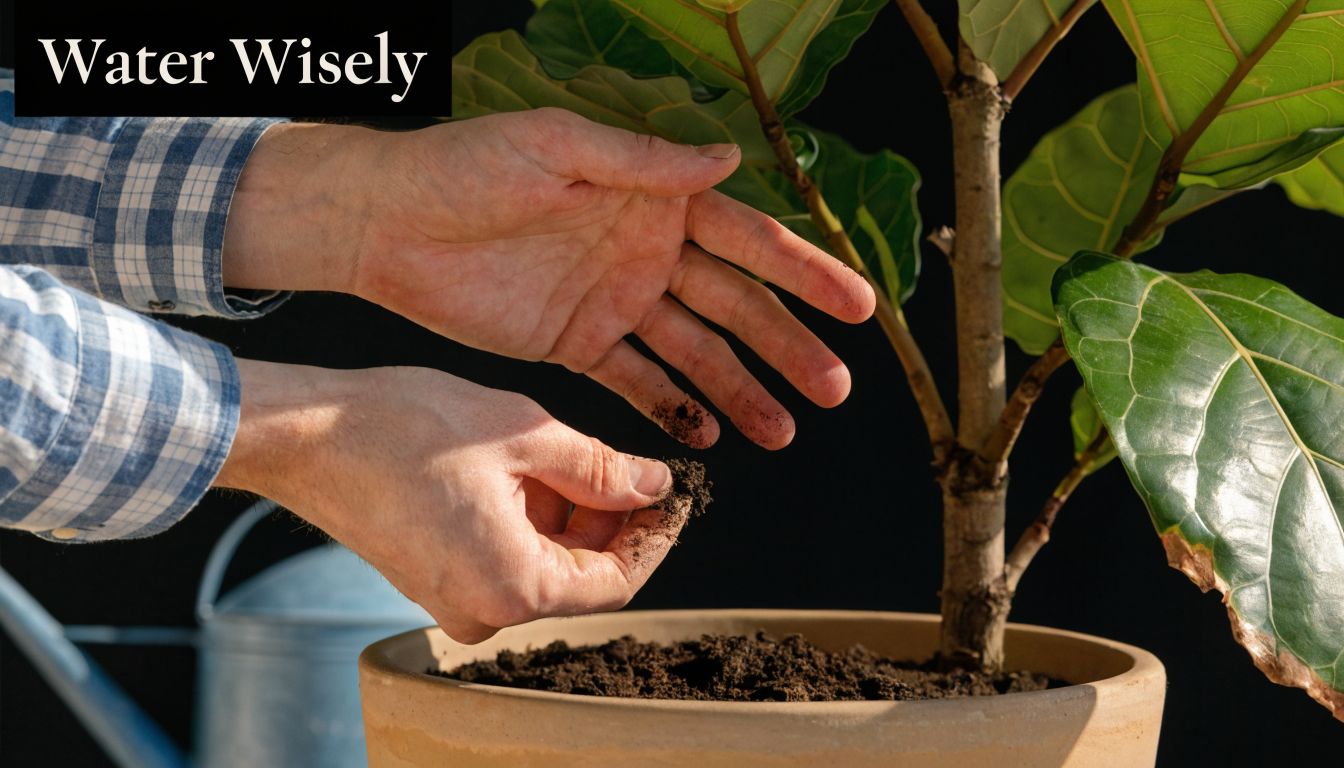
Stop following a rigid schedule
A fiddle leaf fig in a bright room drinks differently from one in a dim corner. A larger plant in active growth uses water faster than a smaller one in winter. That's why “every Sunday” isn't a reliable system.
The second-knuckle test works because it measures the root zone more accurately than the soil surface. The top can look dry while the middle of the pot is still wet. If you keep adding water at that point, roots sit in oxygen-poor soil and begin to fail.
What overwatering looks like
An overwatered yellow leaves fiddle leaf fig usually shows a softer kind of decline. Leaves can look dull, limp, and tired before they fall. If drainage is poor, the damage speeds up.
Use this checklist:
- Soft yellow leaves: These often point to excess moisture, especially on lower leaves.
- Brown spotting with yellowing: That combination often means the roots are under stress.
- Heavy pot that stays wet: Soil that remains wet for too long is a warning sign.
- No drainage or blocked holes: Water has nowhere to go, so roots pay the price.
For a deeper look at why this happens and how to prevent it, read the hidden dangers of overwatering and how to prevent them.
What underwatering looks like
Underwatering feels different. The leaves usually look thinner, drier, and more brittle. The whole plant can seem depleted instead of soggy.
If the leaves feel crisp and the soil has pulled away from the edge of the pot, don't assume fertilizer is the answer. Rehydrate the root ball properly first.
A practical method is to water thoroughly, let excess water drain away, and then wait until the soil again dries to the second knuckle before repeating. Don't “sip water” into the pot every day. That often leaves parts of the root ball dry and parts constantly damp.
This short video gives a useful visual on moisture checking and watering technique.
Use tools if you tend to overthink
If you're never sure whether the pot is still wet, use a simple moisture meter. It doesn't replace observation, but it cuts down on bad guesses. The best growers I know don't water by habit. They water by evidence.
Finding the Perfect Spot for Light and Stability
A fiddle leaf fig can survive in the wrong spot for a while. It just won't stay happy there.
The key phrase is bright indirect light with some gentle direct sun exposure. In a real home, that often means close to a bright window, not stranded in the middle of the room. East-facing light is usually gentle and dependable. Near a south-facing window can also work if the plant isn't getting blasted after a sudden move from lower light.
Light affects watering more than people think
Low light and overwatering often arrive together. When a plant gets less light, it uses water more slowly. If you keep watering at the same pace, the soil stays wet longer and roots struggle.
That's why a plant that looked fine in summer can start yellowing after being shifted deeper into the room or after seasonal light drops. The owner thinks the problem is random. It usually isn't. The plant's water use changed before the watering habit did.
Stability matters almost as much as light
Fiddle leaf figs hate repeated disruption. Drafty doors, heating vents, sudden cold snaps, and constant repositioning all create stress. A stressed plant is less efficient at regulating moisture and growth, so small care mistakes hit harder.
A good placement test is simple:
- Can the plant stay there long term? Frequent moving causes setbacks.
- Is the light consistent day to day? Stable exposure is easier on the plant.
- Is it away from vents and temperature swings? Leaves react quickly to harsh shifts.
Pick a “home base” and let the plant adapt there. Constant improvement attempts often create more stress than the original problem.
When the location is right, watering becomes easier to judge and recovery speeds up. When the location is wrong, every other fix works harder than it should.
The Right Way to Feed and Fertilize Your Fig
A fiddle leaf fig can't live on old potting soil forever. If it's been in the same mix for a long stretch with no supplemental feeding, yellowing can come from simple depletion.
That's especially true because nutrient uptake depends on pH. When soil pH drops below 6.0, fiddle leaf figs can develop yellowing from nutrient lockout that limits uptake of key nutrients such as nitrogen and magnesium. Applying a balanced 16-5-11 slow-release fertilizer is part of the documented remediation approach, and this method produced 85% reversal of yellowing within 4–6 weeks in controlled studies described in this guide to fixing yellow fiddle leaf fig leaves.
Know when your plant is hungry
Nutrient-related yellowing usually looks more even and less dramatic than root rot. The plant can appear pale, washed out, and stalled. New growth may come in weak, and older leaves may lose their deep green tone.
Nitrogen matters because it supports chlorophyll production. When the plant can't access enough, leaves often move from healthy green to lighter green and then yellow.
What works better than random feeding
The best feeding plan is boring on purpose. Use a balanced, fiddle-specific fertilizer, apply it consistently during the active growing season, and avoid the urge to overcorrect with heavy doses.
A practical feeding approach looks like this:
-
Check pH if yellowing keeps returning
If the pH is too low, fertilizer alone won't solve the problem because the roots can't use nutrients efficiently. -
Feed during active growth
Healthy fiddle leaf figs produce new leaves every four to six weeks in spring and summer according to the earlier cited plant care guidance, so that's when feeding supports real work. -
Use slow-release nutrition for steadier results
Slow-release pellets are easier to manage than erratic liquid feeding when consistency is the goal.
What doesn't work
A starving plant won't recover from water alone, but a stressed plant also won't enjoy being blasted with fertilizer. If roots are damaged, excess feeding can push them further.
Feed a growing plant. Rescue the roots first if the soil is sour, compacted, or staying wet for too long.
If your fig hasn't been repotted or fed in a long time, nutrition should move high on your suspect list. Yellowing from hunger tends to improve gradually once the plant has a stable light setup, workable pH, and a regular fertilizer rhythm.
Emergency Interventions for Pests and Root Rot
Some fiddle leaf figs slide from “a little off” to “serious trouble” because the owner keeps making small surface adjustments while the roots are failing underneath. It's time to stop tweaking and start inspecting.
I think of this as plant ER care. You don't need to panic, but you do need to be decisive.

First rule out pests
Spider mites, scale, and other sap-sucking pests can weaken a fig and leave it looking tired and yellow. I check the undersides of leaves first, then stems, then the junction where the leaf meets the branch.
Look for:
- Fine webbing or speckling: Often points to mites.
- Raised bumps on stems or leaves: Scale is a common suspect.
- Sticky residue or repeated yellowing on one section: Sap feeders may be present.
If you find pests, isolate the plant, wipe leaves carefully, and repeat treatment consistently. One cleaning almost never finishes the job.
When root rot is the real problem
Advanced root rot usually shows up as a sequence, not a single symptom. Existing care content often misses the compound risk created by overwatering plus low light, but this combination is especially hard on fiddle leaf figs. A pattern of yellowing leaves, brown spots, and leaf drop together points to advanced root stress, and recovery requires repotting into fresh, well-draining soil while also increasing light and adjusting watering as explained in this root rot diagnosis and recovery guide.
That sequence matters. If you only water less but leave the plant in dense, wet soil in a dim spot, the roots keep losing ground.
The repotting decision
Unpot the plant if the symptoms are stacking up and the soil never seems to dry properly. Then inspect the roots.
Healthy roots are usually firm and lighter in color. Rotten roots tend to look dark, mushy, or slough off easily. Trim away the damaged sections with clean scissors, discard the old soil, and repot into a fresh, airy mix with proper drainage.
Use this order:
- Remove the plant gently
- Inspect and trim damaged roots
- Discard exhausted or sour soil
- Repot into a well-draining mix
- Move the plant into stronger appropriate light
- Restart watering cautiously, not generously
For a practical walkthrough, this article on root rot signs and fixes is helpful.
Root rot recovery never comes from one change. You need the full reset: fresh soil, better drainage, stronger light, and a smarter watering pattern.
That's the difference between a temporary pause in decline and a real recovery.
Your Proactive Fiddle Leaf Fig Care Routine
The biggest mistake people make after recovery is treating the plant like it's fixed forever. It isn't. A fiddle leaf fig does best with a repeatable rhythm.
The good news is that the routine doesn't need to be complicated. It needs to be observant.
A simple maintenance rhythm
Use a seasonal pattern instead of a strict all-year routine.
- Spring and summer: Check moisture often, feed consistently, and watch for fresh leaf production.
- Cooler, darker months: Slow down watering, keep the light exposure steady, and don't assume dry indoor air means the roots need more water.
- Every month: Wipe dust from leaves so the plant can use available light more effectively.
- During regular care: Scan for pests before they turn into a bigger cleanup project.
Small actions prevent bigger rescues
Prune damaged leaves when the plant is actively growing and only after you understand why they yellowed. If you remove foliage without fixing the cause, the plant just repeats the problem.
Also watch the pot itself. Soil compacts over time. Drainage holes clog. The root ball changes. “Set it and forget it” care sounds easy, but it's exactly how many yellow leaves fiddle leaf fig problems keep coming back.
The routine that actually lasts
The best plant owners aren't the ones doing the most. They're the ones doing the right small things on a repeatable schedule.
That means:
- Check before watering
- Keep the location stable
- Feed during active growth
- Inspect leaves and roots when symptoms stack up
- Respond early, not dramatically
A healthy fiddle leaf fig isn't a mystery plant. It's a pattern plant. Learn the pattern, and yellow leaves stop feeling like a crisis.
If your fiddle leaf fig needs better support from the soil up, Leaves & Soul offers purpose-built houseplant fertilizers, specialty soils, and plant care supplies that make consistent care much easier. It's a practical place to start when you're ready to move from guesswork to a cleaner, more reliable plant routine.