


A 2-liter retail bag can cost under €4, a 14-liter bag commonly costs €18–€26, and U.S. listings can reach roughly $18–$65. The fair price depends on grade, particle size, durability, and shipping, not the bag's headline price alone.
You're staring at two listings, both labelled akadama. One is a small local bag that looks cheap. The other comes from a bonsai specialist and costs more, but contains enough substrate for several repottings. The obvious question is which bag saves money today. The useful question is which one costs less per growing season.
Akadama for sale varies by hardness, screening, particle size, packaging, origin, and freight. A soft, dusty grade may look like a bargain until it collapses into mud. A harder, well-screened grade may cost more at checkout but remain useful for longer. Shipping can also change the calculation, especially when the material travels internationally.
This guide gives you a practical way to judge value before you buy. It also explains when akadama earns its place in a mix, when another substrate is smarter, and how to avoid paying a premium for a product that doesn't suit your tree.
The Moment You Start Comparing Akadama Bags
You find two listings labelled “akadama.” One is a small local bag with a low price. The other costs more but contains enough material for several repottings. Do not decide from the checkout total. Compare what each bag costs per growing season after screening, shipping, and replacement.
Akadama for sale differs by hardness, screening, particle size, packaging, origin, and freight. A soft grade packed with fines can collapse into mud and lose airflow quickly. A harder, well-screened grade may cost more initially while delivering more usable seasons. The right comparison is total growing-season cost, not price per bag.
Current listings show 2-liter bags under €4, 14-liter bags around €18–€26, and U.S. retail packs from roughly $18 to $65, depending on grade and package size (Eastern Leaf's akadama listings). Treat those figures as reference points, not a universal price list. Regional supply, shipping, and package format can change the delivered price sharply.
The bag price hides the growing-season cost
A cheaper bag with soft particles and heavy dust may require more screening, lose structure sooner, and force an earlier repot. A larger bag with durable granules can leave you with more usable substrate and a lower cost per season, even if its shelf price is higher.
Calculate five things before buying:
- Usable volume: Measure what remains after removing dust and broken fragments.
- Grade durability: Harder particles generally keep their shape longer.
- Shipping weight: Mineral media can make delivery a major part of the final bill.
- Mix role: If akadama is one component, calculate the amount your recipe uses.
- Pot and tree size: Fine particles in a deep pot can reduce airflow faster than a suitable coarse grade.
Practical rule: Choose the grade your tree needs, then compare delivered price per usable liter and expected season of service.
Akadama has a narrow Japanese supply base, with production concentrated mainly in Tochigi and Ibaraki Prefectures. That sourcing pattern helps explain why a local bag and an imported specialist bag can differ so much. The lowest-priced option may still suit a small project, while the highest-priced bag may offer the wrong grade or particle size. Judge performance after freight and over the full growing season, not at checkout.
What Akadama Actually Is and Why Growers Trust It
Akadama is a granular Japanese volcanic clay used as a bonsai substrate. It comes from hardened layers associated with the Kanto Loam, a volcanic ash deposit formed over the Quaternary period, which began about 2.58 million years ago (history and geology of akadama). Its horticultural use is far newer, with accounts placing its beginnings around 1923 or 1937, followed by wider commercial production during the 1950s and 1960s Satsuki azalea boom.
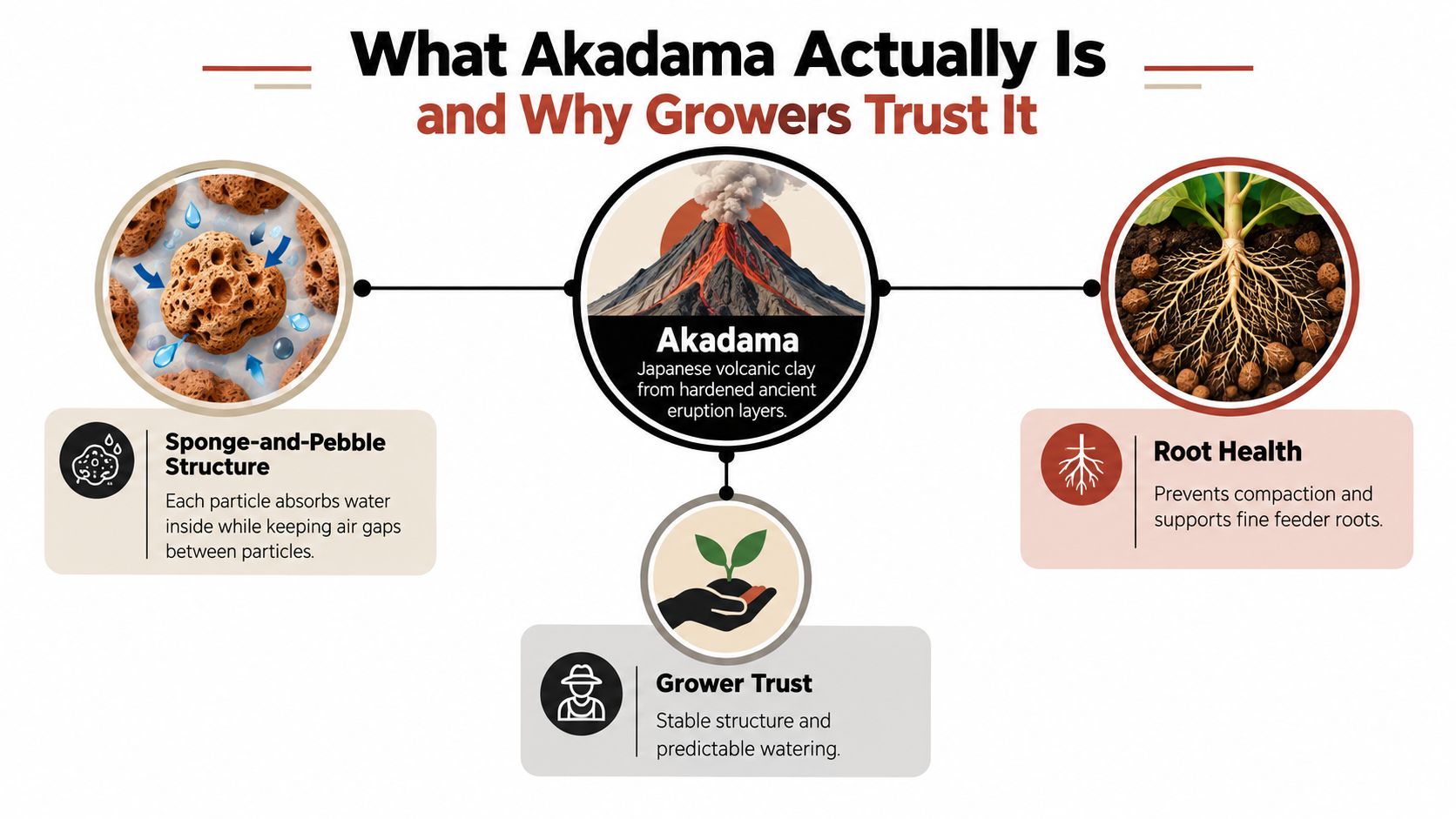
Each particle functions like a porous sponge, with air gaps between the grains. Its structure holds water and dissolved nutrients, while the spaces between particles let air reach the roots. The result is a medium that stays moist without compacting into a sealed block.
Why particle structure matters
Akadama works through the balance of water retention, drainage, root contact, and air space. Fine grades keep roots close to moist particles and hold more water. Coarse grades leave larger gaps, improving drainage and oxygen diffusion (bonsai soil component guidance).
Hardness matters just as much as particle size. Softer akadama breaks down sooner. Harder grades preserve open pore space longer, which can reduce structural decline across a growing season. As particles degrade into fragments and dust, drainage suffers and roots receive less oxygen.
That breakdown rate belongs in the buying decision. A cheaper bag may deliver less usable structure and require replacement sooner, while a harder grade can cost less per growing season despite a higher shelf price. Shipping weight also affects the value of mineral media, so compare delivered cost with usable volume and expected service life.
Pure akadama suits specific setups, but it is not required for every bonsai. Many growers combine it with pumice, lava, bark, kanuma, or other mineral media. For guidance on selecting a workable substrate, see this guide to finding the best bonsai soil.
My view: Akadama earns trust as a controllable structural ingredient, not as magic soil in a bag.
Grades and Particle Sizes That Actually Matter
Choose particle size from the growing setup, not the product label. Pot depth, tree size, root density, and watering conditions determine whether fine, medium, or coarse akadama will perform well.
Fine particles hold more water and keep roots close to moist surfaces. Coarse particles leave larger air spaces and drain faster. As pot and tree size increase, a larger grain usually makes sense. A medium grade around 2–4 mm suits many mature bonsai because it balances moisture and aeration. For a practical explanation, read this guide to how soil particle size affects drainage.
Match the grade to the container
Use fine akadama in a shallow shohin pot or for delicate root work. Medium grade is the sensible starting point for many established bonsai. Choose coarse particles for large trees, deep containers, or wet conditions where excess moisture must leave quickly.
| Particle Size | Best For | Pot Diameter | Tree Type |
|---|---|---|---|
| Fine, around 1–3 mm | Shohin, seedlings, fine root work | Small and shallow pots | Small deciduous bonsai and propagation |
| Medium, around 2–6 mm | General-purpose bonsai mixes | Medium pots | Deciduous, tropical, and many established trees |
| Coarse, around 6–12 mm | Large root systems and high drainage | Large or deep pots | Conifers and larger specimen bonsai |
These ranges overlap by design. A shallow pot holding a thirsty tree may need a finer blend than a deep pot with the same species. Frequent watering or humid weather makes excessive fines a poor choice because they can leave the mix short of air.
Screen before you trust the bag
Japanese grades are generally sorted more carefully than ungraded imports. Cheaper alternatives may include dust, broken fragments, and inconsistent sizes that compact after watering. That does not make every non-Japanese product unusable. It means you should inspect the contents instead of treating the label as proof of performance.
Check the usable material, not just the bag price. A heavier shipment with abundant dust may deliver less workable volume, while durable, well-screened akadama can cost less per growing season because it keeps its structure longer. Listings that provide only weight and origin are incomplete. Look for particle-size information and screen the material yourself when needed.
For pots under 15 cm, buy pre-screened akadama or sift it before potting. That small step removes fines, clarifies the actual grade, and helps you compare total delivered value rather than price per bag alone.
Where Akadama Shines and Where It Disappoints
Akadama is excellent for bonsai when you need a visible, adjustable balance between moisture and air. It anchors newly potted trees, gives fine roots a consistent medium, and makes watering easier to judge because the granules change appearance as they dry.
For deciduous bonsai, that balance can support dense feeder-root development and steady growth. The weakness is structural: akadama eventually breaks down, especially when a softer grade faces repeated wetting, drying, and root disturbance. Pumice and lava generally keep their shape longer, so a mix containing those materials may remain open for more time.
Bonsai gets the strongest case
Use akadama when your watering routine benefits from a moisture buffer and when you want a medium that shows changes clearly. Pair it with pumice or lava rather than assuming a single substrate must do everything.
The result depends on the grade and the environment. A fine mix in a wet climate can become too dense after breakdown. A coarse mix in a dry, windy location may drain faster than the roots can use.
Succulents need restraint
Succulents and caudex plants usually don't need akadama as the dominant ingredient. In an unglazed or deep pot, akadama can retain more moisture than the plant wants, particularly if airflow is poor.
Use abundant pumice or lava for these plants, and treat akadama as a limited component when you need additional water retention or root contact. If the pot stays wet, changing the mineral balance is more useful than watering less.
Houseplants rarely need it
Akadama has niche uses for orchids, aroids grown in terracotta, and bonsai-style figs. Standard tropical houseplants in a suitable peat-based or bark-based mix can grow well without it. Paying imported-substrate prices for a plant that already has an appropriate medium is unnecessary.
| Plant Category | Moisture Retention | Root Development | Repot Frequency | Overall Verdict |
|---|---|---|---|---|
| Bonsai | Adjustable and dependable | Strong when particles stay open | Depends on grade and conditions | Worth using in a balanced mix |
| Succulents and caudex plants | Often higher than needed | Good only with strong aeration | Driven by moisture and breakdown | Use sparingly |
| Indoor houseplants | Useful for selected species | Helpful in specialist mixes | Usually not the deciding factor | Optional, not a universal upgrade |
Akadama is a specialist tool. It isn't a compulsory upgrade for every plant on your shelf.
How to Mix Akadama Into a Soil That Works
A good mix starts with the tree's water demand and the pot's drainage, not with a fashionable recipe. Use clean, screened components and keep the particle sizes reasonably consistent so fine material doesn't settle into the gaps between coarse pieces.
For a conifer such as a pine or juniper, use a 1:1:1 blend of akadama, pumice, and lava in a medium particle range. This gives the root system mineral contact while keeping the structure open. Conifers generally benefit from a mix that drains freely rather than one built around maximum water retention.
A deciduous bonsai such as a maple, elm, or hornbeam can take a more akadama-heavy blend. Use 2 parts akadama, 1 part pumice, and 1 part lava, with particles around 2–5 mm. The additional akadama provides a larger moisture buffer, while pumice and lava protect the air spaces.
Adjust the recipe instead of forcing it
For acid-loving species, replace part of the blend with kanuma rather than treating akadama as the only option. For small shohin pots, use finer material and include a small amount of sphagnum when the container dries too quickly. Avoid blindly copying a mix from a grower in a different climate.
The same recipe can behave differently in a covered greenhouse, a windy balcony, and a shaded outdoor bench. Watch how quickly the pot dries and how easily water runs through. Then adjust particle size before changing every ingredient.
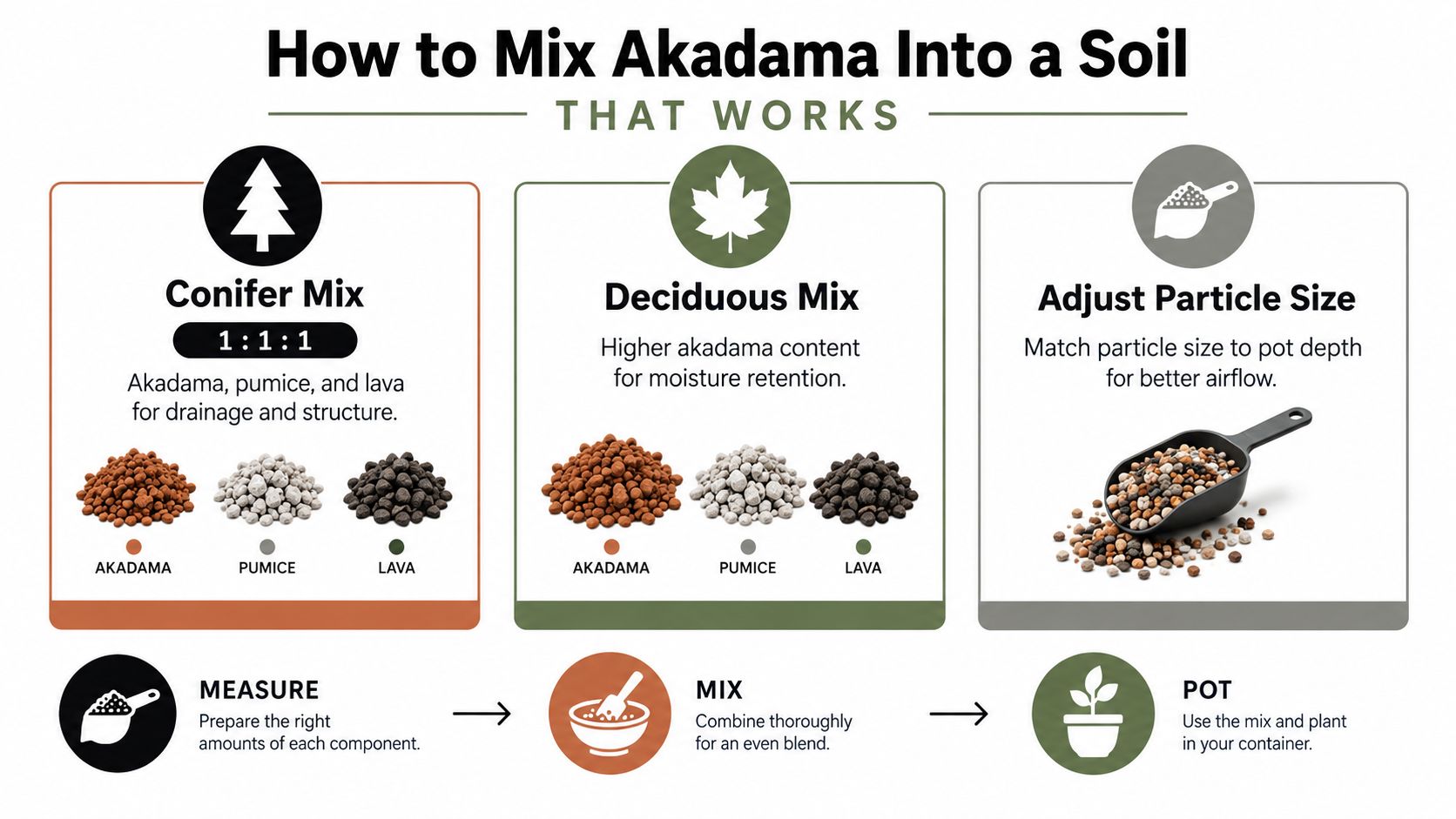
Sift, rinse, and pre-wet
Run the dry material through screens before mixing. Remove the finest fraction, shake off loose dust, and separate obvious broken pieces. Excess fines can fill the air spaces that make a mineral mix work.
Pre-wet the finished blend before potting. Dry akadama can initially resist water, while pre-wetted particles settle more predictably around the roots. Place the tree, fill the container without compressing the mix hard, and water thoroughly.
For a broader starting point, compare this bonsai soil mix recipe. When reusing old material, sieve out the mud fraction, discard degraded particles, and sterilize what remains before using it again.
Here's a visual walkthrough of the mixing logic:
Shipping, Packaging, and Regional Sourcing Realities
Akadama is heavy, fragile, and sourced from a relatively narrow region. Japanese production is concentrated mainly in Tochigi and Ibaraki Prefectures, while exporters describe open-cast mining and worldwide distribution (Japanese akadama production and export context). That combination creates a strange market: demand is international, but supply is geographically limited.
Shipping can erase the apparent saving on a larger bag. A local specialist may charge more per liter but deliver intact, screened material. An overseas marketplace may show a lower product price and then add freight, handling, or breakage risk at checkout.
Packaging tells you what the seller expects
Look for clear photographs of the actual granules, the stated particle range, and protective packaging. A sealed inner bag or double packaging suggests the seller understands that crushed fines can change the product before it reaches your bench. Loose packing deserves more caution, particularly when the shipment travels a long distance.
If you're evaluating a seller for the first time, check the return terms and how the vendor handles damaged bags. A useful general reference on freight packing for logistics can help you recognize sensible protection for heavy, breakable cargo.
| Region | Common Origin | Typical Bag Size | Average Shipping Cost | Lead Time |
|---|---|---|---|---|
| Japan | Japanese regional mines | Retail and specialist bags | Varies by destination and carrier | Varies by stock |
| Europe | Imported Japanese material and regional resale | Small retail and larger specialist bags | Often shaped by domestic delivery and handling | Usually shorter from local stock |
| North America | Imported Japanese material and reseller inventory | Retail and bulk formats | Can form a substantial part of the delivered price | Depends on import and warehouse stock |
The table is a buying framework, not a universal rate card. Sellers don't publish identical shipping terms, and regional stock changes the result.
Consolidate heavy purchases
If you need pumice, lava, mesh, wire, or pots, combine them into one order when the seller's shipping structure makes that sensible. Paying for one coordinated delivery can be more efficient than ordering each mineral component separately.
Don't buy a huge bag merely to “save on shipping” if the grade doesn't suit your pots. A damaged or unsuitable substrate is expensive even when delivery was cheap.
Smart Alternatives When Akadama Is Hard to Get
Akadama shortages, freight costs, and inconsistent regional stock make substitutes practical. The right replacement depends on which function you need: air space, water retention, anchorage, acidity, or long-term structure.
Pumice is the closest practical partner for many growers. It stays open, supports drainage, and works well in mixes where akadama supplies moisture retention. Lava rock adds durable structure and weight, although its surface texture and grading vary.
Kanuma belongs in a narrower category. It suits acid-loving plants, especially azaleas, but it isn't a general replacement for akadama. Calcined clay products such as Turface or Moler are underrated for tropical plants because they can add mineral structure without forcing you to import Japanese material. Seramis can help in selected indoor mixes, but its behavior and particle shape don't make it a universal bonsai substitute.
Compare the job, not the brand name
| Substrate | Drainage | Breakdown Rate | pH | Cost per Liter, Approx. | Best Use |
|---|---|---|---|---|---|
| Akadama | Balanced, grade-dependent | Moderate to slow, grade-dependent | Mildly acidic to near neutral | Regional and grade-dependent | Bonsai mixes needing moisture retention |
| Pumice | High | Slow | Generally near neutral | Regional and supplier-dependent | Aeration and durable structure |
| Lava rock | High | Slow | Generally near neutral | Regional and supplier-dependent | Drainage, weight, and long-term structure |
| Kanuma | Moderate | Moderate | Acidic | Regional and supplier-dependent | Acid-loving plants |
| Calcined clay | Moderate to high | Product-dependent | Product-dependent | Regional and supplier-dependent | Tropical and mineral indoor mixes |
| Seramis | Moderate | Product-dependent | Product-dependent | Regional and supplier-dependent | Selected houseplant applications |
Because verified market prices vary by region and pack size, don't treat a generic cost-per-liter figure as reliable. Compare the delivered price of the actual product in your cart.
Two useful nonstandard approaches
For bonsai, a 1:1:1 akadama, pumice, and lava mix remains a dependable starting point when you want a balanced mineral medium. If akadama is unavailable, try 5 parts pumice, 3 parts pine bark, and 2 parts lava. That mix won't behave identically, but it can provide a credible balance of drainage, organic moisture buffering, and structure.
My preferences are blunt. Turface deserves more attention for tropicals. Crushed LECA gets recommended too casually when its water behavior doesn't suit the pot or root system. For junipers in a dry climate, 100% pumice can be a credible low-cost answer when your watering routine supplies what the substrate doesn't retain.
Pay for akadama when you need its particular moisture-and-air balance and can source a durable, properly graded product. Choose pumice and lava when longevity, local availability, or shipping economics matter more.
A Confident Akadama Buying Checklist
Use this list at checkout. If a listing fails several checks, leave it alone.
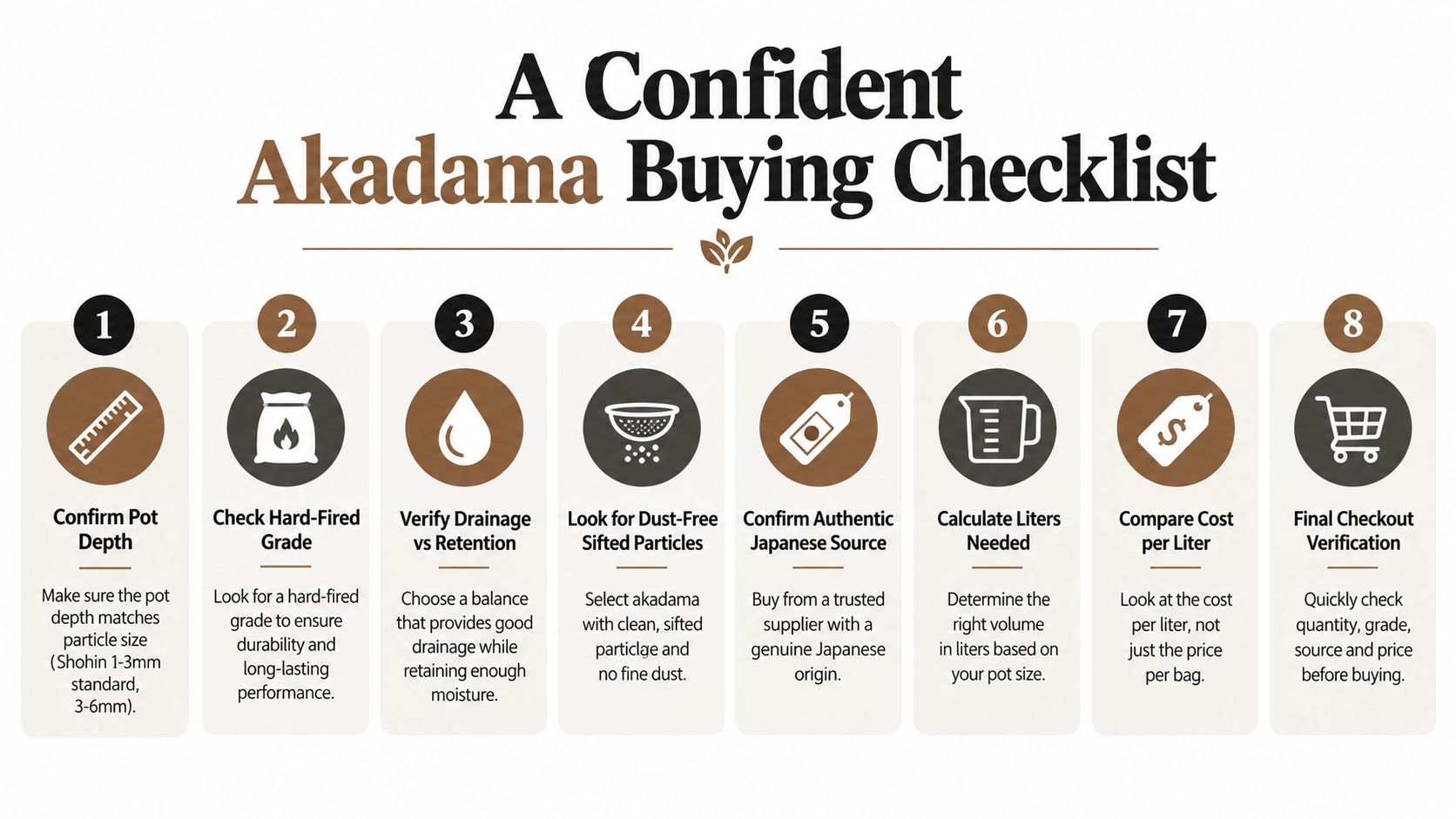
- Match the pot depth: Choose fine particles for shohin, medium particles for ordinary bonsai containers, and coarser particles for deep pots.
- Inspect the granules: Look for reasonably uniform reddish-brown particles rather than a bag dominated by dust.
- Confirm the grade: Hard-fired material is the safer choice when you want structural life and fewer premature replacements.
- Check the moisture balance: Fine material retains more water, while coarse material gives roots more air.
- Verify the origin: Japanese akadama commands a premium because supply is regional and grading can be more consistent.
- Calculate usable volume: Account for sifted dust and broken material, not just the printed bag size.
- Compare delivered value: Judge cost per usable liter and expected growing-season service, not price per bag.
- Read recent reviews: Search for complaints about powder, caking, crushed particles, damaged packaging, and weak return support.
Apply a strict value test
A larger bag makes sense when you have several trees or already need other heavy components. A small bag is sensible for one small pot, especially when you want to test the grade before committing to bulk stock.
Don't accept vague listings. The seller should identify the particle size, package volume, and origin clearly enough for you to compare products. If the vendor won't explain what arrives in the bag or how damaged material is handled, review practical guidance on how to define vendor failure before ordering.
Keep one extra liter available for top-dressing refreshes and minor repotting repairs. That small reserve is more useful than discovering halfway through a job that the bag contains too many fines.
Checkout rule: Choose the substrate that gives your tree the right air and water balance at the lowest realistic cost per season.
Leaves & Soul offers professional-grade bonsai soils, fertilizers, pots, wiring kits, and a Premium Bonsai Soil All Purpose Blend in pre-mixed 2.2 and 8.2 dry-quart formats, giving you an alternative to buying akadama separately. Visit Leaves & Soul to compare a ready-to-use bonsai medium with your akadama options, then choose the mix and accessories that fit your tree, pot, and watering routine.