


Ficus retusa and Ficus microcarpa are the most beginner-friendly indoor bonsai choices, with Ficus retusa reported at a 92% five-year indoor survival rate. True indoor bonsai are tropical or subtropical species such as Ficus, Carmona, and Sageretia, while juniper, pine, and maple generally need outdoor light, seasonal change, and winter dormancy.
The popular advice that “any bonsai can live indoors” creates more disappointed growers than successful ones. A bonsai may look like a miniature tree on a store shelf, but its biology hasn't changed. Put a juniper in a warm room with weak light, and careful watering won't replace the outdoor conditions it needs. Choose a tropical Ficus for the same room, provide strong light, and the odds improve dramatically.
The best indoor bonsai plants aren't just the prettiest options. They're the species that match your window exposure, winter temperature, humidity, watering habits, and willingness to use a grow light. The table below gives a practical starting point, but your home conditions should make the final decision.
| Species | Light Requirement | Humidity Need | Watering Frequency | Beginner Score |
|---|---|---|---|---|
| Ficus microcarpa or Ficus retusa | Bright, indirect light, with supplemental lighting when needed | Moderate, stable humidity preferred | Water when the surface begins to dry, keeping the mix evenly moist | Excellent |
| Chinese elm | Moderate to bright light, supplemental light may be necessary | Moderate | Water when the upper layer begins to dry | Good |
| Dwarf jade | Strong light, often more intense than foliage bonsai | Low to moderate, with good airflow | Allow the mix to dry more between waterings | Good for bright homes |
| Carmona, or Fukien tea | Bright, consistent light | Moderate to high | Water consistently, never leaving roots saturated | Intermediate |
| Sageretia, or sweet plum | Bright light and stable placement | Moderate to high | Water before the mix dries completely | Intermediate |
Understanding What Makes a Bonsai Truly Indoor
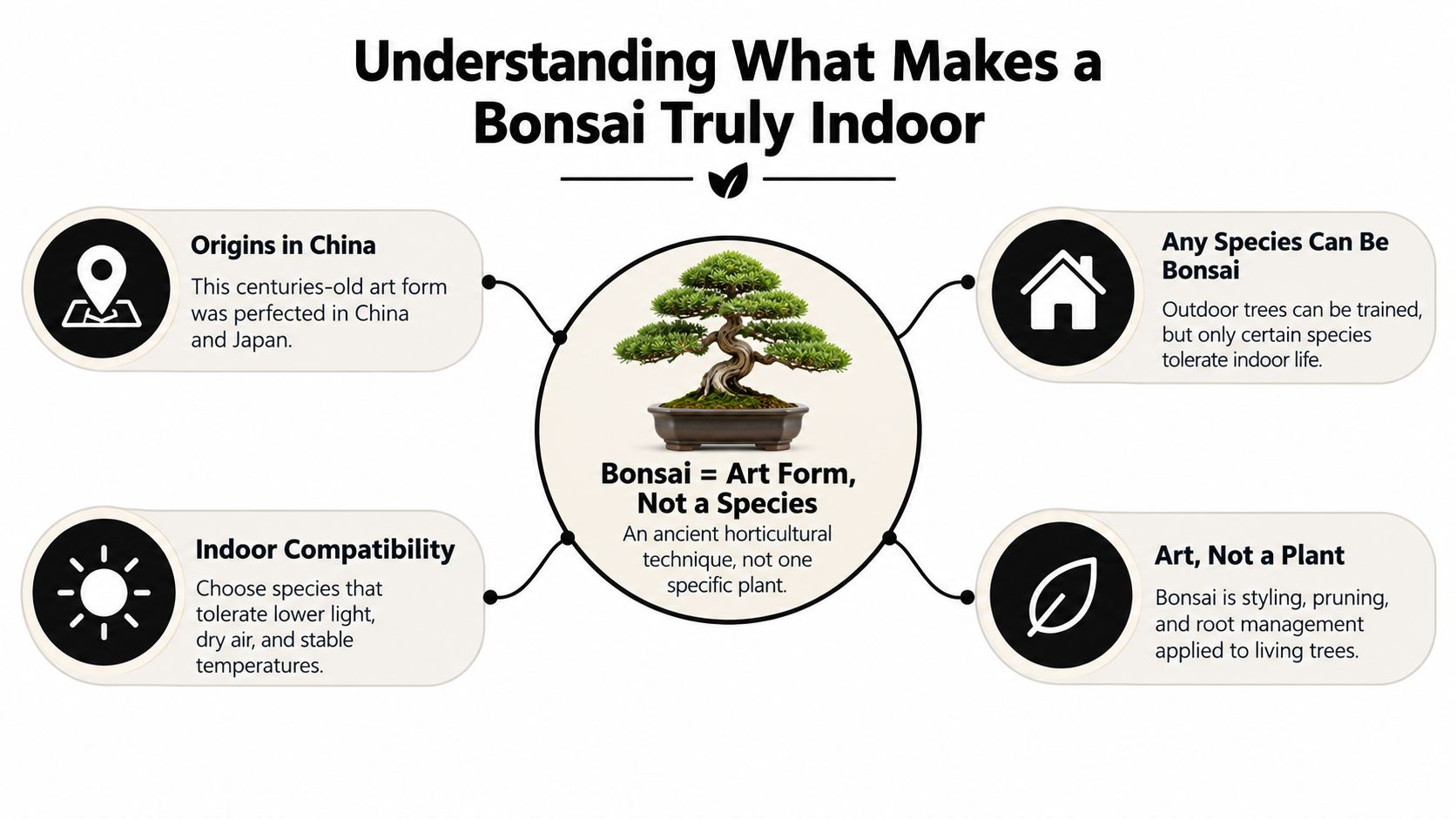
Bonsai isn't a plant species. It's a horticultural art form, involving pruning, styling, root management, and container cultivation across many kinds of trees. The tradition developed from China's penjing tradition roughly 2,000 years ago, and Buddhist monks are believed to have introduced miniature trees to Japan more than 1,000 years ago, where the practice became formalized as bonsai. The historical background is documented by The Huntington's bonsai collection.
That history matters because traditional bonsai developed around outdoor trees and seasonal cycles. A juniper, pine, or Japanese maple doesn't become an indoor plant because someone has trained it into a small shape. These temperate species generally need strong outdoor light, temperature variation, and winter dormancy. Keeping them inside year-round usually asks the tree to function outside its normal biological rhythm.
The tropical and temperate divide
Tropical and subtropical trees are realistic candidates for permanent indoor placement. Ficus, Carmona, Sageretia, dwarf jade, and schefflera can tolerate stable warmth and may adapt to the lower winter light available in a home, although none of them will thrive in a dark corner.
Temperate trees work differently. Their dormant period isn't a minor preference. It forms part of their annual growth cycle. A tree that needs cold-season rest may survive a short indoor display, but that doesn't make it a permanent houseplant.
Practical rule: “Indoor bonsai” describes a growing environment, not a universal category of tree.
Before buying, ask one question: Can this species live indoors permanently under my actual conditions? If the answer depends on a sunny window, a timer-controlled grow light, and protection from heating vents, include those requirements in the purchase decision. The guide to whether bonsai can grow indoors is useful for separating indoor-capable species from outdoor trees that are only being displayed inside temporarily.
Top 5 Indoor Bonsai Species Compared
Species choice decides whether indoor bonsai feels manageable or frustrating. I tell beginners to stop looking for the “best” tree in the abstract and start with the species that matches normal home conditions. A tree can be attractive, widely sold, and still be a poor indoor choice if it wants more sun, more humidity, or more seasonal change than the room can provide.
Ficus stays at the top for one reason. It forgives more of the mistakes that happen in real homes. One widely shared gardening comparison from The Home Sprouts reports that Ficus retusa performs strongly indoors over the long term, and that growers who begin with ficus often stay in the hobby longer than people who start with less indoor-adapted trees. That lines up with what many nursery owners see in practice. Ficuses handle pruning well, recover steadily, and usually cope better with small swings in watering and household temperature than other common options.
How the main candidates differ
Ficus microcarpa and Ficus retusa are still the safest recommendation for an average bright room. They backbud reliably, build convincing bonsai character over time, and usually rebound after beginner errors that would set back a fussier tree for months. They are not low-light plants, though. Put them too far from the window and growth becomes thin, soft, and stretched.
Chinese elm gives you finer branching and a more traditional silhouette, which is why many growers are drawn to it early. Indoors, the trade-off is light. It needs a brighter placement than many sellers imply, and it responds quickly when that light is missing. I recommend it for beginners only if the window or grow-light setup is already good.
Dwarf jade is often the right pick for a sunny sill and a busy owner. Its succulent leaves and stems store water, so missed waterings are usually less damaging than overwatering. The catch is simple. In heavy soil or a damp room, it declines fast, and weak light ruins the compact look people buy it for.
Carmona microphylla, or Fukien tea, appeals to people who want small leaves and occasional flowers. It can become a beautiful indoor bonsai, but it wants consistency. Sudden moves, dry air, or erratic watering often trigger leaf drop, so this is better for someone who enjoys close observation.
Sageretia thea, or sweet plum, has a refined texture that many indoor growers love. It can do well in a stable bright space, but it is less forgiving than ficus and less drought tolerant than dwarf jade. For many beginners, it works better as a second tree than a first.
Evaluating Your Home Growing Conditions
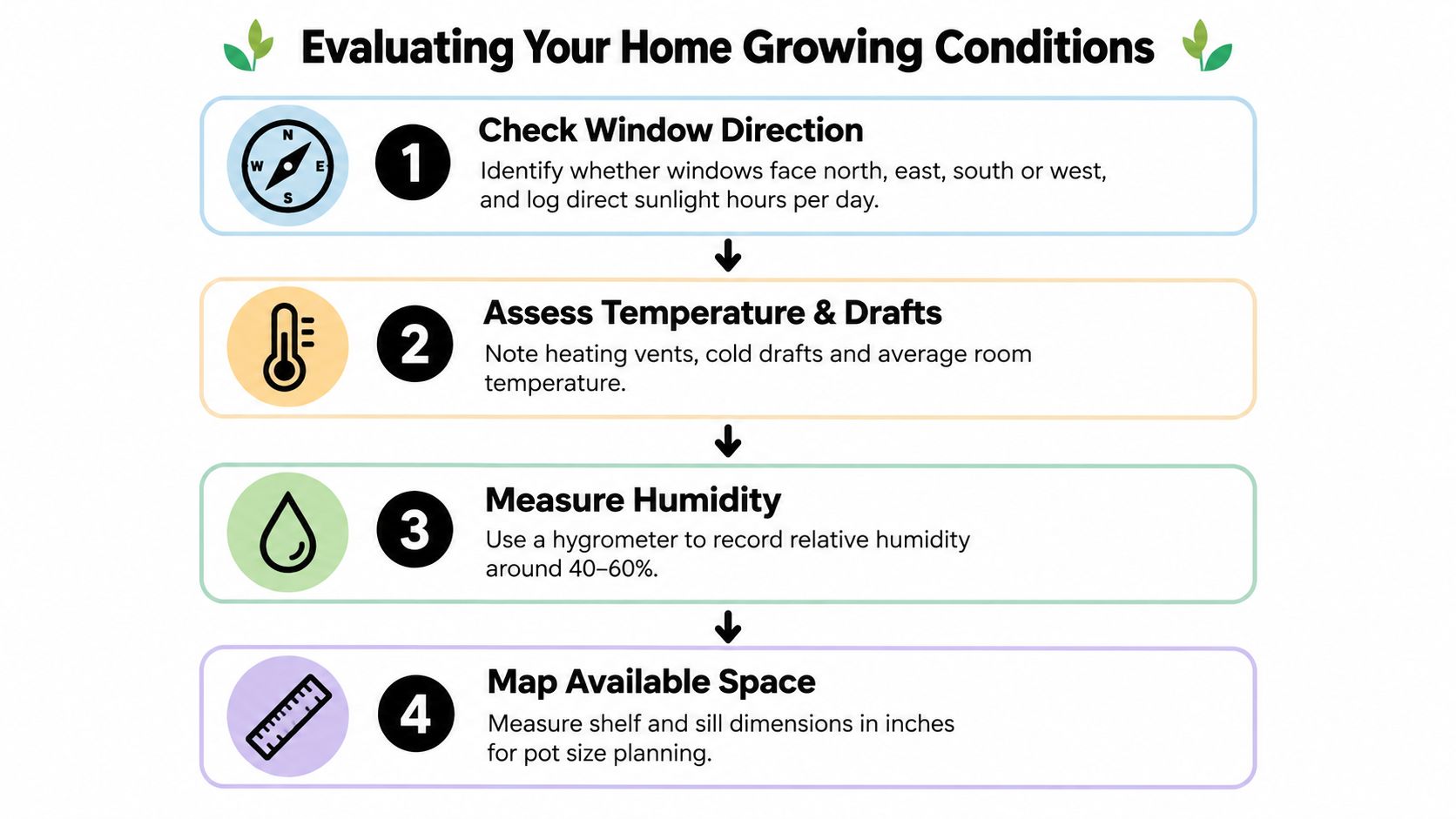
Your home isn't just “bright” or “dark.” Light changes with window direction, season, glass, curtains, nearby buildings, and the distance between the tree and the window. Temperature changes around vents and windows matter too, especially for tropical bonsai that dislike sudden drafts.
Start with the placement, not the plant. An east-facing window often gives gentler morning light, while a south- or west-facing window may require filtered midday or afternoon sun. If foliage becomes elongated or the spaces between leaves increase, the tree is signaling that its current light is insufficient. A light meter can provide a more useful reading than visual judgment.
Use DLI instead of “bright room”
Daily light integral, or DLI, describes the total amount of usable light a plant receives over a day. A technical indoor-bonsai guide places ficus and Chinese elm in an approximate target of 6 to 10 mol/m²/day, equivalent to roughly 139 to 231 µmol/m²/s at canopy level over a 12-hour photoperiod. The same guide assigns jade a higher target of 12 to 16 mol/m²/day, or approximately 278 to 370 µmol/m²/s over 12 hours, because it's a succulent. See the practical discussion of grow-light requirements for bonsai.
Measure light at the leaves, not at the lamp. Use a timer, then watch the plant's growth. Compact shoots and healthy leaf color suggest a better match than a label promising “full spectrum.”
Check the room around the pot
Record where heating vents, radiators, air-conditioning outlets, and drafty windows sit. A tropical bonsai can handle ordinary indoor warmth, but forced air can dry the foliage and soil quickly. A hygrometer helps you see whether the air is consistently dry instead of relying on how the room feels. If you live in an arid climate, this resource on what humidity level is best in Tucson provides useful context for assessing indoor conditions.
For a broader explanation of how window exposure affects bonsai placement, see bonsai sunlight needs. A grow light isn't a sign that you've chosen badly. In many homes, it's the tool that makes an indoor species choice realistic.
Essential Care Requirements for Indoor Bonsai
Indoor bonsai have limited root space and limited environmental buffering. The pot dries, warms, or stays wet more quickly than a garden bed, so small care decisions have a large effect. Four areas deserve attention from the first day: drainage, light, watering, and nutrition.
Build an airy root environment
Standard houseplant soil often holds too much water and compresses around fine roots. Use a purpose-made bonsai mix with mineral components that create air spaces and allow excess water to drain. The right texture should hold enough moisture for the species without remaining sticky or saturated. This guide to soil for indoor bonsai explains why a free-draining mix matters.
Choose a pot with a drainage hole and never let the container sit directly in collected water. A glazed ceramic pot can work well indoors, provided its drainage is unobstructed. If you're matching the display to your room, decorative options such as brass plant container decor can complement the plant, but use the decorative vessel as an outer cover rather than a sealed substitute for a draining bonsai pot.
Water by the substrate, not by the calendar
Check the mix with a finger or wooden moisture stick. For ficus, Carmona, and Sageretia, water thoroughly when the surface begins to dry, then allow excess water to escape. The aim is evenly moist, never waterlogged substrate. Ficus microcarpa prefers moist conditions, but persistent saturation leaves its roots vulnerable.
A pebble-and-water tray can increase humidity around the canopy when the pot stands above the waterline. It won't fix inadequate light or replace watering, and the pot base mustn't sit in the tray water. Keep leaves and the surrounding surface clean, then adjust placement if a vent or radiator is drying the plant.
This care video demonstrates the practical handling involved in maintaining bonsai indoors:
Feed lightly and monitor the canopy
Bonsai fertilizer should support steady growth, not force a flush of weak shoots. Follow the label for the product and reduce feeding when the tree isn't actively growing. Leaves & Soul's 18-6-8 slow-release Bonsai Fertilizer Pellets are one product option, while a complete kit may combine bonsai soil, fertilizer, and a glazed container for a first setup.
Fertilizer won't correct a tree placed in weak light. If the canopy becomes elongated, move the tree closer to a suitable window or add supplemental lighting before increasing nutrients. North Carolina State University describes the same central balance for Ficus microcarpa, noting that low light causes leggy growth while excessive afternoon sun can scorch foliage. Its Ficus microcarpa care profile is a useful reference for placement and moisture management.
Why Species Choice Determines Beginner Success
Most indoor bonsai failures start at the shop bench, not on the windowsill. Beginners often buy a tree labeled “bonsai” without being told whether it is a tropical species that can adapt to indoor life, or a temperate species that needs outdoor seasons to stay healthy. Put a juniper in a heated room all year, and the problem is biology, not effort.
That distinction shapes beginner success more than styling potential does.
Ficus gives new growers the widest margin for error in an average home. It handles normal household fluctuations better than many classic outdoor bonsai subjects, and it responds predictably to pruning. Carmona and Sageretia can also live indoors, but they ask for more consistency in light, humidity, and temperature. If the room conditions drift, they usually show stress sooner. For someone still learning branch selection, shoot trimming, wiring, and root care, a forgiving tropical species makes practice possible without turning every mistake into a decline spiral.
As noted earlier, growers who begin with forgiving tropical species tend to stay in the hobby longer. That is why species choice comes before styling ambition. A tree that fits the room lets you build observation skills. A tree that fights the room teaches frustration first.
Match the tree to your commitment
Choose Ficus if you want the classic bonsai look and can give it bright light with regular check-ins. Choose dwarf jade if your home is brighter and you want a plant that forgives a missed watering or two, but skip it for a dim desk or shaded shelf. Choose Carmona or Sageretia only if you are willing to watch them more closely and keep conditions steady through the week.
Junipers, pines, and Japanese maples are excellent bonsai. They are usually the wrong starting point for indoor growers because they are outdoor trees by nature. This discussion of whether bonsai can live indoors supports the same practical rule I give customers every season. Choose for the climate you can actually provide, not for the silhouette you admire most.
Making Your Final Bonsai Selection
The right choice becomes clearer when you describe the room and your routine before looking at the tree. Start with the amount of usable light, then account for temperature stability, watering attention, and whether you can add equipment.
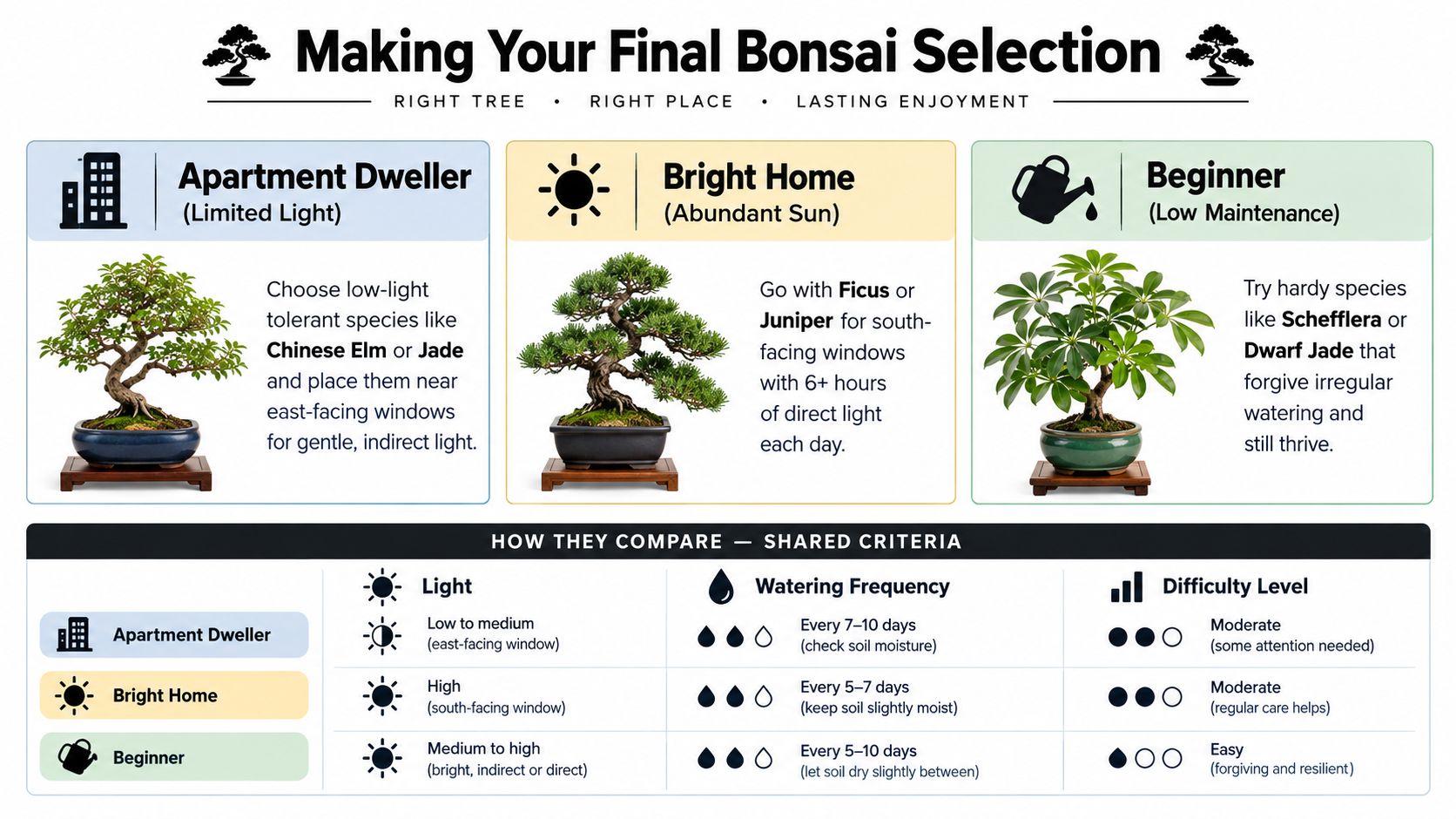
If you live in an apartment with limited light
Choose Ficus or Chinese elm only if you can place the tree close to the brightest available window or provide a grow lamp. “Low light tolerant” doesn't mean “happy in a dark room.” If the apartment receives weak winter light, select the lamp before buying the bonsai and use the canopy's growth pattern to fine-tune the setup.
If your home has a bright south-facing window
Ficus is the strongest first choice when filtered, abundant light is available. Dwarf jade can also suit this profile, but it needs brighter conditions and a drier watering rhythm. Protect either tree from harsh reflected heat and monitor the leaves for scorch after moving it into stronger sun.
If you're buying for an office
Look for a Ficus when the desk sits near a bright window and the temperature stays relatively stable. A tree placed in a windowless office needs supplemental lighting, not optimistic scheduling. If no one can check the soil, don't choose a species that requires consistently moist conditions and close observation.
If you're ready to treat bonsai as a serious hobby
Use a light meter, measure at canopy height, and run a timer-controlled grow light when natural exposure falls short. Carmona and Sageretia become more realistic choices when you can maintain consistent humidity and avoid drafts. This approach also gives you room to experiment with wiring and pruning without using an unsuitable outdoor species as your first project.
Your final question should be practical: Which tree can I keep healthy in this exact room for the next season, not which tree looks most impressive today?
Common Beginner Mistakes and How to Avoid Them
The most common failure starts with a good intention. A new owner waters every day because the bonsai pot is small, then notices yellowing leaves and adds more water. Indoor bonsai need moisture, but roots also need air. Check the substrate first, improve drainage, and empty standing water rather than following a fixed calendar.
Weak light causes a different pattern. Ficus microcarpa may remain alive near a distant window, but low light can produce elongated shoots and sparse growth. Move the tree toward a bright east-, south-, or west-facing window with filtered midday light, or add a grow lamp. Don't respond to stretched growth by pruning harder while leaving the light unchanged.
Temperature shocks often appear as sudden leaf drop. A tree moved from a warm nursery to a cold windowsill, or placed beside a heating vent, may lose foliage even when the watering seems correct. Keep placement stable, protect the tree from drafts, and avoid repotting immediately after purchase while it adjusts.
Finally, don't replace a struggling tropical bonsai with a juniper just because the juniper looks more traditionally “bonsai.” Junipers and many maples need outdoor conditions and dormancy. If you want to improve your skills indoors, choose a species that can survive the environment first, then practice styling on a healthy tree.
Leaves & Soul offers bonsai-specific soil, slow-release fertilizer such as its 18-6-8 Bonsai Fertilizer Pellets, glazed ceramic pots, wiring supplies, and complete starter kits for indoor growers. Visit Leaves & Soul to choose a setup that matches your bonsai species, light levels, and care routine.