


The most popular advice on bonsai ficus fertilizer tells you to find the perfect N-P-K ratio and feed on schedule. That's backwards. A ratio can be sensible and the tree can still decline if salts build up faster than roots use nutrients, if you feed into dry substrate, or if low indoor light has slowed growth to a crawl. In a shallow bonsai pot, concentration, timing and water quality often decide the outcome more than the numbers printed on the bag. Treat feeding as salt management first and product shopping second, and most of the usual problems become easier to prevent.
Why Ficus Bonsai Need a Different Feeding Plan
A Ficus in a large pot or a commercial interiorscape planting has room to dilute mistakes. Your bonsai doesn't. Its roots occupy a small volume of substrate, water moves through that volume quickly, and anything you dissolve into it stays close to fine roots until the tree uses it or you flush it out.
Think of the pot as a small savings account. Every application is a deposit. The tree makes withdrawals only when it's actively building leaves, shoots and roots. If you keep depositing while withdrawals slow down, the balance doesn't sit there harmlessly. It concentrates as the substrate dries, and that's when roots get stressed.
Where production guidance helps and where it stops
Commercial Ficus guidance is useful for orientation, including which nutrient balance suits foliage growth and whether a complete formula should include micronutrients. It wasn't written for a tree in a few handfuls of bonsai substrate on a windowsill. Production benches have larger containers, controlled irrigation and far more buffering capacity.
That gap changes three practical decisions:
- Concentration matters more than total amount: A dose that's mild in a large nursery pot can become strong in a shallow bonsai container as water evaporates.
- Light sets the budget: Strong light supports active shoot production and nutrient use. Dim indoor conditions slow uptake, so the same feed can accumulate.
- Watering is part of feeding: How often you water, how freely the pot drains, and what minerals arrive in your water all change what's left in the root zone.
A bonsai pot doesn't forgive a heavy hand the way a garden bed does. Dose for the volume you've actually got, not the tree you wish you were feeding.
Ficus are forgiving in many ways. They push new growth readily indoors, tolerate pruning, and often keep growing longer into the year than temperate outdoor bonsai. That vigor tempts growers to feed constantly. Don't mistake a long growing season for unlimited demand. When light drops and extension growth stalls, nutrient demand drops with it, even if the leaves stay green.
A sound bonsai ficus fertilizer plan therefore starts with observation. Is the tree extending shoots? Is the substrate staying evenly moist rather than swinging from soaked to bone dry? Is drainage fast and clear? Answer those questions first, then choose a ratio, a product form and an interval that fit the answers. The sections ahead work through that order, from reading labels to spotting salt stress before it gets misdiagnosed as hunger.
Reading N-P-K Ratios for Ficus Foliage
The ratio on the bag is the least decisive part of a ficus feeding plan, and growers who obsess over it usually miss what the pot is accumulating. The three numbers are nitrogen, phosphorus and potassium, in that order. For a foliage tree, they aren't equally urgent. Nitrogen drives leaf and shoot formation, which is most of what you're building and refining. Phosphorus plays a supporting role in energy transfer and root function, and Ficus bonsai rarely need it in large proportion. Potassium supports tissue strength and processes tied to water regulation, so it matters for leaves that hold up between waterings.
That balance explains the University of Florida IFAS guidance for commercial interiorscape Ficus, which recommends controlled-release fertilizer, water-soluble fertilizer with micronutrients, or a combination of both, with an N:P:K ratio of 3:1:2 or 3:1:3. The same production guidance lists 3 pounds of elemental nitrogen per 1,000 square feet per month, a nursery benchmark that should not be applied directly to a small bonsai container.
What a 3 to 1 relationship actually means
A 3:1:2 relationship means nitrogen is supplied at roughly three times the phosphorus level, with potassium at about twice the phosphorus level. If you're new to label math, understanding plant fertilizer numbers is worth reviewing before you buy anything. As a plain example, a formula built around three parts nitrogen to one part phosphorus keeps the emphasis on foliage without pushing phosphorus higher than the tree can use.
You don't need an exact match down to the decimal. A complete fertilizer where nitrogen clearly leads phosphorus, potassium is present in a meaningful amount, and micronutrients are included covers the requirement. What you generally don't need is a high-phosphorus root booster marketed as a cure for weak growth. Extra phosphorus won't fix low light, compacted substrate or damaged roots, and unused nutrients still add to the salt load.
Your water decides how the same ratio behaves
Two growers can run identical fertilizer on identical trees and get different results, because the label only tells you what goes into the jug. What reaches the roots, and what stays in the pot afterward, depends on the water that carries it.
- Rainwater arrives almost empty of dissolved minerals. Feed mixed into it behaves predictably and leaves little behind, but it also contributes nothing, so a fertilizer without micronutrients develops gaps over a long season.
- Filtered or reverse-osmosis water sits close to rainwater for feeding purposes. You get a consistent baseline and can hold one dilution rate for months without drift.
- Mineral-rich tap water arrives already carrying calcium and other dissolved solids. Each watering adds mineral load on top of the feed, so a schedule that looks moderate on paper concentrates faster in the substrate.
Pick the ratio once, then spend your attention on what the water adds and what the pot keeps. That part of feeding is nowhere on the label.
Choosing Pellets, Liquids or Slow-Release Feeds
Product form decides how steady the nutrient supply is and how much control you keep. None of the three common forms is automatically right. The right choice depends on your schedule, your watering habits and how closely you watch the tree.
The comparison below sums up the trade-off before you look at specific products.
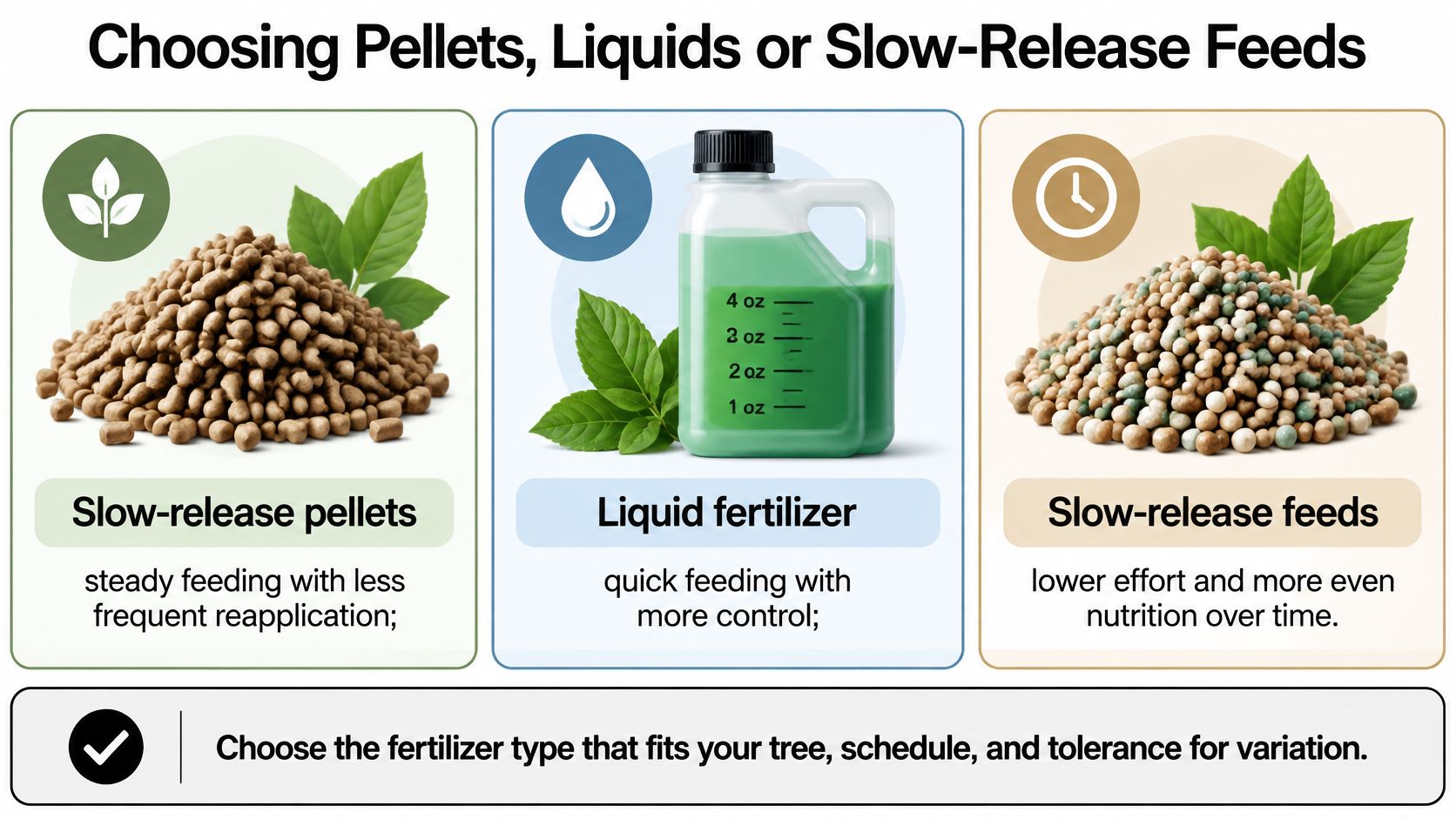
Slow-release pellets sit on or in the substrate and release nutrients gradually as you water. They suit growers who'd rather apply once and top up occasionally than mix feed every week. The weakness is visibility. Pellets can wash into moss, roll off a mounded surface, or get forgotten, and then a second application doubles the intended load.
Liquid feeds give you the most control. You choose the concentration, apply it to moist substrate, and nothing remains to release later beyond what the substrate holds. That control costs effort. You have to mix accurately, and it's easy to drift stronger over time if you measure by eye. If you're weighing formats, comparing liquid and pellet fertilizer covers the day to day differences in more depth.
Slow-release granules and coated products aim for even nutrition over time with less frequent reapplication. They reduce the sharp peaks that come with concentrated liquid doses. They don't remove the need for judgment, because release still depends on moisture and temperature, and a small pot has little room to spread granules thinly.
Watch how application looks in practice before you commit to a form, especially the difference between a measured dose and a casual handful.
What to require from any product
Whatever form you pick, Ficus fertilizer selection guidance from the University of Florida points to a complete formulation containing micronutrients and an N:P:K ratio near 3:1:2 or 3:1:3. Micronutrients such as iron, manganese, zinc, boron, calcium and magnesium help prevent deficiencies in the restricted root volume of a bonsai container, and a high-phosphorus root booster is not the practical choice.
Within that frame, Leaves & Soul sells 18-6-8 slow-release Bonsai Fertilizer Pellets, ready-to-use liquid fertilizers, spray formulas, and bonsai kits that bundle soil, fertilizer and a container. Compare the 18-6-8 label against the guidance rather than treating it as a perfect match. Its nitrogen to phosphorus proportion lines up with the three to one relationship, while its potassium proportion sits lower than the two to three parts suggested in the 3:1:2 and 3:1:3 patterns. That's a workable foliage-leaning pellet for growers who value convenience, provided you dose conservatively for a small pot. It isn't a reason to ignore watering and salt checks.
Stacking warning: Don't layer pellets under a regular liquid program unless you've deliberately reduced both. Two mild products combined can equal one strong one.
Choose one primary method. Learn how your tree and your water respond to it for a full stretch of active growth. Switching products every few weeks tells you nothing and makes salt problems harder to trace.
Timing Feeds to Growth and Light Levels
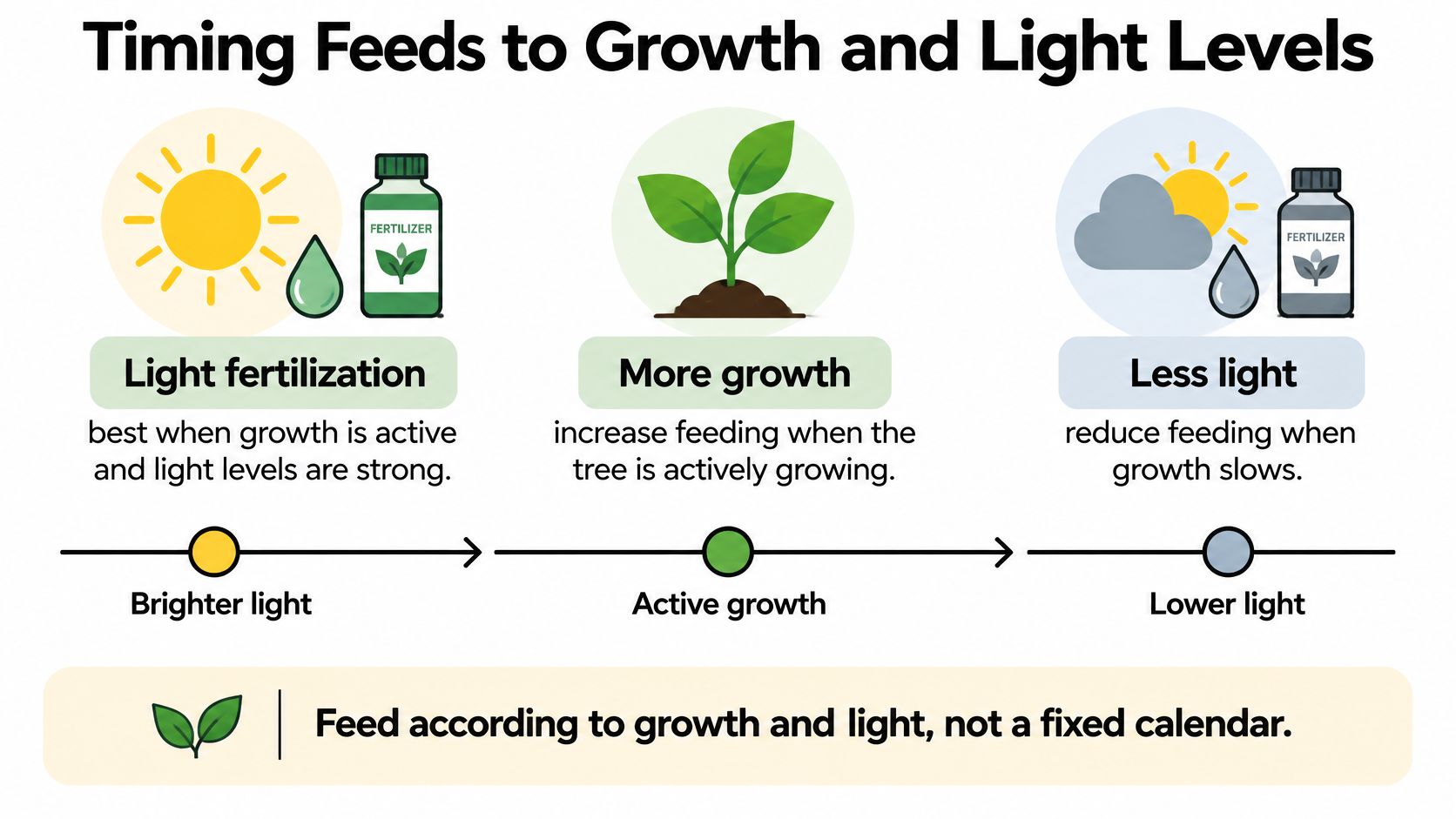
Feed the growth in front of you, not the date on the calendar. A Ficus under strong light pushing fresh shoots is spending nutrients. The same tree sitting in weak winter light with no extension growth is mostly maintaining itself, and fertilizer you add then has nowhere productive to go.
Extension guidance on Ficus feeding indicates that light fertilization is most appropriate after new shoots form and again toward late summer, while an Illinois Extension discussion recommends very dilute liquid feeding around once monthly and cautions that Ficus generally do not require frequent feeding.
The timeline below shows how that growth-led rhythm looks across a season.
A growth-led sequence you can follow
- Wait for visible growth: Look for extending shoot tips and new leaves unfolding. That's your signal that roots and canopy are active enough to use a feed.
- Start dilute: Begin with a light application rather than a full-strength catch-up dose. A tree coming out of a slow period doesn't need a surge.
- Hold a steady rhythm: While growth continues and light stays strong, keep applications light and spaced, around the monthly pattern noted in the guidance above for liquid feeding.
- Ease off as growth slows: When extension stops, days shorten or indoor light falls, reduce feeding or suspend it. Resume when you see fresh growth again.
Why light changes the dose, not just the date
Strong light drives photosynthesis, which supplies the carbon the tree uses to build new tissue. New tissue is what creates nutrient demand. In low light, the tree builds less, so nutrient uptake falls even though the fertilizer salts remain in the substrate. That's the mechanical reason a dose that's fine in bright conditions can cause trouble in a dim corner.
Indoor Ficus complicate this because they don't always show a clean dormant season. A tree near a bright window or under good supplemental lighting may grow for much of the year. A tree several feet from glass may stall for months. Judge by shoot tips, not by what the species is supposed to do in a greenhouse.
Also watch water use as a supporting signal. A tree that suddenly drinks much more slowly in the same conditions may have slowed growth, root trouble or both. Feeding harder in response to that slowdown usually makes the diagnosis worse.
Applying Dilute Fertilizer Without Stressing Roots
A fertilizer label cannot account for the salts already in your water or potting mix. Before feeding, check that the tree is growing, the root ball is moist, and water drains freely. In a shallow bonsai pot, those conditions matter as much as the N-P-K ratio.
Virginia Cooperative Extension bonsai guidance recommends applying fertilizer before and during active growth. It also advises diluting ordinary houseplant fertilizer to one-quarter to one-half strength. Treat that range as a cautious starting point, not a fixed dose for every product or tree.
Check the tree before you mix anything
- Water first: Fertilize an adequately watered root ball. In dry substrate, salts become more concentrated in the remaining moisture and can expose fine roots to a stronger solution.
- Skip stressed trees: Hold off if the tree is drought-stressed, recently repotted, diseased, or inactive. Wait until it has recovered and shows growth.
- Check drainage: Water should flow freely through the drainage holes. If it pools or drains slowly, address the drainage problem before adding fertilizer salts.
If the tree looks unwell, hold the feed. Fertilizer supports active growth; it does not repair damaged roots or replace suitable watering.
Apply according to the product form
For liquid feed, follow the product label. If you are adapting a general houseplant fertilizer, begin at the dilute end of the range above. Mix thoroughly and apply evenly to moist substrate until a small amount drains through. Measure each dose so the concentration stays consistent.
For pellets or granules, use the label's placement and amount, adjusting for the bonsai pot's small volume. Keep them clear of the trunk and where watering can reach them. Record the application date to avoid adding another dose before the first has run its course.
For sprays, follow the label and use them as a supplement unless the product is specifically intended as a complete feeding method. Foliar uptake does not remove the need to manage the root zone.
Water normally after feeding, and note how quickly the pot drains. If leaf spotting, brown margins, or stalled growth appear after an application, pause further feeding and check the tree and its growing conditions before dosing again.
Spotting Salt Stress Before Adding More Fertilizer
When a Ficus looks poor, the common reflex is to feed it. That reflex causes real damage, because salt stress, underwatering, root damage, pests and low light can produce overlapping symptoms. Adding fertilizer to a tree that's already carrying excess salts increases the very burden that's hurting it.
Ficus production guidance on aeration and soluble salts identifies good aeration and soluble-salt management as important, with leaching recommended when salt levels become excessive. Symptoms such as brown leaf margins, sudden leaf drop, crust on the soil surface and stalled roots can be misread as nutrient deficiency, prompting even more fertilizer.
The checklist below puts those warning signs in the order you should check them.

How salts build up in a shallow pot
Every watering leaves something behind. Fertilizer contributes soluble salts, and mineral-rich tap water adds its own load. As water evaporates from the surface and transpires through leaves, those dissolved minerals stay in the substrate and become more concentrated. A shallow pot with a small volume reaches that point sooner than a deep nursery container, especially if you water lightly and rarely flush fully through the drainage holes.
A white or yellowish crust on the substrate surface or around the drainage area is a visible clue. Brown leaf margins and tip damage are less specific, since dry roots and low humidity can look similar. Sudden leaf drop is even broader. Ficus drop leaves in response to moves, drafts, light changes and watering swings. That's why reviewing signs of over-fertilizing plants alongside your watering history gives a fuller picture than any single symptom.
Pause rule: If growth has stalled and you see crust, margin burn or leaf drop together, stop feeding and flush with plain water before you consider any nutrient product.
Flushing means watering thoroughly and repeatedly so water runs freely from the drainage holes, carrying dissolved salts with it. Discard the runoff rather than letting the pot sit in it. Then wait. A tree under salt stress needs time and clean moisture, not a corrective cocktail.
Match your routine to your water
- Rainwater: Usually low in dissolved minerals, so it adds little background salt. It's well suited to flushing. Keep collection containers clean so you're not introducing debris or algae into a fine bonsai substrate.
- Filtered water: Filtration reduces some minerals and treatment chemicals depending on the system, so results vary. It's a reasonable middle option, but don't assume it removes everything. Watch for crust as your feedback.
- Mineral-rich tap water: Hard water raises the background salt load with every watering, even between fertilizer applications. With hard water, feed more conservatively, flush with plain water periodically, and be slower to blame pale leaves on hunger.
Water chemistry varies a lot between regions and even between buildings. Your crust, drainage behavior and leaf margins tell you more about your actual situation than general advice written for another city's tap supply.
Building a Simple Ficus Feeding Routine
A routine you can repeat calmly beats an ambitious program you abandon by midsummer. Keep it to a short monthly rhythm tied to growth, with salt checks built in rather than bolted on after trouble appears.
The monthly rhythm
- Confirm active growth: Look for extending tips and new leaves. If the tree is sitting still in low light, skip the feed and reassess later.
- Water thoroughly first: Bring the root ball to even moisture and let excess drain away before any fertilizer touches the substrate.
- Apply one dilute, complete feed: Use your chosen pellets, liquid or slow-release product at a conservative rate for the pot size. One method at a time.
- Record what you did: Note the date, product and strength. Memory is unreliable across a collection, and records prevent double applications.
- Check for salt signs at watering: Look at the surface for crust, watch leaf margins, and confirm drainage stays free. Flush with plain water when buildup looks likely.
- Pause when growth slows: Reduce or suspend feeding during low-light, inactive stretches, then resume dilute feeding when fresh shoots return.
First tree versus established tree
With a first Ficus project, simplicity protects you. One complete fertilizer, one interval, consistent watering and good light will teach you how the tree responds. A starter setup that bundles matched soil, fertilizer and a suitable container can remove early guesswork about components that don't fit together, which helps during the first season when you're still learning basic watering judgment.
An established tree in a refined pot needs the same restraint with closer observation. Older trees in small volumes of aging substrate can accumulate salts faster and drain more slowly as roots fill the pot. If feeding response declines over time despite good light, suspect substrate condition and root congestion before suspecting the fertilizer formula. Repotting and salt management solve those problems. A stronger feed doesn't.
Refinement goals also matter. Heavy feeding pushes coarse, fast growth with larger leaves and longer internodes, which works against fine ramification on a developed tree. Lighter, steadier feeding supports health without forcing soft growth you'll only prune away. Match the feeding pressure to the stage of development, vigorous for building, restrained for refining.
Here's your concrete next step. Take the fertilizer already on your shelf and read its label against the guidance in this article. Check whether nitrogen leads phosphorus in roughly the three to one pattern, whether micronutrients are listed, and whether you've been stacking it with another product. Then pick one healthy, actively growing Ficus, water it well, apply that single product at a dilute rate, and write the date down. Judge the result by new growth and clean leaf margins over the following weeks, not by how strong the mix smelled on application day.
If you're setting up a first Ficus or simplifying an established tree's care, Leaves & Soul carries slow-release bonsai fertilizer pellets, liquid plant foods, soils and complete kits that bundle soil, fertilizer and a matched container. Start with one complete fertilizer that fits the ratio and dilution guidance above, pair it with consistent watering and periodic plain water flushing, and build your routine from what your tree shows you.