


You're standing in front of the fertilizer shelf with a fiddle leaf fig that's looking tired, a bottle of liquid feed in one hand, and a tub of pellets in the other. Both labels promise healthy growth. Both display an N-P-K analysis. Yet one may give the plant a quick nutritional push, while the other may release nutrients gradually. Choosing the right form matters more than choosing the flashiest label.
The practical answer is simple. Use liquid fertilizer for speed, precision, and orchids or quick corrections. Use pellets for steady maintenance, bonsai, and plants that prefer restrained feeding. For many houseplants, a hybrid approach works best, with pellets as the base and liquid only when the plant needs more immediate support.
Why the Form You Choose Matters More Than the Brand
Two fertilizers can show similar nutrient numbers and still behave completely differently in a pot. The form determines whether nutrients arrive dissolved in the irrigation water or remain in the soil as a measured supply that releases gradually. That difference affects how quickly roots can access nutrients, how often you need to feed, and how much control you have over each application.
A liquid concentrate is ready to dilute and distribute. You decide the dose each time you water, so you can respond to active growth, a pale new leaf, or a plant recovering from repotting. That control also creates responsibility. A concentrated mix applied too strongly can raise salt levels around delicate roots and create stress quickly.
Pellets take the opposite approach. You place a measured amount on or into the growing medium, then moisture gradually activates the product. The method is less immediate, but it's more forgiving for people who forget weekly feeding or who want a longer interval between applications. Slow release doesn't mean risk-free, though. Too many pellets can keep supplying nutrients after the plant has stopped growing.
The same shelf, different feeding habits
Consider the fiddle leaf fig in that shopping scene. If it has healthy leaves and you want routine support, pellets provide a practical baseline. If the plant is actively producing new growth and you need to correct a suspected deficiency, a carefully diluted liquid feed gives you more control over timing and dose.
Bonsai create a different problem. Their containers are small, their roots are confined, and their growth needs restraint. A steady pellet program usually suits them better than repeated strong liquid applications. Orchids grown in bark are another story. Pellets can lodge above the roots or release unevenly through chunky media, while diluted liquid fertilizer can move through the root zone more predictably.
What should decide your purchase
Ignore the idea that one form is universally superior. Ask three questions instead:
- What plant are you feeding? Bonsai, succulents, fiddle leaf figs, and orchids don't have identical nutrient needs or root environments.
- Do you want rescue or maintenance? Rescue favors liquid. Maintenance often favors pellets.
- How often will you realistically fertilize? Choose the form that matches your habits, not an ideal schedule you won't follow.
The label's N-P-K analysis matters, but it doesn't tell the whole story. The form controls the delivery behavior, and delivery behavior determines whether feeding feels precise, gentle, or difficult to manage.
How Liquid and Pellet Fertilizers Actually Work
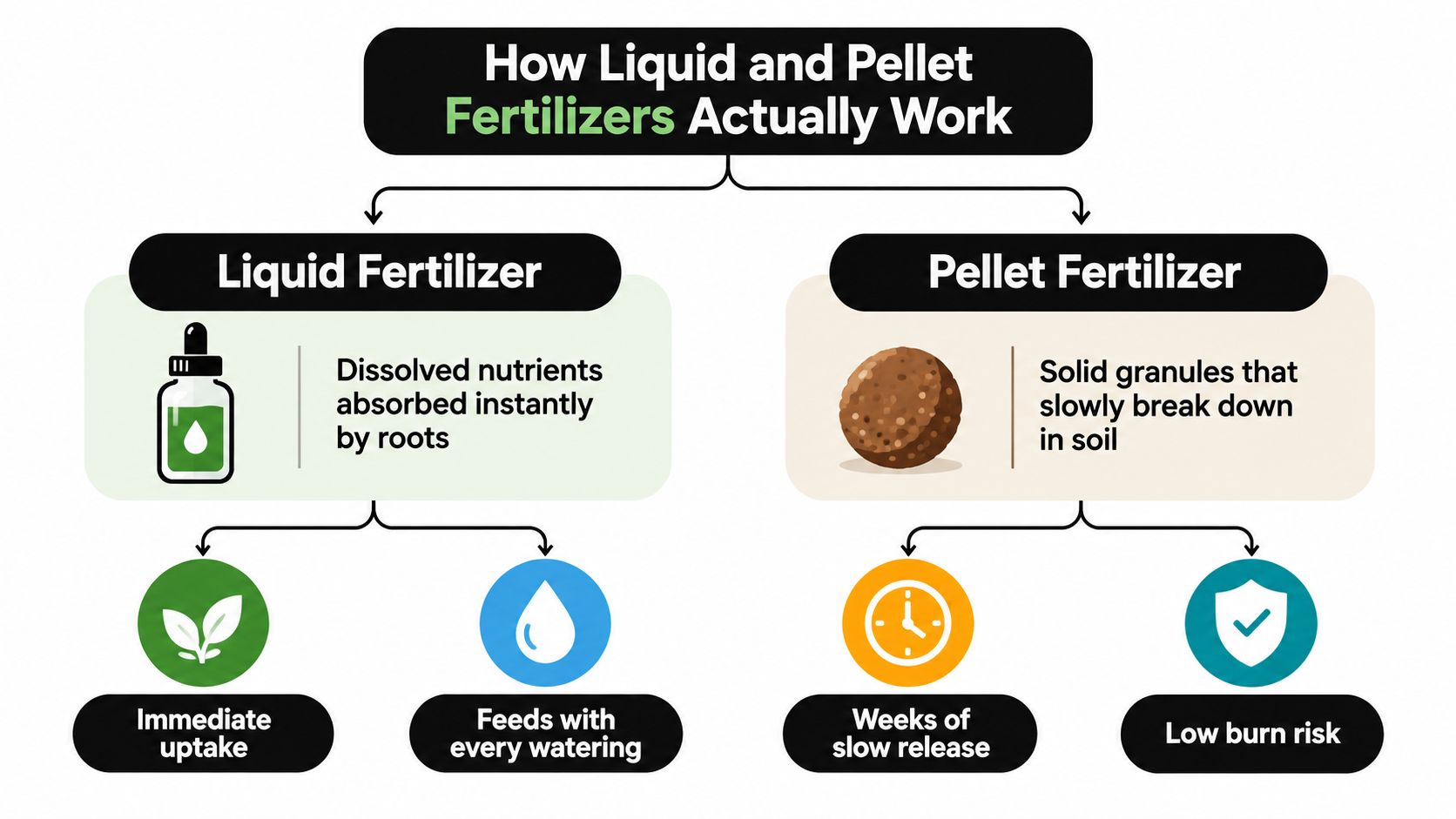
Liquid fertilizer contains nutrients already dissolved in water or in a concentrate that becomes soluble when diluted. Once you apply it to damp soil, roots can encounter those nutrients quickly. Foliar applications can act even faster because leaves may absorb part of the diluted solution, although foliar feeding works best when it matches a plant's active demand.
Pellet fertilizer contains solid granules that dissolve or release nutrients as moisture and, in some products, temperature affect the coating or matrix. The plant doesn't receive the entire nutrient supply at once. Instead, the product meters availability over an extended feeding window. That makes pellets a tool for controlled delivery, not merely a dry version of liquid fertilizer.
Why pellets represent a separate innovation
Pelletized fertilizer developed as its own product category. Milorganite's history of pelletized fertilizer identifies 1926 as the introduction of its first pelletized, dust-free, multi-nutrient fertilizer. Later milestones included Osmocote in 1967 and Nutricote in 1985, followed by PolyOn and Multicote near 1990.
Those dates show why slow-release pellets shouldn't be treated as a simple packaging choice. Manufacturers developed them to regulate nutrient availability over time, reducing the immediate surge associated with fully soluble feeding. The result is a product that depends on the growing environment, especially moisture and temperature, to determine how quickly nutrients become available.
Core difference: Liquids deliver a wave. Pellets deliver a slow tide.
That mental model makes the rest of the decision easier. A liquid feed is useful when you want to choose the moment and concentration. A pellet feed is useful when you want the product to keep working after application without requiring another measuring session at every watering.
For a closer look at how ready-to-dilute products fit into a houseplant routine, see this guide to liquid plant food. The important point is that identical nutrient numbers can produce radically different results when one fertilizer is immediately dissolved and the other is engineered to release gradually.
Comparing Liquid and Pellet Fertilizers Side by Side
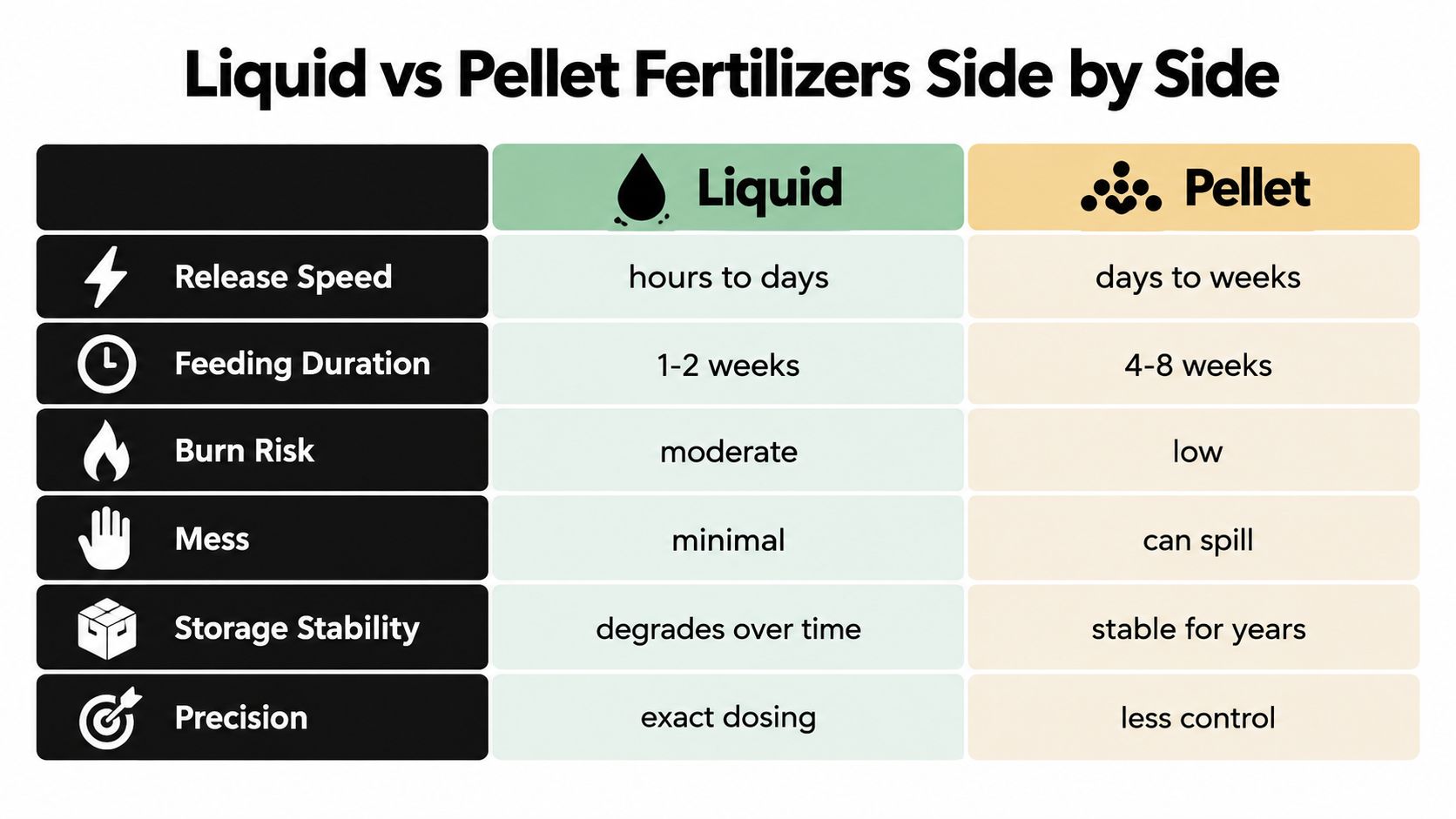
The liquid vs pellet fertilizer debate becomes clearer when you stop asking which one is “stronger” and compare the job each one performs. Liquid fertilizer generally wins when you need rapid availability and exact dosing. Pellets win when you want a longer feeding window and less frequent handling.
| Criterion | Liquid Fertilizer | Pellet Fertilizer |
|---|---|---|
| Release behavior | Nutrients are dissolved and quickly available | Nutrients release gradually as moisture interacts with the granule |
| Feeding control | Dose can be adjusted at every application | Dose is largely set when pellets are applied |
| Burn exposure | Can cause rapid stress if mixed too strongly | Often gentler when applied correctly, but excess pellets can continue feeding |
| Placement | Easy to distribute through watering or foliar application | Depends on where granules sit and how evenly moisture reaches them |
| Storage concern | Some liquid products can lose stability during storage | Pellets are generally easier to store over longer periods |
| Best use | Quick correction, active growth, and precise feeding | Routine maintenance and extended feeding |
Speed isn't the same as performance
Liquid feeding can change plant response because nutrients arrive in a highly available form. In a long-term Clemson dissertation examining creeping bentgrass and hybrid bermudagrass, clipping yield and clipping nitrogen were reduced when granular fertilizer was replaced with half or all liquid fertilizer, demonstrating that changing form can change plant performance rather than preserving the same result. You can review the Clemson dissertation on fertilizer form and turf response for the underlying research.
The lesson for houseplant growers isn't that liquid is bad. It's that delivery form changes the plant's response, and the right choice depends on timing, placement, and the growing medium. In highly calcareous soils, granular phosphorus can dissolve poorly and precipitate near the granule, which can make fluid fertilizer more effective for phosphorus delivery in that specific condition.
Storage deserves more attention
Storage is where pellets often beat liquids. Research on liquid digestate notes that liquid fertilizers can release nitrogen more rapidly, but ammonia volatilization during storage creates a practical constraint. The same research reports that pelleting improves storability and can improve phosphate and potassium availability over time. See the research on liquid digestate storage and pelleting for that comparison.
For a gardener who fertilizes sporadically, this matters. A liquid concentrate may sit in a warm cabinet between uses, while pellets remain a dry, compact product that is easier to reseal and transport. Check the manufacturer's storage directions either way, and keep both forms away from children, pets, heat, and moisture.
Learn how slow-release fertilizer pellets fit into plant care when you want fewer applications and a more measured supply. Liquid wins the speed and precision columns. Pellets win the storage and extended-maintenance columns.
Which Form Works Best for Bonsai, Fiddle Leaf Figs, Succulents, and Orchids
Plant type should decide the default form. A bonsai in a shallow pot doesn't need the same feeding strategy as a phalaenopsis orchid in bark, and neither should be managed like a thirsty fiddle leaf fig in a large container.
Bonsai
Pellets win for routine bonsai feeding. A slow-release bonsai formulation, such as an 18-6-8 product, gives the grower a controlled base supply suited to a confined root environment. The goal isn't explosive growth. You want steady nutrition that supports foliage and root activity without repeatedly flooding a small pot with soluble salts.
Place pellets across the surface rather than in one dense pile. Water normally, observe the tree, and remove old material when the product has finished its release period or when you repot.
Bonsai verdict: Choose slow-release pellets for maintenance. Keep liquid fertilizer for targeted supplemental feeding during clear active growth.
Fiddle leaf figs
Fiddle leaf figs respond well to a hybrid program. Pellets provide a steady foundation for a plant that is actively growing, while liquid fertilizer gives you a way to make a controlled adjustment when new leaves look unusually pale or growth stalls.
Don't treat yellowing as automatic proof of nutrient deficiency. Check light, watering, drainage, and roots first. If the plant is otherwise stable and the issue points toward nutrition, use a properly diluted liquid application rather than adding a large quantity of pellets on top of an existing feed.
Fiddle leaf fig verdict: Use pellets for the base, liquid for a measured correction.
Succulents and cacti
Succulents and cacti generally favor light, infrequent feeding, especially during active growth. Pellets can work well because they release gradually, but the dosage must suit the small root system and gritty, fast-draining medium. Avoid scattering a heavy layer across a tiny pot.
Winter changes the decision. When growth slows sharply, pause routine feeding rather than allowing a slow-release product to continue supplying nutrients without corresponding plant demand.
Succulent verdict: Use a restrained pellet application during active growth, and avoid routine feeding during dormancy.
Orchids
For phalaenopsis orchids growing in bark, liquid fertilizer is the clear winner. Bark creates open spaces, so pellets may remain perched near the surface or release unevenly depending on where irrigation water travels. A diluted liquid feed moves through the medium and reaches roots more uniformly.
Flush the pot with plain water as part of your routine to limit residue buildup, and never use fertilizer as a substitute for correct light, watering, airflow, or root health.
Orchid verdict: Choose diluted liquid fertilizer for predictable distribution through bark.
Application Timing, Rates, and Frequency That Actually Work
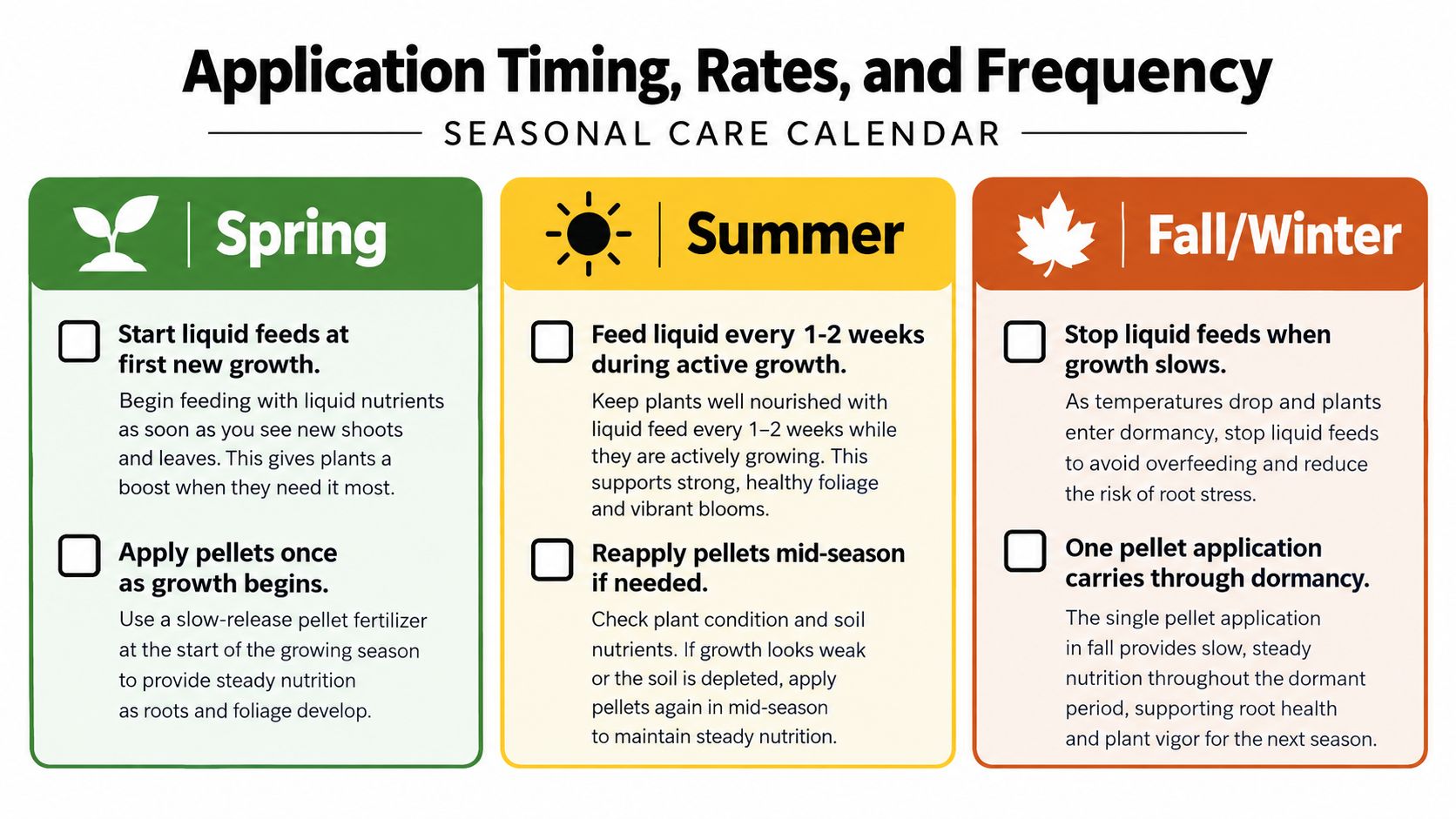
A good fertilizer applied at the wrong moment is still a poor feeding decision. Liquid fertilizer works best when the plant is actively growing and can use the available nutrients. Pellet fertilizer should go into the pot early enough for its release pattern to overlap with the plant's growth flush.
Use the product label as the authority for concentration and quantity. There is no safe universal rate across brands, plant sizes, potting mixes, and nutrient analyses. Start conservatively, especially with small containers, fresh transplants, stressed plants, and species with sensitive roots.
A practical plant-by-plant schedule
- Bonsai: Apply slow-release pellets as active growth begins, following the label quantity for the container. Add liquid only when the tree is clearly growing and you need more control than the pellets provide.
- Fiddle leaf figs: Begin feeding when new growth resumes. Use pellets for baseline nutrition, then use a diluted liquid feed only after checking the plant's light, water, and root conditions.
- Succulents and cacti: Feed sparingly during active growth. Pellets suit growers who want a low-intervention routine, but stop when the plant enters a clear dormant period.
- Orchids: Use diluted liquid fertilizer during active root and leaf growth. Apply it through the bark mix rather than relying on pellets that may sit away from the roots.
Time feeding before demand
Extension guidance recommends applying soil nutrients a few days before the desired uptake period, and it links strong nutrient-use efficiency with matching release and application to rapid vegetative growth. The 4R nutrient stewardship guide supports that timing principle.
Timing rule: Liquid fertilizer rewards close observation. Pellets reward early placement before the growth flush.
Water the plant before applying fertilizer if the medium is dry. Dry roots are more vulnerable to concentrated solutions, and a dry pot can distribute moisture unevenly. If you're unsure whether a plant is hungry, wait and inspect its growth conditions before adding more product.
Cost, Environment, and the Hidden Trade-offs Most Comparisons Skip
The cheapest-looking container isn't always the cheapest feeding routine. Liquid fertilizer may seem economical because you dilute a concentrate, but each application requires measuring, mixing, and repeating. Pellets can cost more at the register while stretching across a longer feeding interval, which changes the practical cost per feeding.
That convenience has a real value for indoor growers. Pellets don't require a watering can filled with fertilizer, and they reduce the chance of splashing a cabinet, windowsill, or wood floor. Liquid fertilizer remains more convenient when you already water with a bottle or want to feed several plants with different doses in the same session.
Storage changes the equation
Pellets are usually easier to store for gardeners who fertilize irregularly. Keep them dry and sealed, and they're less likely to create the storage concerns associated with liquid products. Liquid fertilizers can be affected by storage conditions, and research on digestate specifically identifies ammonia volatilization as a nitrogen-loss pathway during storage.
That doesn't make every liquid houseplant fertilizer unstable. It does mean you should follow the label, close the cap tightly, avoid heat, and avoid transferring the product into an unmarked container.
Runoff and waste depend on behavior
Both forms can contribute to runoff when you overapply or water heavily immediately afterward. Pellets release more gradually, but they can still waste nutrients if you scatter them beyond the active root zone or apply them while the plant is dormant. Liquids can move quickly through a porous pot and out of the drainage hole, especially when the mix is already saturated.
- For cleaner indoor feeding: Pellets usually create less measuring and splash mess.
- For targeted correction: Liquid provides better control over the dose and placement.
- For occasional gardeners: Pellets reduce the number of feeding decisions.
- For frequent travelers: A correctly applied slow-release product can maintain a routine when weekly watering and feeding are inconvenient.
Your broader fertilizer choice also involves the distinction between synthetic and organic fertilizer. Form tells you how nutrients are delivered, but the ingredient source and salt profile still matter.
A Simple Decision Rule for Choosing the Right Fertilizer Form
You can choose the right form in about a minute. Start with the plant, then identify the job, then match the product to the amount of attention you want to give it.
First ask what you're feeding
- Bonsai: Pick slow-release pellets for steady, controlled maintenance.
- Succulents or cacti: Pick a restrained pellet product during active growth, and don't keep feeding through dormancy.
- Fiddle leaf fig: Pick pellets if the plant is stable. Choose liquid when you need a carefully measured correction after ruling out light, water, and root problems.
- Orchid in bark: Pick diluted liquid fertilizer for more even movement through the growing medium.
Then ask what result you need
If the plant needs immediate, adjustable nutrition, liquid is the better tool. It lets you control every application and makes sense for active growth, foliar supplementation, or a targeted response.
If the plant needs a dependable maintenance program, pellets are more practical. They reduce repeat handling and suit growers who prefer to place the product correctly and let moisture manage the release.
The 60-second rule: Rescue and precision call for liquid. Maintenance and steady feeding call for pellets.
A hybrid program is often the most sensible choice for established houseplants. Use pellets as the background supply, then reach for a diluted liquid feed only during peak growth or when the plant's condition and growing environment support a specific correction. Don't stack both forms automatically. Check whether the pellet product is still active before adding liquid.
Leaves & Soul carries both liquid plant foods and purpose-built slow-release products, including options for houseplants, orchids, and bonsai care. Visit Leaves & Soul to choose a fertilizer form that matches your plant, your potting mix, and the feeding routine you intend to follow.