


The most popular advice about organic cactus fertilizer is also the least useful: “Organic means gentle, so use it regularly.” A cactus doesn't care whether a nutrient came from a bottle, compost, or another natural source. Its roots respond to available nutrients, moisture, oxygen, temperature, and concentration. An organic product can still overwhelm a small pot if you apply too much, while a mild formulation may remain unavailable if the growing medium is cold and dry.
The better question isn't which fertilizer promises the strongest growth. It's how organic nutrients become available in a porous cactus substrate, and whether that release matches the plant's slow biology. Once you understand that process, labels become easier to interpret and feeding becomes a small seasonal adjustment rather than a routine chore.
Why Cacti Need a Restrained Feeding Strategy
Indoor placement does not turn a cactus into a high-demand houseplant. Its biology is built around water conservation, tissue storage, and controlled development. Roots take up nutrients only when moisture, oxygen, temperature, and concentration allow it, while the plant's stored water supports a slower growth rhythm. The University of Minnesota Extension describes cacti as having comparatively low fertilizer requirements and recommends feeding only once or twice per year, in late spring or summer during active growth (University of Minnesota Extension guidance on cacti and succulents).
Frequent feeding can therefore create a mismatch. Tropical foliage plants may use regular nutrients to build a broad canopy. A desert cactus has less active root growth and a body designed to hold water, so rich applications can encourage faster expansion before the plant has formed firm, well-structured tissue.
Practical rule: Feed a cactus to support healthy seasonal growth, not to force visible change every week.
Why stronger isn't safer
Fertilizer strength must match the plant's demand and the container's limited root volume. The University of Minnesota Extension recommends a formulation with a higher phosphorus proportion than nitrogen and applying it at half the label rate. That lower concentration reduces the amount delivered during each treatment.
A gritty, porous mix drains quickly, but it does not erase fertilizer residues. Repeated watering can leave soluble nutrients behind in a small root zone, where concentration rises between thorough waterings. The substrate may look dry while salts remain near the roots. In this setting, stronger feeding is less like giving a larger meal and more like adding a concentrated solution to a small reservoir.
Plant identity and growing conditions should guide the decision. The guide to fertilizing succulents is useful because “succulent” includes plants from different habitats with different growth patterns. A true desert cactus generally belongs at the conservative end of any succulent feeding recommendation.
Organic still requires discipline
Organic ingredients may release nutrients gradually, yet their behavior still depends on the substrate's biology. A heavy top-dressing of immature material can stay wet around roots, release nutrients unevenly, or reduce the air-filled spaces that roots need. In a dry, porous mix, microbial activity may also slow when moisture is insufficient, so a nutrient source can remain present without becoming immediately available.
Treat fertilizer as a seasonal supplement. Apply a modest amount to a healthy cactus during active growth, then let light, temperature, watering, and drainage carry most of the plant's development. A compact cactus that grows slowly while retaining firm, proportional form is usually receiving a better program than one pushed into soft, sudden expansion.
How Organic Nutrients Mineralize in Porous Substrates
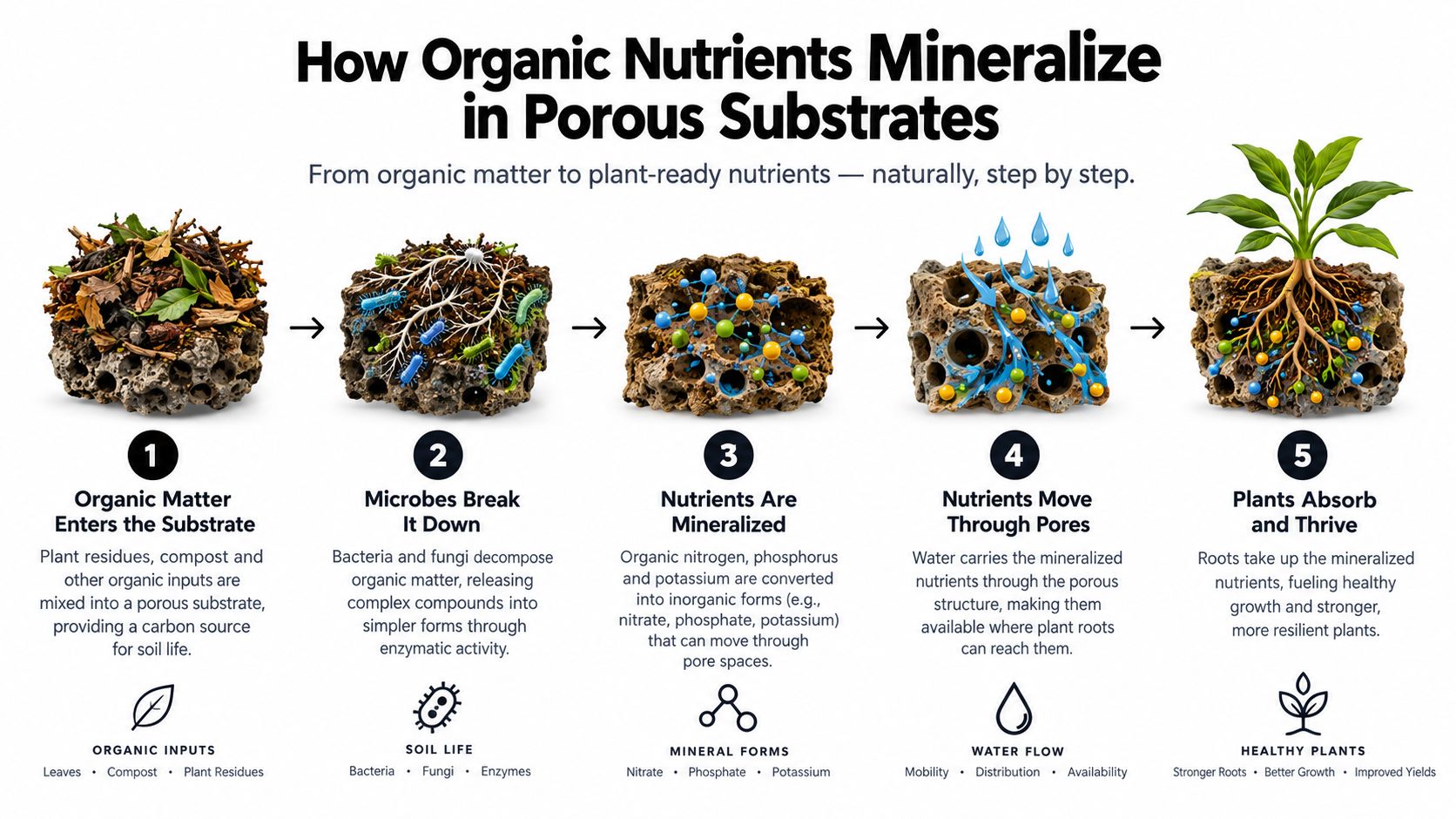
Organic cactus fertilizer does not place nitrogen directly into a root-ready form. Soil microorganisms first decompose the organic material, then mineralize it into ammonium and nitrate. Temperature, moisture, and the fertilizer's carbon-to-nitrogen ratio control how quickly that conversion occurs, as explained in the Washington State University Extension explanation of plant mineral nutrition. For a closer look at the organisms involved, see this guide to understanding microbial activity in your soil.
A soluble synthetic fertilizer follows a simpler path. Water dissolves its salts, making nutrients available according to the product's solubility and the movement of water through the pot. Organic material enters a biological process instead. Microbes need sufficient moisture, workable temperatures, and a carbon supply that does not make them consume available nitrogen faster than they release it.
The carbon-to-nitrogen balance
The carbon-to-nitrogen ratio helps explain why organic products with similar label language can behave differently. Materials below roughly 20:1 generally mineralize readily. High-carbon inputs can temporarily immobilize nitrogen because microbes use available nitrogen while decomposing them, leaving less plant-available nitrogen during the early phase.
Cactus substrates make that delay more noticeable. Porous mixes drain quickly and may remain dry between waterings, so microbial activity can rise and fall. A cool indoor pot may support little decomposition, while a warm outdoor container receiving periodic moisture can process the same amendment more readily.
Finished compost with a carbon-to-nitrogen ratio below 20:1 is expected to release nitrogen more readily. High-carbon material may provide little first-season nitrogen. Adding more because the cactus shows no immediate response can create an eventual overload instead of correcting the original delay.
Why the label needs interpretation
An organic NPK value describes the product's nutrient content, not an instant delivery schedule. The plant-available portion depends on biological conditions inside the pot. A modest amount of mature, relatively low-carbon material applied to moist media is easier to manage than a large dose of undecomposed manure or high-carbon compost.
Patience matters because mineralization takes time. Do not apply another dose only because new growth is not visible after a short interval. Check whether the cactus is warm enough, bright enough, and actively growing. Slow visible response can still reflect an appropriate nutrient supply, especially in a plant adapted to restrained growth.
Comparing Organic and Synthetic Fertilizer Impacts
Organic and synthetic fertilizers aren't moral opposites. They deliver nutrients through different mechanisms, and each has a place in cactus culture. The practical comparison is between biological, delayed release and rapidly soluble nutrients, especially in a small container where salts and moisture have limited room to move.
Synthetic fertilizer can offer precise nutrient analysis and a quick response when roots are active. That speed also demands careful dilution. Repeated soluble applications may leave fertilizer salts behind as water evaporates, particularly when a porous potting mix receives frequent feeding.
Organic fertilizer generally asks for more patience. Microorganisms must mineralize organic nutrients, and the release rate changes with moisture, temperature, and the material's carbon-to-nitrogen ratio. Its slower behavior can suit growers who want a restrained program, but it doesn't remove the need for careful application.
| Feature | Organic Fertilizer | Synthetic Fertilizer |
|---|---|---|
| Nutrient availability | Depends on microbial mineralization and growing conditions | Usually becomes soluble and available more quickly |
| Application control | Gradual, but variable with moisture, temperature, and ingredients | More chemically predictable when diluted correctly |
| Salt behavior | May reduce the intensity of an immediate soluble spike, depending on the product | Repeated applications can contribute to salt accumulation in containers |
| Best fit | Patient growers using mature, transparent ingredients | Growers who want precise, rapid nutrient delivery |
| Main caution | Applying more because the plant doesn't respond immediately | Applying too much or too often in a small pot |
A commercial label can't tell you everything about how a product will behave in your collection. Ingredient maturity, physical form, watering habits, and the biological activity of the substrate all matter. A liquid organic feed may be easier to distribute evenly than a dense top-dress, while a pellet can continue releasing nutrients after conditions change.
The comparison in this discussion of synthetic and organic fertilizer can help frame the choice without treating either category as automatically safe. For cacti, the more important decision is whether the product allows you to maintain a low, controlled nutrient supply.
This video provides another visual way to think about fertilizer behavior and application:
Seasonal Application Timing and Moisture Requirements
Buying an organic cactus fertilizer does not determine the result. Timing does. A cactus can receive a suitable product and still gain little if it is dormant, cold, or receiving weak light. Nutrients are used most effectively during active growth, so feeding generally belongs in late spring or summer, as described in the University of Minnesota Extension guidance on cacti and succulents.
A simple seasonal rhythm
Late spring: Watch for firm new growth before feeding. Once the plant is growing and its roots are functioning normally, apply a restrained feed at half the label rate.
Summer: Continue only while growth remains active and the medium dries properly between waterings. Warmth can help microbes mineralize organic nutrients, but heat by itself is not a reason to increase fertilizer.
Autumn: Reduce feeding as light levels and growth decline. Seasonal dates are only a guide. A cactus in a bright, warm greenhouse may keep growing after one on a cool indoor windowsill has slowed.
Winter: Withhold fertilizer during dormancy or low-light stagnation. If roots and microbes are inactive, nutrients may remain in the pot until warmer, brighter conditions return.

Moisture activates the biology
Organic nutrients must first mineralize before roots can use much of them. Moisture supports that microbial process, while air-filled pore spaces supply roots with oxygen. Applying dry fertilizer to a bone-dry, stressed root ball can produce uneven release. Apply a modest amount to moist media, then water normally so the material reaches the root zone without forming a concentrated pocket.
The goal is not continuous dampness. Coordinate feeding with a normal watering event during active growth, then allow the porous substrate to dry as appropriate. If a pot dries rapidly or is watered infrequently, microbial activity may slow. In a cool, dry indoor setting, organic nutrients can therefore become available more slowly than they do in warm outdoor conditions.
Feed when the plant can use the nutrients, and provide enough moisture for mineralization without turning the root zone into a reservoir.
Check three conditions before feeding:
- Active growth: Look for firm new development rather than relying on the calendar alone.
- Healthy roots: Delay feeding if the cactus shows rot, severe dehydration, or recent root damage.
- Proper drainage: Confirm that excess water can leave the container freely.
If one condition is missing, correct the growing environment first. Fertilizer cannot replace light, oxygen, or a functioning root system.
Evaluating DIY Recipes and Historical Soil Amendments
Organic fertilization long predates modern product labels. A 2023 review reports that organic-fertilizer use can be traced back approximately 6,000 years, and describes how the Roman agricultural writer Columella classified fertilizers into manure, compost, ground fertilizer, and mineral fertilizer, identifying manure as the best form (2023 review of organic fertilizers).
That history supports the legitimacy of recycling plant and animal materials into soil. It doesn't mean every traditional amendment belongs in a small cactus pot. Field agriculture has a large soil volume, rainfall patterns, and microbial environment. A container gives excess nutrients, salts, moisture, and undecomposed material far less room to disperse.
What makes a DIY amendment suitable
Finished worm castings, mature compost, and carefully diluted organic liquids can be useful when applied conservatively. The key word is finished. Mature material has undergone enough decomposition to reduce the risk of strong microbial competition and unpredictable nutrient release.
Raw manure is a poor choice for a container-grown cactus. It may be too concentrated, too biologically active, or insufficiently decomposed. High-carbon compost can also temporarily immobilize nitrogen as microbes use available nitrogen during decomposition, as described in the earlier mineralization guidance.
A practical DIY filter looks like this:
- Maturity: Use material that is fully decomposed and stable.
- Texture: Avoid dense additions that clog the air spaces in a gritty mix.
- Dilution: Treat teas and liquid emulsions as concentrates, not routine drinking water.
- Observation: Test any new approach on a healthy plant before using it across a collection.
Tradition needs container-scale control
The historical lesson is not “old materials are always better.” It's that nutrient recycling has a long agricultural foundation, while modern products add standardization and repeatability. A commercial organic cactus fertilizer can blend variable ingredients into a more consistent application, which matters when the plant occupies a small pot.
Gardeners who enjoy the visual and geological side of natural materials may also appreciate resources such as desert rose selenite from Astro West, but decorative minerals shouldn't be confused with a measured fertilizer amendment. Keep ornamental objects separate from nutrient decisions unless a product is specifically formulated and labeled for horticultural use.
Selecting the Right Formulation for Your Collection

The richest fertilizer is rarely the right choice for a cactus. Select a formulation by examining how its nutrients will behave in your porous substrate, then match that behavior to your watering routine, climate, and collection.
Begin with the NPK analysis. The University of Minnesota Extension recommends a formulation with a higher phosphorus proportion than nitrogen and applying it at half the label rate (University of Minnesota Extension guidance on cacti and succulents). Use that guidance as a starting point, not as a reason to treat phosphorus as a cure-all. Cacti generally benefit from a modest, purpose-built nutrient profile rather than a strong, nitrogen-heavy houseplant feed.
Match the form to your habits
Liquid concentrates give you direct control over dilution. They suit collections where individual plants need different feeding levels, and they can be applied to already moist media during active growth. Because nutrients move with water, measure the dilution carefully and avoid turning every watering into a feeding.
Slow-release pellets reduce the number of applications, but their behavior depends on moisture, temperature, and the product's coating or formulation. A pellet releasing nutrients in a dry, cool pot will not behave like one in warm, regularly watered media. Match the release pattern to the cactus's seasonal activity, container size, and growing conditions.
Top-dress amendments can work when the material is mature, stable, and used sparingly. Dense or poorly decomposed material can fill the air spaces that roots need, so physical texture matters as much as the nutrient label.
Read beyond the front label
Look for transparent ingredient information, clear dilution or application directions, and a distinction between total organic nutrient content and immediately available nutrients. Products that support restrained application are easier to manage than those framed around maximum growth.
Leaves & Soul offers a 13-11-11 slow-release succulent fertilizer pellet described as suitable for cactus and succulent plants, with a single application lasting up to 180 days, according to its product information. The extended-release format may suit growers who prefer fewer applications, provided it is matched to plant activity, container size, moisture, and the manufacturer's directions.
For a mixed collection, separate true desert cacti from faster-growing or moisture-loving succulents. Record feeding dates, substrate moisture, and plant response. Those observations reveal whether mineralization is occurring at a useful pace, which is more reliable than chasing a perfect formula.
Leaves & Soul offers fertilizers, soils, and amendments for cacti, succulents, and other indoor plants, including a slow-release succulent fertilizer pellet for controlled feeding. Visit Leaves & Soul to compare a formulation with your collection's needs.