


You buy a handsome little ficus, set it in a beautiful pot, place it near a bright window, and do your best not to overwater it. For a few weeks, it seems happy. Then the leaves start yellowing. A few drop. The top of the soil looks dry, but the tree still seems unhappy, so you water again. Now the pot stays wet too long, and the tree looks worse.
That moment frustrates almost every bonsai grower at some point. The pot is fine. The light may be acceptable. The pruning probably isn’t the issue. The hidden problem is often the ficus bonsai tree soil.
Most beginners think of soil as filler. Bonsai growers learn that soil is the tree’s real working environment. It stores water, releases air, anchors roots, and controls how nutrients move. In a shallow bonsai pot, that job gets harder. There isn’t much room for error.
A ficus is forgiving compared with many bonsai species, which is one reason it became so widely grown indoors. Since the mid-20th century, Ficus species such as Ficus benjamina and Ficus retusa have become among the most widely cultivated bonsai trees in Europe and North America, and by the 1990s European bonsai nurseries reported that Ficus made up roughly 15 to 20% of bonsai stock sold, a share that stayed relatively stable into the 2020s, according to this ficus bonsai soil reference. That popularity is a blessing for learners. It also creates a trap. People assume a tough tree will tolerate poor soil forever.
It won’t.
Good ficus bonsai tree soil isn’t just “better dirt.” It’s a deliberately built root zone. Once you understand why each particle is there, watering gets simpler, root health gets easier to read, and repotting stops feeling like guesswork. The overlooked parts matter most: how to adjust your mix for your climate and routine, and how to recognize when old soil has compacted enough to hurt the tree.
Introduction The Root of Ficus Bonsai Health
You water your ficus, the leaves still look decent, and yet the tree never seems to gain strength. New growth stays small. The pot remains wet long after you expected it to dry. A few weeks later, leaves begin to yellow or drop, and the problem appears to have come out of nowhere. In practice, the trouble often started much earlier, down in the soil.
That is why skilled bonsai growers check the root zone before they change fertilizer, light, or pruning. The canopy is the tree’s message board. The soil is the workshop where essential work happens.
For a ficus bonsai, soil works like a pantry and a sponge at the same time. It stores water and nutrients, but it must also leave open space for air. In a shallow bonsai pot, those jobs become harder because there is so little room for error. A mix that stays dense or soggy shuts roots off from oxygen. A mix that breaks down and compacts over time can cause the same problem, only more slowly and with less obvious warning.
Healthy bonsai begin in the pot, not in the canopy.
That slow change is one of the most overlooked parts of ficus care. A tree may seem fine in a fresh mix, then gradually become harder to water correctly as the particles wear down and the spaces between them collapse. Beginners often describe this as a watering problem. Often, it is a structure problem.
Ficus rewards good soil quickly because it produces roots fast in warm, active conditions. That speed is helpful, but it also means the tree reacts quickly when the root environment is wrong. A mix that works in one season may hold too much water in winter or dry too fast in peak summer. So the main question is not only what soil to use. It is why that mix works, when it stops working, and how to adjust it before the tree shows stress above the soil line.
If your ficus feels unpredictable, start there. Read the pot, the drainage speed, and the age of the mix. Once the root environment makes sense, watering, feeding, and repotting become far easier to judge.
The Science of a Perfect Soil Environment
Regular potting soil and bonsai soil are built for different jobs. In a deep nursery pot, a heavier organic mix can still work because there is more room for excess water to spread out. In a shallow bonsai pot, that same mix can stay wet for too long, settle into a dense layer, and squeeze oxygen away from the roots.
That difference is the whole science problem.
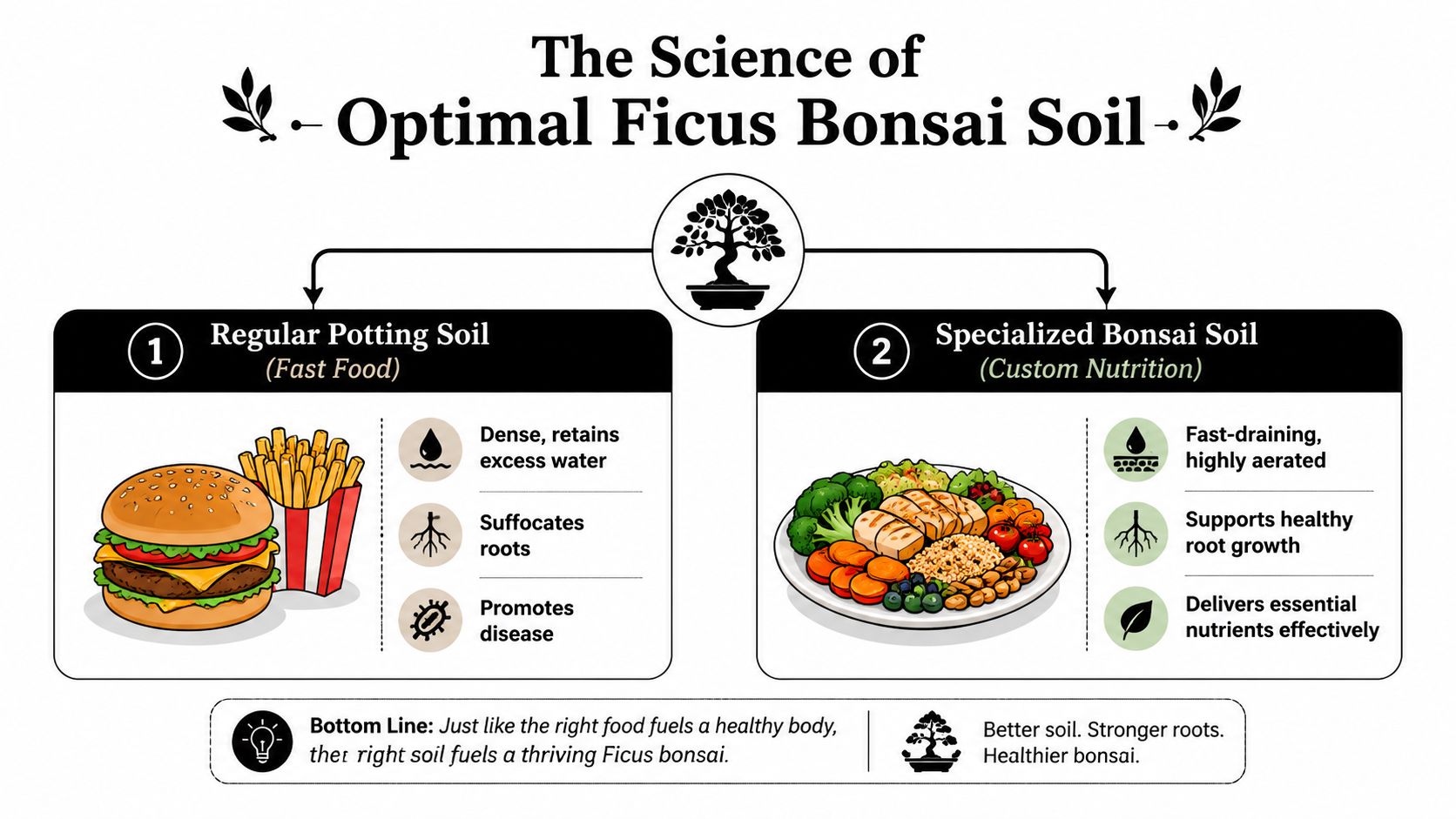
A ficus soil mix has to do four things at once, and it has to keep doing them month after month, not just during the week after repotting.
- Drain extra water quickly. Water should move through the pot instead of pooling around fine roots.
- Hold open pore space for air. Roots respire. Without oxygen, they slow down, then rot.
- Keep enough moisture between waterings. Fast drainage is useful only if the particles still hold a reserve of water inside and between them.
- Resist collapse over time. A mix that starts coarse but crumbles into fines gradually becomes harder to water and harder for roots to inhabit.
That last point deserves more attention than it usually gets. Soil failure is often slow. A fresh mix may behave beautifully in spring, then become tighter and less predictable as particles weather, roots fill the pot, and repeated watering pulls small debris downward. What looks like a watering mistake is often a structure problem that has been building for months.
Why particle-based bonsai soil works
Ficus growers often rely on akadama, pumice, and lava rock because each material solves a different part of the root-zone puzzle.
Akadama holds water and helps retain nutrients. It is the ingredient that gives the mix some buffering capacity instead of letting every feeding wash straight through.
Pumice keeps the mix lighter and more porous. It creates internal air space and slows compaction.
Lava rock adds durability. It helps preserve channels for drainage and gives the mix a rigid skeleton that resists collapse.
Together, those particles create a root environment with both moisture and breathing room. For growers who want a clearer picture of why that balance changes with grade size, Leaves & Soul offers a useful explanation of how soil particle size affects drainage.
Particle size matters more than many care guides admit. Large particles create bigger air gaps and faster drainage. Smaller particles hold more water, but they also pack more tightly, especially after a season of watering. That is why the same ingredients can behave very differently depending on how coarse or fine they are.
The chemistry under the surface
Good bonsai soil is not only a physical structure problem. It is also a nutrient-holding problem.
Growers often shorten this idea to CEC, or cation exchange capacity. The term sounds academic, but the practical meaning is simple. Some soil particles can catch nutrient ions from fertilizer and hold them near the roots, then release them gradually as the tree uses them. Materials with useful CEC help create a steadier feeding pattern instead of a sharp flush followed by empty runoff.
That is one reason akadama remains popular in serious bonsai culture. As explained in Kaizen Bonsai’s soil guide, growers value it not just for water retention but for its ability to support a more stable nutrient environment through the growing season.
Practical rule: A strong bonsai mix manages water, oxygen, and nutrient access at the same time.
Air inside the pot decides root health
Roots need water, but they also need open space after watering. If the mix stays waterlogged, the fine feeder roots that do most of the absorbing begin to fail first. The canopy may still look acceptable for a while, which is why soil problems are easy to miss early.
This is where seasonal judgment matters. In warm months, a ficus grows roots quickly and uses water faster, so a slightly more moisture-retentive mix can be helpful. In cooler months, especially indoors under weaker light, that same mix may stay wet too long. The best soil for ficus is not a frozen recipe. It is a structure you can adjust to suit growth speed, temperature, humidity, and your watering habits.
The same principle shows up across horticulture. The article on healthy soil fundamentals from Lawn & Leaf Solutions offers a useful reminder that oxygen, drainage, structure, and nutrient access always work together, whether the plant is a lawn grass or a miniature fig.
Why regular potting mix usually disappoints in bonsai
High-quality potting mix can grow many healthy plants. Bonsai asks for tighter control.
Most potting soils contain fine organic material designed to stay moist in larger containers. In a shallow bonsai pot, those fine particles break down further, settle into the gaps, and reduce airflow. Watering becomes less predictable. The top may look dry while the lower half remains soggy. Then compaction starts feeding on itself. Slower drainage means longer saturation, and longer saturation speeds root decline.
A particle-based bonsai mix is easier to read. Water moves through it cleanly. The surface response is more consistent. The change over time is slower and easier to spot before the tree declines.
That is the goal of good ficus soil science. You are building a root environment that stays understandable through the seasons, instead of one that turns into a mystery after a few months.
Building Your Ideal Ficus Soil Mix
Once you understand what each ingredient does, mixing soil becomes much less mysterious. You’re not hunting for a magic recipe. You’re balancing moisture retention against drainage for your specific conditions.
That last part matters. Many care guides tell growers to use akadama, pumice, and lava rock, but they stop there. The bigger challenge is deciding how much of each to use when your home is dry, your climate is humid, or your watering habits are inconsistent. That gap is real, and it’s one reason growers often feel unsure even after learning the basics, as noted in this discussion of soil composition adjustments for conditions and habits.
Three practical mix formulas
Use these as working formulas, not rigid commandments. They’re designed to help you think clearly about the direction of adjustment.
| Mix Name | Akadama | Pumice | Lava Rock | Best For |
|---|---|---|---|---|
| All-Purpose Beginner Mix | 1 part | 1 part | 1 part | Balanced conditions and growers learning how their ficus drinks |
| Humid Climate Mix | 1 part | 2 parts | 1 part | Damp rooms, rainy seasons, or growers who tend to water early |
| Dry Climate Indoor Mix | 2 parts | 1 part | 1 part | Heated homes, dry air, bright indoor spots, or trees that dry quickly |
The equal-parts version is the easiest place to start. It gives you a stable middle ground and teaches you how your tree behaves in your environment.
The more draining formula increases pumice. That creates a looser mix that sheds water more readily.
The more moisture-retentive formula raises akadama. That helps the root zone stay evenly moist a bit longer between waterings.
You aren’t choosing a “good” or “bad” mix. You’re choosing which problem you need the soil to solve.
How to decide which way to adjust
Growers usually overcomplicate this. Don’t begin with theory. Begin with observation.
If your ficus stays wet too long, reduce the moisture-holding fraction and increase the airy fraction. If it dries faster than your routine can support, move the other direction. Soil blending is less like baking and more like tuning a radio. Small shifts matter.
Here’s a simple way to think through it:
- Your room feels humid for much of the day. Lean toward more pumice and keep the mix open.
- Your tree sits near warm indoor airflow or bright sun. Lean toward more akadama so moisture lasts longer.
- You water generously and tend to worry over dry surfaces. Choose a more draining mix so the roots don’t pay for your caution.
- You travel or miss a day now and then. A slightly more moisture-retentive mix can give you breathing room.
Seasonal changes that most guides skip
Many growers ask whether they need a separate soil mix for winter and summer. The honest answer is that some do, and some don’t. It depends on how extreme the change is in your home or region.
A ficus moved outdoors for warm weather may suddenly dry much faster because of sun and wind. The same tree brought indoors later may stay wet longer because air movement drops and light is weaker. If you use one mix all year, your watering practice must adapt sharply. Some growers prefer that. Others adjust the mix at repotting to better match the dominant season.
You don’t need a dramatic change. Even a modest shift in the akadama-to-pumice balance can make daily care easier.
A useful rule of thumb is to ask one question: What is the bigger risk in this season, drying out too fast or staying wet too long? Build your mix to defend against that risk.
DIY versus pre-mixed options
Some growers enjoy sourcing and blending each ingredient. Others want consistency without storing bags of separate components. Both approaches are reasonable.
If you want a ready-made route, Leaves & Soul’s guide to finding the best bonsai soil is helpful for comparing what to look for in a mix. Leaves & Soul also offers a pre-mixed bonsai soil that can serve growers who want a prepared blend instead of mixing components by hand.
The main point is not whether you mix it yourself. The main point is that the blend should behave predictably in a shallow pot.
A workshop example
Let’s say two students bring nearly identical ficus trees.
One lives in a bright apartment with dry forced air. The owner waters carefully but finds the soil dries sooner than expected.
The other lives in a more humid space and tends to water every time the surface looks pale.
I would not give them the same formula. The first grower benefits from a little more akadama. The second needs a more open, forgiving blend. Same species. Different soil decisions.
That’s why “the perfect ficus bonsai tree soil” is never just about ingredients. It’s about ingredients in context.
A Step-by-Step Guide to Repotting Your Ficus
Repotting scares people because it looks like surgery. In practice, it’s closer to a health check. You remove the tree, inspect the roots, clean up what’s no longer helping, and rebuild the environment.
That’s especially important because old soil changes even when the tree looks fine above ground.
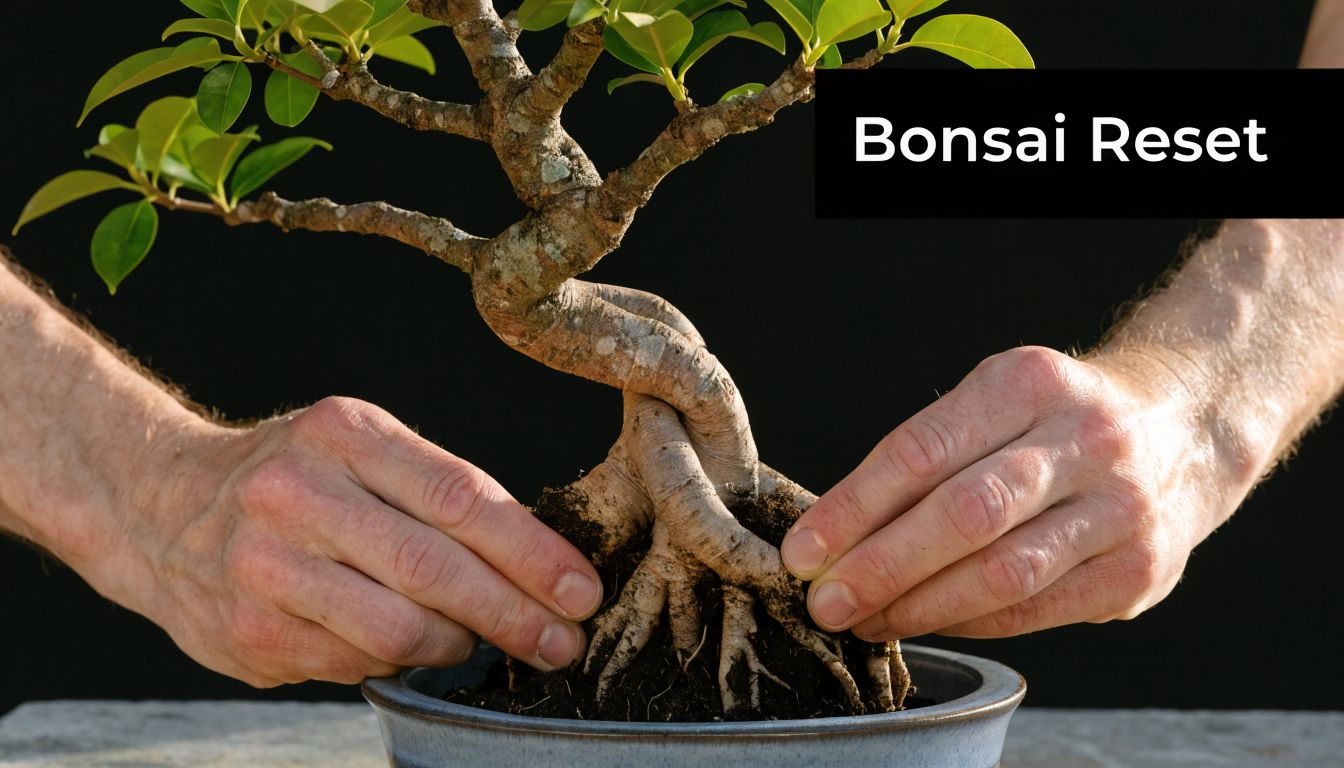
Organic components and poor-quality inorganic materials can compact heavily over time, even leading to zero root growth. Premium inorganic blends for ficus typically need replacement every 12 to 18 months to stay ahead of that problem, according to this discussion on soil compaction and repotting intervals for ficus bonsai.
Signs your tree is asking for fresh soil
You don’t always need a calendar to tell you. The tree and pot usually give clues.
- Water lingers too long. What once drained cleanly now sits in the pot.
- The surface hardens. Soil starts feeling crusted or packed.
- Growth stalls. New leaves get smaller or less frequent.
- Roots look unhappy. Healthy feeder roots are light and active-looking. Problem roots are darker, mushy, or lifeless.
If those signs appear, don’t wait for the perfect date. Correcting the root environment matters more than clinging to a schedule.
The repotting sequence
Repotting goes better when you work in order and don’t rush.
- Prepare the new pot first. Add mesh over drainage holes and set your tie-down wire before the tree comes out of the old container.
- Water the tree beforehand if the root ball is bone dry. Slightly moist roots are easier to work with than brittle dry ones.
- Remove the tree gently. Loosen around the edges, then lift carefully from the pot.
- Comb out old soil. Use a root rake or chopstick with patience, especially around the outer root mass.
- Inspect the roots. Keep healthy roots. Remove obviously damaged, dead, or rotting sections.
- Seat the tree securely. Movement after repotting damages fresh root tips.
- Work new soil into every gap. Use a chopstick to eliminate hidden air pockets around the roots.
- Water thoroughly after potting. This settles the mix and shows whether drainage is functioning.
The goal isn’t to bare-root the tree aggressively. The goal is to replace failing soil with clean, stable structure.
For growers who want a visual walkthrough, this repotting video helps show the pace and hand movements involved:
Root pruning without panic
Beginners often either cut far too much or avoid cutting anything. Neither extreme helps.
A ficus usually tolerates root work well when it’s healthy, but your job is still selective. Remove what’s clearly compromised first. Then reduce excess length where needed to fit the pot and encourage finer branching in the root system.
Healthy roots are usually firm and lighter in color at the tips. Unhealthy roots often feel soft, dark, or sour-smelling. If the inner root mass is dense and packed, tease it open enough that fresh soil can contact living roots.
If you’re nervous about that stage, this Leaves & Soul article on repotting bonsai without damaging roots is a useful companion because it focuses on handling roots carefully rather than aggressively.
Aftercare matters as much as the repot
A freshly repotted ficus needs stability. Don’t combine repotting with every other stressful task. Avoid heavy pruning at the same moment unless the tree’s condition demands it.
Place it where light is bright but not punishing. Water thoroughly, then let the new soil’s surface guide your next watering instead of following your old rhythm automatically. A fresh, open mix often changes how often the tree needs water.
The first goal after repotting isn’t top growth. It’s renewed root function.
Adapting Care and Troubleshooting Root Issues
You repot your ficus into a clean, open mix. A week later, the old watering habit is still in charge. That is where many root problems begin.
Fresh bonsai soil changes the pace of care. Water now moves differently, air reaches the roots more easily, and the mix dries in a more predictable cycle. If you miss that change, you can still overwater a tree sitting in excellent soil.
The root zone works like a pantry and a sponge. It stores water and nutrients, but it also needs open space between particles so roots can breathe. Over time, even a good mix can lose that balance. Fine particles settle, organic matter breaks down, and repeated watering packs the soil tighter. Seasonal care matters for the same reason. A ficus may use water quickly in bright summer growth and much more slowly in the dimmer, cooler part of the year.
Watering a fast-draining mix correctly
The goal is evenly moist soil that still contains air. Ficus roots handle that balance well. They struggle when the mix stays saturated for long stretches or dries so far that feeder roots shut down.
A particle-based mix often dries faster at the surface than beginners expect. The top can look dusty while the center is still damp. That is why fixed schedules cause trouble. The pot, the season, the amount of light, and the tree’s growth rate all change how quickly moisture is used.
Use a simple routine:
- Check below the surface. A fingertip, chopstick, or wooden skewer tells you more than the top layer alone.
- Water thoroughly when the tree needs it. Wet the full root ball so dry pockets do not remain inside.
- Let excess water leave the pot completely. Standing runoff turns an airy mix into a wet chamber.
- Adjust with the season. In warm, bright conditions, check sooner. In slower winter growth indoors, give the mix more time to approach the next watering point.
If watering always feels mysterious, inspect the soil structure. Good soil makes the wet-to-damp-to-nearly-dry cycle easier to read.
Reading the warning signs
Leaves report stress, but roots usually write the story first.
Yellowing leaves with soil that stays wet for days often point to low oxygen around the roots. The problem is not just “too much water.” It is water sitting in a mix that is no longer giving roots enough air.
Crisp edges or brittle leaves with a mix that races dry can mean the particle size is too coarse for your room, your tree is rootbound, or summer conditions are pulling moisture out faster than the roots can replace it.
Leaf drop after a move or temperature change may be ordinary stress. If the pot also smells sour or stays heavy, the root zone deserves closer inspection.
Watch the pattern, not a single symptom. Healthy root systems create a steady rhythm. Water goes in, extra moisture drains out, and the mix gradually dries until the next watering.
What root rot really is
Root rot is often misunderstood. It usually develops because the root environment stayed wet, dense, and oxygen-poor long enough for roots to weaken and decay.
That distinction matters. If you treat root rot as a mystery disease, you may reach for additives and keep the same bad soil. If you treat it as an environmental failure, the solution becomes clearer.
Work through it in this order:
- Pause automatic watering. Confirm whether the mix is drying between waterings.
- Check drainage speed. If water sits on top or trickles through slowly, compaction may be the issue.
- Inspect the root ball if symptoms persist. Soft, dark, foul-smelling roots confirm decline better than leaf color alone.
- Remove decayed roots and collapsed soil. Leave what is firm and alive.
- Repot into a stable, airy mix. Recovery starts when the root zone can breathe again.
Compaction is the quiet part of this problem. A ficus may seem fine while the soil gradually shifts from granular to clogged. Then watering becomes erratic, the center stays wet too long, and root loss begins below the surface. That is why troubleshooting is not only about what mix you used, but also when that mix started to break down.
Feeding in a leaner soil system
Open bonsai soil gives you control, but it does not supply much nutrition by itself. Fertilizer fills that gap.
The easiest way to understand it is this: soil holds resources in place, and fertilizer replenishes them. Inorganic particles drain well and also help retain nutrients on their surfaces, especially when watering is thorough and regular. A ficus in active growth responds well to consistent feeding because the roots can access oxygen and nutrients at the same time.
Keep the feeding rate in step with the season. Feed more actively when the tree is growing strongly in warm, bright conditions. Reduce or pause if growth slows, light drops, or the tree is recovering from root trouble.
A simpler daily mindset
Ask a better question each day. Is the root zone moving through a healthy cycle?
Right after watering, the mix should be fully moist. Then it should shift to damp, with air returning between particles. Then it should approach the point where the tree is ready for water again. Learn that rhythm, and both seasonal adjustment and root troubleshooting become much easier.
Conclusion Your Path to a Thriving Ficus
A healthy ficus bonsai is usually decided below the soil surface. The canopy shows the results, but the roots set the pace.
Soil works like a pantry and a sponge. It stores water and nutrients, then releases them while still leaving room for air. Once you understand that balance, daily care becomes easier to read. Watering stops being a fixed schedule. Fertilizing becomes more precise. Repotting becomes regular maintenance instead of a rescue job.
The core lesson is simple, but it rewards close observation. Use a granular mix that keeps pores open for oxygen, drains excess water, and holds enough moisture for steady root function. Then adjust that mix to your conditions. A ficus growing in summer heat, strong light, and fast evaporation may need slightly more water retention. The same tree in a cool indoor room may need a more open structure so the root zone does not stay wet too long.
That is the part many care guides skip. Good ficus bonsai soil is not only about what goes into the pot on repotting day. It is also about when the mix begins to change. Over time, even a well-chosen soil can break down, settle, and compact. The surface may still look acceptable while the lower root zone loses air space. If you remember one long-term principle, remember this one. Monitor the soil as it ages, not just the tree as it grows.
Experienced growers often use blends built around akadama, pumice, and lava because those particles create a predictable balance of drainage, moisture retention, and structure. The exact ratio matters less than the reason behind it. Each ingredient has a job, and the mix works best when those jobs stay in balance for your climate, watering habits, and stage of growth.
Once that design makes sense, you can make changes with confidence. You are no longer guessing. You are reading the season, checking the soil structure, and giving the roots what they need at the right time.
If you’re ready to put these ideas into practice, Leaves & Soul offers bonsai soils, fertilizers, pots, and starter-friendly accessories that can help you build a healthier root environment for your ficus. Whether you prefer to mix your own formula or use ready-to-use materials, the right tools make consistent care easier.