


Orchid food is a specialized, water-soluble fertilizer designed for epiphytic plants that require low-dose, frequent feeding to avoid salt buildup in their bark medium. It supplies the three primary macronutrients, nitrogen, phosphorus, and potassium, alongside secondary and micronutrients that contribute to healthy growth.
The surprising part is that orchids usually struggle less from a lack of fertilizer than from receiving too much at once. A strong dose may look helpful on the label, yet the same concentration can stress orchid roots, especially when the plant grows in bark or moss instead of nutrient-rich soil.
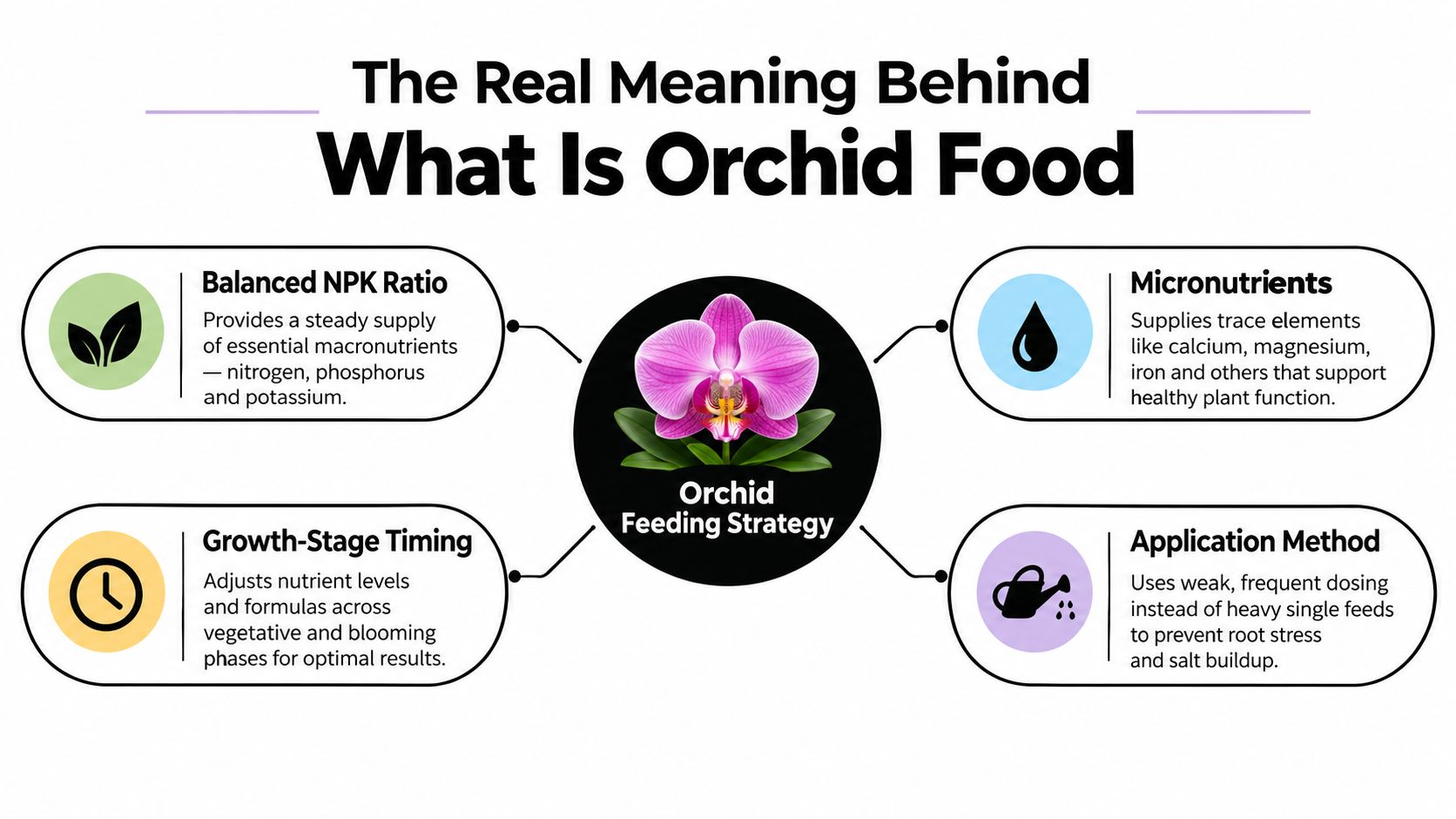
That's why the useful answer to “what is orchid food” isn't just “a fertilizer with a special label.” It's a delivery strategy. The right product, concentration, timing, and flushing routine work together to give an orchid enough nutrition without leaving damaging salts around its roots.
The Real Meaning Behind What Is Orchid Food
A new orchid owner often brings home a flowering Phalaenopsis, places it in a bright room, and reaches for the same plant food used on leafy houseplants. The orchid may flower beautifully for a while, but trouble can begin when the roots sit in a concentrated fertilizer solution trapped among bark pieces.
Orchids have a different starting point from plants grown in ordinary potting soil. Many are epiphytes, which means they naturally grow attached to trees rather than rooted in deep ground. Their roots encounter brief supplies of moisture and dissolved nutrients, followed by airflow and drying. Indoor bark and moss mixes imitate parts of that environment, but they also leave little room for careless dosing.
Orchid food therefore has two jobs. It must supply nutrition, and it must deliver that nutrition in a form and concentration the roots can tolerate. Guidance on the nutrients found in orchid fertilizer describes 18 essential elements for healthy plant growth, including the three primary macronutrients, secondary nutrients, and micronutrients.
The growing medium changes the feeding plan
A standard houseplant may have soil that holds nutrients between waterings. Coarse orchid bark behaves differently. Water runs through it quickly, and the roots experience a repeating wet-dry cycle. Moss can hold moisture for longer, while older, partially decomposed media may retain more salts.
That variation explains why a bottle labeled “orchid food” cannot make every feeding decision for you. A balanced formula may be appropriate, but the grower still has to consider how much water the medium holds, how quickly it drains, and whether the plant is actively producing leaves or roots.
Practical rule: Treat the label as a starting point, not as permission to use the strongest possible dose.
A weak, balanced formula is generally more suitable than aggressive feeding because orchids can be damaged by overfertilization. The product matters, but the way you apply it matters just as much. Orchid food is best viewed as measured nutrition delivered through water, not as a booster that forces flowers to appear.
Decoding N-P-K and the Weakly Weekly Method
The three numbers on a fertilizer label show the relative emphasis of its primary nutrients:
- Nitrogen supports leafy growth: It is associated with the plant's vegetative development and is often the first number growers examine.
- Phosphorus supports plant functions: It forms part of the overall nutrient balance, but a higher middle number isn't automatically better for flowering.
- Potassium contributes to general vigor: It works as part of the plant's broader nutritional system rather than acting as a guaranteed bloom trigger.
The label tells you the formula's composition. It doesn't tell you that your orchid needs the full package rate. For orchids, concentration often deserves more attention than the ratio printed on the front of the container.
The American Orchid Society popularized the practical phrase “weakly, weekly.” The method means using roughly half or even a quarter of the package rate and applying a mild solution regularly during active growth, rather than giving the plant a heavy monthly dose. The reasoning is straightforward: a small amount that reaches the roots repeatedly is easier to manage than a large amount that remains in the medium.
Why dilution changes the risk
Think of orchid roots as receiving small sips rather than a large meal. When the solution is too concentrated, dissolved salts can remain around the roots as water evaporates. Repeated applications without plain water can increase that residue, particularly in a medium that doesn't drain freely.
The value of a low-dose approach is supported by the precision used in orchid nutrition research. One fertilizer program reported its best results for cymbidiums at approximately N 100 ppm, P 20 ppm, K 75 ppm, Mg 25 ppm, and Fe 8 to 10 ppm, as summarized in the American Orchid Society's fertilizer guidance. Those figures illustrate how carefully managed orchid feeding can be, not how much fertilizer every home grower should attempt to measure.
Use the package instructions to prepare a diluted solution, then adjust the routine to the plant's growth and medium. If the orchid is producing new roots or leaves, regular light feeding may make sense. If growth has slowed, reduce feeding rather than maintaining the same dose out of habit.
Less fertilizer at a repeatable concentration is safer than an occasional correction with a strong solution.
Plain water also belongs in the method. Alternating fertilizer water with plain water helps carry residual salts out through the drainage holes. If a product's instructions conflict with the needs of your orchid's medium, prioritize the plant's condition and reduce concentration rather than increasing it to chase faster results.
Liquid, Spikes, and Powders, Choosing Your Format
The format of orchid food affects how much control you have over concentration. For most orchids grown in bark or moss, that control is more valuable than convenience alone.
| Format | Main advantage | Main concern | Best fit |
|---|---|---|---|
| Liquid fertilizer | Easy to dilute and adjust | Requires measuring and mixing | Growers following a low-dose routine |
| Soluble powder | Stores compactly and mixes into water | A small measuring error can change concentration | Larger collections and regular feeders |
| Fertilizer spikes | Convenient and slow releasing | Nutrients may concentrate in one area | Setups where the product and medium are carefully matched |
Liquid fertilizer is the simplest format for practicing weak, frequent feeding. You can prepare a mild solution, apply it with a normal watering routine, and change the concentration when the plant's growth slows. That makes liquid food useful for beginners who are still learning how quickly their bark mix dries.
Soluble powders offer similar control once they're mixed accurately. They can suit growers with several orchids, but the powder must dissolve thoroughly and the package rate should never be treated as a target dose by default.
Spikes are less flexible. A slow-release product continues supplying nutrients after application, which can make it harder to respond quickly when the orchid enters a slower growth phase or when the medium begins retaining moisture and salts. Orchid guidance generally favors diluted, water-soluble feeding at regular intervals over dry fertilizer applications because the roots and media need protection from salt buildup and must cope with rapid wet-dry cycling, as discussed in this analysis of orchid fertilizer delivery.
If you're also exploring broader plant nutrition, happy plants with Little Green Leaf offers useful context on fertilizer choices beyond orchids. For a more focused comparison of application methods, see this guide to liquid fertilizer for orchids.
How to Feed Orchids During Every Season
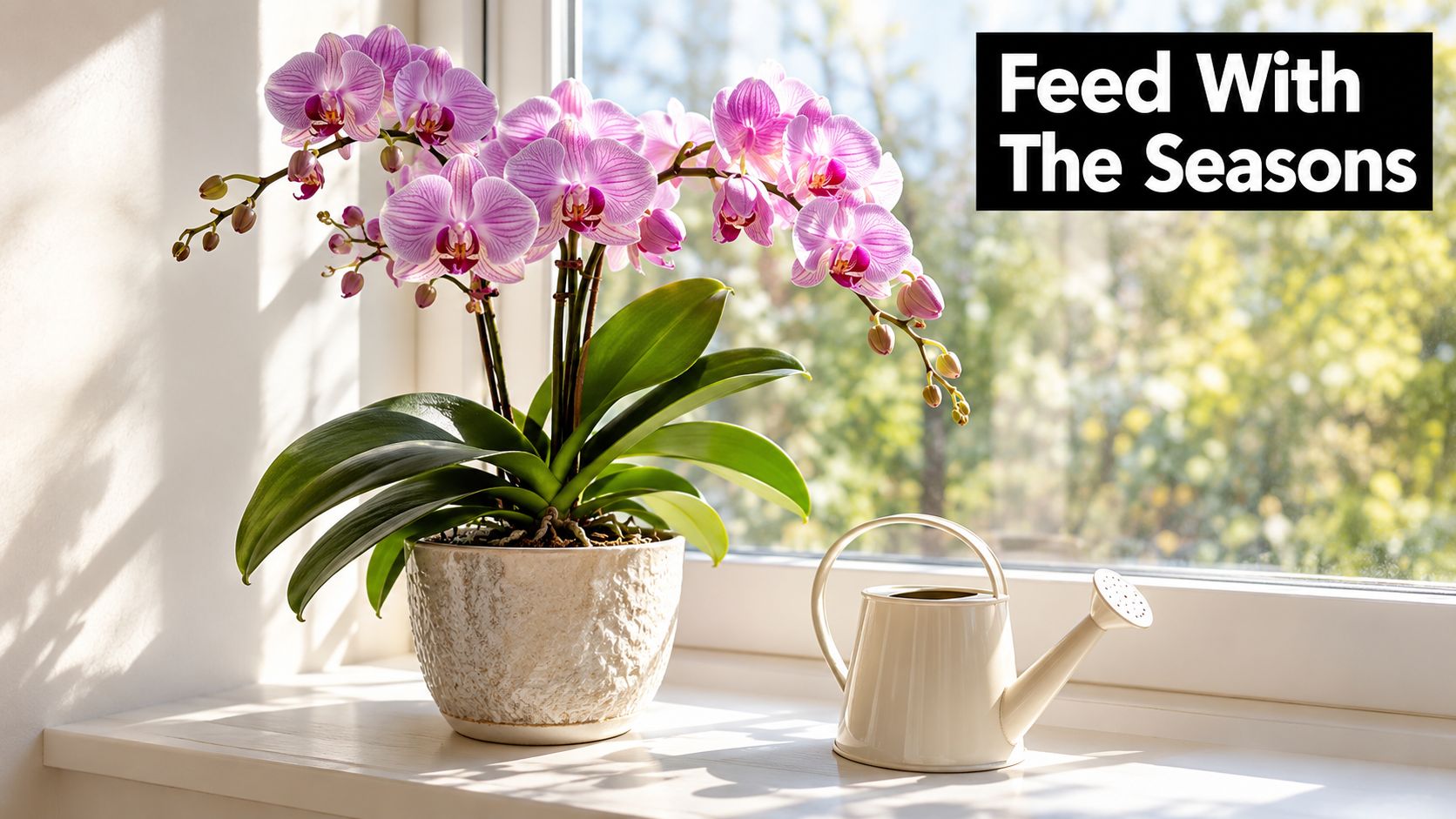
An orchid doesn't follow the calendar as strictly as a human schedule. It responds to light, temperature, watering, root activity, and the appearance of new growth. Seasonal changes provide useful clues, but the plant's condition should decide whether feeding continues at the same frequency.
A practical feeding sequence
- Check for active growth. Look for a developing leaf, fresh root tips, or other visible signs that the plant is using resources. A resting orchid doesn't need the same routine as one producing new tissue.
- Water the medium appropriately. The roots and bark should receive moisture without remaining in stagnant water. Allow excess solution to drain completely from the pot.
- Apply a diluted fertilizer solution. During active growth, use roughly half or a quarter of the package rate rather than a full-strength application. Some guidance recommends feeding as often as every other watering in fresh bark mix, but that frequency should be reduced when the medium holds salts or breaks down.
- Alternate with plain water. Plain watering helps flush residue through the drainage holes. This step is especially important when you've used fertilizer repeatedly or when the potting medium has begun retaining moisture.
During brighter, warmer growth periods, an orchid may tolerate regular light feeding when its roots and leaves are developing. In cooler periods or after growth slows, reduce applications substantially. Some growers feed about monthly or stop altogether when the plant is resting or growing in a salt-retentive, partially decayed medium. The orchid fertilizer schedule guidance from St. Augustine Orchid Society emphasizes adjusting the routine instead of treating fertilizer as a fixed year-round requirement.
Watch the pot, not just the calendar. Fresh, open bark drains differently from older bark or dense moss. Low light also changes the equation because a plant that isn't producing much new growth has less demand for added nutrients.
The video below provides another visual look at orchid feeding and care:
For a more detailed routine that connects feeding frequency with plant activity, use this orchid fertilizer schedule as a practical reference. The safest routine is one you can repeat consistently while checking the roots, leaves, and condition of the medium.
Diagnosing Deficiency and Overfeeding Signs
Nutrient problems can look similar to watering, light, temperature, or root problems. A yellow leaf doesn't automatically mean the orchid needs fertilizer, and a lack of flowers doesn't prove that phosphorus is missing. Start by checking the whole growing situation before adding more nutrients.
Signs that the plant may be underfed
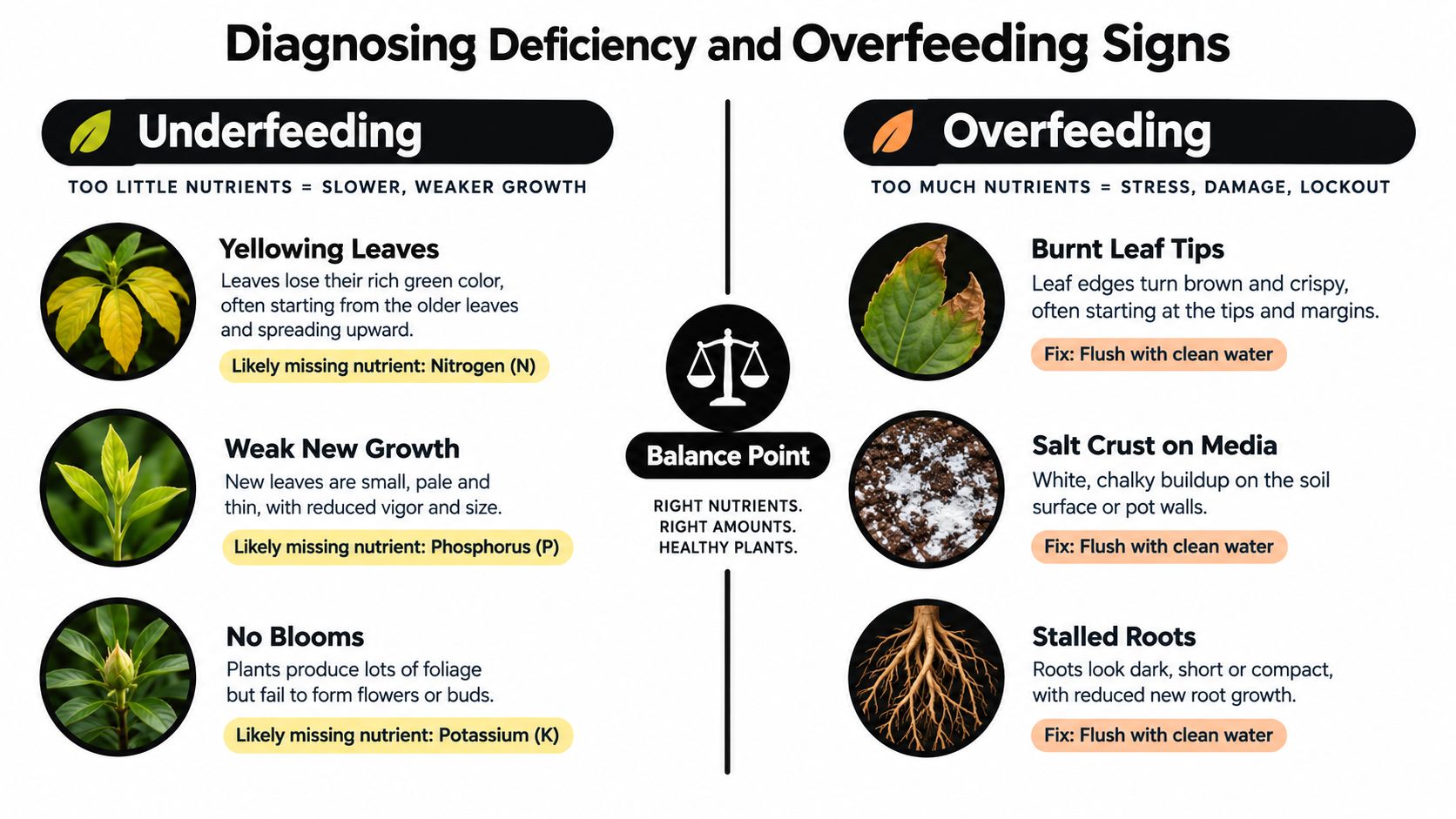
An orchid receiving too little nutrition may show weak new growth, pale foliage, or limited development, especially if it has been growing for a long time in depleted media. Those signs are not a diagnosis by themselves. Inspect the roots, check whether the plant receives suitable light, and consider whether the potting mix has broken down.
Different nutrient shortages can produce overlapping symptoms. Nitrogen, phosphorus, and potassium all support different parts of plant function, but guessing from a single leaf can lead to unnecessary feeding. A balanced, diluted routine is usually more sensible than adding a concentrated nutrient based on one visual clue.
Signs that the plant is receiving too much
Overfeeding often leaves a more direct warning around the root zone. Look for brown or burned leaf tips, a white crust on the medium or pot, and stalled root growth. These signs suggest that salts may be accumulating, though other growing conditions can contribute to root stress as well.
Stop adding fertilizer when overfeeding seems likely. Flush the medium thoroughly with plain water and allow it to drain, then resume only at a lower concentration once the plant has stabilized. If roots are damaged or the medium has become dense and salt-retentive, changing the growing medium may be more useful than trying to correct the problem with another product.
A struggling orchid needs diagnosis before nutrition. More fertilizer rarely fixes a root problem caused by poor drainage or accumulated salts.
Making the Smart Choice for Your Collection
The most useful buying question isn't “Which orchid food has the strongest N-P-K?” Ask instead, “Can I control the concentration, match the product to my medium, and flush the roots when needed?”
A balanced fertilizer can work when you dilute it appropriately and apply it during active growth. An orchid-specific blend may offer a convenient nutrient profile or include secondary and micronutrients suited to the product's intended use. Neither label removes the need to observe the plant.
A simple selection filter
Choose a water-soluble liquid or powder if you want direct control over every feeding. This format works well for a single Phalaenopsis on a predictable watering routine or for a collection where different plants need different concentrations.
Consider a slow-release option only when you understand how the product behaves in your specific medium. Bark, moss, and partially decomposed mixes don't hold water or salts in the same way, so a routine that works in one pot may be inappropriate in another.
Read the label for more than the N-P-K ratio. Check whether the instructions explain dilution, whether the product is intended for orchids, and whether you can stop or reduce applications easily when growth slows. A formula with a balanced ratio may be perfectly serviceable, while a specialized product may make the intended use clearer.
Research summarized in this study of fertilizer ratios and concentration in orchids highlights an important distinction: orchid feeding advice often focuses on the formula, while concentration may be the more practical variable for growers to manage. That shifts the decision away from chasing a magic label and toward building a careful system.
For one orchid, keep the routine simple. For a varied collection, record which plants are actively growing, which medium each uses, and how quickly salts appear. The best orchid food is the product that lets you provide measured nutrition without losing control of timing, dilution, or drainage.
Leaves & Soul offers orchid fertilizers in formats such as slow-release pellets and ready-to-use spray, giving growers options for different feeding routines and levels of concentration control. Visit Leaves & Soul to explore orchid nutrition and choose a feeding approach that fits your plants, potting medium, and care schedule.