


The bag in your hand says "feeds for up to four months." Behind you at home is a bonsai in a 6 inch pot sitting in a bright, warm room, and a fiddle leaf fig parked beside a radiator. Four months at what temperature, in what medium? The label won't say, and the person at the register usually can't either.
That gap is the actual decision you're making. Buying slow release fertilizer isn't a shelf-finding exercise, it's a timing match: the pellet's rated duration against the warmth and moisture your growing space really runs at, and against how much nutrient buffering a small pot has. Get that match right and where to buy slow release fertilizer becomes a simple question about who publishes the numbers you need. Get it wrong and you'll pay for eight months of feeding and get four.
Where to Buy Slow Release Fertilizer by Retailer Type
Six kinds of seller stock these pellets, and they don't do the same job. Match the source to what you need this week: product in hand, a bulk bag for outdoor beds, or a technical sheet you can read before you pay.
| Retailer type | Best for | Main strength | Main limit |
|---|---|---|---|
| Garden centers and nurseries | Buying today and asking local questions | Products seen in person, same-day pickup | Narrow range of controlled-release brands |
| Farm-supply stores and co-ops | Larger bags for outdoor beds and lawns | Dependable bulk products, knowledgeable on field use | Little guidance for bonsai or indoor pots |
| Home-improvement and big-box stores | Convenient restocking with easy returns | Wide availability | Labels often lack release duration details |
| General online marketplaces | Comparing many brands and prices | Largest selection | Listing accuracy varies and sellers may not be verified |
| Specialist online plant shops | Matching a formula to bonsai, houseplants, succulents or orchids | Products sorted by plant type and application | Shipping needed and no same-day pickup |
| Direct brand websites | Checking the full technical sheet and official rate | Most complete product data | Single-brand range only |
Garden centers and nurseries win when a plant needs feeding this week. You can turn the tub over, read the back panel, and ask what the staff use on their own stock. The catch is range: most carry one or two controlled-release brands, and rarely a pellet sized for a 6 inch bonsai pot.
Farm-supply stores and co-ops sell larger bags for beds and lawns at dependable quality, and the staff know field crops cold. Ask them about release duration in a houseplant pot and the conversation stalls.
Big-box stores are convenient for restocking and easy returns, but their labels often skip release duration entirely. If you want to know how that aisle is organized before you drive over, this breakdown of what the plant fertilizer aisle at Home Depot stocks saves a wasted trip.
Online is smaller than it feels. Dataintelo's chemical fertilizer distribution estimate puts offline stores at 87.6% of global chemical fertilizer distribution in 2025, around $187.6 billion in annual sales, with online at 12.4%, about $26.6 billion, growing at 12.3% a year. Those figures cover chemical fertilizer broadly, not pellets for pots, but they explain why your local shelf is deep and your search results are chaotic.
Specialist plant shops sort by plant type, which is how you find a formula for a succulent or an epiphyte in two clicks. The trade-off is shipping and no same-day pickup. Direct brand sites publish the full technical sheet and the official application rate, and only that brand's range.
None of this is a recent gardening trend. Oregon State's controlled-release fertilizer overview traces mixed chemical fertilizers sold commercially in the United States to 1849, polymer urea-formaldehyde products to 1936 with commercialization in 1955, and the first Osmocote to 1960. That history is why two bags side by side can use completely different release technology. The category carries real weight too, valued at USD 5,215.2 million in 2024 by Cognitive Market Research.
My rule: buy locally when a plant needs feeding this week, and buy from a specialist shop or a brand site when the formula, release duration and temperature basis matter more than speed.
Label Details That Decide a Good Buy
If a listing can't state release duration and the temperature it was measured at, treat the product as unverified and ask for the technical sheet before you pay. That single rule filters out most of the weak options on any shelf.
Controlled-release prills work by diffusion: water enters through the coating, dissolves the nutrient inside, and it moves outward. Because water and heat drive that process, advertised longevity is measured at a stated substrate temperature, often about 70°F (21°C), though some manufacturers use 82°F (28°C), as Ohio State's controlled-release fertilizer factsheet explains. If your medium runs warmer than the stated basis, the pellet finishes sooner. In a bright, heated room, a product rated for several months in a cool nursery can deplete well before the label suggests.
Why the Reference Temperature Changes the Answer
A duration without a temperature is a marketing claim, not a specification. Two bags can both say "4 months" while one was measured at 21°C and the other at 28°C, which means they behave differently in your living room. Read for the basis, not the headline.
Check the coating type next. Polymer, sulfur and chemically stabilized nitrogen are three different mechanisms, and they fail in different conditions. Then read the guaranteed analysis and confirm which nutrient the slow-release rating covers, because some labels rate nitrogen only while phosphorus and potassium go to work immediately.
The share of nitrogen that is slow release matters as much as the total number. Compare that figure with total nitrogen rather than trusting the front of the bag: a high N-P-K number built mostly on quick-dissolving nitrogen is a fast feed in slow-release clothing. If you want the mechanics in more depth, this explanation of what slow release fertilizer actually is covers how coated prills differ from low-solubility granules.
| Label item | What a good listing shows | Why it matters |
|---|---|---|
| Guaranteed analysis | Full N-P-K and which nutrient the slow-release rating covers | Shows whether the release claim applies to all nutrients or only nitrogen |
| Release duration | Stated months of feeding | Sets the reapplication interval |
| Reference temperature | Substrate temperature used for the duration | Allows adjustment for warm or cool growing spaces |
| Slow-release nitrogen share | Percentage of nitrogen that is slow release | Separates true slow release from quick-dissolving blends |
| Coating type | Polymer, sulfur or stabilized nitrogen named | Indicates how release is governed and what remains after release |
| Application boundaries | Medium, container type and dose rules | Prevents overfeeding small bonsai pots |
Tick those six items before you pay. If you also grow flowering crops and want to understand how bloom-stage feeds are built, the Botanist Seeds guide to bloom nutrients explains the phosphorus and potassium side of the equation.
Matching Release Time to Your Climate and Pots
The label duration is a starting point, never a promise. Here's the comparison your average product page should give you and doesn't.

University of Florida IFAS guidance is blunt about it: controlled-release products release according to coating characteristics, substrate moisture and temperature, and warmer, wetter conditions generally accelerate the process. So a pellet in a humid, heated room and the same pellet in a cool greenhouse are two different products in practice.
Temperature is the dominant variable. A Utah State University Extension summary of polymer-coated fertilizer research reports average release-rate increases of 1.8% to 13.1% per additional °C depending on formulation, with the sharpest changes between 20°C and 40°C. That range is wide because formulations differ, which is exactly why the technical sheet matters more than the front of the bag.
| Growing condition | Expected release | Buying adjustment |
|---|---|---|
| Heated indoor room | Faster than a cool-rated label implies | Choose a product rated at warmer temperature or split the dose |
| Cool greenhouse or nursery | Closer to the stated duration | Standard label duration is a reasonable guide |
| Humid tropical climate | Accelerated by moisture and heat | Plan for a shorter interval and log dates |
| Dry outdoor container | Variable with irregular watering | Check the medium and reapply by observation |
| Small bonsai pot | Fast relative to limited buffering | Use a lower dose and a shorter interval |
Practical rule: pick the product whose duration and temperature basis survive the warmest, wettest corner of your growing space, not the average.
Small pots deserve their own warning. A bonsai container holds a few cups of medium and almost no nutrient buffering, so a release rate that's gentle in a 5 gallon pot can push roots hard within weeks. Reduce the dose and shorten the interval instead of trusting a field rate.
There's a deeper watch-out here. Controlled release and slow release aren't the same claim. Coatings govern diffusion in controlled-release products, while low-solubility materials lean on microbial activity, and heat plus moisture can push those to release unpredictably. In a hot, frequently watered pot, that combination is the one to avoid.
Here's how to translate all of it into a purchase you can track:
Record the application date and the expected end of release on a plant tag or in your phone. Reapply when the plant tells you it's hungry, not when the calendar says so, and never top up early on a hunch.
Price, Size and Shipping Tradeoffs
Bag price is the least useful number on the page. What you're buying is months of feeding, so convert the ticket price into cost per month before you compare anything. Here's the current range of pellet products and what they list at.
| Product | Ratio | Listed price (USD) |
|---|---|---|
| Bonsai Fertilizer Pellets Slow Release | 18-6-8 | $10.38 |
| Fiddle Leaf Fig and House Plant Fertilizer Pellets Slow Release | 16-5-11 | $11.38 |
| Orchid Fertilizer Pellets Slow Release | 13-11-11 | $12.38 |
| Succulent Fertilizer Pellets Slow Release | 13-11-11 | $10.38 |
| Indoor Plant Fertilizer Pellets Macro+ | Not stated | $11.30 |
Pack size isn't disclosed the same way across the range. The orchid pellets come in a 5.2 oz resealable bag and are made and packaged in the USA, which some buyers weigh against imported alternatives. Where a listing doesn't give a weight, treat bag size as unknown rather than guessing from the photo, and ask before ordering if the quantity decides the purchase.
Convert Bag Price Into Cost per Month
Say a bag costs $10.38 and its label gives four months of feeding for your pot size. That's about $2.60 per month, and that's the number to hold against every competing product. A $16 bag rated for eight months is cheaper per month than a $9 bag rated for three, which is the whole trick. Confirm the duration on the product page before you run the sum, because a price comparison built on an assumed duration is worthless.
The orchid pellets illustrate the point well. A single application lasts up to 180 days because of the controlled release, so the $12.38 should be read per application cycle rather than per bag.
Shipping changes the arithmetic at the small end. A lower bag price can vanish once postage lands on a single-item order, so check the shipping threshold and delivery window on the product page before you commit. On a small order, the delivered cost is what you compare, not the sticker.
Buying pattern worth copying: buy the smallest pack that covers one full release cycle, test it on two plants, then size up once you know the duration holds in your room.
There's a wider principle at work in any purchase where quality isn't visible from the outside, and this piece on balancing costs with The Green Advantage makes the case well: the cheapest unit price often carries the highest total cost once you account for reapplication.
The trap is the bulk bag. A big tub of a product whose release rate is wrong for your containers isn't a bargain, it's a decade of the wrong dose. Buy quantity only after the formulation has proven itself in your space.
Safety and Environmental Checks Before You Buy
Slow release gets marketed as the safe option, and that assumption needs correcting. It reduces how often you feed and it may reduce leaching, but the nutrients don't disappear if you overdo it. Excess nitrogen and phosphorus can still move into groundwater or surface water, particularly when granules land on paving and wash into a drain. Apply pellets to the growing medium only, and sweep up spills on hard surfaces rather than hosing them away.
Coatings are the other half of the story. They can be waxes, resins, sulfur or polymers, and the environmental picture is shifting: European rules target intentionally added microplastics in fertilizer products, with some impurity limits scheduled to tighten in 2026, as the New Hampshire fertilizer rules filing sets out. Ask which coating a product uses and whether it complies with the rules where you garden.
Label rules help. In the United States, some fertilizer labeling requirements force the slow-release component to be identified and guaranteed at a specified minimum level, and Clemson Extension advises comparing slow-release or water-insoluble nitrogen with total nitrogen, treating 50% or more slow-release nitrogen as a stronger benchmark.
Storage habits matter with children and pets in the house. Keep the sealed bag off the floor and out of food cupboards, reseal it after use, and wash your hands after handling pellets.
If runoff has already damaged grass and a dog is being blamed for the patches, the Modern Yard Landscapes guide to repairing urine patches walks through the repair before you add more nitrogen to the same spot. And if you're still deciding between coated pellets and a liquid organic feed, this comparison of synthetic versus organic fertilizer puts the trade-offs side by side.
Before paying, ask four questions: what governs the release, what share of the nutrient is slow release, what application boundaries apply, and what the coating is made of. A seller who answers all four is a safer source than one quoting only price and availability.
How to Buy and Apply Slow Release Fertilizer Step by Step
Once you've chosen the retailer type and read the label, the application itself is mechanical. Work through these in order, because each step feeds the next.
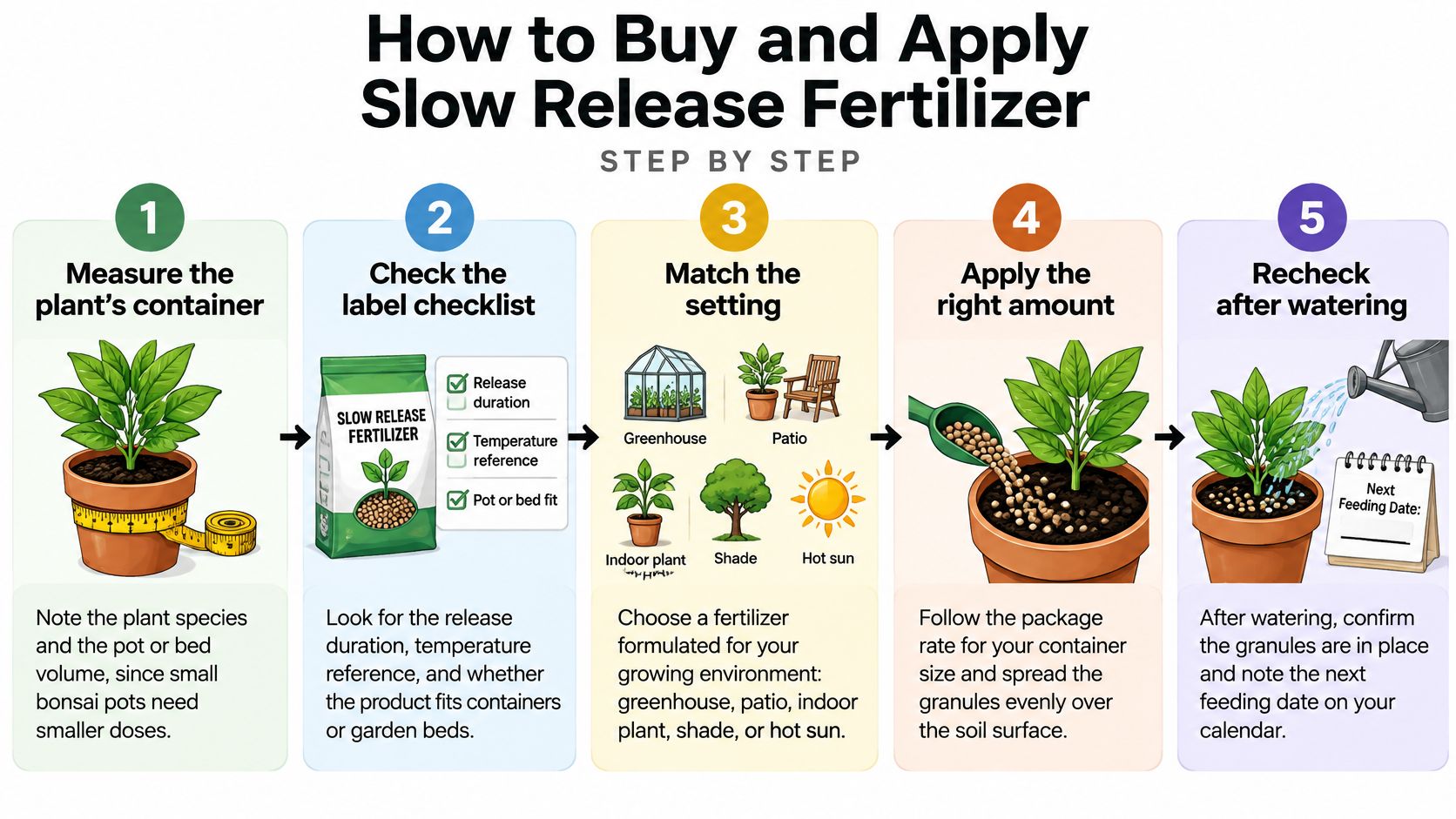
- Measure the container and name the plant. Note the species and the pot or bed volume in litres or quarts, because a 6 inch bonsai pot and a 14 inch floor pot take very different doses. Guessing here is the most common cause of overfeeding.
- Run the six-item label check. Duration, reference temperature, slow-release nitrogen share, coating type, application boundaries, and which nutrient the rating covers. If two of those are missing, walk away.
- Pick a source that matches the urgency. A local nursery if the plant needs feeding this week, a specialist shop or brand site if the exact formula and release timing drive the decision.
- Calculate the dose from the label rate for your volume, then cut it if the space is hot or you water often. That reduction is the single biggest protection for small pots.
- Apply to moist medium, spread evenly, and keep pellets off foliage and the pot rim. Pellets scattered onto dry medium sit inert until the next watering, which delays the first release and makes your timing notes wrong from day one.
- Log the date and the expected end of release. Skipping the temperature basis is how a product finishes a month early and you blame the plant instead of the arithmetic.
- Check the plant before the next scheduled application. Look for the direction of new growth, leaf colour and any salt crust at the soil line, then decide whether the interval was right.
Overfeeding shows up as crisp leaf margins, a white mineral crust on the surface, or stalled growth in a plant that should be pushing. Underfeeding is quieter: pale new leaves, long gaps between flushes, and stems that stay thin.
The routine is working when you see steady new growth through the season, even leaf colour, and a clean soil surface with no crust. That's a product matched to your room, applied at a dose your pot can buffer.
Confirm Your Pick Before You Order
Three checks settle the purchase. First, does the source fit your urgency and publish the detail you need? Second, does the label state duration, temperature basis and slow-release share? Third, does the release timing suit your room, climate and pot size? If all three line up, buy. If one doesn't, the cheaper product isn't cheaper.
Take a bonsai grower in a warm, bright room. The 18-6-8 Bonsai Fertilizer Pellets at $10.38 are formulated for that plant type, and the Fiddle Leaf Fig and House Plant Fertilizer Pellets at $11.38 use a 16-5-11 ratio built for foliage plants rather than woody miniature trees. Compare the reference temperature against the room's summer temperature, confirm the slow-release share, and choose the source that publishes the full technical sheet rather than the one with the flashiest bag.
Then shortlist two products, read both technical sheets, and order the smaller pack first. One release cycle tells you more about how a pellet behaves in your conditions than any comparison table, including this one.
The one action for today: write down your pot volume and the date you apply, so the next purchase is decided by what the plant actually needed.
Do that for a single season and your buying decisions stop being about shelf position or price per bag. They become about a duration you've verified in your own room.
Leaves & Soul sells professional soils and slow release pellets built for specific plant types, including bonsai, fiddle leaf fig and houseplants, succulents and cacti, and orchids, so you can compare formulas on duration, ratio and application rather than guesswork. Every product page gives you the nutrient ratio and price you need to run the cost-per-month sum before you order, and there's a 100% satisfaction guarantee behind the range. Start with the Leaves & Soul fertilizer collection and buy the smaller pack for one release cycle, then size up once you've seen how the pellets behave in your own growing space.