


You’re probably here because the same thing happens to almost every new bonsai grower.
You decide you want a bonsai tree. Then you start looking. A local garden center has a few tiny conifers. An online shop has hundreds of photos. A specialty bonsai nursery shows beautiful trees that look far beyond beginner level. Within half an hour, a simple idea starts to feel oddly complicated.
That confusion is normal.
A bonsai isn’t just a plant you buy on impulse and set on a windowsill. It’s a long-term tree project. The place you buy it from shapes how easy or frustrating your first year will be. A healthy, suitable tree gives you room to learn. The wrong tree can make bonsai seem harder than it really is.
Many beginners assume the only good answer to where to get bonsai trees is “buy one from a bonsai specialist.” That can be a great path, but it isn’t the only one. In fact, one of the most overlooked options is often sitting in plain sight at an ordinary garden center: nursery stock with strong trunks, good movement, and real bonsai potential.
Your Journey into the Art of Bonsai Begins Here
A first bonsai often begins with a very ordinary moment. You see a tree in a friend’s home, in a garden center, or in a video online and think, “I’d love to grow one of those.”
Then the questions arrive fast. Should you buy online or in person? Is a cheap little tree a bargain or a mistake? Do you need something already trained, or can you start with raw material?
A first tree does not need to be a rare specimen. They need a tree they can understand. That means healthy roots, a species that suits their climate or indoor setup, and a source they can trust.
Interest in bonsai is also growing well beyond a niche hobby. The North America bonsai market is projected to grow at a 6.6% CAGR from 2023 to 2030, driven by urbanization and rising interest in miniature trees as symbols of patience and perseverance, according to Data Bridge Market Research’s North America bonsai market report.
That matters because it means you’re not hunting for something obscure. More growers, more sellers, and more access to bonsai material have made the hobby easier to enter than it used to be.
Practical rule: Your first bonsai doesn’t need to be impressive. It needs to be healthy, teachable, and forgiving.
If you keep that in mind, the search becomes much simpler. You’re not looking for “the perfect bonsai.” You’re looking for the right starting point.
Comparing Local Nurseries Online Shops and Specialty Growers
Most bonsai buyers end up choosing from three places: a local nursery, an online shop, or a specialty bonsai grower. Each works. Each has tradeoffs.
The mistake is assuming one source is always best. The better question is: best for what kind of buyer?
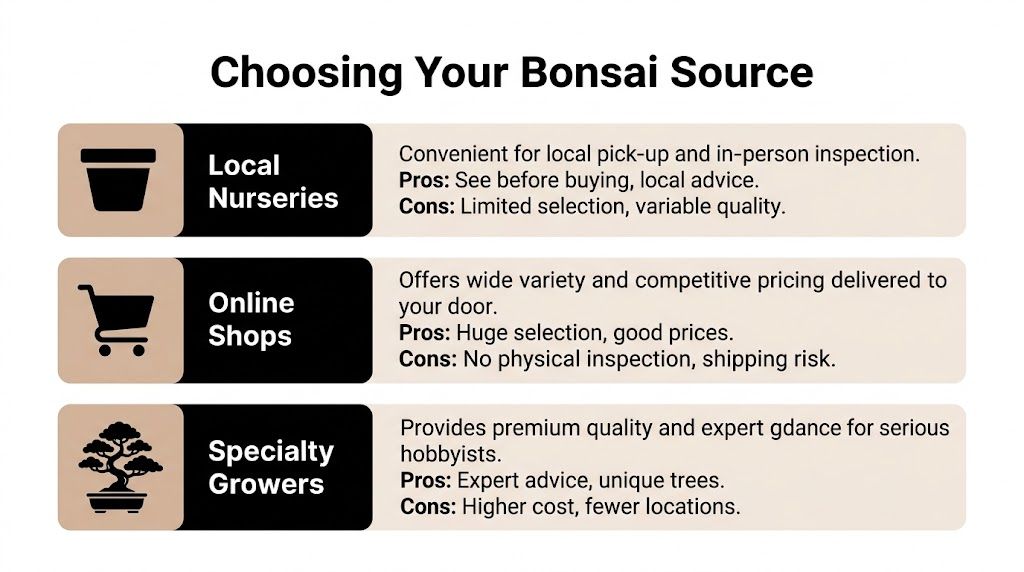
Local nurseries and garden centers
This is the source many beginners overlook. A general nursery may not label anything “bonsai,” but it may have excellent nursery stock.
That means ordinary trees and shrubs that haven’t been trained as bonsai yet but already have useful features: trunk thickness, lower branches, bark character, or an interesting bend. Existing guidance on where to get bonsai trees often skips this path, even though cost-conscious enthusiasts can find affordable, high-potential nursery stock at local general nurseries, sometimes for under $50, as noted by Bonsai Empire’s bonsai trees for sale guide.
A local nursery gives you one big advantage. You can inspect the actual tree.
You can check the trunk from every angle. You can look for surface roots. You can avoid weak foliage, bad grafts, and awkward shapes that won’t improve with time. That’s much harder to do from a product photo.
Good local nursery candidates often include junipers, maples, elms, boxwood, and other woody plants with small or reducible leaves. What matters most is not the label. It’s the structure.
Online shops
Online buying is convenient and often gives you the widest species range. If your local options are limited, online shops can solve that fast.
You may find pre-bonsai, starter trees, indoor tropicals, tools, soil, and pots in one place. Good listings also show multiple angles and mention pot size, species, and basic care needs.
But online buying asks you to trust the seller’s photos, packing, and honesty. You can’t gently lift the pot to gauge root mass. You can’t look under foliage for pests. You can’t tell whether the trunk is better from the left or right until it arrives.
So online is often best when the seller is clearly specialized, provides detailed photos, and communicates well.
Specialty bonsai growers
A specialty bonsai nursery is the premium route. It offers better material, more accurate species guidance, and trees that have already been shaped with bonsai in mind.
These growers usually understand trunk line, taper, branch placement, root spread, and long-term training. That expertise shows in the stock.
For a beginner, this can be wonderful if the budget allows. For an experienced hobbyist, it can save years of development work.
A strong bonsai source doesn’t just sell trees. It filters out weak ones before you ever see them.
Bonsai sourcing options at a glance
| Source Type | Cost | Selection | Beginner Friendliness | Best For |
|---|---|---|---|---|
| Local nurseries | Often lower, especially for nursery stock | Limited to what’s in season and locally stocked | High if you can inspect in person and ask questions | Beginners, budget buyers, people who want to shape their own tree |
| Online shops | Varies from budget to premium | Broad, often the widest range | Moderate, depends on listing quality and seller reliability | Buyers with limited local access, people looking for specific species |
| Specialty growers | Usually higher | Curated rather than broad | High if the nursery gives guidance | Serious beginners, collectors, hobbyists seeking strong material |
The overlooked winner for many beginners
If you’re new, local nursery stock is often the smartest starting point.
You’ll spend less, learn more, and feel less pressure to keep a polished tree “perfect.” You also begin to understand something central to bonsai: many good bonsai don’t start as bonsai at all. They start as ordinary plants with promise.
That shift in mindset changes how you shop. Instead of asking, “Where can I buy a finished bonsai?” you start asking, “Where can I find a healthy tree with a future?”
How to Inspect a Tree Before You Buy
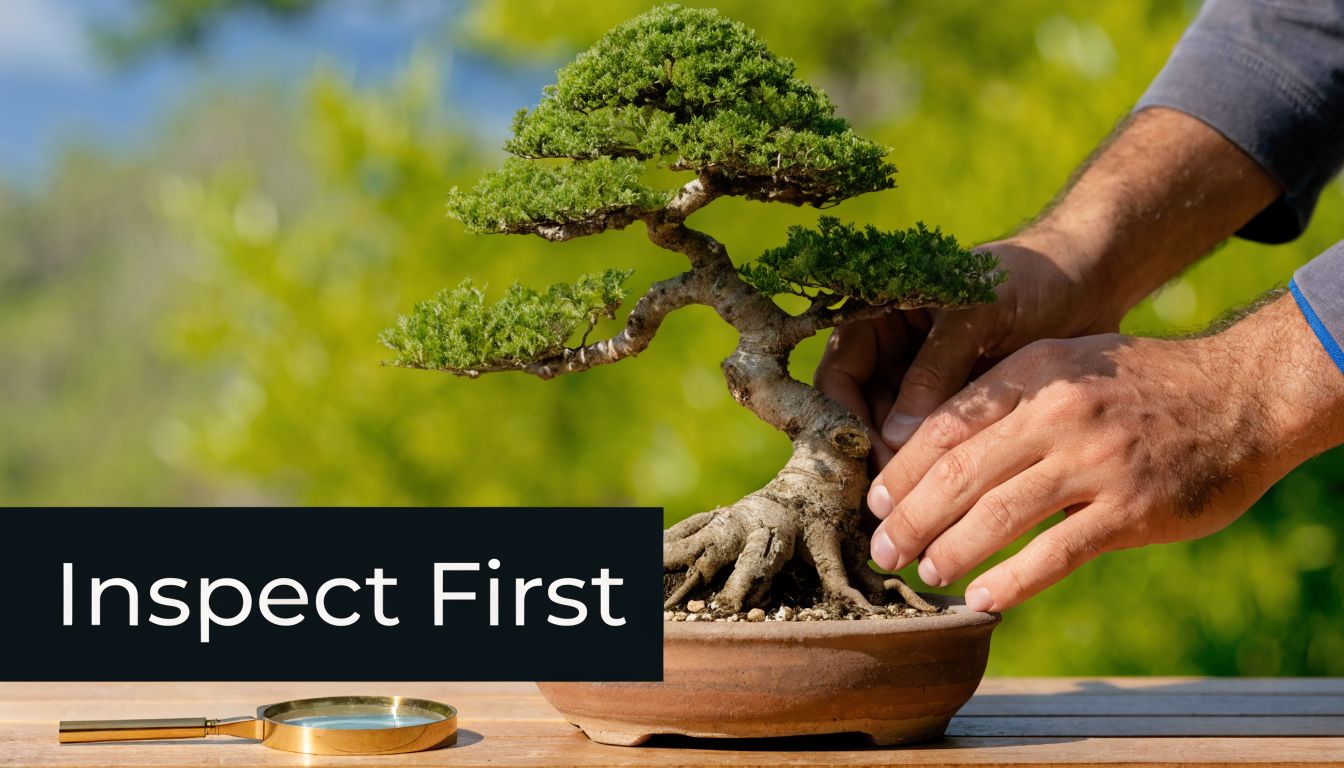
Once you’ve found a possible tree, slow down and inspect it. This matters more than the label on the pot.
A weak tree in a pretty container is still a weak tree. A plain nursery shrub with good health and structure may become a far better bonsai over time.
Statistics reveal that fewer than 1% of bonsai cultivation attempts yield believable, mature trees, which is a strong reminder to start with healthy material from a reputable source, as explained in Bonsai Empire’s discussion of bonsai interest worldwide.
Check health first
Health comes before style. Always.
Look closely at the foliage and stems.
-
Color and vigor
Leaves or needles should look appropriate for the species. You want steady, even color, not limp growth, crisp edges, or widespread yellowing. -
Pests and disease
Check under leaves, along branch joints, and near the soil line. Sticky residue, webbing, black spots, or cottony buildup are warning signs. -
Soil condition
If the soil is bone dry and pulling away from the pot edge, the tree may have been neglected. If it’s dense and swampy, roots may be struggling. -
Trunk stability
Gently touch the trunk near the base. It should feel anchored, not loose and wobbly.
Study the trunk and root base
Beginners often focus on the top of the tree. Bonsai growers look lower first.
The trunk gives a tree age and presence. The root flare, often called nebari, helps the tree look grounded. Even very young material can show hints of both.
Look for these features:
-
Taper
A trunk that’s thicker at the base and gradually narrows upward usually looks more convincing. -
Movement
Slight bends or directional interest can add personality. Perfectly straight isn’t always bad, but it’s less flexible for many styles. -
Surface roots
If you can see roots spreading from the base, that’s a plus. Avoid material where the trunk looks like a stick poked into soil.
Buy the trunk first. Branches can be grown, removed, or rewired later.
Be careful with common beginner traps
Some trees look bonsai-like because they’ve been quickly styled for sale. They may have a tiny pot and decorative rocks, but not much real potential.
Watch for:
-
Reverse taper
A section of trunk that bulges above a narrow base. -
Bad grafts
Swollen, awkward joins can remain obvious for years. -
Bar branches
Two branches emerging directly opposite each other at the same point can create a stiff look. -
Forced indoor choices
A tree sold indoors isn’t always an indoor species. If you’re unsure, this guide to types of trees to consider when wanting to grow a bonsai tree helps sort species by growing conditions.
A quick visual walkthrough can help you practice what to notice before you buy:
A simple pass or buy test
If you’re standing in front of a tree and feel unsure, ask yourself three questions.
- Does it look healthy right now?
- Does the trunk have at least one appealing angle?
- Can I picture a smaller, more refined tree hidden inside it?
If the answer is no to two or more, leave it there.
Buying Online What to Know About Shipping and Regulations
Buying online can work very well, but you need sharper judgment because your eyes are replacing your hands.
Start with the listing itself. You want multiple photos, a clear species name, and an honest description of size and condition. If every image is taken from far away or only from one flattering angle, be cautious.
What a good online listing should show
A trustworthy seller usually makes inspection easier, not harder.
Look for:
- Front and side views so you can judge trunk line and branch placement
- Close photos of the base to reveal root flare and soil surface
- Seasonally appropriate foliage rather than old, generic photos
- Care notes that explain whether the tree is indoor or outdoor
If you’re also buying tools, soil, or pots at the same time, this article on how to spot a quality bonsai accessory seller on Amazon is useful for separating serious sellers from generic listings.
Shipping quality matters
A reputable bonsai nursery can make online buying much safer. Careful pre-sale conditioning and shipping methods lead to post-purchase survival rates that often exceed 95% for acclimated stock, according to Bonsai Outlet’s beginner guide on choosing a first bonsai tree.
That doesn’t mean every shipped tree arrives perfect. It means good sellers prepare for the stress of transit.
Ask or look for these details:
- Pot secured inside the box
- Branches protected from crushing
- Weather-aware shipping timing
- Live arrival or satisfaction policies
If you’re comparing delivery options and want a practical sense of logistics costs, it helps to understand courier prices before choosing express or standard shipping.
When you buy online, packaging is part of the product.
Regulations and plant movement
Plant shipping rules can complicate online orders, especially across borders and sometimes across state or regional lines. Sellers may need to ship bare-root, restrict certain species, or refuse delivery to some locations.
Before ordering, check three things:
- Soil restrictions because some places limit plants shipped in soil
- Species restrictions if the plant is regulated or invasive in your area
- Seasonal limits during very hot or very cold weather
If the seller doesn’t mention any of this, ask. A careful seller will answer plainly.
When the tree arrives, open it promptly, inspect it, and give it a calm recovery spot. Don’t repot or prune immediately unless there’s a clear problem.
Best Bonsai Sources for Beginners and Advanced Hobbyists
Not every buyer should shop the same way.
A beginner needs forgiveness. An advanced hobbyist may need character, rarity, or a specific species with years of development behind it.
If you’re just starting
My advice is simple. Start with nursery stock from a local garden center or a modest pre-bonsai from a reliable seller.
That first tree is your teacher. You’ll learn watering, placement, pruning restraint, and seasonal growth by working on something that doesn’t feel too precious. If you want help choosing species that are easier to live with at the start, this guide to the best beginner bonsai trees is a practical next read.
Beginners usually benefit most from trees that are:
- Healthy over fancy
- Affordable enough to experiment with
- Suited to their real environment, not their ideal one
If you’ve already kept trees alive for a while
Then specialty nurseries become much more valuable.
At that stage, you can use what they offer. You’ll notice subtler things such as trunk taper, branch placement, internode length, and root spread. You’re also more likely to know what you want from a tree before you buy it.
That’s when paying more can make sense.
The strongest long-term approach
A smart middle path is hybrid sourcing. Buy local when climate adaptation and in-person inspection matter most. Buy online or from specialists when you want better history, unusual stock, or a more refined starting point.
That approach isn’t just convenient. Strategic hybrid sourcing can produce 25% to 40% superior nebari circumference growth in the first 12 months versus single-channel buys, according to Bonsai Trader’s comparison of online versus local bonsai buying.
For many hobbyists, that’s the true answer to where to get bonsai trees. Don’t commit to one source forever. Use each source for what it does best.
The best bonsai buyers stay flexible. They don’t chase one store. They chase good material.
Essential Tools and Supplies for Your New Tree
Buying the tree is only the opening move. What you bring home with it matters almost as much.
A bonsai needs a setup that supports root health, steady growth, and controlled development. That usually starts with a few basics, not a giant toolkit.
The short list that matters most
-
Well-draining bonsai soil
Ordinary potting mix often holds too much moisture for bonsai containers. Bonsai soil helps roots breathe and makes watering more predictable. -
A suitable pot
The right pot isn’t just decorative. It needs drainage holes, enough room for the root system, and a shape that fits the tree’s stage of development. -
Targeted fertilizer
Small containers don’t hold nutrients for long. A bonsai-specific feeding routine supports foliage, root growth, and recovery after training. -
Basic pruning and wiring tools
You don’t need a massive collection at first, but you do need clean cutters and properly sized wire if you plan to shape branches.
Think beyond bonsai styling
A new owner often focuses on appearance first. Better growers think first about establishment. Root health, watering rhythm, and seasonal placement come before refinement.
If you want a broader grounding in planting fundamentals, this ultimate guide to tree and shrub planting is helpful because many of the core principles carry over: matching plant to site, protecting roots, and avoiding stress during transitions.
The best supply kit is the one that helps your tree settle in and grow strongly. Styling can wait a little. Health can’t.
Frequently Asked Questions About Buying Bonsai
Is it cheaper to buy a bonsai or start from seed
Starting from seed can be inexpensive, but it demands patience, space, and a willingness to wait years for usable structure. For most beginners, buying a starter tree or nursery stock is the more practical route.
You get a living tree with an established trunk and root system, and you begin learning bonsai skills right away.
Can any small tree become a bonsai
Not every small plant makes good bonsai material. Size alone doesn’t make a bonsai.
You want woody species that tolerate pruning, respond well to root work over time, and have traits that scale down well. Good trunk character and branch potential matter much more than whether the plant is already tiny.
What’s the difference between indoor and outdoor bonsai
This confuses almost everyone at first.
An indoor bonsai is usually a tropical or subtropical species that can live in warm, bright indoor conditions. An outdoor bonsai needs seasonal change, fresh air, and the light levels of outdoor life. Many trees sold as bonsai are outdoor species and won’t thrive long term inside a typical home.
When in doubt, identify the species first and build care around that. Don’t rely on the store label alone.
If you’re ready to bring home your first bonsai or improve the care of one you already own, Leaves & Soul offers purpose-built bonsai soils, slow-release fertilizers, pots, wiring kits, and complete starter sets designed to help your tree settle in and thrive. It’s a practical place to get the essentials right from day one.