


Commercially available 5–10 mm akadama measured 17.7% solid material, 12.0% liquid, and 70.3% gas under the conditions reported in bonsai-focused technical material on growing medium. That 70.3% gas-phase figure reframes bonsai soil particle size completely. You're not choosing pebbles for appearance. You're deciding how much of the pot is air immediately after watering, and how quickly that air is replaced by water as grains break down.
Most growers inherit a recipe, akadama plus pumice plus lava in some proportion, and assume the recipe controls performance. It doesn't, not by itself. The same ingredients at different sizes create different pore networks, and the same recipe with more dust in it behaves like a different soil. A sieve and a drain test tell you more than a bag label can.
Treat every range in this article as a starting point to verify in your own pot. Measure the fractions, water thoroughly, watch how long the root zone stays saturated, and adjust the grade before you change the ingredient list. That's the discipline that separates a mix that works for a season from one that holds its structure for years.
Particle Size Classes at a Glance
One millimetre is the line between structure and filler in a bonsai pot. Define bonsai soil particle size by sieve opening. A brand name, a bag colour and the word “bonsai” on the label describe packaging, not the pore network inside the pot. Sort a sample through a stack and record what each screen retains. A workable convention uses four bands: extra-fine at 1 mm or less, fine at about 1–3 mm, medium at 3–6 mm, and coarse at 6–12 mm. The 3–6 mm band is the common starting point for standard bonsai. Test it against your container depth, your watering routine and a measured drain test.
What Each Class Does in the Pot
| Working class | Sieve opening | Pore behaviour | What to watch |
|---|---|---|---|
| Extra-fine | 1 mm or less | Fills gaps between larger grains | Slows drainage and gas exchange |
| Fine | about 1–3 mm | Smaller pores hold more water | Can stay saturated too long in a standard pot |
| Medium | 3–6 mm | Large air spaces with enough moisture retention | Default for many standard bonsai |
| Coarse | 6–12 mm | Free drainage and high oxygen | Dries quickly and needs more frequent watering |
The classes describe pore size, not product prestige. Each band builds a different pore network, and pore diameter decides whether a pore holds water against gravity or drains and refills with air. A pot filled mostly with 1–3 mm material behaves like a different soil from one filled mostly with 6–12 mm material, even when the ingredient list is identical.
The trade-off runs in one line. Larger particles create larger pores and more oxygen. Smaller particles create smaller pores and hold more water. Excess fines close the network down by filling the spaces the larger grains created.
Why the Label Tells You Nothing
A bag label does not report sieve distribution. Two bags with identical ingredient lists can perform oppositely if one carries a heavy dust fraction and the other has been screened. You do not know which one you have until you measure it. That uncertainty matters most in shallow pots, where limited substrate volume makes moisture and oxygen swing quickly. A small shift in grade produces a large change at the root. Screening out dust and selecting a consistent grade helps prevent the compaction that shallow containers encourage.
Use the dominant class as a diagnostic checkpoint before potting. If most of the mix falls into the fine and extra-fine bands, predict waterlogging, slow surface drainage and roots that stay wet long after watering. If most of it sits in the coarse band, predict the opposite failure: a mix that drains freely and then dries before the tree can use the water. Both outcomes follow from pore size, and both are visible in the sieve before they show up in the foliage. Recheck the grade after a season. Fines accumulate as grains break down, so the same recipe drifts toward the fine band over time.
Matching Particle Size to Tree Size
Start with the grade table, then test it against your container and your watering routine. The bonsai soil guide updated in 2026 recommends 3–6 mm particles for standard bonsai, 2–4 mm for shohin trees, and 4–8 mm for large trees in deep pots.
| Tree or container | Particle size | Why this grade |
|---|---|---|
| Shohin and mame | 2–4 mm | Small root mass and shallow pots dry fast; finer grades hold more water |
| Standard bonsai and young trees | 3–6 mm | Balanced air space and moisture retention |
| Large trees in deep pots | 4–8 mm | Coarser grains keep a large root mass oxygenated |
| Large containers or drought-prone conditions | 4–8 mm | Check against measured drainage and irrigation before committing |
The Reasoning Behind the Grades
Fine grades suit small trees because of geometry, not delicacy. A shohin pot holds a small volume of substrate around a small root mass, and that volume loses water quickly through the surface and the pot walls. Finer particles bring more surface area per unit volume, and their smaller pores retain more moisture between waterings. Without that retention, a tiny tree cycles from soaked to dry inside a single warm day.
Standard grades suit most trees because they don't force a choice. At 3–6 mm the pore network holds usable water while still draining the excess, so roots get oxygen without the grower having to water twice daily. Deciduous and conifer trees at standard size both start in this band. Species preference refines the recipe later, grade comes first.
Coarser grades suit larger root masses in deeper containers. A deep pot holds a taller column of substrate, and the centre of a large root ball is the hardest place to keep oxygenated. Larger grains keep the pores open through that depth and reduce the chance that the middle of the pot stays saturated while the surface looks dry.
Species name alone doesn't set the grade. Container scale, root mass, climate, and watering frequency do.
A Worked Example
Say you've got a young tree in a shallow pot and you water daily. The shallow volume dries fast, but your daily watering replaces that loss, so you sit at the lower end of the standard range, around the finer side of 3–6 mm, where retention helps without creating chronic wetness. Now move that same species into a large, deep training container and stretch the watering interval. The deeper column and bigger root mass push you toward the coarser end, because drainage and oxygen at depth now matter more than surface drying.
The tree hasn't changed species. The container and the routine changed, so the grade changed with them. Reassess whenever you move a tree into a larger or smaller container, and whenever your watering frequency shifts with the season or your schedule. A grade that was correct in a training pot can be wrong in a display pot, even with the identical recipe.
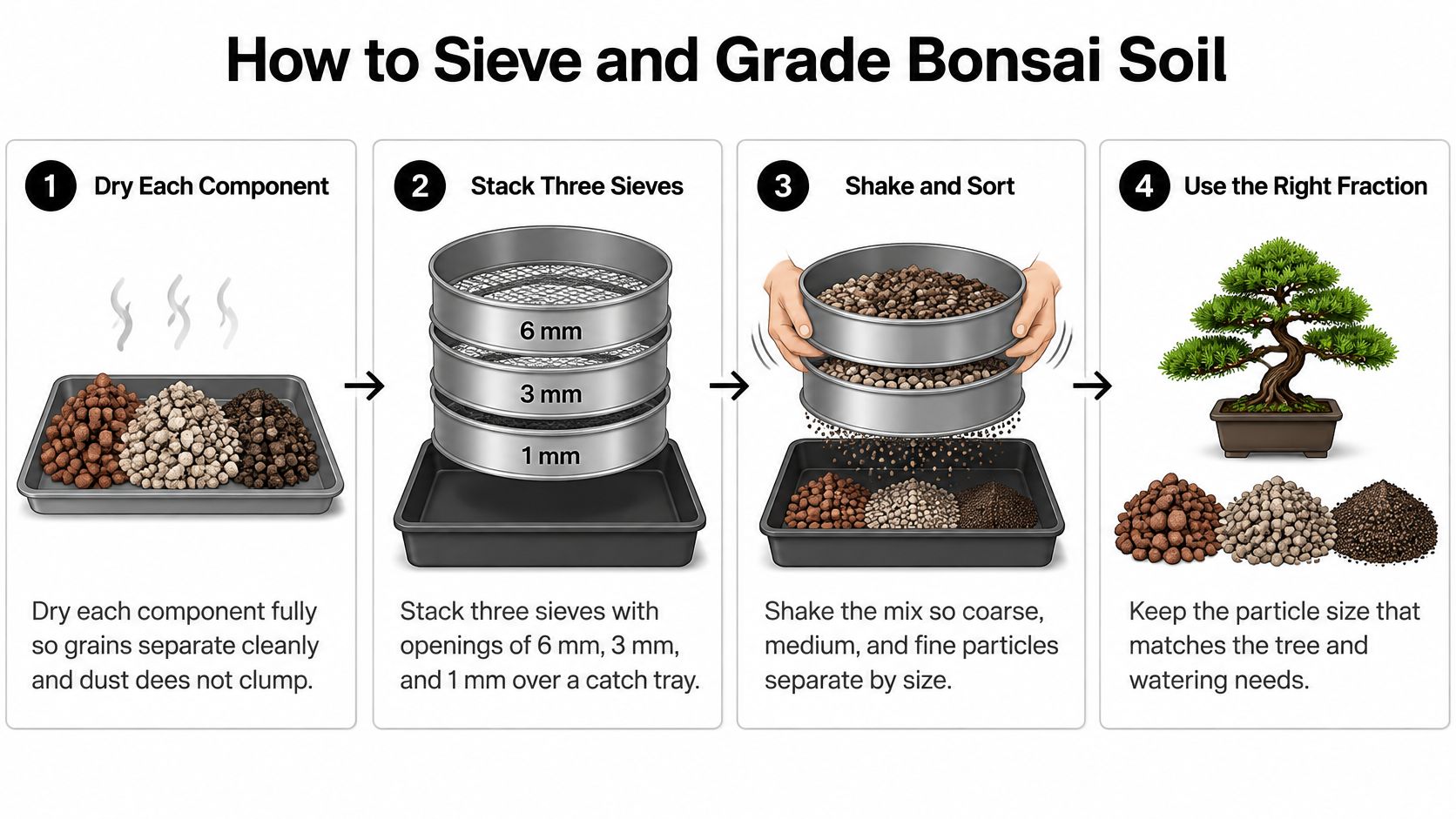
How to Sieve and Grade Bonsai Soil
Dry material, a stacked set of sieves, and a scale turn guesswork into a distribution you can record and repeat. Work through these steps for every component before anything gets mixed.
- Dry each component fully. Dry grains separate cleanly and dust falls through instead of clumping onto damp surfaces, so your fractions reflect real size rather than moisture.
- Stack three sieves over a collection pan. Use openings of 6 mm, 3 mm, and 1 mm, coarse on top, so one pass sorts the material into usable bands.
- Load roughly one litre at a time and shake for about a minute. Small loads let grains find the openings. Shaking much longer grinds softer grains against the mesh and manufactures the very fines you're trying to remove.
- Weigh each fraction. The material caught between the sieves gives you your working bands, with 3–6 mm as the working grade for standard trees. Material that lands in the pan under 1 mm is dust, and you reject it when durable aeration is the goal.
- Keep a modest fine fraction for moisture buffering. A small share of fines slows drying usefully. Keep it small enough that it can't fill the gaps between larger grains.
- Screen each component separately before mixing. If you blend first and sieve later, fine particles from one ingredient migrate into the voids of coarse particles from another, and you've lost control of the distribution.
- Store each graded fraction in a labelled container. Write the size range and the date on it. Unlabelled buckets become anonymous mixes within a month.
The visual sequence below follows the same order, from drying through to selecting the fraction that matches your tree.
Why Uniformity Matters More Than Average Size
A mix can average 4 mm two ways, as uniform 4 mm grains, or as 8 mm chunks padded out with dust. Those mixes behave nothing alike. Media that combine particles of significantly different sizes end up with lower total porosity, lower water-holding capacity, and lower air-filled porosity than media built from more similar sizes. The mechanism is simple packing. Small particles occupy the voids between large ones, connected air spaces collapse, and water moves through the pot along narrower, slower paths.
That's why the nominal size printed on a bag is a weak specification. The distribution across your sieves is what counts. Record the share in each band when you grade a batch, and you'll be able to reproduce a mix that worked, or diagnose one that didn't, a season later.
A correctly graded fraction is easy to recognise. The grains look even, no powder clings to them, and a handful poured from palm to palm leaves your skin clean rather than dusty. Pot a test quantity, water it, and watch it drain. Free drainage with no surface pooling confirms the grade. Powder on your hands or water sitting on the surface tells you the dust fraction is still in there, whatever the label claimed.
Pore Space, Drainage and Water Retention
What does particle size change inside the pot? It changes the pore network, and the pore network is where roots live. If you're still building background on the medium itself, our guide to what bonsai soil is and how it's structured covers the ingredient side. This section covers the physics those ingredients create once they're sized and packed.
The close-up below shows what you're building toward, roots moving through an open, coarse-textured matrix with visible space between grains.
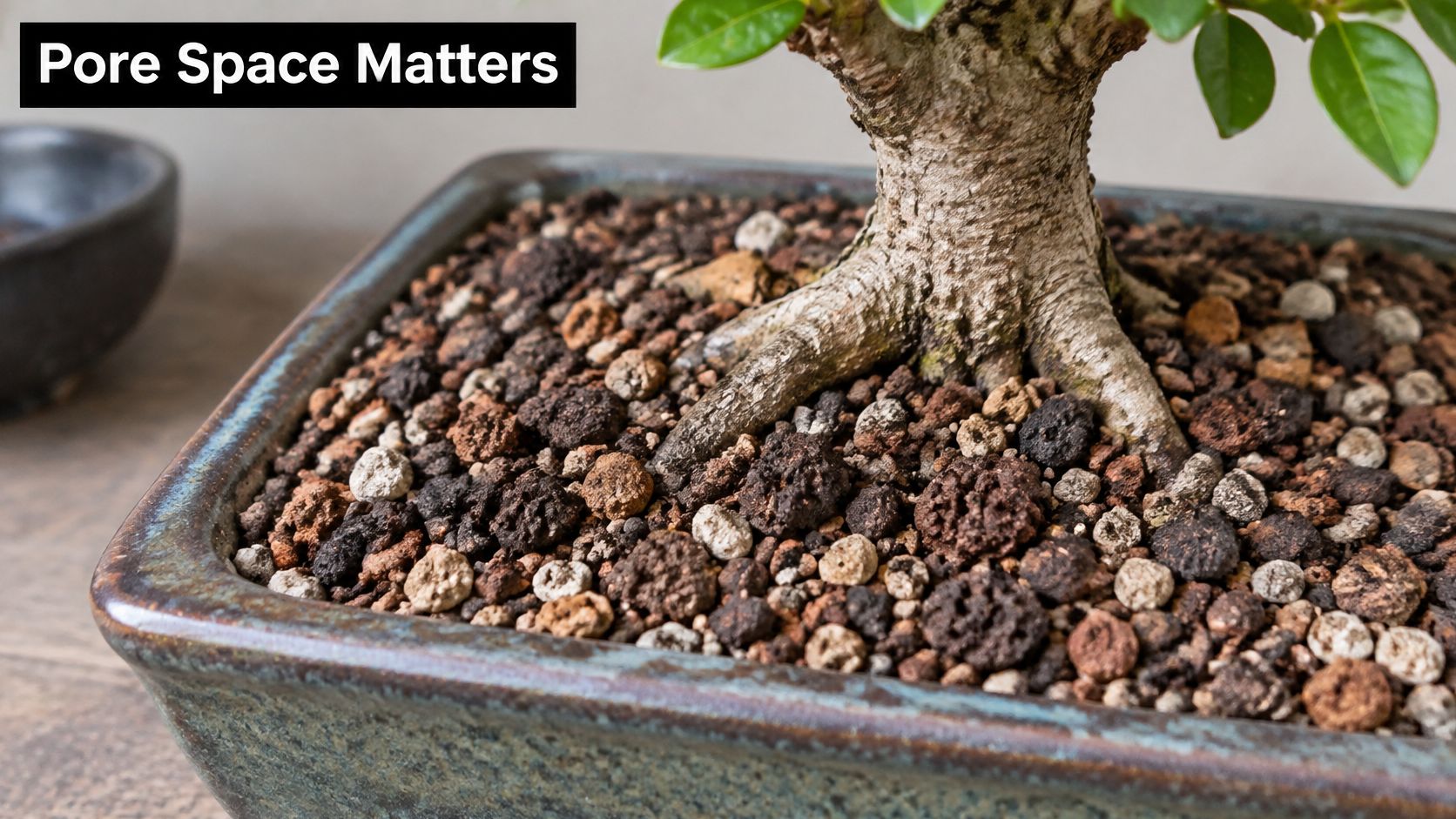
Smaller grains create smaller pores and raise water-holding capacity, while larger grains create larger pores, more air space, and less water retention. Extension guidance summarised in the container media review from the Reforestation, Nurseries and Genetic Resources program gives a practical benchmark of 10–30% air space after irrigation and drainage, with 50–85% total porosity, 25–35% available water, and 0.19–0.70 g/cm³ bulk density.
| Benchmark | Target range | If the mix falls outside |
|---|---|---|
| Air space after drainage | 10–30% | Below 10%: poor oxygen; above 30%: fast drying |
| Total porosity | 50–85% | Low: compaction; high: weak structure |
| Available water | 25–35% | Low: frequent watering needed; high: wet roots |
| Bulk density | 0.19–0.70 g/cm³ | High: compact, poorly aerated; low: unstable mix |
How to Read Each Value
Air space after drainage is the headline number. It's the share of the pot that returns to air once gravity has pulled out what the pores can't hold. Below the range, oxygen diffusion slows and roots sit in chronic wetness. Above it, the mix drains so freely that you're watering to a schedule the tree dictates hourly in summer.
Total porosity tells you how much of the pot is pore at all, water-filled or air-filled. A low reading points to compaction, usually fines packed into voids. Available water is the portion roots can extract, so a low value means frequent irrigation and a high value means the root zone rarely dries. Bulk density flags structural extremes. A very dense mix is typically fine-heavy and poorly aerated, while an unusually light one can be unstable and give roots poor anchorage.
The demonstration below shows drainage behaviour in a potted mix, which is the field version of these laboratory values.
The Drain Test You Can Run Today
Water thoroughly until the whole root ball is wet and excess runs freely from the drainage holes. Then observe. If the root zone stays saturated for a long period, your fines are clogging the larger pores and air space is too low. If the mix dries within hours, the coarse fraction dominates and available water is too low.
Practical rule: When drainage is wrong, adjust the balance of coarse and fine fractions. Don't swap ingredients at random and hope.
Changing an ingredient without changing the grade often reproduces the same pore network with a different colour of grain. Changing the grade changes the physics directly.
Akadama, Pumice, Lava and Zeolite Compared
These four components earn their place in a mix for different structural reasons, and they age at very different rates. If you're sourcing the first of them, our overview of akadama and how to choose a grade sets out what's typically on the market. Judge each material here by size, stability, and water behaviour.
Akadama
Akadama is commonly sold as 5–10 mm granules. A 2025 summary of Chiba University research reports that commercially available 5–10 mm Akadama contained 17.7% solid phase, 12.0% liquid phase, and 70.3% gas phase. That gas share explains its strong aeration immediately after watering, when most of the pore volume has already drained back to air.
The catch is that akadama isn't static. Its fired clay granules soften and break down over seasons of wetting, drying, and root pressure. Breakdown produces fines, fines fill pores, and air space falls year by year. An akadama-heavy mix therefore starts open and gradually closes, which is why it needs periodic re-sieving and eventual replacement rather than indefinite reuse.
Pumice and Lava
Pumice and lava supply the stable skeleton of a mix. Neither breaks down at anything like akadama's rate, so the coarse fraction they provide holds the pore network open across many seasons. That durability makes them the structural insurance in a blend whose other components are slowly degrading.
They differ in handling. Pumice is lighter and holds more water in its internal pores, so it buffers moisture but asks for care not to overwater in cool, dull weather. Lava is heavier, more durable still, and holds less water, which suits growers who water generously and want the excess gone. The weight difference also matters practically, since a lava-heavy mix anchors a top-heavy tree in a shallow pot better than a featherlight one.
Zeolite
Zeolite plays a supporting role rather than a structural one. Growers use it in small proportions, with 2–5 mm particles, for water retention and ion exchange, holding moisture and nutrients in reserve and releasing them as the mix dries. Because it functions as a buffer rather than a framework, it complements the other three instead of replacing any of them.
The comparison resolves into one rule. An akadama-heavy mix gives high initial air and a root-friendly texture, but you pay for it with earlier replacement as granules degrade. A lava-heavy mix is stable for years, but its lower water holding demands closer attention to watering frequency. Choose based on which cost you'd rather manage, repotting labour or irrigation vigilance, and grade whichever you choose to the same band so the comparison stays honest.
Mix Recipes by Tree Type
A recipe is a hypothesis about pore space, not a shopping list. The proportions below assume every component has been screened, because percentages by volume only repeat when the fractions are consistent. A batch with the same ratios but a heavier load of dust will drain differently from one graded cleanly. The bonsai soil mix recipe method covers batch preparation in more detail; the table sets the starting proportions.
| Tree type | Main component | Additives | Target particle size |
|---|---|---|---|
| Shohin or mame | Akadama 70% | Lava 20%, zeolite 10% (2–5 mm) | 2–4 mm |
| Deciduous, standard | Akadama 50% | Pumice 30%, zeolite 20% (2–5 mm) | 3–6 mm |
| Conifers, standard | Akadama 60% | Lava 25%, zeolite 15% (2–5 mm) | 3–6 mm |
| Large trees in deep pots | Akadama 50% | Lava 35%, zeolite 15% (2–5 mm) | 4–8 mm |
Read the table by pot size first. The shohin mix is the finest of the four, built on 70% akadama with a smaller share of lava and the lowest zeolite proportion, because a tiny pot needs retention above all. The large deep-pot mix is the coarsest, pushing lava to 35% so a big root mass in a tall substrate column keeps its air. The two standard recipes sit between them, shifting the pumice and lava balance for deciduous trees and conifers while holding the same 3–6 mm grade.
Zeolite stays in a narrow band across every recipe because it works as a buffer rather than a framework. Common practice puts it at about 10 to 20% of the mix by volume with 2 to 5 mm particles, and every row above sits inside that range.
Mixing Procedure
- Measure each graded component by volume in the same scoop. One scoop for everything makes the percentages real and the batch repeatable.
- Combine the components dry and turn until the colour is even. Uneven colour means uneven distribution, and pockets of one ingredient create pockets of different pore behaviour.
- Moisten lightly and check for dust. If a dust cloud rises when you turn the mix, fines survived your sieving and the batch needs another pass.
- Pot one test tree and water it fully. Don't commit a collection to an untested batch.
- Observe drainage over the first 30 minutes and root-zone moisture over the next day. That window tells you whether the grade, not the recipe name, matches your conditions.
Adjusting the Recipe
A recipe is a starting point to verify. If drainage is too slow, move 10% of volume from fine to coarse. If the mix dries within hours, move 10% toward finer grades or toward zeolite within its band. Change one variable, then run the drain test again.
Log each recipe with its date, its fractions, and its drainage result. Over several seasons that log becomes your own evidence base, specific to your climate, your pots, and your watering hand in a way no published table can be.
Common Problems and How to Fix Them
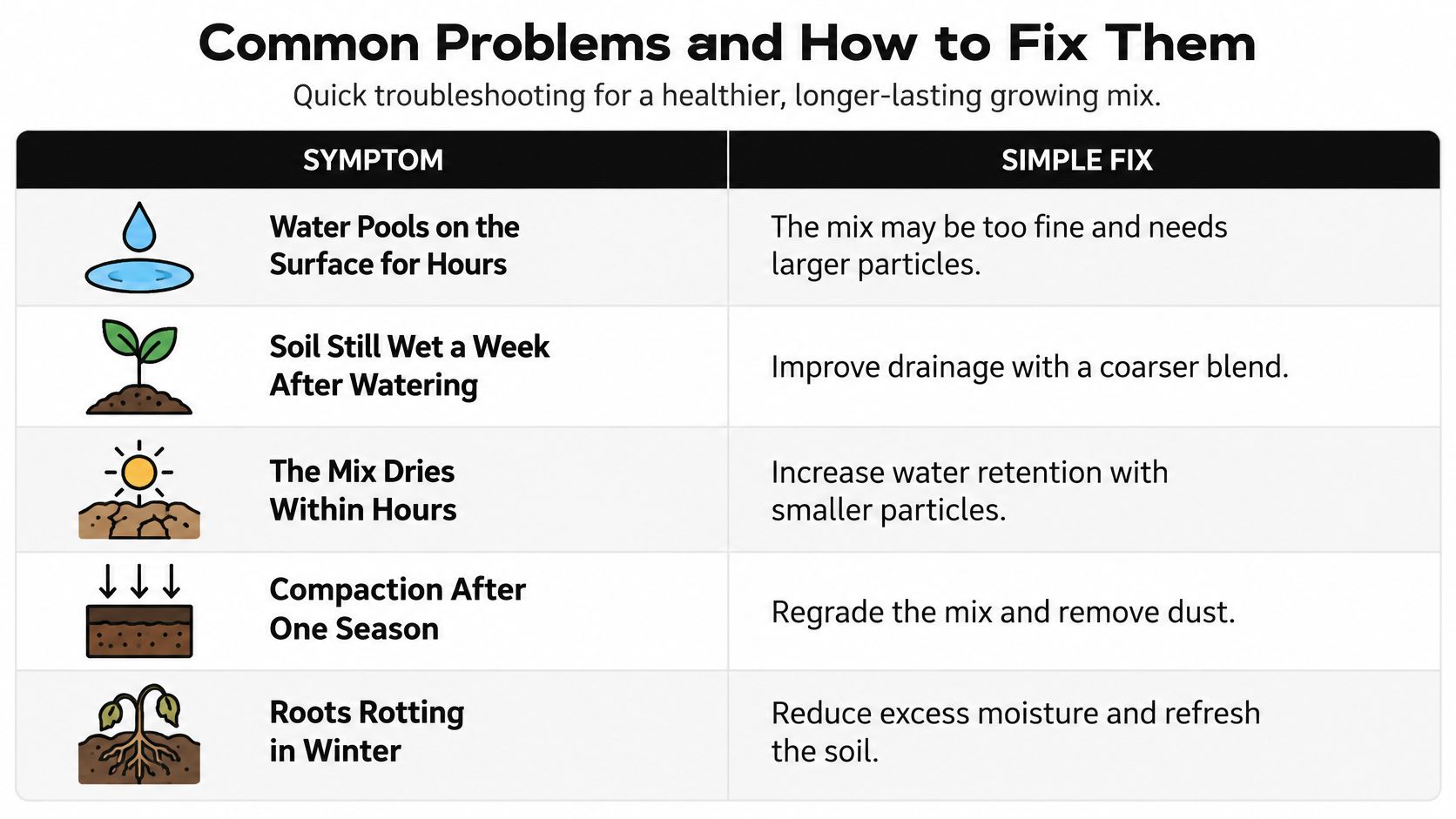
Most soil failures announce themselves at watering time, months before the foliage complains. Match the symptom to the particle cause first, because the same yellowing tree can come from opposite pore problems.
| Symptom | Likely particle cause | Fix |
|---|---|---|
| Water pools on the surface for hours | Fines fill the macropores | Sieve out dust below 1 mm and repot in a coarser grade |
| Soil stays wet a week after watering | Too many fines or high available water | Increase the coarse fraction and reduce fines |
| Mix dries within hours | Coarse-only mix or too little water-holding material | Move toward 2–4 mm grades or add zeolite at 10–20% |
| Mix compacts after one season | Decomposed organics and migrating fines | Resieve the base and replace the broken-down fraction |
| Roots rot in winter | Low air space and chronically wet roots | Check air space is within 10–30% and coarsen the mix |
The chart below condenses the same symptom-to-fix logic into a quick reference for the potting bench.
The Stability Problem Nobody Warns You About
Particle size isn't a permanent specification. Organic components decompose, softer mineral grains crumble, and every watering carries fine particles downward, where they accumulate near the base of the pot. A recipe that drained freely in year one can waterlog by year three with identical watering, because the distribution inside the pot has drifted even though the ingredient list hasn't.
Substrate guidance from Purdue Extension on growing media frames the underlying principle clearly: physical properties rather than ingredient names determine plant performance, and one extension recommendation places most amendment particles between 0.5 and 4 mm, with less than 20% below 0.5 mm. Once breakdown pushes your fine share well past that kind of threshold, the same recipe has become a different medium.
Indoor growers feel this drift first. Less frequent watering and limited airflow mean a fine-clogged base stays wet far longer than it would on an outdoor bench, and the grower blames the watering can instead of the sieve.
The Repeatable Seasonal Check
Sieve a sample from the top few centimetres and another from the base, and record the share below 1 mm in each. A base sample much finer than the top sample confirms migration. Pair that with drainage speed after a thorough watering, and reassess after each growing season rather than on a fixed repotting calendar.
Separate the fixes by urgency. Adjusting watering frequency or allowing a longer drying interval buys time without disturbing roots. Replacing the broken-down fraction, regrading the whole mix, or rebuilding it with fresh zeolite requires repotting, so schedule it for the right season for the species. Don't let a drainage problem talk you into unsafe out-of-season root work.
Confirm Your Soil Grade Before You Repot
Repotting resets the pore network. The mix that passed a sieve when you bought it can fail the same check today if fines have collected, so confirm the grade before the tree leaves its pot. The sequence below turns a bag of ingredients into a measured medium.
- Confirm the tree class. Shohin, standard, or large sets the target band. Decide this before you touch a sieve.
- Sieve each component to that band, then mix. Grade first, mix second, so every ingredient contributes the same pore size. Discard the dust you screen out rather than adding it back.
- Build a test batch and check air space and drainage. Use the same pot depth and compaction you plan for the final planting. Water the batch fully and time how long saturation lasts.
- Apply the decision rule. Saturation lasting more than a day means the mix needs coarsening. Drying within hours means it needs refining or a small addition of zeolite.
- Repot only after the test batch behaves as expected. If the test batch holds too much water, the final pot will hold more.
Pre-Mixed Bags Still Need Checking
A pre-mixed soil is a starting point, not a verified grade. The label lists ingredients, not the distribution inside the bag, and transport generates fines as grains rub together. Sieve a sample on arrival, note the share under 1 mm, and decide whether the batch goes straight into a pot or needs dust removed first.
For growers who want a prepared base, Leaves & Soul's Premium Bonsai Soil All Purpose Blend is pre-mixed and sold in 2.2 and 8.2 dry quart sizes for $17.94 USD. Professional Clay Pebbles improve drainage and aeration and leave space for roots to expand where a coarser structural element is needed. Both still get the same arrival check. The sieve verifies the batch regardless of who mixed it.
The Test Batch Is the Decision Point
A test batch that drains slowly is telling you to change the grade before roots are cut, not after.
If the fine share is high but the structural ingredients are still sound, screen out the dust and replace that volume with fresh coarse material. If the coarse fraction crumbles under light pressure, the batch has lost the structure that created its pore space, and no amount of screening will restore it. Rebuild that batch with fresh components.
Record the grade on the batch: sieve date, share under 1 mm, and drain time. That note makes the next repot a comparison rather than a guess. Particle size becomes a measurement you maintain, not a specification you buy once. The sieve shows what is in the bag, the drain test shows how it behaves, and the note shows whether the batch has changed by the time you need it.
Ready to put a measured grade to work on your next repot? At Leaves & Soul you'll find pre-mixed bonsai soil, clay pebbles for drainage and aeration, fertilizers, and glazed ceramic bonsai pots. Sieve-check your blend on arrival, run the drain test, and repot with confidence in what's in the pot.