


If lava rock makes a bonsai mix drain beautifully, why can a tree still wilt shortly after watering? Drainage and usable moisture aren't the same thing. Water can leave the pot freely while the roots have too little moisture available between irrigations.
Choosing lava rock for bonsai means deciding how much permanent structure your tree needs without sacrificing its water supply. Particle size, initial wetting, and your watering routine matter more than whether the stone is red or black.
What Lava Rock Is and Why Bonsai Growers Use It
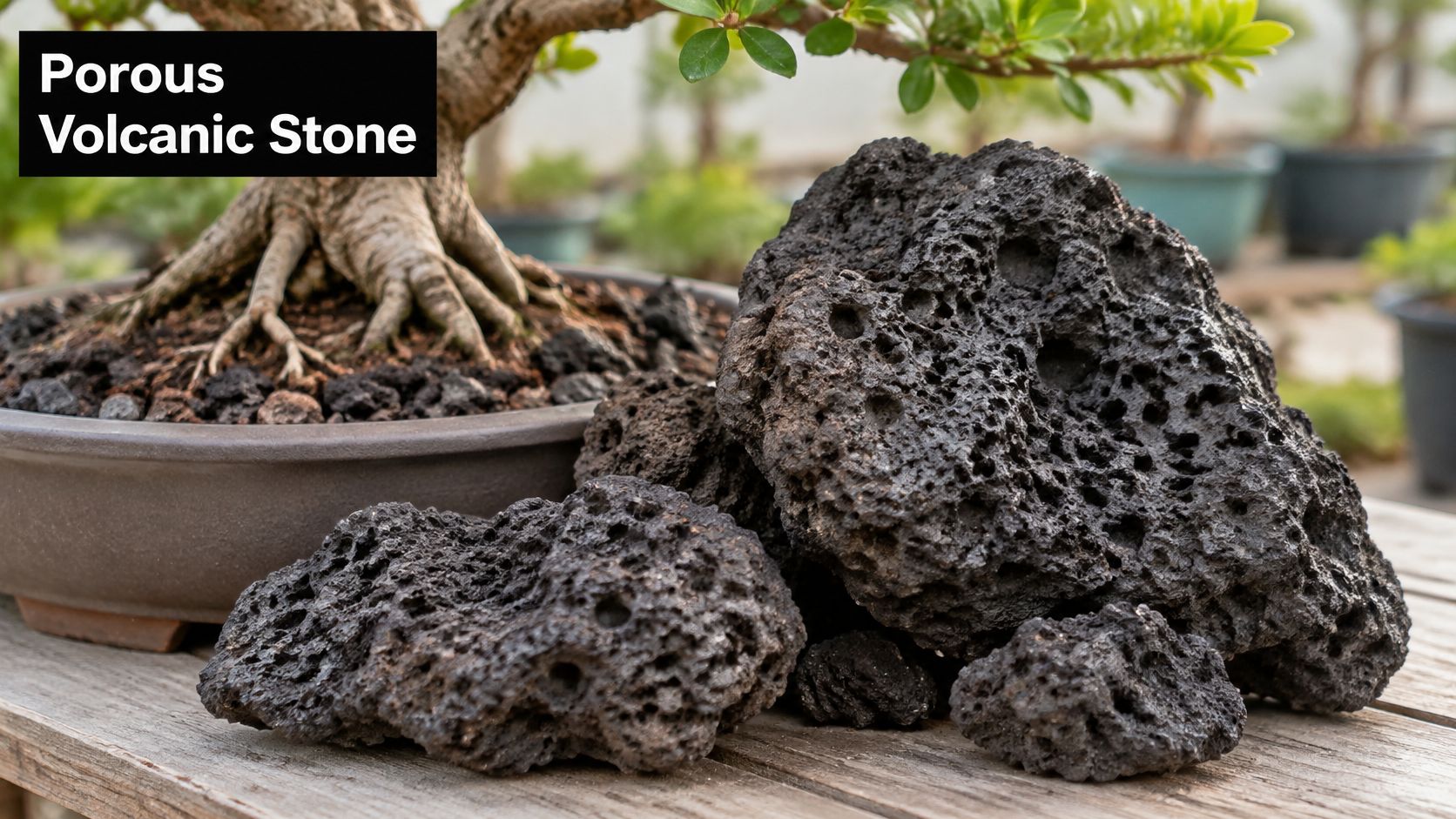
Lava rock is a porous volcanic stone, typically formed when gas-rich basaltic lava cools quickly. Escaping gas leaves cavities in the stone, while crushing and screening produce the irregular granules used in bonsai substrates.
Think of it as a sponge made of stone, but don't take that analogy too far. The useful resemblance is its porous structure, not an ability to supply abundant water whenever roots need it.
What happens around the roots
Say you're repotting a maple from compacted nursery soil into a granular substrate. Rather than surrounding its roots with a continuous mass of fine material, you're arranging particles that touch at scattered points, leaving passages between them.
Those passages let excess water escape and air return after watering. The rough faces also provide contact surfaces for roots, although securing the tree with anchoring wire remains essential.
Water inside a stone behaves differently from water between stones. A study of volcanic container media in the Journal of the American Society for Horticultural Science examined how water movement changes as the material dries, showing why judging a substrate only while it's saturated misses an important part of its behavior.
Structure is only part of a soil mix
A bonsai substrate must let roots breathe while keeping moisture accessible. Adding a hard mineral component addresses the physical framework, but it doesn't automatically provide the right moisture buffer.
If granular substrates are unfamiliar, this explanation of what bonsai soil is helps distinguish a purposeful particle mix from ordinary garden soil.
Keep these roles separate:
- Between particles: Open spaces provide drainage and root-zone aeration.
- At particle surfaces: Roots contact moisture films and rough mineral faces.
- Inside particles: Pores may contain water, but not all of it is equally accessible.
That distinction prevents the most common misunderstanding: a stone can look full of holes without functioning as a generous water reservoir.
Particle Sizes and Grading Chart for Bonsai
Choose the grade before choosing the recipe. Two bags of the same red lava can behave like different substrates: one screened to a narrow band of granules, the other crushed into everything from powder to chunks. Particle size sets the width of the air channels between stones, and those channels decide how fast water leaves the root zone.
The spaces between particles do the essential work in the mix. Smaller granules pack closer together, so the gaps shrink and hold moisture films longer. Larger granules leave wider channels that drain quickly and refill with air. Neither is automatically better. The right band depends on how fast your container dries and how often you can water.
These bands are practical sorting categories rather than guarantees of performance. The HortScience bonsai-substrate paper and accompanying particle-size guidance support using screened red-lava grades around 2–4 mm and 3–6 mm, with smaller particles favoring retention and larger particles favoring air space.
Lava rock grades and what each one does in bonsai
| Grade | Typical size | Best use | Water and air behavior |
|---|---|---|---|
| Fines | Below about 2 mm | Rinse out before mixing | Fill gaps, slow drainage, reduce air |
| Fine grade | About 2–4 mm | Small pots and moisture-sensitive situations, blended with pumice | More retention, less interparticle air |
| Medium grade | About 3–6 mm | General bonsai mixes | Useful compromise between drainage and retention |
| Coarse grade | Above about 6 mm | Large containers; sometimes used as a base layer | Larger gaps and less moisture buffering |
Check the bag yourself
Spread a sample on a tray beside a millimeter ruler. Judge the bulk of the material, not the largest pieces displayed on top.
A bonsai sieve set makes sorting straightforward. A kitchen sieve can remove dust, but check its opening size before assuming it separates a useful bonsai grade.
- Separate oversized pieces: Set them aside rather than forcing them into a shallow root zone.
- Remove loose powder: Dust coating every stone makes an apparently coarse bag behave finer after watering.
- Inspect the bottom: Transport often concentrates fragments and dust beneath the visible granules.
Practical rule: Buy the particle distribution you need, not merely a bag labeled bonsai lava.
Match the grade to the container
A small pot has little margin for moisture loss, especially on a windy bench. A finer screened share helps hold water longer between irrigations, but adding powder is no substitute for choosing a suitable grade.
A large tree in a shallow pot does not automatically need large stones. Root-ball depth and the spaces available between roots matter more than trunk thickness.
Avoid creating abrupt fine and coarse zones just to make the surface look tidy. Those zones dry at different rates, so the visible surface becomes a poor guide to the roots beneath it.
Coarse grades shift more of the moisture burden onto your watering routine. Pre-soaking the stone before potting keeps dry lava from pulling water out of the root ball at the first watering, and checking dry-back daily during the first weeks tells you whether the grade you chose fits your conditions.
Start with a consistent medium grade unless your container or growing conditions give you a clear reason to change. Then observe the actual dry-back rather than assuming a supplier's grade name describes how your pot will behave.
Benefits and Drawbacks of Lava Rock in Bonsai
Lava earns its place through physical persistence, not exceptional moisture storage. It can help maintain a workable root environment, but the same open structure becomes a disadvantage when your tree's water use exceeds what the mix can supply.
A mineral-substrate study published in Horticulturae in 2026 measured approximately 10% plant-available water by volume in the lava granules tested and identified pore connectivity as an important control on hydraulic behavior. That's a finding about the tested material, not a guaranteed specification for every bag.
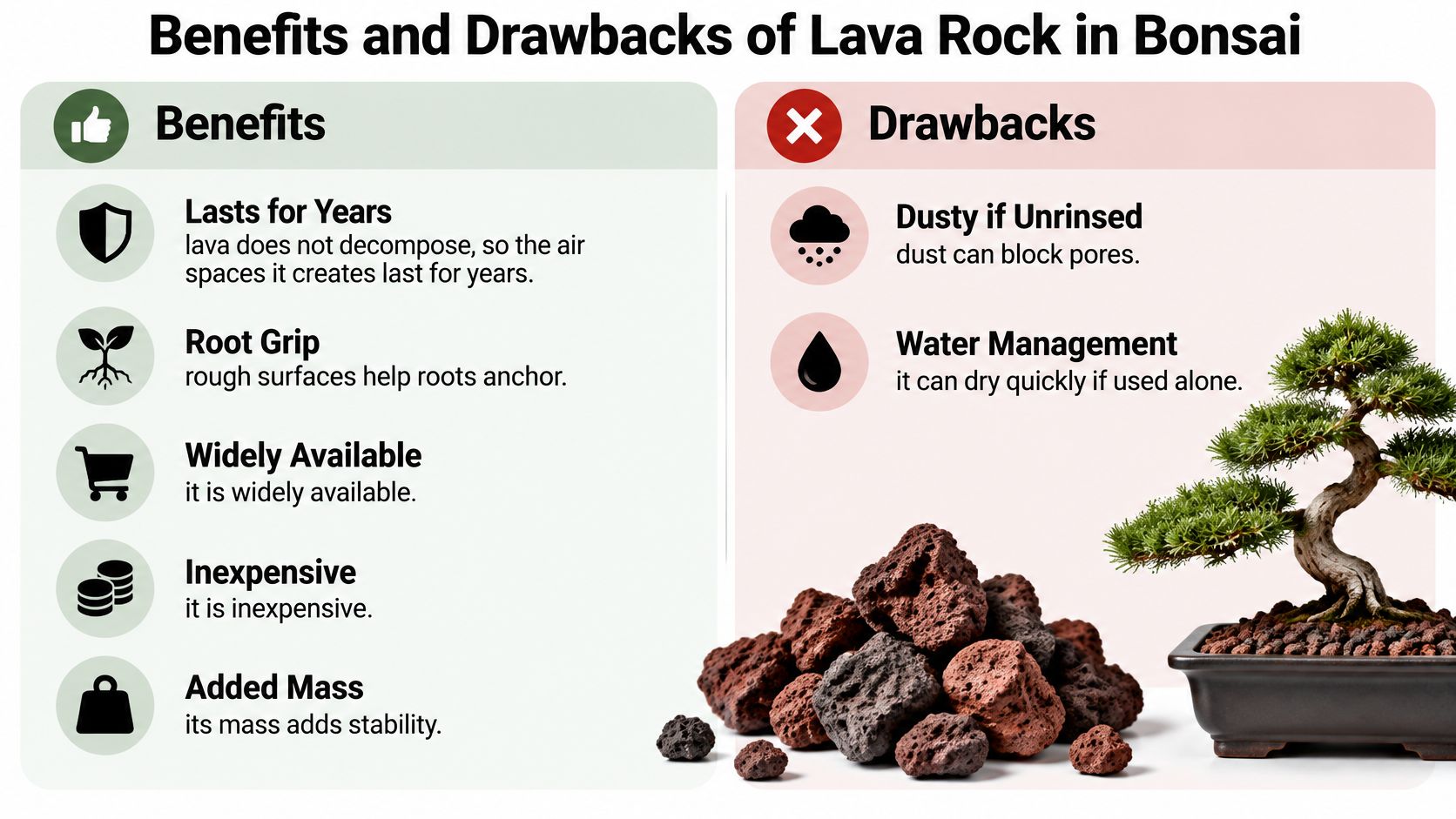
| Benefits | Drawbacks |
|---|---|
| Doesn't biologically decompose like organic amendments | Provides limited plant-available moisture |
| Rough faces give roots contact points | Unwashed dust can obstruct the spaces between grains |
| Adds useful mass to the substrate | Makes large containers heavier to move |
| Can be sourced as a durable mineral aggregate | Similar-looking products may wet and dry differently |
Who benefits from using it
Lava suits growers who want a lasting mineral fraction and can monitor irrigation closely. Outdoor conifers can use an open mix effectively, provided the recipe also matches the climate, pot, and grower's availability.
That doesn't make a warm, dry room an ideal place for a lava-heavy conifer mix. Junipers and pines generally belong outdoors, and forced-air heating can make moisture management harder rather than easier.
Small containers, thirsty deciduous trees, and exposed balconies deserve particular caution. Their owners often need more moisture-buffering material, not just more frequent reminders to water.
What it won't solve
Adding lava won't correct blocked drainage holes, a badly compacted core, or a tree sitting in collected runoff. Nor does its permanence mean the entire substrate can remain untouched indefinitely.
Fine particles, roots, and mineral deposits can alter a mix even when the lava itself remains intact. Treat the stone as a durable framework component, not a promise that drainage and watering will look after themselves.
Mix Recipes and Use Cases for Lava Rock
A useful recipe describes a direction, not a universal formula. Measure components by volume, using the same scoop, and keep their particle bands reasonably compatible.
The combinations below are practical starting concepts rather than validated species prescriptions. Adjust them to the tree's health, container depth, exposure, and the time you can realistically spend watering.
Lava rock mix recipes by use case
| Use case | Starting mix by volume | Where it suits | Watch for |
|---|---|---|---|
| General soil amendment | Comparable scoops of medium lava, akadama, and pumice | A trial mix for temperate growing conditions | Unexpectedly rapid drying during heat |
| Fast-draining conifer mix | Increase medium lava relative to the general blend | Outdoor junipers and pines where excess retention is a demonstrated problem | Summer irrigation demand |
| Moisture-retaining mix | Make akadama the larger share, with fine screened lava and pumice | Small pots and moisture-demanding trees | Reduced air space if particles become too fine |
| Top dressing | A thin covering of clean medium lava | Pots needing a tidier surface and less splash | Concealed moisture conditions beneath it |
| Drainage layer | Prefer a continuous graded mix; use a separate coarse base only deliberately | Specialized container arrangements | Perched moisture above the size change |
Blending through the root zone
As an amendment, lava should be distributed throughout the substrate rather than concentrated around a pocket of old soil. Otherwise, you may create a freely draining outer ring around a center that stays wet.
For a hypothetical measuring exercise, use equal scoops of the main components to create a reference batch. If a matching test pot dries too quickly, increase the moisture-retentive share in the next batch, changing only one variable at a time.
Don't interpret a species name as a complete recipe. A maple under shade cloth and a maple on a windy balcony can need different moisture buffers.
Using it on top or at the base
A clean top dressing can reduce splash and keep loose substrate from moving during watering. However, lava doesn't guarantee a dry surface or prevent moss, and a thick covering can hide the condition of the actual growing mix.
A coarse bottom layer deserves more caution. Water doesn't necessarily cross readily from a finer upper mix into a much coarser lower layer, so the boundary can leave moisture perched above it.
A clear drainage hole and a continuous, suitable substrate are usually more useful than a decorative layer of oversized stones.
Use drainage mesh to retain the mix without blocking the outlets. In shallow bonsai pots especially, preserve usable root space rather than sacrificing it to a presumed drainage improvement.
How to Repot a Bonsai with Lava Rock Step by Step
Repot during the appropriate window for your species, with a healthy tree and all materials ready. Changing substrate and pruning roots are separate stresses, so don't combine an unfamiliar mix with aggressive root work.
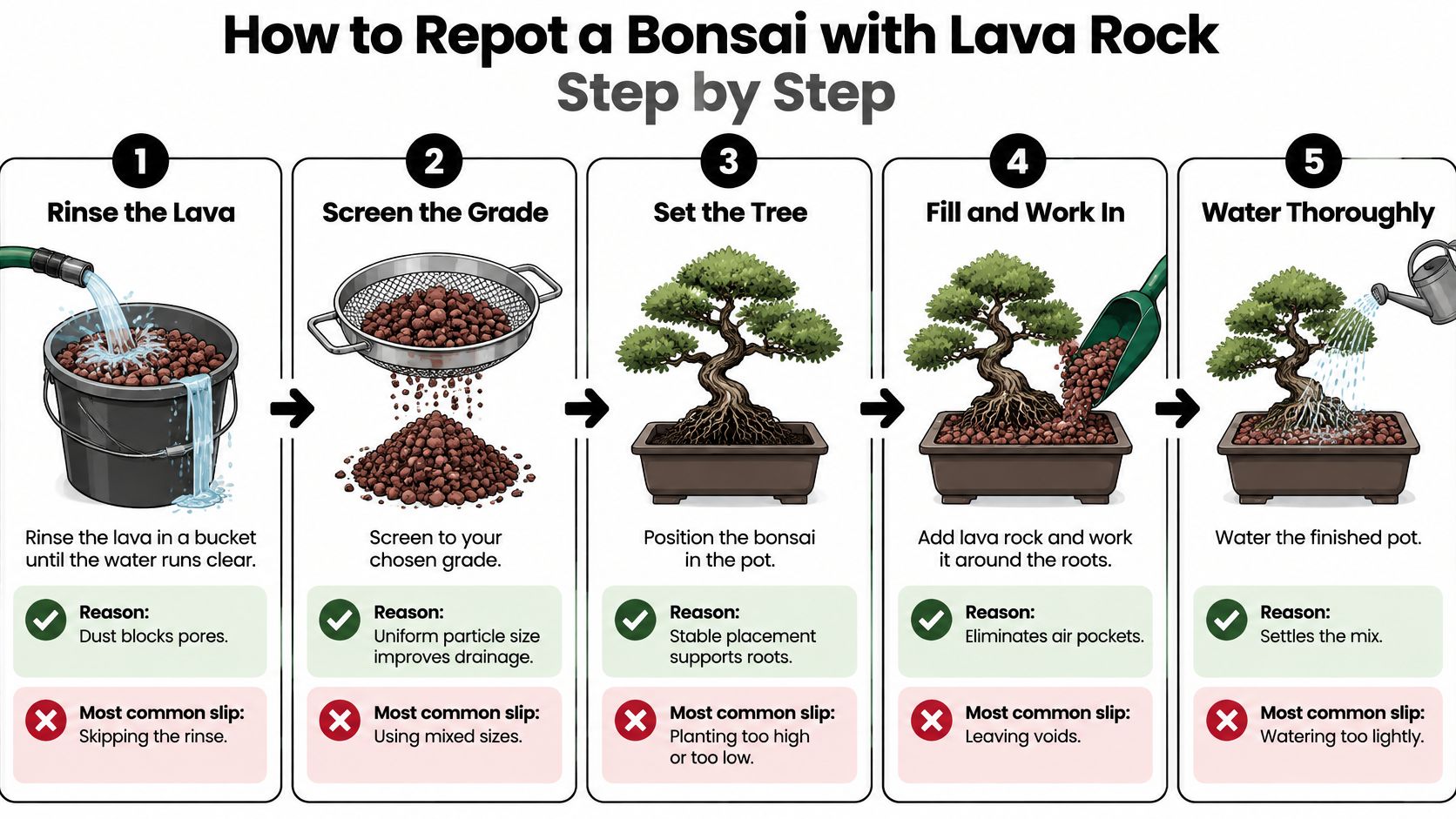
This visual summarizes the main handling stages.
Prepare the substrate and pot
- Rinse the lava thoroughly. Agitate it in a bucket, pour away cloudy water, and repeat until loose dust is largely gone. Skipping agitation can leave powder trapped between stones even when the final rinse looks clear.
- Screen to the selected grade. Separate loose fines and oversized chunks so the material fits the root zone. Don't crush everything smaller with a hammer and return the resulting dust to the batch.
- Pre-wet the screened material. Immerse a sample and let it take up water before blending. Soaking improves initial wetting, but it doesn't turn lava into a high-capacity reservoir.
- Check wetting rather than watching the clock. Turn the submerged granules and observe whether air continues to escape, then drain a sample and compare its weight and appearance with dry material. Bubbles stopping is a useful observation, not proof that every internal pore is saturated.
- Measure and blend. Use a scoop to combine the chosen components, then turn the batch until the lava is evenly distributed. Measuring by weight would distort the recipe because the components have different densities.
- Prepare drainage and anchoring. Secure mesh over the holes and install tie-down wire before adding substrate. Don't wait until the roots are exposed to discover that the wire or mesh is missing.
Handle roots conservatively
- Remove the tree and assess the root ball. Loosen accessible old substrate with a root hook or chopstick, and trim only what the species, season, and tree's condition allow. Don't apply a fixed root-removal fraction to every tree, and don't bare-root a conifer to achieve a completely uniform mix.
- Set, secure, and fill. Establish the planting height, tie the tree firmly, and guide substrate between roots with gentle chopstick movements. Fill large voids without grinding delicate roots against sharp granules, then water thoroughly until the whole root zone is wetted.
- Provide sheltered aftercare. Protect the tree from drying wind and intense sun while adjusting shade to the species and conditions. Check moisture within the root zone and use pot weight as supporting evidence, rather than repeatedly watering because the top stones look pale.
For a closer look at root handling, use this guide to repotting bonsai without damaging roots.
Watch the handling sequence before beginning if you're unfamiliar with positioning and filling a bonsai pot.
A firmly anchored tree and predictable moisture loss are encouraging early signs. They don't prove root recovery, so postpone heavy styling and other stressful work until the tree shows an appropriate return to growth.
Lava Rock Compared with Akadama, Pumice and LECA
Most growers blend materials because no single component does every job equally well. Compare them by the function you need, not by whether another enthusiast has stopped using a particular ingredient.
Lava rock, akadama, pumice and LECA side by side
| Component | Origin and form | Water holding | Breaks down over time | Typical role |
|---|---|---|---|---|
| Lava rock | Rough, porous volcanic granules | Low to moderate, product-dependent | Doesn't biologically decompose | Structure, air spaces, drainage |
| Akadama | Japanese granular clay, sold in different hardness grades | Moderate to high | Can soften and fragment into fines | Moisture and nutrient retention |
| Pumice | Lightweight porous volcanic material | Moderate | Generally maintains mineral structure | Drainage with moisture buffering |
| LECA | Rounded, expanded fired-clay pellets | Requires careful management in conventional soil use | Generally durable | Mainly hydroponic and semi-hydroponic systems |
What the differences mean in practice
Choose more akadama when you need a larger moisture buffer and are prepared to monitor its changing structure. Not all akadama is calcined, and hardness matters, so inspect the product rather than treating the name as a uniform specification.
A guide to choosing akadama for bonsai can help you evaluate it as a component instead of buying by label alone.
Pumice often provides a useful middle ground for growers who want a porous mineral fraction without placing all their confidence in lava's internal pores. LECA needs a different approach: smooth, rounded pellets don't automatically substitute well for angular bonsai granules, especially in shallow containers.
What the root-growth comparison tells us
In a 2023 Crataegus discussion, the author described repotting 14 trees, approximately half from a lava-containing mix and half from an akadama–pumice mix, and reported denser root balls and finer root growth in the trees without lava.
That's an anecdotal comparison, not a controlled experiment establishing that lava suppresses roots. Tree history, irrigation, component grading, and other differences could affect the outcome.
The useful question is whether your own mix maintains the moisture conditions needed for fine roots. If you substitute lava for pumice, don't assume the same watering schedule will remain appropriate.
For a grower who frequently misses watering, increasing lava can be a poor trade. For someone managing persistent excess retention in an otherwise suitable setup, its structural contribution may be useful.
Common Problems and How to Fix Them
A pot that dries within hours needs a moisture check before it needs another ingredient. Surface appearance alone can't distinguish a dry root zone from a dry-looking mineral covering.
Lava rock symptoms, causes and fixes
| Symptom | Likely cause | Fix |
|---|---|---|
| Soil dries within hours | Too much coarse material, limited pot volume, or high exposure | Shelter from drying wind and plan a more moisture-buffered mix |
| Water runs straight through and the tree wilts | Incomplete wetting, channeling, or damaged roots | Water slowly across the entire surface and check moisture inside the root ball |
| Slow drainage and soggy roots | Blocked outlets, fines, or a compacted old core | Clear outlets and assess whether corrective repotting is needed |
| Green film or crust on top dressing | Persistently damp surface, algae, or accumulated fines | Lift the affected covering and inspect the substrate beneath |
| White crust on the rim | Mineral deposits from irrigation water or fertilizer | Review water and feeding, then flush if drainage is sound |
| Sparse, slow root growth | Moisture instability, unsuitable grading, or broader health problems | Review the root environment before increasing fertilizer |
Separate immediate relief from structural changes
You can change watering technique and shelter immediately. Water slowly enough to wet the whole root zone, let runoff escape, and avoid leaving the pot in a saucer of water.
Changing the recipe is usually a job for the appropriate repotting window. Don't repeatedly disturb a struggling tree just to test different ingredients.
For broader help distinguishing drought from excess moisture, Shopifarm's guide to rescue plants from watering problems is a useful companion, provided you adapt the advice to bonsai species and container conditions.
Verify the diagnosis
A wilting tree in wet soil doesn't need automatic additional watering. Damaged roots may be unable to supply the canopy even when moisture is present.
Weigh the pot after thorough watering and drainage, then compare later readings under similar conditions. Pair that trend with a careful internal moisture check, because pot weight shows water loss, not exactly where the remaining water sits.
Keep short notes on exposure, watering, and symptoms. A consistent pattern is more useful than a single alarming afternoon.
Choose Your Lava Rock Mix Before Your Next Repot
Buy lava with a stated particle band and a clear description of its intended use. A photograph of attractive red stones tells you little about the amount of dust or oversized material hidden in the bag.
If the supplier doesn't state a grade, request a sample or measure a small purchase before committing to a full repot. Keep a little of your current successful substrate nearby so you can compare particle distribution directly.
Inspect, store, and reuse carefully
Spread the sample on a light-colored tray and inspect the bottom of the bag. You're looking for consistent granules, limited loose powder, and no unexplained coatings or debris.
- Store clean material covered: A lidded bucket keeps leaves, soil, and other contamination out.
- Label the container: Record the supplier and grade so a successful mix can be reproduced.
- Evaluate used lava separately: Remove roots and screen out broken substrate rather than returning everything to the fresh batch.
- Reject questionable material: Don't reuse substrate from a diseased tree indiscriminately, and don't assume rinsing removes every accumulated deposit.
Durability makes reuse possible, not compulsory. The condition of the whole recovered material matters more than whether the individual stones still look hard.
Test before committing roots
Choose a grade for the container and exposure, then select a blend that gives the species an appropriate moisture buffer. Finally, test the candidate mix in a spare container similar to the intended bonsai pot.
Before you repot: Compare a pre-wetted sample with an initially dry sample under the same conditions. Observe initial wetting and subsequent weight loss rather than judging drainage speed alone.
An unplanted pot can't reproduce a tree's water uptake, but it can expose obvious problems with uneven wetting or unexpectedly rapid drying. Use it to reject unsuitable combinations, not to calculate a permanent irrigation schedule.
This week, gather a sample, a sieve, a measuring scoop, and a scale. Wet the sample thoroughly, record the drained weight, and follow how it changes in your actual growing location before deciding how much lava belongs around your tree's roots.
Leaves & Soul offers purpose-built bonsai soils, fertilizers, pots, and accessories for assembling a practical repotting setup. Visit Leaves & Soul to explore the options, then choose your substrate around the particle grade and moisture behavior your tree needs.