


“Use half strength” is the most popular advice about liquid plant food for succulents, but it leaves out the most important question: half strength of what? A concentrated houseplant fertilizer and a mild cactus liquid aren't interchangeable just because you measure both with the same spoon.
Good feeding starts with the guaranteed analysis, the amount of concentrate added to water, and a plant that's growing. It also requires separating too much fertilizer in an application from salts accumulating between waterings. Those problems overlap, but they don't always need the same fix.
What Liquid Plant Food Does in a Pot
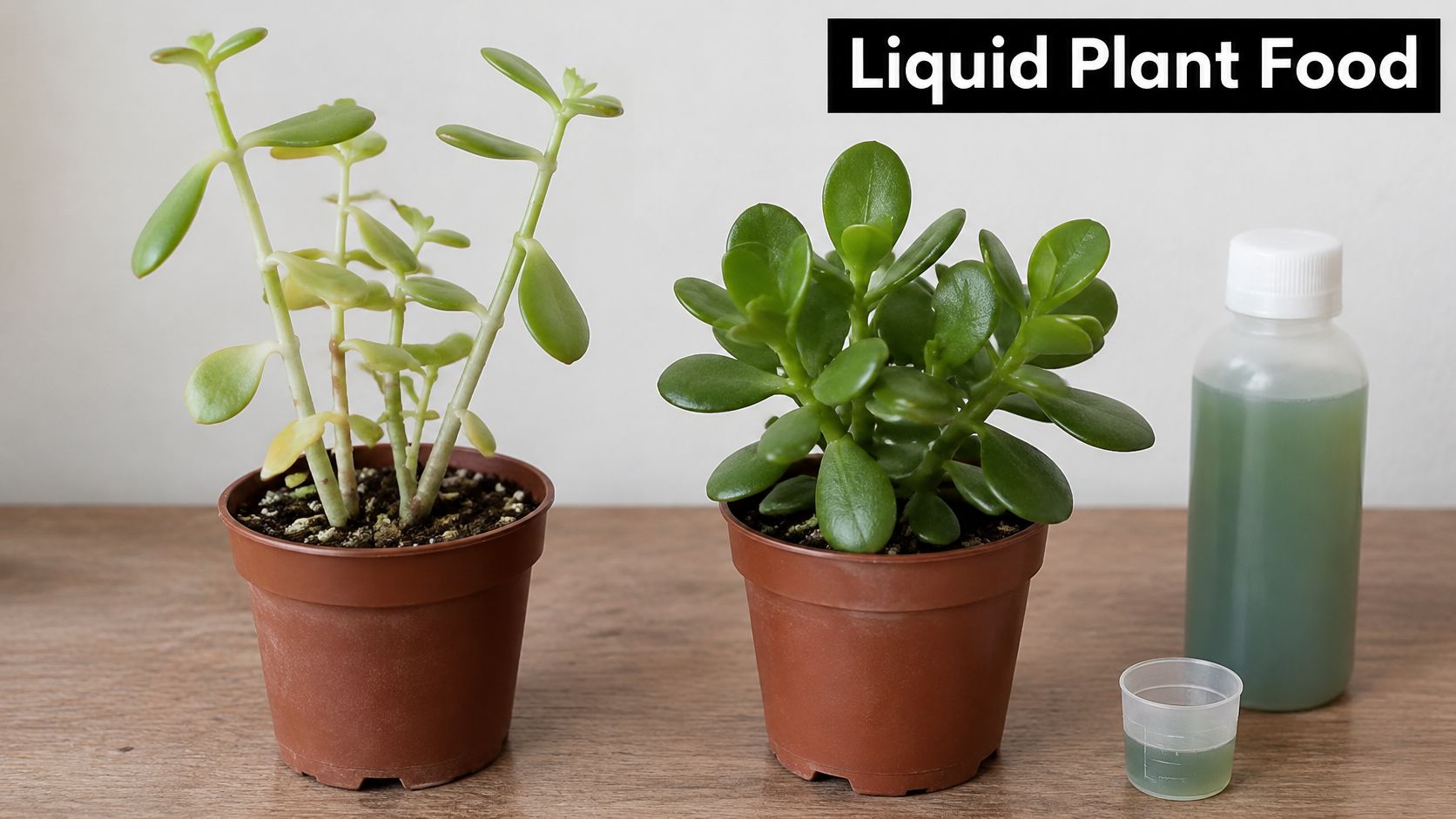
Say a jade gets fed like a tomato every Sunday. Its owner wants fuller branches, but instead sees thin, pale stems. Another jade receives a carefully measured, weak solution only when it's producing new leaves and stays compact. Fertilizer could explain part of that difference, but light matters too. Feeding doesn't compensate for a dim windowsill.
Liquid plant food is fertilizer supplied in solution or mixed into water before application. Some bottles are concentrates; others are ready to use. Soluble powders can also become liquid feeds once dissolved. Don't dilute a ready-to-use product as though it were a concentrate without checking its directions.
The comparison below illustrates the kind of growth difference that should prompt a care check, not an automatic extra feeding.
Fast delivery needs careful measurement
In a container, dissolved nutrients move with irrigation water through a confined root zone. That makes a liquid convenient when you want to control the next application rather than commit to fertilizer already mixed into the pot.
University of Maryland Extension's fertilizer guide describes quick-release fertilizers as highly soluble materials mixed with water and explains that watering fertilizer in helps make nutrients available while reducing root salt-burn risk. The same ready availability makes careless application risky: concentrated fertilizer around roots isn't a reserve the plant can ignore.
Keep these limits in mind:
- Growth comes first. Feed a plant that's making healthy new tissue, not one resting or declining.
- Measure instead of estimating. A capful isn't a dependable unit unless the label defines it.
- Protect dry roots. Don't pour fertilizer solution onto a bone-dry root ball.
- Keep the basics separate. Fertilizer supplies minerals; suitable light, drainage, and watering make growth possible.
The formula on the bottle is less important than its combination of nutrient concentration and application instructions. Choose a product you can measure accurately, not just one with a succulent pictured on its label.
N-P-K Profiles and Feeding Rates
Liquid formulas, dilutions, and baseline frequency for succulents
| Formula type | Example analysis | Use it for | Starting dilution | Baseline frequency |
|---|---|---|---|---|
| Low balanced houseplant liquid | Similar nitrogen, phosphate, and potash percentages | General maintenance on mixed succulents | Conservative reduced houseplant rate, checked against the label | Infrequent applications during active growth |
| Phosphorus-forward | Middle number higher than nitrogen | Modest nutrient supplementation and root support | Reduced houseplant rate | Sparse feeding during the growing period |
| Potassium-rich tomato or bloom liquid | Higher third number | Plants for which a potassium-rich feed is appropriate | Product-directed dilution, adjusted conservatively | Seasonal applications while growing |
| Specialist cactus and succulent liquid | Lower nitrogen, balanced or slightly potassium-forward | Cacti and succulents in container mixes | Succulent-specific label rate, provided it suits the plant | Label schedule during active growth, or less |
| High-nitrogen lawn or foliage food | First number substantially higher than the others | Not a sensible default for succulents | Don't use lawn products for this purpose | None |
These are selection rules, not interchangeable recipes. A balanced houseplant liquid can be practical when you already own it, but its ordinary houseplant directions may be more generous than your succulent needs. A specialist liquid is convenient only if its directions are clear and its delivered concentration is appropriate.
Read the analysis before the marketing
The N-P-K figures describe percentages by weight of nitrogen, phosphate expressed as P₂O₅, and potash expressed as K₂O. They aren't a direct statement of how much elemental phosphorus or potassium reaches the roots. Our explanation of plant fertilizer numbers helps distinguish the guaranteed analysis from the feeding instructions.
A lower balanced analysis is easy to understand, but low numbers alone don't guarantee a weak final solution. A manufacturer may recommend adding more of a dilute product to the watering can. Conversely, a concentrated product may call for a much smaller measure.
A phosphorus-forward formula is a defensible option for restrained feeding, but the middle number isn't a promise of compact growth. Light and species characteristics still determine plant shape. Likewise, a potassium-rich liquid doesn't make a tender succulent frostproof or force an immature plant to bloom.
Choose for the plant you have
For a mixed collection, favor a clearly labeled liquid that includes trace nutrients and gives measurable container-plant directions. Check for micronutrients rather than automatically buying a separate supplement. Iron, manganese, zinc, and boron may appear in the trace-element list; calcium and magnesium may be listed separately.
Avoid using lawn fertilizer as a shortcut. Its intended application, nutrient balance, and possible additional ingredients make it a poor match for a small succulent pot. A foliage fertilizer also deserves closer scrutiny if nitrogen dominates its analysis.
Shopping rule: Choose the bottle whose analysis and dilution you can explain, not the bottle with the most ambitious growth claim.
Mark the product's intended rate before mixing. If its instructions don't clearly distinguish concentrate from ready-to-use solution, resolve that uncertainty before applying it.
How Nitrogen Phosphorus and Potassium Shape Succulent Growth
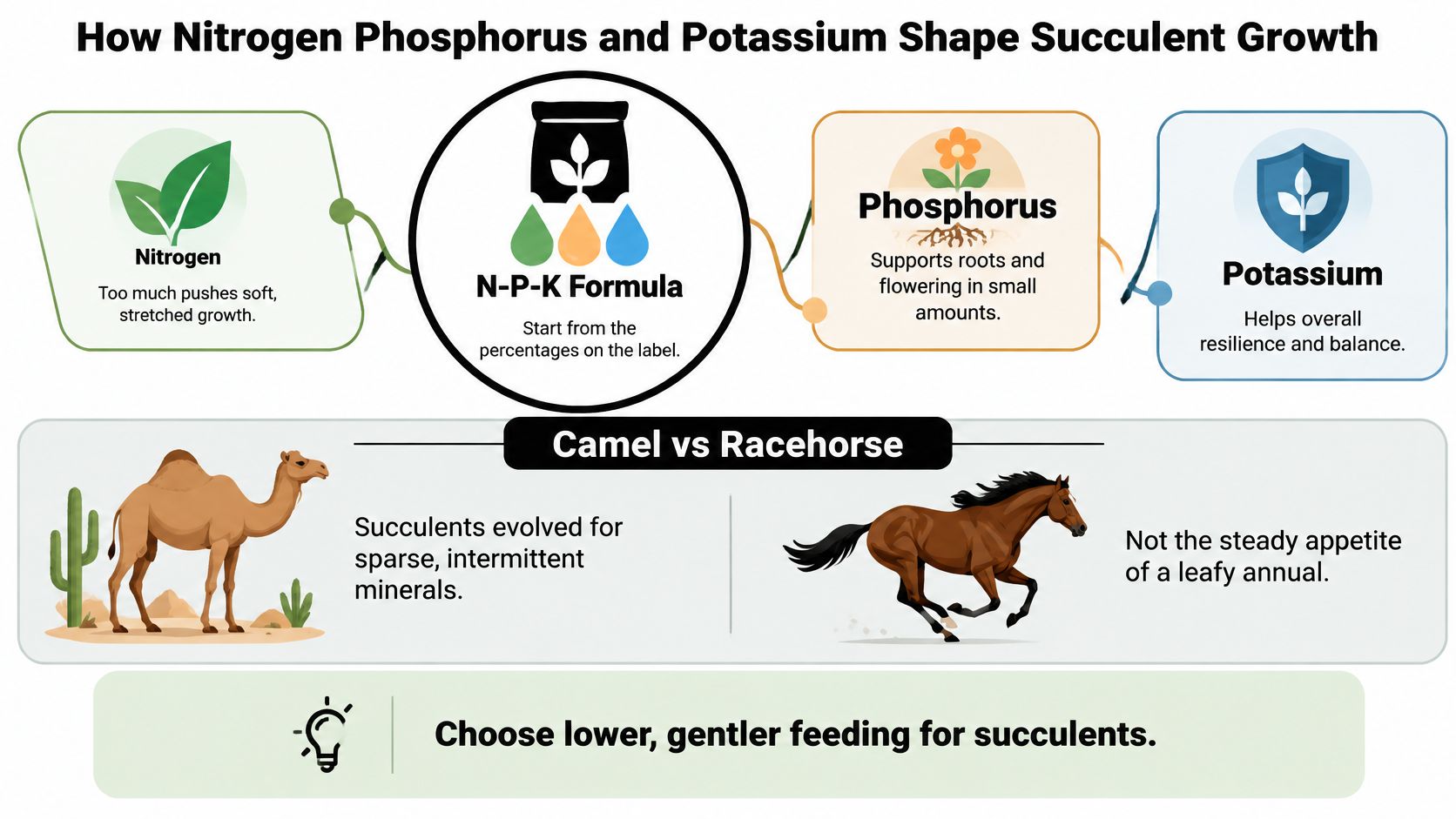
Think of a succulent as a camel rather than a racehorse. The comparison isn't about whether it needs nutrients. It's about expecting modest, intermittent inputs rather than treating every plant like a fast-growing leafy annual.
University of Minnesota Extension recommends fertilizing cacti and succulents once or twice annually during late spring or summer growth, using houseplant fertilizer at half the label rate, and favors more phosphorus than nitrogen. That's a conservative baseline, not a reason to chase a very high middle number.
What the nutrients actually support
Nitrogen supports leaves and stems. Enough helps a plant build healthy tissue, but generous nitrogen won't create sturdy growth when light is inadequate. Soft, elongated growth calls for checking both feeding and exposure. Changing fertilizer brands won't tighten an already stretched stem.
Phosphorus supports roots and new shoots. That makes it relevant to normal development, not a special treatment reserved for flowering. Adding more than a plant can use doesn't create a better root system by default.
Potassium supports flowering, fruiting, and cold hardiness. Treat that last role carefully: adequate nutrition supports normal plant function, but fertilizer doesn't replace suitable winter protection.
The nutrient roles are easier to remember as a set of different jobs rather than a ranking of good and bad ingredients.
Match nutrition to the pace of growth
Trace nutrients have smaller but necessary roles. Iron and magnesium contribute to healthy green tissue, while calcium contributes to cell-wall structure. Small requirements don't mean those nutrients are optional, but they don't justify pouring in a separate micronutrient blend without a reason.
Compare a jade making fresh leaves in bright conditions with a lithops in a resting phase. The jade may benefit from a modest maintenance feed; the resting lithops shouldn't receive fertilizer just because the jade does. A trailing sedum extending vigorously outdoors may use nutrients differently again.
Watch the actual plant rather than assigning every succulent the same appetite. New leaves, firm tissue, and normal species-specific form are more useful than the hope that fertilizer will speed everything up.
A healthy slow-growing succulent isn't necessarily underfed. Slow growth can be the plant's normal pace.
Use the selected formula to support that pace. Don't use it to demand a different one.
How to Mix and Apply a Real Dose
A useful dose description includes product strength, concentrate amount, water volume, and solution applied to the pot. “Half strength” describes only a fraction of a manufacturer's recipe.
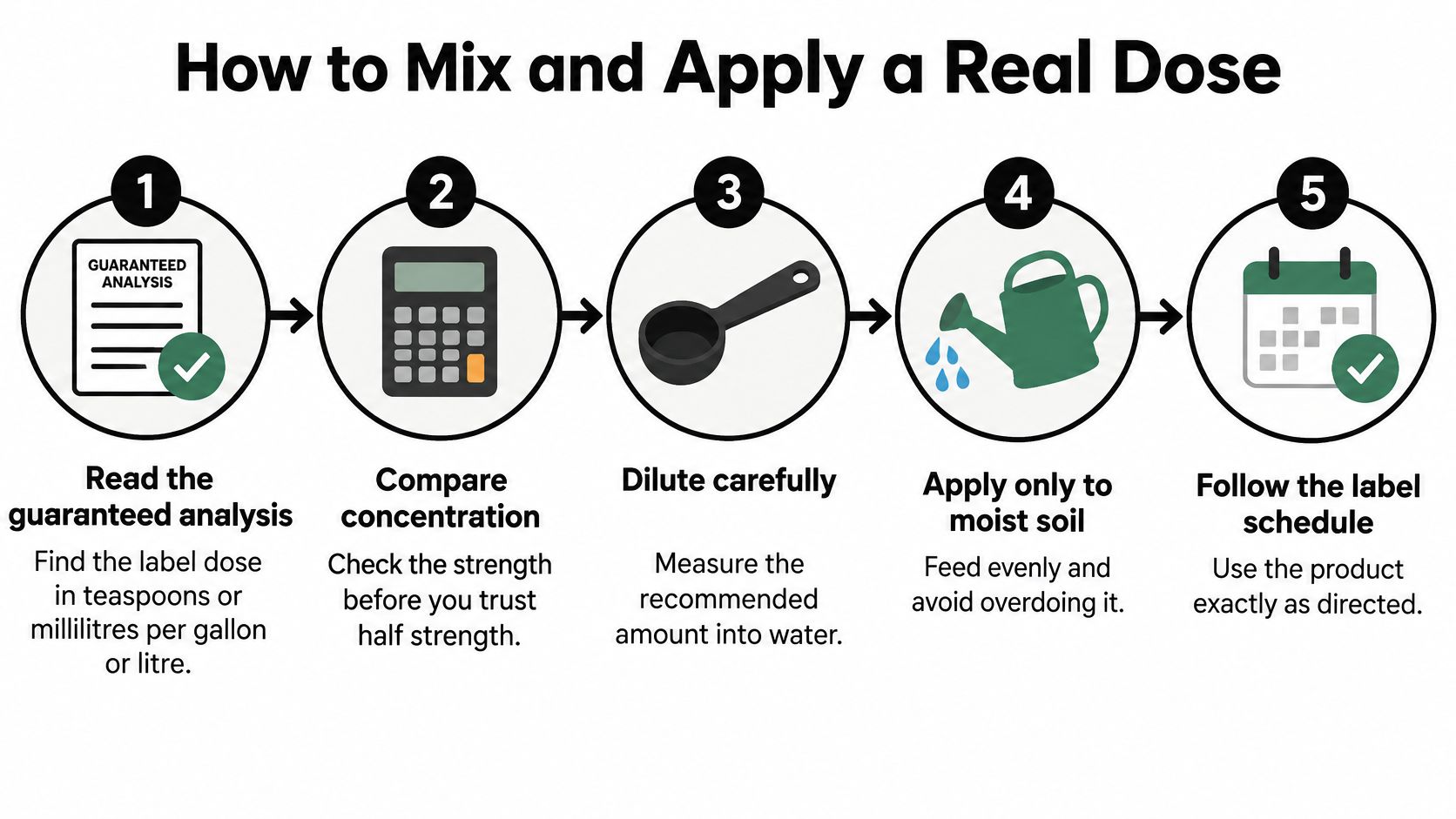
Keep the label beside your measuring syringe or graduated jug while you work. The visual below summarizes the application sequence, but the bottle's directions determine the actual measure.
Measure concentration before volume
- Read the guaranteed analysis and dilution together. Record the nitrogen percentage and the amount of product recommended per container of water. Make sure you're reading container-plant directions rather than outdoor bed instructions.
- Compare equivalent quantities, not just fractions. Nitrogen percentage multiplied by the fraction of label rate gives a useful screening index, but it isn't an actual nutrient dose unless the products' recommended concentrate quantities are equivalent. Different label rates, and different liquid densities when measuring by volume, can change the result.
Nitrogen delivered per dose at different dilutions
The following is a hypothetical arithmetic comparison, assuming equal full-rate concentrate masses mixed into equal water volumes. The units are relative, not a feeding target.
| Product analysis | Dilution used | Nitrogen delivered (relative units) |
|---|---|---|
| 2-2-2 houseplant liquid | Full label rate | 2 units |
| 10-10-10 houseplant liquid | One-quarter label rate | 2.5 units |
| 10-10-10 houseplant liquid | Half label rate | 5 units |
Under those assumptions, the stronger product at half rate supplies more nitrogen than the weaker product at full rate. Without those assumptions, percentage times dilution fraction alone can mislead. For a mass-based comparison, multiply the concentrate mass by its nitrogen mass fraction, then account for the final water volume.
- Select a conservative starting dilution. The Leaves & Soul cactus fertilizer guide discusses starting around one-quarter to one-half of the normal rate during active growth. Don't automatically reduce or increase a specialist formula without checking whether its label already provides succulent-specific directions.
- Check root-ball moisture. If it's completely dry, lightly moisten it with plain water first. If water won't enter or leave the mix properly, fix that problem instead of adding fertilizer.
- Mix thoroughly and apply to the soil. Measure concentrate into water, distribute the solution evenly, and let a little reach the drainage hole. Empty the saucer rather than leaving roots standing in runoff.
- Keep solution off decorative leaf surfaces. Avoid spraying hairy leaves or the powdery farina on echeveria and dudleya. Soil application avoids unnecessary residue and disturbance.
- Record what you used. Note the date, product, dilution, and plant response. Our guide to fertilizer application rates provides additional context for interpreting rate instructions.
Adjust the amount, not automatically the strength
A small pot takes less solution than a large outdoor bowl at the same concentration. Don't make the larger pot's mixture stronger merely because it holds more soil. A slow-draining substrate needs correction, not repeated small doses used to work around poor drainage.
Withhold fertilizer from plants suffering rot, recent sun damage, transplant stress, or a cool, dark rest. Resume only when roots and growth are functioning normally.
For an additional application demonstration, use the video below alongside your own product label.
Repeated weak feeding isn't automatically safer than occasional feeding. If dissolved salts stay in the container, lowering each dose doesn't eliminate accumulation.
When the Growing Season Changes the Schedule
Different feeding calendars make more sense when you stop treating them as competing universal rules. A conservative succulent schedule, a general houseplant schedule, and a greenhouse-style growing-season program assume different growth conditions.
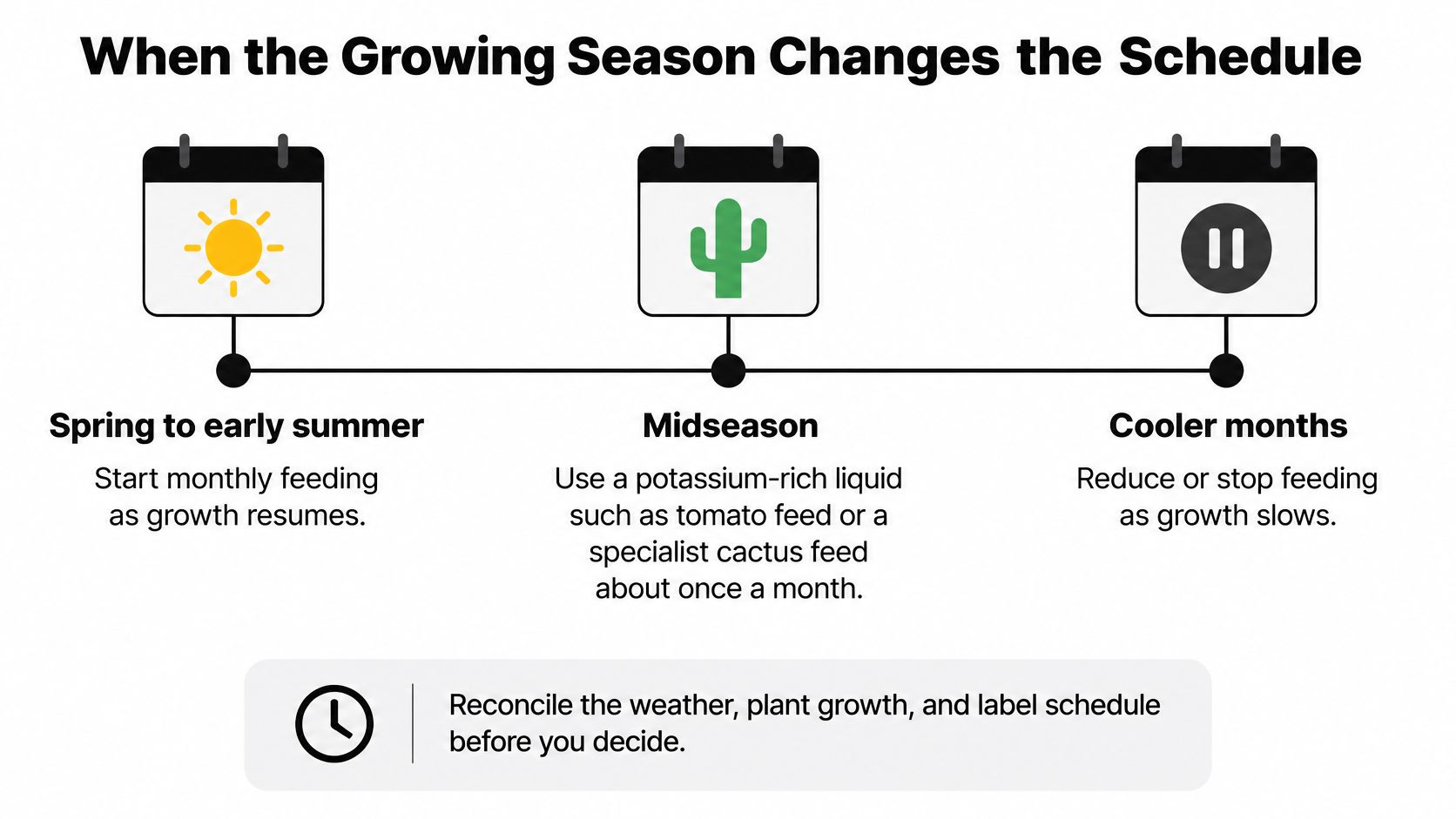
The Royal Horticultural Society's cactus and succulent guide recommends monthly feeding during active growth, broadly April through September in UK conditions, using a potassium-rich liquid such as tomato feed or a specialist cactus feed. That calendar describes a growing window, not permission to feed an inactive plant.
Use growth to choose your position
A warm, bright plant producing normal new leaves can justify more regular supplementation than a slow plant in limited indoor light. The conservative approach suits plants that grow little, receive modest light, or pause when temperatures change.
Don't combine the most frequent schedule with the strongest dilution you can find. Frequency and concentration belong in the same decision. A mild specialist recipe used regularly isn't equivalent to a strong general-purpose feed used on that same calendar.
Useful observations include:
- Fresh growth: Look for new leaves, segments, pads, or offsets rather than judging by the date alone.
- Normal form: Firm, proportionate growth supports continuing the existing approach; softer or stretched growth calls for reassessment.
- Changing water use: A pot staying wet longer may signal slower growth or cooler conditions.
- Stable root conditions: Suspected salt accumulation is a reason to pause, even if the calendar says feeding is due.
The seasonal illustration is a starting point for warm-season growers, not a rule for every species.
Move the season with the plant
A southern-hemisphere grower shouldn't copy a northern-hemisphere month list. Nor should someone growing succulents under reliable indoor lighting assume that outdoor weather perfectly describes conditions at the pot.
Species matter too. Some aeoniums and mesembs grow during cooler conditions and rest in heat. Identify the plant before treating summer as its automatic feeding season.
Stop scheduling applications when healthy new growth stops, the root zone stays cold, or the plant enters its normal rest. If you use an electrical conductivity meter, a consistent rise under comparable testing conditions is another reason to investigate rather than feed again.
The practical schedule is therefore conditional: a suitable growth window, an actively growing plant, and a measured product rate. A missed feeding usually gives you time to observe. An unnecessary one adds something the pot must then manage.
Salt Burn Versus Thirst and Rot
Brown tips, a white crust, damp soil, and good light can look confusingly like a plant that needs help. Adding more food is the wrong first response. The roots may already be exposed to too many dissolved salts, including minerals contributed by irrigation water.
Excess salts can injure roots as well as leaf margins. A plant-nutrition paper on salinity and nutrient management also describes the importance of salinity effects on root development. That helps explain why visible decline may follow trouble below the surface.
Succulent symptoms that look like a feeding problem
| Symptom | More likely cause | What to do |
|---|---|---|
| Brown tips and a white crust on the mix | Accumulated fertilizer or irrigation-water salts | Stop feeding; consider flushing only if drainage is fast |
| Soft mushy stem after a heavy watering | Root or stem rot associated with prolonged wetness | Unpot, remove damaged tissue with clean tools, and use suitable gritty mix without fertilizer |
| Pale stretched leaves | Weak light, potentially aggravated by excess nitrogen | Improve light gradually and reassess feeding |
| Firm red or purple color | Sun or cold response, sometimes normal species coloration | Check exposure and temperature before treating it as deficiency |
| Wrinkled leaves that plump after water | Underwatering | Correct watering; consider feeding only during healthy growth |
| A few lower leaves drying one at a time | Natural aging | Observe without increasing food |
| Yellow new growth with hard tap water | Possible iron unavailability or unsuitable root-zone conditions | Investigate water quality and roots before increasing fertilizer |
These are diagnostic clues, not proof. A white deposit may come partly from hard water, and wrinkled leaves can also occur when damaged roots can't take up moisture. Check the substrate and roots before deciding that appearance alone identifies the cause.
Check the water before flushing
An EC meter measures electrical conductivity, a practical indicator of dissolved salts. Test source water and substrate extracts using a consistent method; readings from different methods aren't directly interchangeable. EC doesn't identify which salts are present or prove a particular nutrient deficiency.
If the source water is contributing substantial minerals, consider collected rainwater or appropriately treated lower-mineral water. An ordinary carbon filter may improve taste without removing the dissolved minerals responsible for hardness, so “filtered” doesn't automatically mean low-salt.
Flush only when the container drains freely and the roots aren't already sitting in prolonged wetness. Use plain, suitable-quality water, allow runoff to leave completely, and don't return the pot to a full saucer. Clear-looking runoff doesn't prove salts are gone, because dissolved salts aren't necessarily visible.
Recovery priority: Reduce the salt load without creating a waterlogged root zone.
Don't turn flushing into an automatic frequent routine. A compacted, persistently wet mix may need replacement rather than more water, and an injured plant needs recovery before another fertilizer application.
Choose a Liquid or a Slow Pellet
Choose liquid fertilizer when adjustability matters most. You can change the concentration for the next application, withhold it when growth stalls, and measure a small quantity for a small collection. That control is particularly useful when you're still learning a plant's seasonal behavior.
Choose slow-release pellets when convenience matters more than immediate adjustment. They reduce mixing work, but release depends on the formulation and growing conditions. They aren't automatically gentler, and stopping future applications doesn't remove fertilizer already in the pot.
Make the choice with these checks
- You want to respond to changing growth. Liquid gives you more control over the next watering.
- You prefer fewer mixing tasks. Pellets can fit an established routine when used at their container-specific label rate.
- The pot drains poorly. Choose neither until you've corrected the root environment.
Our liquid versus pellet fertilizer comparison can help you weigh those practical differences. Don't add a routine liquid program on top of a fresh pellet application without accounting for both nutrient sources.
At Leaves & Soul, our fertilizer selection includes liquid plant fertilizers and Succulent Fertilizer Pellets | 13-11-11 Slow Release, priced at $10.38 USD. The pellet analysis describes the nutrient balance, not the dose appropriate for your pot; use the product's application instructions rather than comparing its printed percentages directly with a diluted liquid.
A liquid is often the easier choice when a plant's growth window may close soon, because you can omit the next feed. Pellets suit growers who can commit to a less adjustable program. Neither format fixes poor light or damaged roots.
This week, check the bottle you own, write down its nitrogen analysis and mixing directions, and decide whether your succulent is ready for food. If it is, measure the chosen dilution, apply it to a suitable slightly moist root zone, and make the next feeding date conditional on continued healthy growth.
Leaves & Soul offers soils, liquid plant fertilizers, and slow-release options for home succulent and cactus care. Visit Leaves & Soul to compare formats and choose a fertilizer and growing mix that fit your plant, drainage, and feeding routine.